

And Break It Not, page 1
part #13 of Guild Wars Series


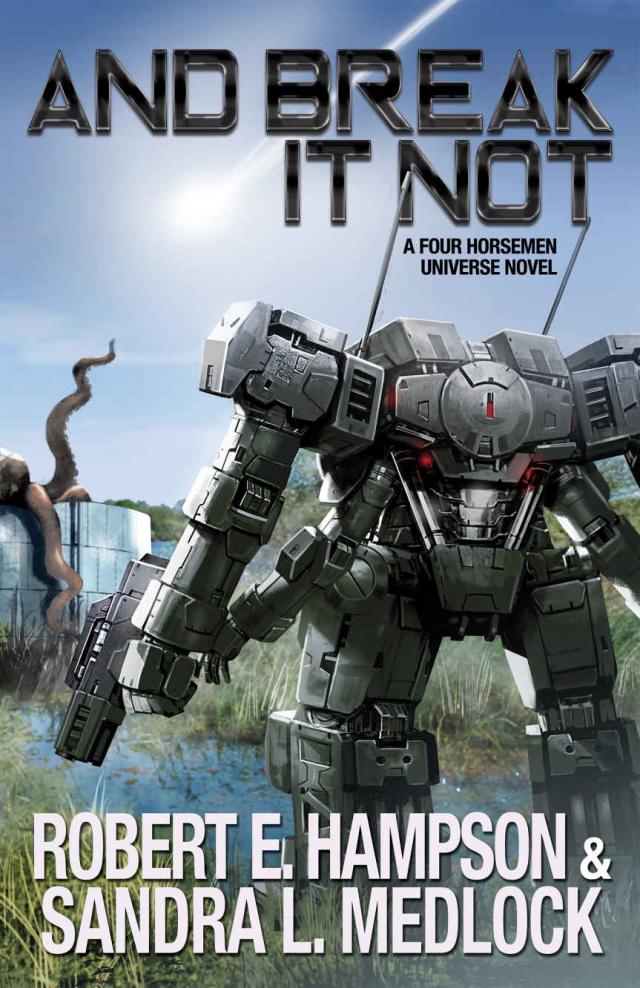
And Break It Not
Book Thirteen of The Guild Wars
By
Robert E. Hampson & Sandra L. Medlock
PUBLISHED BY: Seventh Seal Press
Copyright © 2021 Robert E. Hampson & Sandra L. Medlock
All Rights Reserved
* * * * *
Get the free Four Horsemen prelude story “Shattered Crucible”
and discover other Seventh Seal Press titles at:
http://chriskennedypublishing.com/
* * * * *
Do you have what it takes to be a Merc?
Take your VOWs and join the Merc Guild on Facebook!
Meet us at: https://www.facebook.com/groups/536506813392912/
* * * * *
For a suggested reading order guide to the Four Horsemen Universe, go to:
https://chriskennedypublishing.com/4hu-reading-order/
* * * * *
For a listing of all the Four Horsemen books, go to:
https://chriskennedypublishing.com/the-four-horsemen/
* * * * *
Cover Design by Brenda Mihalko
Original Art by Ricky Ryan
* * * * *
License Notes
This ebook is licensed for your personal enjoyment only and may not be re-sold or given away to other people. If you would like to share this book with another person, please purchase an additional copy for each recipient. If you’re reading this book and did not purchase it, or it was not purchased for your use only, then please purchase your own copy. Thank you for respecting the hard work of this author.
This book is a work of fiction, and any resemblance to persons, living or dead, or places, events or locales is purely coincidental. The characters are products of the author’s imagination and used fictitiously.
* * * * *
Dedication
For Ruann, the love of my life; for Mom, my first fan; for Dad, my hero—I just wish you could have seen this one. - REH
For James and Jamie, with love. For Mom, for all her help, and for my Dad…I miss you so much. - SLM
Acknowledgements
It took a while to get this one rolling, but the plans for a sequel to Do No Harm began as soon as the previous manuscript was presented. The reception for that book just absolutely blew us away, and it was surprising that every reader seemed to have a different opinion as to the “best character.” They were also pretty unanimous in calling for more.
That’s a pretty tall order—asking for more and asking for more of multiple characters. It is natural for an author to introduce new characters in a new book but it can result in a fairly large cast, so we hope to do justice to your favorites. We’ve also encountered a lot of interest in the Wrogul by other 4HU authors, which led to development of an extensive “family tree” of Todd’s buds, and their buds, and their buds…you get the idea. I think we have it figured out, and it is certain that one or more readers will correct us if we don’t.
As always, we thank Mark Wandrey and Chris Kennedy for creating the universe and letting us play in it. Many thanks to Kacey, Marissa, Kevin, and many more for character and guild ideas, and to Brent for bouncing ideas around. Then Casey and I started…well, the concept has grown.
By the way—my apologies to Brent’s mom. In Do No Harm, tuckerizing him as Azure’s premier bioscientist was meant to be a one-time joke. Then we teased him about girls named Emily—it was all based on a mutual friend’s dream in which someone named Emily was mean to him. Then he ended up surrounded by Emilys in real life. So, we wrote that in…and Brent’s mom started berating him for the fictional character’s perceived mistreatment of the ladies.
Oops.
You will notice that we’ve been much kinder to Doctor Roeder in this volume. As happens to many authors—we didn’t plan it this way, the character(s) just grew. You will also hopefully be reading more from the real Doctor Roeder in the future now that he has passed his final hurdle and earned his PhD. Congratulations, my friend. I wanted to memorialize it here for all eternity!
Oh! Yes, I said volumes. When I first started planning a sequel, Mark, Chris, and I discussed two more books. Then Sandra and I got to talking about what stories we wanted to tell and came up with another book. Then the darned characters started telling us what they wanted! Next, Brent, Casey, Sandra, and I got to talking and added one, maybe two more. I don’t know how many volumes there will be—but for now, we’ve taken to calling this cycle “The Wrogul’s Oath.” The Wrogul. Also, the oath. We’ll let the readers figure out which Wrogul, and some of you may find certain title phrases familiar. So, consider Do No Harm to be installment One (even though it is technically Book 9 of the Omega War), and this is Book Two.
Mostly, I thank my family for supporting me, particularly Ruann for cracking the whip of writing encouragement. I thank Chris S., KC, Doc, Cathe, Eeps, Jeremy, Mike, Scott, Joseph, Greg, Monalisa, Tara, and Bridget for listening to my ideas and posing some unique responses. For Speaker Alpha, thanks for reading and critiquing early versions and telling us what you want to read! Finally, my great appreciation to Sandra for sharing the vision for this story, despite the early bumps when we hadn’t quite figured out how to make them all fit together.
Rob Hampson
Kernersville, NC, May 2021.
Contents
Dedication
Acknowledgements
Prelude
Part One: Azure
Chapter 1
Chapter 2
Chapter 3
Chapter 4
Chapter 5
Chapter 6
Chapter 7
Chapter 8
Chapter 9
Chapter 10
Intermezzo
Part Two: Amy
Chapter 1
Chapter 2
Chapter 3
Chapter 4
Chapter 5
Chapter 6
Chapter 7
Chapter 8
Chapter 9
Chapter 10
Intermezzo
Part Three: Nautilus
Chapter 1
Chapter 2
Chapter 3
Chapter 4
Chapter 5
Chapter 6
Chapter 7
Chapter 8
Chapter 9
Chapter 10
Intermezzo
Part Four: Hau’ula
Chapter 1
Chapter 2
Chapter 3
Chapter 4
Chapter 5
Chapter 6
Chapter 7
Chapter 8
Chapter 9
Chapter 10
Intermezzo
Part Five: Gamboa
Chapter 1
Chapter 2
Chapter 3
Chapter 4
Chapter 5
Chapter 6
Chapter 7
Chapter 8
Chapter 9
Chapter 10
Intermezzo
Part Six: Ragamuffins
Chapter 1
Chapter 2
Chapter 3
Chapter 4
Chapter 5
Chapter 6
Chapter 7
Chapter 8
Chapter 9
Chapter 10
Chapter 11
Chapter 12
Chapter 13
Chapter 14
Chapter 15
Chapter 16
Chapter 17
Chapter 18
Chapter 19
Chapter 20
Chapter 21
Chapter 22
Chapter 23
Chapter 24
Chapter 25
Chapter 26
Chapter 27
Chapter 28
Postlude
Epilogue
A Final Word of Thanks
About Robert E. Hampson
About Sandra L. Medlock
Excerpt from Book One of the Abner Fortis, ISMC
Excerpt from Book One of the Lunar Free State
Excerpt from Book One of the Chimera Company
Excerpt from Book One of Murphy’s Lawless
* * * * *
Prelude
Scientists of all species debated the origin of the universe. A few races claimed ancestry from well before the Great Galactic War—but none could claim to have been there at the very start. If so, they would have seen an incredible expansion of plasma, primordial matter, and then protons, electrons, and eventually neutrons. Those bits eventually coalesced into atoms and molecules, and from there into great masses of…stuff. The protons—alone or in combination with neutrons—coalesced into stars and began to fuse, forming clumps of protons and neutrons in their core, and shells of electrons orbiting these new atoms. As heat, pressure, and their own gravity increased, those atoms became more complex.
The initial phase, though, was mostly protons…the elusive element that would come to be known as hydrogen. As stars continued to burn, the 2-proton, 2-neutron molecules called helium became more plentiful. In time, those stars aged, exploded, and caused the formation and spread of heavier elements: lithium, beryllium, boron, carbon, nitrogen, oxygen, and fluorine. The process repeated itself, with the new mixture of elements coalescing, igniting fusion, aging, dying in explosive glory, and starting yet again. Each time, the rare heavy elements became heavier, until they formed elements that wouldn’t fuse, such as silicon, iron, and lead, not to mention elements that were so h
As each cycle continued, the universe of plasma and protons gave way to stars and dust. Gravitational eddies formed and began to spin. The lighter elements coalesced into new stars, while the heavier elements gathered into large masses that became planets. One such system formed a star, five small, rocky worlds, four gas giants, and a host of asteroids, comets, dwarf planets…and more dust. It would eventually give rise to an intelligent species that would threaten the status quo in its galaxy. Another such eddy formed a similar-sized star, but with two inner, rocky worlds, a single gas giant, and an outlying rocky world that collected the larger debris of the outer system.
Mostly.
The rocky worlds were still quite hot, just cooling from the heat of condensation, when the outer world caught an interstellar wanderer and knocked it into the inner system. As with any comet, this one collected dust and ices from the interstellar medium. Unlike many, this one never had a chance to show off a spectacular tail of evaporated gases and vapors.
There was a world in the way.
The comet struck the second world, breaking the surface on the side of impact, and plunging a large disk of crust deep into the molten interior. The incredibly hot liquid rock recoiled, pushing the crust back, leaving it wedged higher than the rest of the surface, and opening up huge vents and fissures that sprayed their contents everywhere, building the edges of the broken zone even higher. The comet’s ices—water, carbon dioxide, methane, ammonia—boiled off, leaving the wounded planet with a new atmosphere. Complex carbon molecules gained extra energy from the cataclysm and began to grow.
Eventually the world cooled, and the vapors condensed. Biological life took hold, and the carbon dioxide, methane, and ammonia were used to make more complex carbohydrate chains, leaving oxygen…and water. The result was a world of mostly water, except for a broken ring of solid land around a shallow sea—and the volcanic reminder of a tortured past.
When early astronauts first viewed Earth from space, they marveled at the color of the oceans and coined the term ‘Big Blue Marble.’ Like most toy marbles, however, Earth was swirled with many colors. Oceans covered two-thirds of the globe, but the land varied in color from green to brown. Clouds and ice caps showed white, and the overall effect was more like the mineral marble, with its complexity of colors, shapes, and patterns.
No such mineral comparison came to mind when the first colonists arrived at Azure. The water world was nearly all blue, with the tiniest of brown and red specks denoting islands. The oceans varied from dark to light, as the sun reflected off depths and shallows. There were larger landmasses, but at the time, those were on the back side of the planet, and all the crew of Kamahele could see was blue.
The navigator, or kilo hoku, of their predominantly Polynesian crew wanted to name the planet Wehe ka pe’a, Hawaiian for “close the sail.” He was overruled by the Captain. “The world is blue. Everyone knows it’s blue. We will call it by its name, Bl—”
“Azure.” The interruption came from Makeo Johnston, the colony administrator, who would later become mayor and then governor of the nascent colony.
“—ue…okay, Azure it is.”
* * * * *
Part One: Azure
Chapter 1
Ninety Years Before the Omega War
The planet was eighty-percent ocean, with a few large island-continents midway between Greenland and Australia in size. The continents, numerous islands, and archipelagos were arranged in a circle in one hemisphere, the result of some cataclysm in the distant past. The result was some truly spectacular mountain ranges and seamounts, and considerable tectonic activity surrounding a sea that was largely protected from extremes of weather by the blocking effects of the islands. As a result, most of the population of Azure settled in the “Eastern” Hemisphere, where dry land was abundant, and the seas were well-suited to mariculture and sea-farming. The “Western” Hemisphere was stormy, with few safe anchors, but some truly spectacular forms of aquatic life.
Azure was a tropical dream, but rather than becoming a vacation paradise, it was a simple colony of land and sea farming. Earth’s sea-life adapted easily to the shallow Lepo Sea, with its low salinity—about two-thirds that of Earth oceans—and Earth plants grew well in the coastal plains. The continental interiors were hot and dry, and the windward, outward-facing coasts were stormy and difficult to navigate, but within the protective circle of islands, Humans could live, and even thrive. There was no need to venture far from Landing City or the islands to either side of the main continent of Ho’opa’a.
Until a wrecked alien ship was found in the system, and the amnesic survivor needed a specific set of minerals. Ice samples from the wrecked spaceship revealed a species that lived in water with low salinity—about one percent—half of the already low salinity of Azure’s Lepo Sea. The creatures apparently also needed sulfur, selenium, and other trace minerals. Fortunately, those minerals could be found in volcanic runoff, and the low salinity was common in the brackish waters where the Styx River delta met the sea.
* * *
Earth plants thrived in the new farms, and there was a resurgence in crops that had become scarce or severely limited on their home planet. On Azure, pineapple, macadamia nuts, coffee, chocolate, and sugar cane were no longer considered “luxury goods,” even if they remained rare on Earth, and non-existent in the rest of the Human-occupied galaxy.
The growing food industry on Azure was second only to a burgeoning biotechnology industry. The volcanic soils of the Styx valley and the cool elevations of the Kali Heights gave rise to flowering plants that were typically found only in tropical climes on Earth. In fact, the entire livable area of Azure might as well have been the Pacific Ocean, with its generally temperate climate, and geological and geographical similarities to the islands and continental coasts. Like those same areas, Azure hosted rain forests and cloud forests brimming with biodiversity. Earth life adapted to Azure’s biosphere so readily, it was as if the planet had terraformed itself.
Where once Earth-based pharmaceutical companies would send expeditions to the heart of South America or Southeast Asia scouting for potential medicinals, now the colonists need only grow those same biologicals from seeds and cuttings, cryofrozen and shipped from the home planet. More remarkably, it wasn’t always necessary to import the biologicals, as many seemed to “hitchhike” along with each influx of colonists. Azure was the new “Pacific Rim,” as its namesake became less productive due to urbanization and political policies that reverted so many lands to “hereditary native control.”
A few farsighted Humans, and one amnesic Wrogul, built a new industry for Azure, one based on medicine and medical services. Not long after his arrival, Todd discovered that he had an ability he called fiilash—the ability to vibrate two specialized sensory tendrils at a frequency allowing them to phase effortlessly through tissue and bone. Todd used the fiilash to save the life of the pilot of a crashed shuttle, even though he didn’t know how he knew what to do. The same crash incidentally cost the life of the colony’s best surgeon, and Todd stepped in to fill the role. Fortunately, he would also pass the ability on to his offspring, who budded with the full set of their progenitor’s memory. Unfortunately, none of his buds remembered any more of their shared past than Todd did, but they were able to apply rediscovered skills in medicine, biology, chemistry, and genetics to expand the medical and biotechnological resources of the colony.
Both Humans and Wrogul capitalized on the unique surgical capabilities to build a clinic to treat their own colonists, as well as others passing through their system. When Todd recovered a device from his crashed ship that produced nanocellular automata—commonly known as nanites—he realized that Azure now had the key to several of the Galactic Union’s most advanced technologies. One of those technologies was the pinplant, a brain-to-computer interface used by several other species, particularly Wrogul. Todd’s first bud, Nemo, along with a Human scientist, Sato, developed the first pinplants for Humans. Word quickly passed through the informal communications network of Earth’s mercenary companies that injured mercs could be treated for—even healed of—serious injuries at the Cerulean Clinic, and Azure’s reputation began to grow, quietly and slowly. Even so, the colony remained relatively unknown to the rest of the galaxy.


