

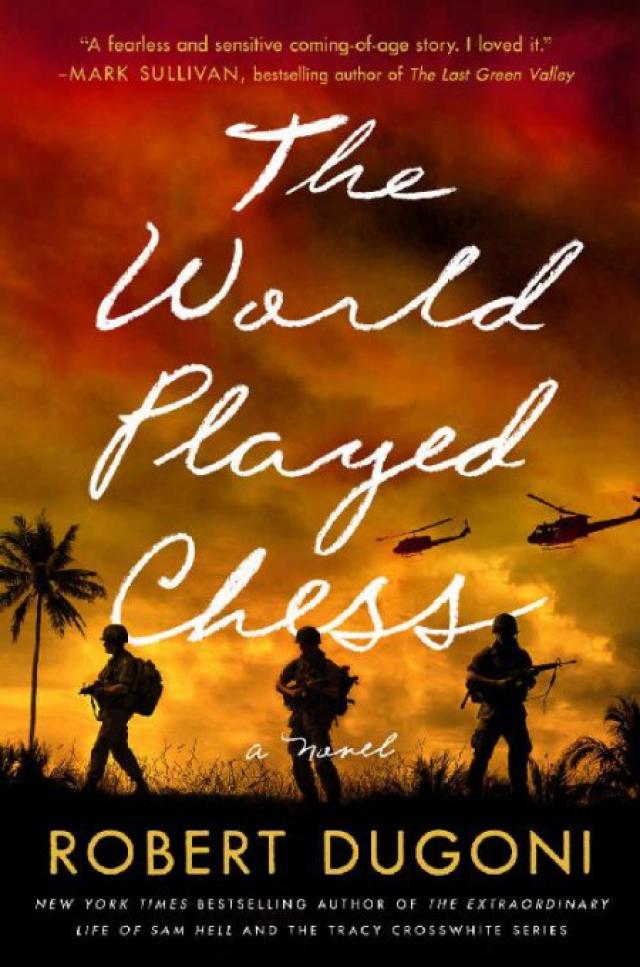
The World Played Chess, page 1


PRAISE FOR THE EXTRAORDINARY LIFE OF SAM HELL
“This is the bestselling Dugoni’s masterpiece, the book by which his work, and that of others, will be measured for years to come.”
—Providence Journal
“Dugoni has produced a novel that, if it doesn’t cross entirely over into John Irving territory, certainly nestles in close to the border . . . Told in two separate time lines (Sam as a boy, and Sam as a man) that eventually come together, and written in a gentle, introspective yet dramatic style that is very different from that of Dugoni’s crime fiction, this is an inspirational story of a man who spends a lifetime getting to know himself.”
—Booklist
“Sam Hell is inspiring and aglow with the promise of redemption.”
—Kirkus Reviews
“Robert Dugoni has a rare and brilliant talent for infusing his characters with complex emotions. It is very hard not to ache for young Sam . . . Frankly, this might be the best book of the year.”
—Bookreporter
“Distinctly different in style from Dugoni’s typical fare, The Extraordinary Life of Sam Hell is a captivating and poignant journey of strength and the power of finding your true self. Without a doubt, this is Dugoni’s best yet.”
—Suspense Magazine
“Dugoni’s writing is compellingly quick, simple, and evocative; readers will immediately empathize with young Sam and will race to discover how his story ends. The Extraordinary Life of Sam Hell is a heartwarming novel that celebrates overcoming the unfairnesses of life.”
—Seattle Book Review
ALSO BY ROBERT DUGONI
The Extraordinary Life of Sam Hell
The 7th Canon
Damage Control
The Charles Jenkins Series
The Eighth Sister
The Last Agent
The Tracy Crosswhite Series
My Sister’s Grave
Her Final Breath
In the Clearing
The Trapped Girl
Close to Home
A Steep Price
A Cold Trail
In Her Tracks
The Academy (a short story)
Third Watch (a short story)
The David Sloane Series
The Jury Master
Wrongful Death
Bodily Harm
Murder One
The Conviction
Nonfiction
The Cyanide Canary (with Joseph Hilldorfer)
This is a work of fiction. Names, characters, organizations, places, events, and incidents are either products of the author’s imagination or are used fictitiously.
Text copyright © 2021 by La Mesa Fiction, LLC
All rights reserved.
No part of this book may be reproduced, or stored in a retrieval system, or transmitted in any form or by any means, electronic, mechanical, photocopying, recording, or otherwise, without express written permission of the publisher.
Published by Lake Union Publishing, Seattle
www.apub.com
Amazon, the Amazon logo, and Lake Union Publishing are trademarks of Amazon.com, Inc., or its affiliates.
ISBN-13: 9781542029377 (hardcover)
ISBN-10: 1542029376 (hardcover)
ISBN-13: 9781542029391 (paperback)
ISBN-10: 1542029392 (paperback)
Cover design by Faceout Studio, Tim Green
First edition
To all the men and women who served in the Vietnam War. Heroes. Every one of them.
CONTENTS
Start Reading
When I was . . .
PROLOGUE
PART I I AIN’T NO SENATOR’S SON
August 26, 1967
Chapter 1
August 27, 1967
Chapter 2
March 12, 1968
Chapter 3
April 1, 1968
Chapter 4
April 7, 1968
Chapter 5
PART II NEVER, NEVERLAND
April 7, 1968
Chapter 6
April 7, 1968
Chapter 7
April 7, 1968
Chapter 8
April 28, 1968
Chapter 9
PART III WHEN YOU COMING HOME, SON?
May 1, 1968
Chapter 10
May 2, 1968
Chapter 11
May 5, 1968
Chapter 12
May 6, 1968
Chapter 13
May 6, 1968
Chapter 14
PART IV PAINT IT BLACK
May 10, 1968
Chapter 15
June 10, 1968
Chapter 16
June 27, 1968
Chapter 17
August 1, 1968
Chapter 18
August 18, 1968
Chapter 19
PART V TAKE ME HOME, TO THE PLACE . . . I ONCE BELONGED
September 24, 1968
Chapter 20
November 14, 1968
Chapter 21
December 2, 1968
Chapter 22
December 12, 1968
Chapter 23
PART VI THE FINISH LINE IS SIX FEET UNDER
December 22, 1968
Chapter 24
December 24, 1968
Chapter 25
Chapter 26
Epilogue
ACKNOWLEDGMENTS
RESOURCES
BOOK CLUB QUESTIONS
ABOUT THE AUTHOR
The world played chess, while I played checkers.
—Origin and attribution debated
When I was a child, I spoke like a child, I thought like a child, I reasoned like a child. When I became a man, I put aside childish things.
—1 Corinthians 13:11
PROLOGUE
A purpose, I have learned, is rarely found, but revealed. Only when I do not search does the purpose become clear.
So it would be with William Goodman’s journal. I had no idea why he sent it to me, but his purpose would reveal itself in time.
William mailed the journal he kept in Vietnam in a five-by-eight manila envelope addressed simply to Vincenzo, without my last name, Bianco. Scrawled in blue ink, the crude numbers and letters appeared rushed, as if William had quickly written the name and my Burlingame address, perhaps worried he might change his mind before he mailed the envelope. He did not provide his name or a return address, but I knew the sender. I had not heard that version of my name in nearly forty years, nor had I seen or spoken with the only person who had routinely used it.
William’s package arrived on a Saturday, via regular mail, with eight American flag postage stamps in the upper-right corner. That caught my attention. I opened the envelope with more than a little curiosity and pulled out a rectangular Tiger Chewing Tobacco tin—the orange and gold leaf scratched and aged, and the four corners, one of which had a dent, displaying flakes of rust. I held the tin like a religious relic, uncertain what it could possibly contain, or if I wanted to open it.
After a moment of contemplation, I popped the lid.
Beneath a folded sheet of paper, the kind once kept by a telephone to scribble hurried notes and phone numbers, I found a three-by-five-inch black hardcover notebook, the lined sheets filled with the same harsh handwriting as on the envelope. I unfolded the sheet and noted an illustration of a birdhouse with an American flag above the round entry hole. Again, it seemed as incongruous with the William I had known as the patriotic stamps.
The note, however, was vintage William—humor, with a seriousness lurking beneath his words.
Vincenzo!
Look what I found in a box in my storage closet.
I guess it wasn’t in the box I threw out with my medals and ribbons after all.
Fate, perhaps.
I was uncertain what to do with it. My wife is gone now. Cancer took her. She had a daughter from a previous marriage who, for all intents and purposes, I raised as my own. But I cannot give this to her. She wouldn’t understand.
It’s just me now. A squad of one.
I almost threw it out. Then I thought of you.
I thought of that summer. 1979? You asked about Vietnam. And you listened when others did not. You saved me from destroying my life, and you were the reason I found my life again. I don’t think you knew that. I never had the chance to tell you. I should have.
I believe we both dreamed of being journalists. I see on the internet you’re a successful lawyer. Dreams are hard to catch, aren’t they? I didn’t obtain my dream, either, not that one anyway, but I achieved so many others I never thought possible. I have no regrets, and I certainly won’t complain. Every minute of every day is a gift, and growing old a privilege, not a right.
I lowered William’s letter and recalled when he’d first said those words to me—in the garage of the Burlingame remodel. I had thought of his words often over the years, and I told them to my own children, though they didn’t have the depth of meaning they had coming from William.
So, the journal . . .
After the marines turned down my request to be a combat reporter, I bought this journal and decided to write my own stories. I once thought these scribblings might someday be the makings of a novel, but maybe they’re just the musings of an aging man once young, a man who lived through hell on earth and somehow survived, bruised and battered, but alive. Or maybe they’re just scribblings . . .
Now they belong to you.
Keep them. Use them if you se
Peace, Semper Fi,
William Goodman
Over the next year, I would endeavor to read one entry a day, as William had written them, never realizing William’s stories would be as significant now as they had been thirty-six years ago, and as painful. Some entries were just a rushed sentence or two, others, longer narratives. I read each entry slowly, searching for William’s hidden meanings. Some made me laugh. Some made me sad. Some were too horrible to imagine, or to live with, which explained why William sent me the journal and did not leave it to his daughter. He no longer wanted to live with the memories—I imagine reality had been hard enough—and he didn’t want her to live with them, either.
But unlike the Vietnam medals William had been awarded, the journal had clearly meant something to him, and he was not yet prepared to throw away his recollections within it.
Whatever William’s reason, the journal’s purpose would reveal itself during my son Beau’s senior year of high school, and it would remind me of that summer, 1979, before I, too, had departed for college—when I’d first met and worked with William Goodman and Todd Pearson, two Vietnam veterans who’d come home from war to find their place in the world forever altered. I had also struggled that summer, in my own way, as Beau would struggle, as all young men struggle to ascend from their teenage years to the mantle of manhood.
William called it OJT. On-the-job training.
I suppose he was right.
Like most eighteen-year-old young men, I inhabited the center of my own universe, though cosmologists steadfastly maintain the universe has no center, that it will forever expand. Try telling that to a high school senior who thinks he’s immortal because he has yet to experience mortality and indestructible because nothing has harmed him, who believes he can achieve anything he puts his mind to simply because others have said he can.
I said as much in my valedictorian address to my classmates, 172 eighteen-year-old young men. “Good seeds,” I had called them, making an analogy to a biblical psalm. Good seeds who had fallen on good ground and would achieve great things. When I had finished, my classmates stood and applauded because, like me, they believed their futures to also be inevitable and rich with promise. The realities of life had not yet popped the bubbles in which we lived. We did not know that nothing is guaranteed, not even nineteen.
Unlike for my own children, social media had not pierced holes in our naivete. My social media consisted of a rotary-dial phone on the kitchen wall, and good luck competing with four sisters to use it. At eighteen years of age, I could count on one hand the number of times I had stepped on an airplane, and I had never traveled outside the state of California, except during summer vacations at Lake Tahoe when my family crossed the border into Nevada. News of the world came only at prescribed hours of the day, only from three television networks—NBC, ABC, and CBS—and only if I chose to watch it.
I rarely did.
I learned of Richard Nixon’s 1974 resignation, and of Elvis Presley’s death in 1977, from important newscasts that interrupted the radio in the car. I did not have the ability to FaceTime, text, Instagram, Snapchat, or Twitter anyone about these events. Not that I’m sure I would have—except, perhaps, to tweet the death of Elvis. I was, and remain, a fan.
Russia was an evil empire, China an emerging but backward giant, and Vietnam . . . Vietnam was just an annoying country on the other side of the world that the United States had failed to liberate from the bonds of communism.
I couldn’t be bothered with any of it.
I intended to make the most of my last summer before I left for college. I intended to go out every night with my high school friends and drink in—literally—what remained of my youth. I wanted to put off, for as long as possible, the responsibilities and obligations I knew would come with being an adult. I had claimed to anyone who would listen that I was Peter Pan, youthful, carefree, and without worry.
A part of me very much wanted it to be so.
But it couldn’t be.
As my classmates’ applause for my valedictorian address faded in the church vestibule and our principal released the class of 1979 into the world, I rushed out those bronze church doors and never saw the fist that would punch me in the face, the fist that would shatter my illusions about life, death, and my Peter Pan youth—the same fist that would punch Beau in the face his senior year.
Like William, I, too, had intended to be a journalist, and I, too, had kept a journal, a present from my mother on my seventeenth birthday. I diligently kept a record of the events that transpired during the next year, including that summer, because I had also been certain my scribblings would someday be the basis for many novels.
Like William, I shoved my journal in a box and forgot about it. Like William, I gave up my dream of writing a novel.
Until the day his journal arrived in the mail.
I found that box in my attic, and in that box I found my brown leather journal beneath the plaques and medals commemorating my high school achievements. Unlike William, I never had the nerve to throw out those awards. In my attic I thumbed through my journal and read that final entry I had written before I left for college. A poem. A very poor imitation of the great Dr. Seuss. I’d written of the reality that came that summer, despite my best efforts to stop it. It came like the Christmas that Dr. Seuss’s Grinch couldn’t steal from the people of Whoville.
It came, just the same.
September 16, 1979
Reality came last summer without boxes or ribbons or packages or bows.
It came without warnings or excuses,
And gripped me from my head to my toes.
And I puzzled and puzzled till my puzzler was sore.
How could I have missed something at my essence, at my very core?
Reality came, yes it did, with its own devilish plot.
It came like a net, and I like the fish, that in it was caught.
It struck like a fist, hitting me square in the jaw.
A blow without warning, unapologetic, and savagely raw.
The pain lingered for days, then for months and, finally, years.
It lingered and lingered until its message became clear.
The world, it seemed, had been busy playing chess,
While I had played checkers . . . and ignored the rest.
PART I
I AIN’T NO SENATOR’S SON
August 26, 1967
“Don’t stand out. Just blend in. Do you hear me?”
“I hear you, Mom.”
My mother draped a gold chain over my head and pressed her hand to the crucifix.
“And don’t be a hero. Just blend in and come home.”
“I will,” I told her, because I knew it was what she wanted to hear.
And I didn’t want to think about the alternative.
Chapter 1
August 29, 2015
I walked into a wall where once had been the entry to our kitchen. I’d had my head down, flipping through the pages of the journal I’d kept at seventeen and wondering what happened to the young man who had wanted to write.
“Damn,” I said.
Elizabeth looked up from the remodel plans she had spread across our dining room table and laughed. “Old habits die hard, I guess,” she said.
“I guess,” I said, rubbing where I had bumped my head. “When did this go in?”
“Yesterday. They’re moving the staircase tomorrow.”
“Moving the staircase?” I said, my tone sharpening and volume rising.
“I’m kidding.”
“Very funny.”
We were in the middle of a remodel that started with just removing a nonstructural wall between the kitchen and the dining room no one ever used. The kitchen had since doubled in size and shifted, to make the family room larger. Elizabeth decided a new kitchen needed new appliances, and a bay window, and, apparently, a new entry. I wasn’t complaining, at least not out loud. It would be nice to have a larger family room, which meant a larger flat-screen, in my way of thinking. It was also practical. Beau, our eighteen-year-old, who would be a high school senior, brought friends home after summer football conditioning, and that would likely continue after Friday-night games in the fall. I’d warned Elizabeth that eighteen-year-old young men after an extended workout were like stray dogs. Feed them and they would keep coming back. They did. I wished I had bought stock in Costco pizza.





