

Who Says I Can't, page 1


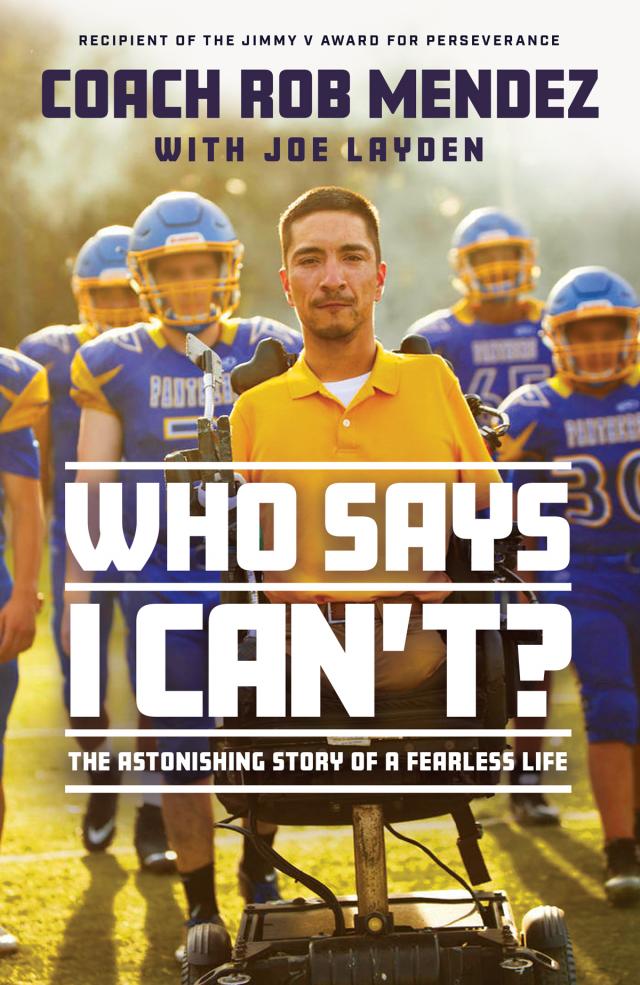
Who Says I Can’t?
Copyright © 2021 by Robert Nieblas
All rights reserved. No portion of this book may be reproduced, stored in a retrieval system, or transmitted in any form or by any means—electronic, mechanical, photocopy, recording, scanning, or other—except for brief quotations in critical reviews or articles, without the prior written permission of the publisher.
Published by Harper Horizon, an imprint of HarperCollins Focus LLC.
Any internet addresses, phone numbers, or company or product information printed in this book are offered as a resource and are not intended in any way to be or to imply an endorsement by Harper Horizon, nor does Harper Horizon vouch for the existence, content, or services of these sites, phone numbers, companies, or products beyond the life of this book.
ISBN 978-0-7852-3941-3 (eBook)
ISBN 978-0-7852-3940-6 (HC)
Epub Edition July 2021 9780785239413
Library of Congress Control Number: 2021930682
Printed in the United States of America
21 22 23 24 25 LSC 10 9 8 7 6 5 4 3 2 1
To my dad, Robert Sr.; mother, Josie; sisters, Jackie and Maddy; both tias, Tota and Cindy; and of course, my Grandpa Danny and Grandma Mona. I dedicate this book to my parents and the rest of my family for their belief in me, their support, and ultimately for bringing love and strength into my heart. My father was my biggest advocate for me growing up, not allowing for anyone else to see me any different and always reminding me to focus on what I am able to do, rather than what I’m not able to do. And my mother showed me that love is everything. She has a big heart and is my biggest supporter. I love you all very much, and I consider myself one of the luckiest individuals to grow up in the family I did.
CONTENTS
Cover
Title Page
Copyright
Prologue
Chapter One
Chapter Two
Chapter Three
Chapter Four
Chapter Five
Chapter Six
Chapter Seven
Chapter Eight
Chapter Nine
Chapter Ten
Chapter Eleven
Epilogue
Acknowledgments
About the Authors
PROLOGUE
AUGUST 26, 2018
It’s funny the way a good day can turn bad without any warning. That is a fact of life for anyone, of course, but it’s particularly true in my case.
Today is a beautiful summer Sunday in the Bay Area of Northern California, specifically in the town of Morgan Hill, where my parents live. I’m staying for the weekend, while my caretaker is out of town. I’m hanging out in the garage, just shooting the breeze with my dad as he does some work, the way we did while I was growing up. The sun is fading in the evening sky, and music is playing in the background. It’s comfortable, familiar, peaceful.
Reflexively, I decide to check my phone. It sits in a cradle just below eye level on my elevated, motorized wheelchair. I lean forward to grab the stylus with my teeth. It’s a simple maneuver, one I’ve executed thousands of times before, and I do it without a thought, like anyone else who compulsively plays with their smartphone. Just a couple of quick pecks, and I’m in sync with the digital world: answering texts and emails, checking Instagram and Twitter feeds, getting ready for my fantasy football draft.
You know, the usual stuff.
But something happens as I reach for the stylus. It registers first as a wave of disorientation. I’m used to feeling the firm snap of a safety belt holding me in place when I move too quickly or too far. And believe me, I do that a lot. I often thrash about in my chair, gesticulating with my head and shoulders, expressing emotion with what I have, rather than worrying about what I don’t have. I lean and twist and turn, sometimes as a means of expression and sometimes in an attempt to alleviate the enormous strain that my spine bears all day, every day. For a guy stuck in a wheelchair, or maybe because I am stuck in a wheelchair, I have an abundance of energy. To minimize the chance of injury, my chair is equipped with two straps: one for the chest, and one for the waist. Much to the dismay of my friends and family, I rarely use the chest strap. Too confining. I figure the waist belt is sufficient. Usually it is.
Unless you forget to use it.
You know how they say everything slows down when you’re in an accident? Well, it’s true. I can feel myself leaning forward, and at some point, I realize there is nothing to stop the progression. My head goes right past the stylus and the phone, and my torso dutifully follows. I am out of the chair now, hurtling—can that possibly be the right word when falling from a height of only four feet? Yes, it seems exactly right—toward the garage floor. I can see the concrete rising to greet me. The feeling of helplessness is impressive, if not overwhelming. I can do nothing to stop the impending catastrophe. I have no arms to break the fall, no legs to absorb some of the impact. I turn my head to the side.
And close my eyes.
I wake in the passenger seat of my father’s Chevy Suburban. His hands are locked on the steering wheel, his eyes red and wet. We are racing down the interstate, toward Saint Louise Regional Hospital.
“Dad, it’s okay. I’m all right.”
This is not true. My head throbs. My face is on fire. Liquid drips into my left eye, sticky and stinging.
“Please, Robert,” he says. “Be still.”
I look down. Blood is everywhere: on the seat, on my clothes. I blink hard, trying to clear my vision. I know I’m hurt, and though I don’t know exactly how bad, I’m worried not only about my health but what my injuries might mean for the new direction my life has taken.
Right now, though, I mainly feel bad for my father, who has been through so much with me—and who taught me never to focus on what I couldn’t do but rather on what I could—and how he will process all of this. Bad enough to see your only son’s head smack against a concrete floor with the sickening sound of a pancake being slapped against a griddle (that’s exactly the way my father would later describe it). But to wonder whether you’d buckled his seat belt, or buckled it effectively, was even worse.
It could have happened to anyone. Anytime. And, ultimately, it’s my responsibility. I am not a child. I am a grown man, thirty years old. But in that moment, there is no consoling my father.
“Don’t worry, Dad.”
He doesn’t respond. He simply cries.
At the hospital he whisks me into the emergency room, carrying me like a toddler against his chest and shoulder. It’s a head injury—the kind that gets you pushed right to the front of the line at the ER. Within minutes, I’m surrounded by doctors and nurses cleaning my wounds and assessing the damage, conversing calmly but forcefully in the staccato rhythm of trauma care. The pain ebbs and flows as they wheel me through the hospital for X-rays and a CAT scan. Six stiches are required to close the gash above my left eye, but of greater concern are the fractures to my orbital bone and cheekbone. The doctors say I’m lucky. It could have been worse. A face-first plant would have shattered my nose. Had I turned too far to the side—a natural and perfectly reasonable response of self-preservation—I could have struck my temple. If that had happened, I might not have even made it to the hospital.
So, yeah, I got off easy.
“When can I go home?” Before anyone can answer, waves of nausea rock me. I start vomiting. And I don’t stop until the meds kick in a few hours later.
I’m discharged at seven o’clock the next morning. My head is still throbbing, my neck aches so badly I can barely move, and my face feels as though it’s been rubbed raw with sandpaper. They tell me the obvious: I’ve suffered considerable damage, including a concussion, and that while the outcome could have been worse, I’m going to feel lousy for a while.
“Take it easy,” one of the docs suggests. “No work.”
“For how long?”
“At least a couple weeks.”
My heart sinks. For twelve years I’ve been coaching high school and Pop Warner football in the Bay Area, and now, finally, I have a team of my own. I’m the head junior varsity (JV) coach at Prospect High School in nearby Saratoga. Classes have already begun; our first preseason game is only a few days away.
Two weeks?
“No way,” I respond. “I need to get back on the sideline. Now.”
Not advisable, the doctor reiterates. “You just can’t.”
I don’t argue. There’s no point. But I can hear the voice in my head, the one I listen to above all others. And I smile.
Who says I can’t?!
CHAPTER ONE
Let’s get the technical stuff out of the way. I was born with tetra-amelia syndrome, a rare congenital disorder that prevents the formation of limbs during embryonic development. How rare? Extraordinarily rare. There are, supposedly, only a dozen or so people in the world currently living with tetra-amelia. I don’t know if this is true. To be honest, I have my doubts. I presume there are at least a handful of people in underdeveloped nations, far from the glare of Western media, who are coping with tetra-amelia. But that doesn’t lessen its uniqueness. To me, statistics are irrelevant, and probability feels arbitrary.
This is my life, and it always has been. I know nothing else. That’s one of the reasons I’ve always been a little uncomfortable with other people defining me by my appearance or by my physical limitations. I don’t think of myself as a football coach without limbs; I am, simply, a football coach. In recent years I’ve received a fair amount of attention, thanks in l
At first, I found the spotlight somewhat disorienting—so many people telling me I’m an inspiration because of the way I deal with a significant physical challenge. I get it. I feel honored that anyone would look at me that way, and I am grateful and humbled to be in a position to help others who might be struggling to overcome hardship. At the same time, I’d be lying if I said I feel heroic. I don’t know what it’s like to have arms and legs. I don’t know what it’s like to walk or run. To me, far more heroic is the person who has these functions and then, through illness or injury or accident, loses them and somehow overcomes the grief and pain and gets on with his or her life.
If I lost my eyesight tomorrow, or my hearing . . . man, I can’t imagine how I would deal with it. What I have now is what I’ve always had. What I don’t have . . . well, it’s hard to miss what you’ve never experienced.
Don’t get me wrong. I’m not suggesting that I don’t have bad days. Sometimes I get angry or frustrated. I’m a football coach. I love sports. I wonder what it would be like to throw a ball. I wonder what it would be like to hold the people I love, to touch them with my hands, rather than my shoulders or face. Not long ago, one of the players on my football team had a panic attack after a game. His body started cramping, and he got scared. I wanted to embrace him, to physically reassure him that everything would be all right. But I couldn’t do that. All I could do was talk to him from my chair and ask others for help. More practically, I’d like to not be dependent on someone else for the daily functions that most people take for granted. I’d like to be able to take a shower and dress myself in the morning. I’d like to be able to feed myself.
Frankly? Bluntly? I’d like to be able to wipe myself after going to the bathroom.
There are days, too, when soreness escalates into pain, and that’s a legitimate challenge to the psyche, as it is for anyone who lives with chronic discomfort. I’m stuck in a wheelchair all day. That, alone, can be problematic. But I also have developed scoliosis related to tetra-amelia. It’s not only that I lack the legs and lower buttocks to help distribute and support the weight of my upper body. There is also the issue of proportions: my head is normal-size, but my torso is smaller than normal. This puts inordinate stress on my spine. I do a lot of stretching. I get physical therapy. Some days I feel pretty good. Other days I hurt. A lot.
That’s not a sob story. It’s not even a complaint. It’s just the truth. But I love my life, and I believe that I have been put on this planet, in this condition, for a purpose. And I embrace that purpose with all my heart. I want to use my platform (funny, it wasn’t so long ago that I didn’t even know I had a platform!) and this book—the story of my life—to help others in any way I can. In the last year, in addition to working full-time as a football coach and teacher’s aide, I’ve addressed hundreds of people face-to-face at speaking engagements across the country. I’ve also been profiled by multiple media outlets, giving me the opportunity to have an impact on millions of people.
It’s been a wild ride, to be sure, and it’s taken some getting used to, but I’m glad that I’ve been able to inspire people to live their lives to the fullest and love themselves for who they are. And it’s something I want to keep doing. This is my calling. This is God’s plan for me. I see that now, and I am grateful.
I was a happy kid. People sometimes have a hard time believing that, yet it’s true. From day one I was nurtured by a badass family that gave me endless love and support but never allowed me to feel sorry for myself or let others place restrictions on what I could do. I know it wasn’t easy for them. My parents, Robert and Josie Mendez, didn’t know of my impending physical challenges until the eighth month of pregnancy. That’s not much time to process the daunting prospect of raising a child born without limbs, of bringing into the world a little boy whose future was, at best, uncertain.
Imagine what it must have been like: months of joyful preparation and excitement, a young couple eagerly anticipating the birth of their second child (my sister, Jackie, was three years old when I was born). Then, suddenly, it’s as though they’re the object of some cosmic practical joke, or a test of biblical proportions. During a routine visit a doctor tells them something is amiss. There are tests and sonograms, and finally the news is broken.
No arms.
No legs.
I’ve thought about this from time to time, how my parents felt when that news was delivered. Doesn’t almost every father dream of playing catch with his son? Doesn’t almost every mother want to feel the warmth of her baby’s arms wrapped around her neck? What is it like to be hit with the realization, stark and cold, that these things won’t be part of your child’s life, of your life together with him? In that instant, I would imagine, you feel a mix of sadness and anger, of being cheated. Mostly, though, I would imagine you feel incalculable empathy for your unborn child. I’m not a parent, but I know that the one thing all parents want is to shield their child from pain. That day in the doctor’s office, my mother and father were told there would be no shielding.
I was different. Pain, in all its myriad forms, would be a fundamental part of my existence. Mom and Dad couldn’t chase it away. All they could do was help me learn how to cope with it.
In many ways, I grew up like other children, which meant that regarding events predating my arrival on the planet, information was dispensed on a need-to-know basis. I heard lots of stories and family history, most often shared by grandparents and aunts and uncles, but this particular subject—the day my parents were told their son would be one in a billion—they kept to themselves.
I come from a tight-knit family, made even tighter by the shared ordeal of raising a child with serious physical challenges. My mother was and is the sweetest person I have ever known; she wears her emotions on her sleeve. My dad is more stoic, but when I was a little boy, he was my best friend and most vocal advocate. If ever there was a time when my parents experienced anger or depression or self-pity over being burdened with a child born without limbs, I didn’t see it. They never felt sorry for themselves, and they didn’t indulge any of my self-pity.
“You can do anything you want, Robert,” they always said. And I believed them.
When I first viewed the ESPN documentary, however, I truly understood the burden my parents carried—the fear and doubt and shock they experienced that day in the doctor’s office, and how it carried over for some time afterward.
My mother said, “I didn’t have a choice to have an abortion, so I had to . . . keep Robert,” leaving these words open to interpretation.
As the camera rolled, I watched my dad stare into the distance, his face carrying the weight of an event thirty years in the past just as clearly as if it happened yesterday.
“In the back of my mind, I’m asking, Why? Why my son?” he said. “You know, less than one hundred born like him in the world.”
No handbook exists for something like this. I suppose you just hope and pray everything turns out all right, that fear and anger will be eclipsed by love. That seems to have been the case for me, and it’s just one of many reasons I consider myself a lucky man. Those frightened, stunned parents in the documentary? Until that moment, I’d never seen them, never known them. I’m proud of them for being honest in the documentary, and I have even greater respect and admiration for them now. We were both given a life sentence, after all, and the extent to which mine would be tolerable, miserable, or filled with joy was largely their determination. I’ve been called “inspirational” and “heroic,” but if I live up to those descriptions, even for a moment, it’s only because I had strong role models.
From their perspective, it seemed I had accepted the situation I was born into, and there was no reason to dredge up gloomier times. It’s cliché, of course, but we lived day by day, and we made the best of it. My parents weren’t going to go back and cry and complain about what might have been. There was no point.


