

Syndrome, page 1


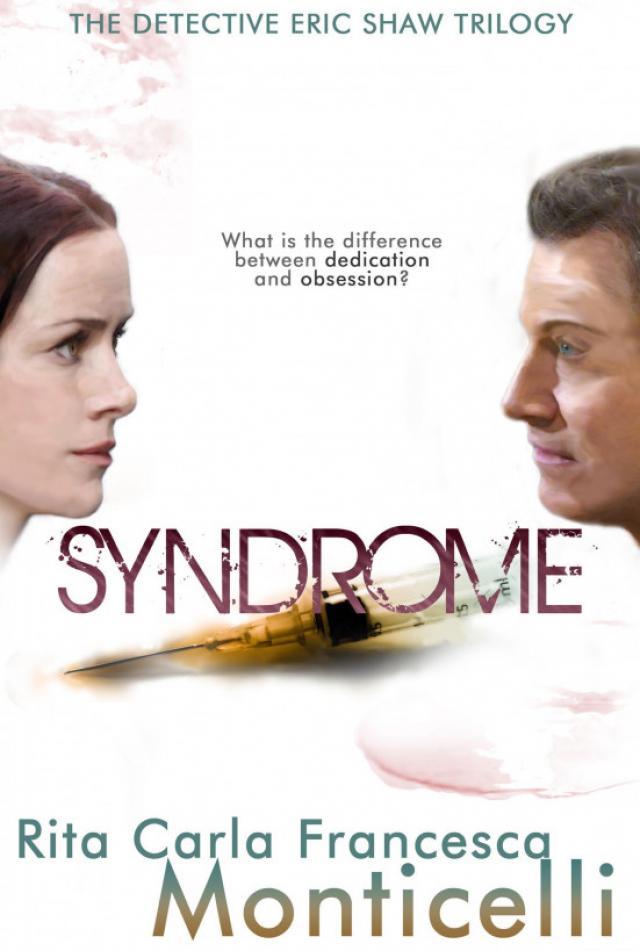
Syndrome
Rita Carla Francesca Monticelli
Copyright © 2023 Rita Carla Francesca Monticelli
All rights reserved.
Table of contents
Syndrome
1
2
3
4
5
6
7
8
9
Did you like this book?
Acknowledgements
About the author
More books by Rita Carla Francesca Monticelli
Do you want to keep updated on the next publications?
Copyright and disclaimer
SYNDROME
Copyright © 2023 Rita Carla Francesca Monticelli
Original title: Sindrome
© 2016 Rita Carla Francesca Monticelli
Translation by: Rita Carla Francesca Monticelli (© 2022)
Translation revised by: Amanda Williams and Julia Gibbs
All rights reserved.
Cover: © 2023 Rita Carla Francesca Monticelli
Original picture (syringe): © Canva/Pan Xunbin
A note from the author: although I have included some real information about the organisation of police forces in London, I nevertheless took full artistic licence concerning professional positions of numerous employees, as well as the logistics and procedures utilised by the Forensic Services and Murder Investigation Teams of London’s Metropolitan Police (e.g. some officers carrying weapons) in order to better adapt them to the plot.
Moreover, numerous real places are mentioned within the book, which are used fictitiously, while others are the product of my imagination. In particular, there is no St Nicholas Hospital in London or, to my knowledge, a pub chain called Murphy’s Den.
This is the second novel in the Detective Eric Shaw Trilogy.
The first book is The Mentor.
This book is written in British English.
1
13 June 2016
When he felt the impact on the side of the transport van, the prisoner was immersed in his thoughts. With his gaze fixed on his handcuffed wrists, where the cold light in the back of the van made the reflections of steel ripple, he’d been recalling what had happened during his court hearing.
His lawyer was convinced they wouldn’t succeed in proving his involvement in that murder. Without any conclusive physical proof locating him at the scene during the crime, the fact he’d confessed to a similar one wouldn’t be enough to find him guilty beyond a reasonable doubt.
He didn’t feel quite so optimistic, though. It wasn’t the second conviction that worried him. There was still the possibility of appeal and anyway, given the years he already had to serve, it wouldn’t make much difference in the short-term. The real problem was that he would lose the little privileges he’d gained by plea-bargaining for the first one, including being sent to Coldingley Prison, where it wasn’t that bad. It wasn’t a maximum security prison, for starters. Moreover, they’d assigned him a single cell and the other guests were quite calm.
He turned for an instant and his eyes fell on the other person who was being transported with him: Aiden Murphy. The man was believed to be the boss of a big drug smuggling ring involving every corner of Britain, but they’d succeeded in locking him up only for illegal possession of narcotics in a quantity ten times the limit intended for personal use. It was nothing compared to all the stuff he was able to get from the Middle East, South America, and who knew where else.
The prisoner loathed druggies, and the same applied to those exploiting them. But except for that little flaw, Murphy seemed a decent bloke. Polite, respectful. Inside the prison, he could count on a swarm of men at his service, but such submission occurred spontaneously, without force or abuse. Possessing that kind of power over others was something not to take too lightly and was worth proper consideration, regardless of how that power had been acquired.
The prisoner’s mind then moved to another powerful person, although of a different nature, the one who’d caused him to end up in prison and who now, not yet satisfied, was trying to bury him. He’d seen again the challenging glance with which that person had faced him from the witness stand.
Perhaps this time things would go differently. His alibi was weak, sure. After all, the person who had provided it to him was an old friend and was therefore considered a less than trustworthy witness. However, he was irreproachable; his criminal record was immaculate. That was the reason the prisoner had asked him to say they were together at the same time it was presumed the murder had taken place. Peter couldn’t have said no. Perhaps he hadn’t done that out of friendship, perhaps it’d been just fear of repercussions, even though his friend was in prison.
With a little luck, the prisoner could avoid that conviction. But the fact remained that he was guilty of that crime, as well as of others, and the way things had gone the previous time, deep down, had undermined the certainty he’d always had in his methods. He’d considered himself precise, methodical, untouchable, yet now he was in a van going from London to a delightful village called Woking, where he would spend the next fifteen years, if all went well, behind bars.
He was still imagining himself within the four walls of his cell when he felt a lateral shove.
His neck almost cracked as his head bent. His arms, kept together by the short chain, rose, only they were actually lowering. The van was overturning whilst his body was held to the seat by the safety belt.
When everything stopped, he found himself looking at the world upside down. He turned his eyes to his hands hanging beyond his head. The faint interior light was off. The one coming from the driver’s compartment, separated by a small-meshed metal net, didn’t allow him to see clearly.
Through absolute silence, a persistent buzz of bees filtered from outside. No voices, no moans. Besides Murphy, there was an officer with him in the back and two more were on the front seats. All unconscious? Dead? He opened his mouth to scream, but his throat choked and barely a breath exited it.
A gunshot, and the bees hushed up.
The prisoner flinched and his torso slipped down a bit, despite the belt’s grip. His eyes started to cooperate; the environment around him was becoming brighter. Or perhaps he was wounded, in shock, and about to pass out?
A second shot made him snap to again.
His mind resumed working. Asking questions and seeking answers. It hadn’t been an accident. Someone was attacking the transport van.
He watched his hands. He moved his fingers. They responded to his command. His legs? He sought them out with his eyes. They were in the shadow of the seat before him. As he focused on them, he realised they leant with his knees against some sort of handrail fastened to the seatback.
Outside, more shots followed one another. Inside, he could instead hear a sizzling noise whilst a revolting smell was spreading out in the air. Diesel.
The prisoner coughed, as an image of the fuel touching the flames of a blaze shaped in his mind. It wasn’t petrol; he knew it wouldn’t catch fire easily, but he didn’t want to find out to what extent in person.
He had to get out of there.
He contracted the muscles in his arms to draw them to his chest and then started following the safety belt ribbon all the way to the buckle. In a frenzy, he touched, searching for the button to make it unfasten. As he pressed it, the fear of it being stuck was replaced by the realisation he would fall head first without seeing where he’d end up. But the split-second of worry was wiped out by him hitting something soft with the top of his back.
A muffled moan followed the impact. But he wasn’t the one who’d let it out. Then, as he completed his fall, an ankle bumped into a solid obstacle, and this time he was the one who moaned.
Struggling to ignore the pain, the prisoner tried to advance on all fours, as far as possible, given that two were tied. He crawled away from what had broken his plunge and, as he did so, he recognised the features of one of the officers. Judging by the cry heard when he ended on top of the bloke, the latter must have been still alive, but wasn’t reacting. Maybe unconscious. That certainly didn’t improve his situation. A smell of burnt plastic filled the air, and the only way out before him was blocked.
A noise made him turn towards the driver’s compartment. A door was open, letting more light in. The driver’s arm was pushing it. The prisoner was about to call for help when he heard two close-range gunshots. He saw the arm fall, but the door reached the end of its travel.
A head peeked in. ‘Murphy, you in one piece?’
Murphy.
The prisoner turned in the opposite direction. As he recalled, the other con was in the last seat on the right, while he’d been placed in the second one on the left, almost poles apart, to avoid any communication or touch. For this purpose, they’d been moved in and out at different times. Their respective hearings had been scheduled at the same time, but Murphy’s had lasted longer than expected, so he had to wait for half an hour in the vehicle, turned in an oven by the morning sun.
‘I am, fuck; get me out of here,’ he heard a husky voice reply. ‘This big box’s going to become a blaze. I can smell burning.’
A screech drowned out his words, making the prisoner’s jaws tense. Then a flash of light flooded the back of the van. A door had opened. He crouched on instinct. He didn’t know who those blokes were, except they must have been Murphy’s henchmen, but he’d seen them snuff out the two officers in the driver’s compartment and, considering the number of gunshots outside and the fact they were rescuing the man now, he had to conclude they’d killed those from the escort.
He flattened himself against the floor, which was actually the van’s ceiling, and hoped they believed him dead. He suspected they wouldn’t appreciate a witness.
There was a hitting and scratching of metal, accompanied by grumbling and cursing.
His throat was tickling. He forced himself to keep his mouth shut to avoid coughing again. He shut his eyes. Just a few minutes and they would go away. And he’d be able to sneak out.
‘Come on!’ another voice shouted.
He opened his eyelids again. Two men were exiting the back of the van. One had a limp and held on to the other. A third one was gesturing to hurry with his arm. When they reached him, he placed himself beside Murphy as well.
Now they were a few metres away from the vehicle and moving farther amongst the trees, but had they turned back, they would see him.
‘Burn it down,’ Murphy ordered. ‘It’ll buy me time to disappear, while they try to pull out the toasted corpses from the walls for identification.’
He had to act now, get out now.
He pressed down his hands to rise, but something stepped on his foot. He held back a cry, as with his vision blurred by tears, he watched the officer he’d fallen onto walking ahead of him. The man was holding his firearm with both hands.
In an instant, he calculated the possible scenarios.
In the best-case one, the policeman would hit one of the three out there, but then the other two would gun him down. What would he gain from all that mess? Nothing. Actually, they would hurry to burn the van to avoid leaving further trace. Whatever happened, that idiot would draw them to him, reducing his chances to leg it.
In his cautious advancing, the officer brushed on something that drew the prisoner’s attention. One of the handrails on the back of the seats, which were likely used to fasten the handcuffs for cons deemed dangerous, was partly sticking out of its position.
He slowly raised on his knees, and then his feet. He reached out to grab it. His fingers from both hands clung to the steel and started pulling. It wouldn’t move, so he pulled harder. At last, the object gave way, and he was thrown backwards. He grasped for the seatback hanging from above, thus avoiding falling and making any noise.
Short of breath, he eyed the officer, who had now reached the van’s open door.
The prisoner moved in silence behind him, like a cat. Stopping him wouldn’t be enough.
The policeman leaped out, pointing his weapon. ‘Hands up!’
What an arse. He was really trying to get himself killed without taking at least one of them with him.
The henchman at Murphy’s left was the first to turn around. A slight perplexity crossed his face as his hand reached for the gun sticking out of his trousers.
The prisoner leapt out as well and, brandishing the metal rod like it was a bat, swung it with a fluid movement. And hit the policeman right in his temple.
The gun went off as the man fell to the ground, but the bullet didn’t hit the mark. The other henchman turned around, followed by Murphy with some difficulty.
That was no time to stop, not yet.
The prisoner changed his grip on the rod, pointing it down, and went over to the unconscious officer. The latter was wearing a bulletproof vest, so there weren’t many vital organs on which he could act.
He took another step to get closer to the man’s head. He was forcing himself not to look up at his audience. They were there, waiting for his next move, on which their decision to kill him or not would depend.
He clenched his teeth and raised the rod, then he lowered it with all the strength he had and drove it into his victim’s neck.
The officer gave a start, stirred, but a gush of blood started oozing rhythmically from the entry point with every heartbeat. His body shook with violent spasms, whilst a red patch expanded, stained the creeping vegetation of the undergrowth and then was absorbed by the soil.
The spurts reduced their intensity until the oozing became a trickle and the last contraction extinguished, turning the policeman into a corpse.
The prisoner was still panting when he found the strength to raise his head.
The first henchman was pointing a gun at him, but Murphy had stretched an arm in his direction. He poked the man’s chest, and the latter looked at him, then lowered the weapon slowly.
The drug smuggler smiled. ‘Looks like I gotta thank you.’ He gestured to the dead man with his head. ‘He could’ve killed one of us.’ He shrugged. ‘Even me.’
The prisoner could not reply. Just one wrong word and it would be his last. He took a deep breath while assessing the situation with a glance.
To his right, separated by the flattened bushes, was the road they’d been travelling. It was occupied by a medium-sized lorry, whose front was smashed up. The back pointed to a private lane from which it had presumably popped out at full speed, certainly not by chance, when the transport van was passing by.
He wished he could turn to look at the van and reconstruct the actual event. Anyway, from what he could gather, it had been struck and pushed to the right lane. It tilted to one side just before reaching the ditch and, because of the drop, overturned, crushing the bushes running along the road and breaking the trunks of two little trees.
There was another vehicle, abandoned sideways: the escort car. The doors were open and two officers were lying face down on the tarmac, motionless. It had been a two-on-two clash. Murphy’s men had a lot of guts in attempting that attack alone, or they were possessed of a high degree of recklessness mixed with stupidity that, for some fortuitous reason, had weighed in their favour.
From his position, he couldn’t spot any other vehicles. Perhaps the few people who could have attended the attack had driven away and were already calling for help after getting to a safe distance. The gunfire he’d heard would discourage any onlookers.
He didn’t know where he was exactly because the van windows were tinted, so he didn’t know the route they’d taken; anyway, given the duration of the journey, they must have already reached the surroundings of Woking. Perhaps not Bisley, where the prison was located, but one of the neighbouring villages.
It remained to be seen whether that would be the place of his death.
He faced Murphy’s confident look, then raised both arms to show him the handcuffs.
The other man, now free from his, beckoned to the henchman on his right. The latter pulled something out of his pocket and threw it towards the prisoner.
He caught it and only then did he realise it was a key. A sense of relief spread throughout his body. ‘Thank you,’ he murmured, nodding at the three of them.
Odds were, this wouldn’t be the day of his death.
Two weeks later. Monday.
‘Keep away from Jimmy!’ the woman shouted, pointing the knife at Dr Catherine Foulger.
‘Mary, please …’ The paediatrician was holding her hands forward. ‘There’s no need to overreact. I know you’re worried about your son, but I can assure you that here at St Nicholas, he’s been continuously monitored. Moreover, he’s recovering. You’ll be able to take him home in a few days.’ She motioned to the child witnessing the quarrel with bewildered eyes. Beside him, a nurse was checking his IV infusion rate. ‘Did you see how he ate with so much appetite?’ Catherine cracked a smile.
Not far from the room door, Adele watched that bizarre scene, keeping her shoulders against the wall, beside a trolley where some blankets were piled. The fluorescent lamp fixed to the ceiling above her was faulty. Only an end of the tube glowed with a faint orange light. From time to time, the rest of it flickered, but then it turned off again.
In the room, the mother burst into tears and lowered her arm.
Adele sighed. That knife wasn’t a particularly dangerous weapon, but used in the right way it could hurt.
Holding the tray used to bring the child’s dinner, the nurse went over to the other woman and placed it in front of her, a clear invitation to put the makeshift weapon on it.


