

A River in Borneo, page 1


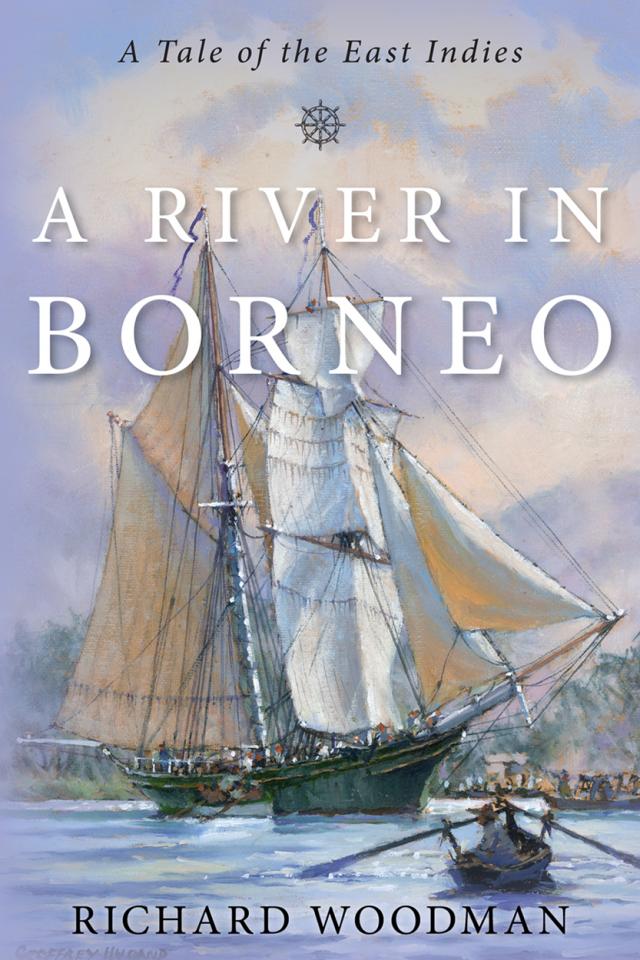
A RIVER IN BORNEO
A Tale of the East Indies
RICHARD WOODMAN
Guilford, Connecticut
An imprint of Globe Pequot, the trade division of
The Rowman & Littlefield Publishing Group, Inc.
4501 Forbes Blvd., Ste. 200
Lanham, MD 20706
www.rowman.com
Distributed by NATIONAL BOOK NETWORK
Copyright © 2021 by Richard Woodman
All rights reserved. No part of this book may be reproduced in any form or by any electronic or mechanical means, including information storage and retrieval systems, without written permission from the publisher, except by a reviewer who may quote passages in a review.
British Library Cataloguing in Publication Information available
Library of Congress Cataloging-in-Publication Data
Names: Woodman, Richard, 1944- author.
Title: A river in Borneo : a tale of the East Indies / Richard Woodman.
Description: Guilford, Connecticut : McBooks Press, [2021]
Identifiers: LCCN 2021038983 (print) | LCCN 2021038984 (ebook) | ISBN 9781493061921 (hardback ; alk. paper) | ISBN 9781493063437 (epub)
Subjects: LCGFT: War fiction. | Novels.
Classification: LCC PR6073.O618 R58 2021 (print) | LCC PR6073.O618 (ebook) | DDC 823/.914—dc23
LC record available at https://lccn.loc.gov/2021038983
LC ebook record available at https://lccn.loc.gov/2021038984
The paper used in this publication meets the minimum requirements of American National Standard for Information Sciences—Permanence of Paper for Printed Library Materials, ANSI/NISO Z39.48-1992.
Contents
Cover
Title
Copyright
Contents
AUTHOR’S NOTE
PART ONE THE RAIN FOREST OF KALIMANTAN (INDONESIAN BORNEO), EARLY SUMMER 1964
PART TWO CHAPTER ONE Singapore
CHAPTER TWO The Brigantine
CHAPTER THREE The Towkay
CHAPTER FOUR Master Under God
CHAPTER FIVE Shaking-Down
CHAPTER SIX An Uncertain Future
CHAPTER SEVEN The Burning Kampong
CHAPTER EIGHT The Pearl
CHAPTER NINE The Rungus Woman
CHAPTER TEN The Disgrace of Wu Chien
CHAPTER ELEVEN Sharimah
CHAPTER TWELVE Teniente Espina
CHAPTER THIRTEEN Captain Kirton’s Dilemma
CHAPTER FOURTEEN Merdeka
CHAPTER FIFTEEN A Cargo of Rifles
CHAPTER SIXTEEN The Spanish Corvette
CHAPTER SEVENTEEN A River in Borneo
CHAPTER EIGHTEEN The Lord of the Ship
PART THREE THE RAIN FOREST OF KALIMANTAN (INDONESIAN BORNEO), SUMMER 1964
PART FOUR ST HELENA’S HOSPICE, COLCHESTER, ENGLAND, DECEMBER 2018
ACKNOWLEDGEMENTS
Guide
Cover
Title
Copyright
Contents
AUTHOR’S NOTE
Start of Content
ACKNOWLEDGEMENTS
I
II
III
IV
V
VI
VII
VIII
IX
X
XI
XII
1
2
3
4
5
6
7
8
9
10
11
12
13
14
15
16
17
18
19
20
21
22
23
24
25
26
27
28
29
30
31
32
33
34
35
36
37
38
39
40
41
42
43
44
45
46
47
48
49
50
51
52
53
54
55
56
57
58
59
60
61
62
63
64
65
66
67
68
69
70
71
72
73
74
75
76
77
78
79
80
81
82
83
84
85
86
87
88
89
90
91
92
93
94
95
96
97
98
99
100
101
102
103
104
105
106
107
108
109
110
111
112
113
114
115
116
117
118
119
120
121
122
123
124
125
126
127
128
129
130
131
132
133
134
135
136
137
138
139
140
141
142
143
144
145
146
147
148
149
150
151
152
153
154
155
156
157
158
159
160
161
162
163
164
165
166
167
168
169
170
171
172
173
174
175
176
177
178
179
180
181
182
183
184
185
186
187
188
189
190
191
192
193
194
195
196
197
198
199
200
201
202
203
204
205
206
207
208
209
210
211
212
213
214
215
216
217
218
219
220
221
222
223
224
225
226
227
228
AUTHOR’S NOTE
THIS STORY IS SET IN THREE DISTINCT PERIODS, THE GREATER PART OF the narrative being between summer 1867 and March 1872, with a prologue and epilogue taking place in the summer of 1964 and an afterword in 2018. Both the dialogue and attitudes herein depicted are, therefore, those of these times. Consequently there is some racist dialogue along with other inter-social prejudices carried by my characters in sections of the story which are today unacceptable. I wish to make it quite clear that no offence is intended by this historical verisimilitude. However, to dismiss the past without reflecting the known—and well documented—behaviours of the time in question, would weaken both the credibility and integrity of my yarn. If nothing else, it shows that while we have a long way yet to go, some progress has been made.
I hope that the occasional use of foreign terms is generally selfexplanatory, but just in case the reader finds this difficult some explanations here may help. The Malay term orang puteh means white man; orang kaya, a rich man, and orang laut, man of the sea—specifically herein a Bugis pirate. The title Tuan, as used on the Singaporean waterfront of the day, was the colloquial and contemporaneous equivalent of the English use of the word ‘sir’ (occasionally elevated to ‘Lord’) as a general term of respect, caste or rank being as important to cultures other than those of the British imperium.
Ship-board ranks were often confusing but broadly speaking the Malay nouns Tindal meant boatswain, and Casab signified the boatswain’s mate (itself a rank that might also be known as lamp-trimmer —‘lampy’—in colloquial English); Jurmudi, was a quarterma
Other nouns and adjectives in common use were Crani (a clerk, but usually a tally-clerk who checked the number of slings, bales, etc. being loaded or discharged by a cargo-vessel), kampong (village), telok (bay), selat (strait), tanjong (headland, point, etc), batu (rock), sungei (river), and besar (big, often used to denote the larger of two islands in small archipelagos, its antonym being kechil). Islands themselves were either pulau or pulo, while small boats—roughly the equivalent of the generic sampan in Chinese waters but also used by Singaporean Chinese—were perahus, pronouced prau, which is sometimes used as an alternative spelling. The Malay kris was a long dagger with a wavy blade, often beautifully made, and a parang a sword or machete. Such weapons were a danger in the hands of an amok, a man who had lost his head and who rushed about killing indiscriminately and from which we derive the expression ‘run amok’ for someone acting in a murderously uncontrolled manner.
Indian—Hindi, Urdu, etc.—words and phrases also migrated east, carried by ships and often mixed up with English, Portuguese, and so forth. Those used herein are Nakoda—meaning a native of the subcontinent who commands a merchant ship and the Malay equivalent of which is Kurmudi. Such vessels were usually termed country-wallahs, an Anglo-Indian compound noun meaning a merchantman, often a large one, beneficially owned in India. The vessel concerned flew a British red ensign and enjoyed the protection of the British Navy. A very large fleet of these vessels had grown-up in the Eastern Seas during the eighteenth century owing to the monopoly held until 1813 (to India) and 1834 (to China) by the East India Company, which prevented British owners in the United Kingdom from trading with places beyond the Cape of Good Hope except under licence from the Company. However, trade from India throughout the eastern seas was permitted in such ships and it was these that first conveyed opium to China in large quantities; however, after the Treaty of Nanking (1842) and the acquisition of Hong Kong, the processed opium was carried in fast British-registered ships, and it was for this reprehensible trade that the Tethys in my story had originally been built.
Country-wallahs were commanded by a variety of men, British, Indian, and mixed-race seamen, often being owned by Brito-Indian merchant houses of which the combination of Scotsmen and Parsis was commonplace, both ashore in their counting-houses, and also afloat. In Singapore Chinese-owned trading houses were headed by a Towkay, or chief merchant.
In Singapore men employed as watchmen or guards were known as Jagas, armed servants of private companies—what we should today call ‘security officers’ and, like their modern equivalents, they would wear a uniform, usually indicating the identity of their employer. For this reason the Jagas working for the House of the Green Dragon wore bright green turbans. Such men, at the time of which I write, were usually of Sikh extraction, domiciled in Singapore and as proud—and often as smart—as guardsmen, frequently being former soldiers of one sort or another.
Originally European vessels trading in eastern waters carried a ‘supra-cargo,’ or ‘super-cargo,’ sometimes known by the Portuguese noun Comprador. This individual was a merchant sailing in a merchant ship to undertake the commercial business on behalf of the ship’s owner(s). In the earliest days of European trade with the east he out-ranked the Master (or Captain) but by the 1860s these tasks were usually a part of the Master’s duties, allowing the Masters to accrue small fortunes on their own account.
However, to smooth commercial transactions, at the time the Tethys was sailing among the islands it was common to carry a Shroff, the Chinese synonym for which was Chin-chew, as a commercial agent who handled cash (itself a word that crept into the English language from the Far East), testing coin for its value, and so forth. The chin-chew usually handled either the universally used currency of the Spanish silver dollar (the reale) or pieces of silver known as sycee silver. He was often the ship’s principal interpreter and could become a very rich man because all trade and commercial transactions were accompanied by presents/bribes/back-handers of various complexities known by a number of names. Here I have used the most common in this part of the world—cumshaw.
Chinese phrases were often too difficult for the white man to learn so a form of common tongue, initiated by the Portuguese as a lingua franca but vastly expanded by the British who, in their traditional failure to master native tongues, simply adopted terms and anglicised them, creating and augmenting ‘pidgin.’ Some of these adoptions linger as remnants today in our own daily discourse: ‘cup of char,’ for a drink of tea; ‘chop-chop,’ meaning ‘hurry-up’; ‘top-dollar’ meaning ‘the best’ or ‘of the finest quality’; ‘savee,’ signifying understanding/knowledge as in ‘I savee’ or ‘you savee?’; and ‘look-see,’ meaning ‘show me’ or ‘I had a look,’ being a few examples. Among the thousands of men manning and servicing ships in eastern waters during these years, pidgin of one sort or another became the common tongue.
To wrap up our definitions, a brigantine of the period was a relatively small sailing vessel having two masts; the foremost, the foremast, carries yards and so-called square sails; the after or main mast bears fore-and-aft sails somewhat similar to a vintage, gaff-rigged yacht of today.
Turning to historical background, although Singapore was founded by the East India Company by treaty with the Temenngong (Sultan) of Johore in 1819, the nature of its rapid expansion as an entrepôt under the protection of the British flag made it not a Malay but an essentially Chinese city, filling with this industrious people, despite edicts by the Emperor in distant Beijing forbidding emigration from the Middle Kingdom. It remains so to this day, its adoption into greater Malaysia having failed. However, at the time in question, despite the city being dominated by Chinese, Malay formed the shared language common to many among the racially diverse inhabitants of the Lion City.
Elsewhere the political map requires some explanation. At the time in which the chief section of this story is set, the huge island of Borneo/Kalimantan was, over most of its southern territory, part of the Dutch East Indies (today’s Indonesian Kalimantan). Its northern coast, however, consisted of three states. The largest was the independent territory of Sarawak, whose ruling Rajah was a white-man, Rajah Brooke, the title having been ceded—uncoerced—as a gift by the nominal overlord and last Malay ruler. At the north-eastern end of the Borneo coast another such private fiefdom, Brunei, under its own Sultan, lay next to the most easterly, a territory today known as Sabah and part of Malaysia, having been for some years known as British North Borneo and corporately owned. In the 1860s and ’70s, however, it was part of the Sultanate of Sulu, and was viewed with an envious eye by the Spanish, the colonial power in the adjacent and huge archipelago of the Philippine Islands. The actual Sulu archipelago stretches from the north-eastern tip of Borneo to the Basilan Strait on the far side of which lies the Philippine port of Zamboanga on the large island of Mindanao.
At the time the Sultanate of Sulu also incorporated the now Philippine island of Palawan, making it a significant power in the region. Sunni Muslim in religion, ruled by Sultan Jamal ul-Azam, its existence as a buffer state between two European colonial empires—the Spanish and the Dutch—both of whom attempted the exclusion of others in their trade, attracted ‘British’ merchants, that racial mix domiciled in that extraordinary city-state of Singapore. These men exploited opportunities provided by legitimate trade and civil unrest. The major port for trade in the Sulu archipelago itself was Jolo, on the island of the same name. In the 1860s it was the centre of a slave-trade as well as a rich source of what was known as ‘island produce’ which included pearls, mother-of-pearl, gum copal and gum damar, camphor, rattans (from which many a Parisian boulevardier’s Malacca cane was made), trepang (sea-slugs), seahorses, and bird’s nests (the Chinese delicacies producing soups and medicines). In addition to these commodities, greater Sulu offered apparently limitless quantities of timber, gums, hides, shells, copra, hemp, sisal or coir, and gutta-percha (a rubber-like product and a precursor to the imminent development of latex rubber), which was used as insulation. Also, dried fish and other comestibles were often on offer to trading vessels in times of plenty. Imports included a variety of western manufactures, clothing, soap, paint, tools, nails, sheet iron, boots and shoes, oils, spirits, glassware, and guns.
In February 1867 the Spaniards (already a declining colonial power shortly to lose the Philippines to the rising Pacific imperialism of the United States of America) sent an auxiliary steam corvette to ‘show the flag’ off Jolo. And on 5th March 1872 thirteen Spanish men-of-war half-heartedly blockaded Jolo in an attempt to put an end to piracy, for which the place was said to act as a base. From the following year they maintained this blockade and in 1875, as part of their colonial policy, they landed 9,000 soldiers, laid siege to the place, captured it, and turned it into a walled stronghold. This ended Jolo’s commercial prosperity and presaged the absorption of the Sultanate into the Philippines, and the turning of its Sultan to a puppet.


