

Crossfire Station, page 1


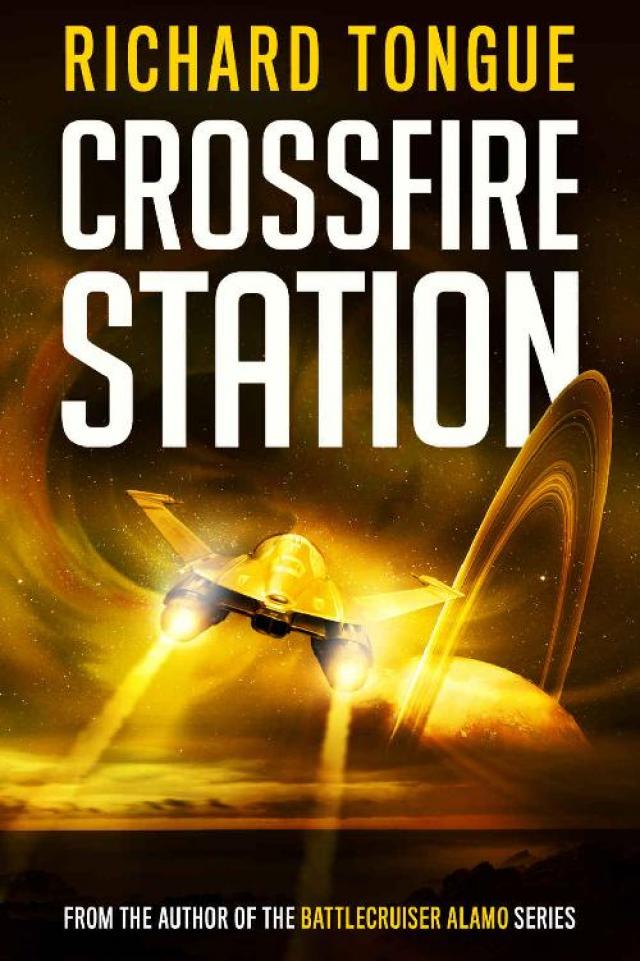
CROSSFIRE STATION
Richard Tongue
CROSSFIRE STATION
Copyright © 2021 by Richard Tongue, All Rights Reserved
First Kindle Edition: July 2021
All characters and events portrayed within this eBook are fictitious; any resemblance to persons living or dead is purely coincidental.
Prologue
Flight Lieutenant Max Quinn smiled as he cruised lazily over Goliath’s majestic rings, billions of particles of ice shimmering from the Altair’s white-hot light. He tapped a control to send his fighter diving down closer to the rings, ignoring the warning light that flickered on his heads-up display, alerting him to the increased risk of debris on his flight path.
The designers had been paid to be conservative, but fighter pilots were paid to take risks, and life was far too short to miss out on a spectacular view like this, his cockpit seemingly close enough to the Ring for him to touch it. He looked up at his trajectory plot, shook his head, then turned his ship back onto trajectory, tapping a control to engage the autopilot once more. He paused for a moment, nodded, then flicked another switch, soft jazz music starting to play from the overhead speakers, a perfect accompaniment to the ride.
Reaching underneath his couch, Quinn pulled out a metal flask and unscrewed the lid, draining the last of the coffee from the container. General Astronautics made the Cougar long-range scout fighter for deep recon, not for the comfort of its pilot, and after seven hours in the cockpit, it was beginning to show. For the hundredth time, he regretted having the warp tug drop him off on the far side of Goliath, but he’d figured a little time to himself before taking up his new assignment would be a good thing, and after a month on the ground, he needed the flight hours.
As the music played, he entered in a control sequence, the cockpit seeming to fade away as the holographic projectors engaged, seemingly setting Quinn floating in empty space, surrounded by a swarm of planets, moons and asteroids, a strategic representation of the local system. Back at the Academy, snapping on the holoprojectors was a favored practical joke to play on freshmen, but it served as a valuable test. Some just couldn’t take it, would usually end up dropping out, staying planetside.
Quinn had reveled in it, and he still did. He swept his arms around to bring Goliath into sharp relief, its entourage of moons and rings clearly on display. A distant world on the frontier of human space, one with potentially valuable mineral deposits, with a single space station home to a couple of thousand prospectors and support crews, owned by a consortium of the first colonial families to settle there, right at the end of the Nationalist Era.
Just one of a hundred outposts, each much the same as the others, scattered all around the Terran Commonwealth, each with its assigned Space Corps liaison officer, a great posting if you liked a quiet life.
Quinn didn’t. Which was the whole point. This was exile, and he knew it. Something to be endured. Though with views like that, it might not be quite so bad as he had first feared.
He turned off the holoprojectors and looked at the clock, then settled back into his couch, letting the music washing over him. In an hour, he’d be landing at Crossfire Station, could finally have a shower and a shave. Placing his flask back in its place, he watched the sensor track, a dozen targets working their way through the rocks, some of them mining ice from the rings, others heading to the closer moons, prospecting for the superheavy elements that had brought humanity out to Altair in the first place, almost a century ago.
His attention was caught by two contacts flying together, close to each other, running underneath the Rings on a course that would take them to the innermost moon, out of sight of the station’s sensor systems. Smugglers, or wildcat prospectors trying to steal someone else’s territory.
Quinn sighed, then targeted his long-range sensors at the targets. A few prospectors playing fast and loose with the law wasn’t going to do any real damage, but their courses were getting close to a couple of the freighters on approach to the station, close enough to represent a navigational hazard.
“Unidentified shuttles, this is Flight Lieutenant Max Quinn of the Commonwealth Space Corps. State your name and intentions, and prepare to transfer your flight data to my system. Over.” Only static replied, and after a minute, he repeated, “Unidentified shuttles, state name and intentions.”
Suddenly, their intentions became clear, the trajectory plot flashing red once again as the two shuttles altered course, swinging around a piece of ice to match his course and speed, setting up for an intercept. Quinn’s eyes widened as his hands worked the controls, sending the incoming sensor data through to the combat computers.
He whistled as the information streamed onto his screen. Someone had done an exceptional job of camouflaging late-model Hawk Assault Shuttles as old, beaten up survey ships, but the power curve was almost impossible to hide, especially if the pilots had murder on their minds.
Bringing his combat computer online, he glanced at his wingtips, a frown on his face. Commander Li had insisted he fly light, no weapons payload, stressing that it shouldn’t be necessary in a friendly system. Now he was about to go unarmed into a gunfight, a prospect that he didn’t savor at all.
“Crossfire Station, this is Lieutenant Quinn,” he said, his right hand working the communications system, trying to find an active relay link. “I have bandits inbound, bandits inbound, request assistance.”
Once more, only static answered his call. The signal was getting to the station, he was sure of that, but as far as he could tell, nobody was listening. Which meant that whoever was attacking him had low friends in high places.
Not that there would be much assistance in any case. Supposedly, the station had an orbital defense network in place, but it was nothing more than a collection of decades-old missile platforms, nothing with the range to knock any of these bandits out of the sky. He could spot the satellites on his sensors, some of them almost ludicrously out of position, but unless someone could arm and aim them, they might as well be just another piece of flying debris.
A smile curled across his face as realization set in. If the duty operator on Crossfire Station wasn’t willing to help him, there was at least a chance that he might be able to help himself. He fired his thrusters again, sending him drifting to the side, his trajectory drifting closer to the nearest missile satellite, a series of warnings flicking on his display to alert his proximity to restricted airspace. He tapped a control, bringing his tactical computer online, setting it the task of establishing a firing solution from the satellite, while he focused on getting control of the defense network from his fighter.
On paper, that ought to be impossible. Having said that, from what he’d seen, the local administration had badly neglected its defense network, and he could assume they were way, way behind on their software updates, and he’d topped his class at the Academy on Security Protocols.
He fired up his comm laser, catching the satellite’s input feed on the first try, then started his electronic warfare suite, targeting the launch systems. He’d be able to aim and guide the missile from the fighter. All the satellite had to do was let him launch one of its warheads.
The enemy ships were drifting into combat formation, lined up on a perfect attack run, right out of the manual. Interesting in its own way. A true professional would vary the approach, keep his opponent guessing, but these two were playing it safe and simple. Maybe they didn’t care, didn’t think that he posed enough of a threat to worry about, or maybe they didn’t know any better. One advantage he could exploit, potentially.
Tapping a control, he said, “Crossfire Station, Crossfire Station, this is Lieutenant Quinn. I am declaring a flight emergency. Reply at once. Over.”
There was no reply. He didn’t expect one. Nor was Crossfire Station even registering that there was anything wrong out here at all. All it took was one technician to throw a switch, and the installation would be rendered blind. Something to investigate once he reached his new duty station. Assuming he fought his way through in one piece.
The long-range sensors showed an exodus from local space, the prospectors who had been working the rings heading for safety as fast as their engines could carry them. Wise enough, under the circumstances. An amber warning lights winked on as he watched, the enemy getting closer and closer to firing range, targeting sensors working to obtain a missile lock.
His hands moved to the flight controls, throwing the fighter into a series of random evasive patterns, the trajectory plot ranging wildly back and forth, trying to throw off the enemy shuttles before they could launch. At last, he heard a dull tone, his tactical computer indicating that it had successfully acquired one of the bandits.
Now he just had to hack into the satellite to make use of it. He turned back to the electronic warfare controls, typing in one command after another, firing program after program to break through the defense network’s firewall. He could detect someone trying to stop him, to firm up the system security, but they were well behind, unskilled, and finally, he had full access, the firing controls switched over to his own system.
He let his fighter rock back onto its original course, still heading for a close flyby of the satellite before his approach to the station. There was no other traffic in the sky now, not for a million miles all around, every civilian ship making for safety with suspicious speed, as though they were a little too accustomed to dogfights in local space.
One shuttle seemed to be behaving differently, racing from the station and heading towards the battlespace. Quinn threw a sensor beam out towards the newly launched vehicle, frowning as he saw nothing other than a lightly modified General Dynamics Starcharger, one with some decidedly non-spec engines fitted, powerful enough that the shuttle’s reactor had to be struggling under the load.
“Pilot, this is Lieutenant Quinn,” he said. “Identify yourself.”
“Jack Esposito,” a wild, female voice replied. “I’m claiming salvage.”
“Salvage? What salvage?”
“Way I figure it, either you’re going to blow those bastards out of the sky, or they’re doing to do it to you. Either way, there’s going to be some mil-spec hardware floating through space in about ten minutes time, and I’m going to grab it before any of the other vultures have a chance.”
Quinn shook his head, and said, “I suppose it’s too much to hope that you might pick up any survivors of this highly profitable war.”
“Not at all, but you won’t like the fees I’ll be charging for pickup. Good luck, Lieutenant. Out.”
“Crazy…,” Quinn muttered, looking back at the tactical display. The two enemy shuttles were locked on their attack pattern, not even bothering with evasive action. Overconfidence, another weapon he could use against them. Not that he had many to play with. He watched the firing computer, the systems working together to select the optimum time to launch, working it to the last millisecond to increase the chance of a successful intercept.
Men didn’t fly fighters. Not really. They hadn’t, not for centuries. The pilot’s job was to manage to battle, to use all the tools at his disposal in order to outwit his opponent and win the day. Periodically, there were proposals to take the human out of the cockpit once and for all, let it all work on slaved automatic systems.
Then someone would come out with a new movie where evil robots slaughtered mankind, and the idea would be quietly shelved for another decade or so. Not that it would ever truly work. Even after centuries of work on the development of artificial intelligence, a smart, cunning pilot could still surprise the computers time and again.
Oddly enough, it was surprisingly difficult to program a computer with the level of insanity required of a top combat pilot.
An amber light flashed on his heads-up display, and a new contact flickered into life on his sensors, a missile launched by the first of the enemy shuttles. Early, right at the extreme limits of firing range. Quinn threw a series of switches to activate the countermeasures, weaving the fighter off to one side as a decoy dropped away to the rear, designed to appear more real to the incoming missile than the fighter itself.
Normally, he’d use his electronic warfare suite to hack into the missile, but that wasn’t an option, not while he was keeping the defense satellites slaved to his launch control systems. He watched the enemy missile approach, gaining speed, deftly drifting past the deployed physical countermeasures and setting up for a strike. All of this was going to come down to a matter of seconds, and he urged the combat computer to work faster, his hand poised over the override to launch his own salvo early, buy his defensive systems a few more seconds to do their job.
He resisted the temptation, and was rewarded by a half-dozen missiles launching from the defense satellite, sweeping past his fighter and heading towards the pursuing ships. With a wild smile on his face, he threw his ship hard to starboard, his countermeasures able to crack into the incoming missile, destroying it well short of its target, local space briefly illuminated by a ball of billowing flame where the warhead had once been.
Naturally, the enemy could play the same trick, but now he could defend the missiles with his own systems, firming up their firewalls and sending updated instructions to counter their attempts to crack into their systems. Then, at last, one of them gave up, turning away and racing down towards the ring, his wingmate holding course a second too long.
That served Quinn well enough. This way he’d have a chance to work out where the enemy ships were based, size up the strength of the opposition. He quickly fired updated commands to the missiles, instructing them to focus on the one remaining shuttle, hoping to fool the cowardly pilot into believing his craven behavior had been justified.
The remaining pilot, braver than his counterpart, died well. Two of the missiles had detonated short, but the remaining four were more than enough to finish the job, and the shuttle expired in a brief flicker of flame, scattered debris filling the sky in its place. The second shuttle continued its race to safety, speeding into the dark, but just as Quinn managed to get his navigation computer plotting its course, the coward’s ship exploded, his sensors recording a reactor overload that could only have one end.
Once more, the sky was clear.
Tapping a control, Quinn said, “Calling Crossfire Station. Calling Crossfire Station. I don’t know what sort of a place you’re running out here, but if I don’t get landing clearance in the next thirty seconds, I’m going to be forced to do something we’re all going to regret. Have your duty Traffic Control officer waiting for me at the landing dock. We need to have words. Out.”
Chapter 1
Quinn let his fighter slowly drift into position alongside the station, firing the briefest burst from his thrusters to lock onto the docking ring, finally hearing the load report that indicated that the two hatches had engaged, the mechanism grinding into life as the double locks slid open. He reached up to pull himself onto the deck, a grey-haired, frowning man wearing a beaten-up technician’s uniform waiting for him.
“You Quinn?” he said.
“Who wants to know?” the pilot replied.
With a grunt, the technician said, “My boss has the servicing contract for your fighter. He told me to check it out, especially after the fight.”
Rising to his feet, Quinn said, “I’m glad someone knew that there was a firefight going on out there. Now, what is your name?”
“Viktor Volkov,” he replied. “What’s it to you?”
“Well, if I’m going to be working with a man, I like to know at least a little bit about him, and it all starts with minor little details like that. Are you checked out on the Cougar Scout Fighter?”
“I’ve worked on them a few times. I’m the best you’re going to get out here, anyway.” He glanced at his watch, and said, “You’re late, though. Only got a few minutes before I finish for the day. You think it’ll wait a while? The boss doesn’t like paying overtime unless he has to, but if the Space Corps is going to foot the bill, that might be a little different.”
With a sigh, Quinn said, “Now, just out of purely academic curiosity, where is the Traffic Control Officer?”
“Probably in some bar by now.”
Raising an eyebrow, Quinn replied, “You’re going to tell me that this sort of thing happens all the time?”
Volkov shrugged, then said, “More often than it used to. A lot of the prospectors are getting hit out on the deeper rocks. Part of the price of doing business. You can pay them off, but sometimes, you know, people get kinda greedy, and I guess they end up paying the price.”
“My predecessor…”
“What predecessor? We haven’t had a Space Corps Liaison out here since I’ve been working this ring, and I’ve been out here for five years now. My boss ain’t happy he’s having to actually work this contract, by the way. I guess he figured it was money for nothing. You know how much that docking port of yours costs to rent?”
“I have a feeling that I’m going to find out, sooner or later.”
Glancing at his watch, Volkov said, “I need…”
“I think my fighter can wait until tomorrow morning,” Quinn said. “Though I want you to find some ordnance and give it a full combat overhaul first thing. Full weapons loadout.”
The mechanic frowned, and replied, “I’m not sure we’ve got any of that stuff around here. Might be in inventory somewhere, but…”
“You go ahead and tell your boss from me that it’s a fundamental part of his contract, and that I’d be forced to not only implement the cancellation clause but insist that all components and parts be immediately returned.”
Volkov’s eyes widened, and he said, “I’ll think of something.”


