

Almost There and Almost Not, page 29


For Kate
always there
1
Great-Great-Great-Aunt Eleanor was really named Elsie.
She won’t admit it, even though she’s little more than a bluster through a room, thin and gray and dusty enough to sneeze at. Eleanor, she insists. Hint of a British accent.
She was raised in Kansas.
I know about Kansas because of Dog.
Dog tells the truth. Or brings it to me, really. It’s not like he can talk. Living or not, he’s still a dog.
I tried to tell my not-so-great Aunt Monica about this once, and she nearly felt my forehead.
I don’t mention Dog anymore.
And I call the great-great-great-aunt Eleanor. What’s the harm? Dead people deserve whatever names they want, I think, though if I had my choice, I’d rather not wait until dying to rid myself of California. People make comments about a name like California.
“What was your mother thinking?” asks Aunt Monica.
“What indeed?” asks Eleanor.
“Watch it,” I warn the deader of my aunts.
Good thing about ghosts is they’re so much your elders, you don’t need to mind them.
That, and their swats go straight through you.
2
Maybe I gave the impression Aunt Monica is dead. She isn’t.
Her swats would make contact for sure, even though she’d have to do it left-handed, seeing as her right arm is bent-casted from finger to shoulder and slung in place. She says she tripped on the back porch steps, but something about the way she says it makes me doubtful it’s the whole story.
Still, I have to trust her. She doesn’t have a dog, so there’s no outside source of information.
The reason I am at Aunt Monica’s is because my mom, who named me, is also dead. Unlike Eleanor, she never visits, though. I wish she would. I have a lot of questions for her.
And because of my dad, too, who did his best for four years but needed a pause from the single-parent raising of an eleven-year-old girl and her need for bras and similar. He decided Alaska was a good place for earning money and a bad place for a bra-needing child, and so he put me and my couple of boxes in his truck and drove me to his sister-in-law Isabelle’s in Minnesota and after a couple of meals (meatloaf, warmed-up meatloaf, and meatloaf sandwiches) knew the Alaska jobs he was after would be all full up if he didn’t get there quick.
He has feelings about stuff like that.
Not the same kind of feelings as there’s-a-ghost-in-this-room feelings, but feelings, anyway.
His feelings weren’t quite right about Aunt Isabelle, though. She was not better at “girl things” than he was, and she didn’t think it a blessing to have some company, either. A week and a half after Dad left, my aunt Isabelle heard about her aunt Monica’s accident and put me and my couple of boxes in her car to see if I could be a blessing to someone else.
And Aunt Monica? Well, she isn’t the sort to have any feelings, as far as I can tell. But it’s only been a few days. Who knows what will happen? I’ve asked Dog, but he isn’t telling.
3
“Listen,” said Aunt Isabelle. She starts a lot of her sentences like that. As if you could avoid hearing her. “Listen, I thought this would be useful to you.”
She was talking to her aunt Monica and waving at me to unload the cooler we’d driven all the way from Minnesota. It was full of meatloaves—brick-size and wrapped in foil. The idea, she explained, was that every few days Aunt Monica could heat one up and be saved any trouble of cooking. Plus, making them had been good practice for her entry in the Minneapolis Meatloaf Cook-Off, which would be happening in the next month and for which she had secured an entry.
“Listen, with so much practicing and recipe experimentation ahead of me, you can see how I wouldn’t have enough room.…” She nodded in my direction just as I was putting the last meat brick in the freezer. You’re going to think I’m dumb, but I thought she was talking about the meatloaf.
Aunt Monica held up her noncasted hand, putting a pause on Aunt Isabelle’s chatter. “Perhaps you could go out back and take in the garden flowers,” she said to me.
Here’s another thing that might make you think I’m dumb. I know now that “take in” means “go have a look,” but when I stepped outside, I thought I’d find some potted plants that needed bringing into the house for the night. When I didn’t find any pots on the back porch, I kept looking, stepping out to the lawn and into the enormous garden Aunt Monica has bordering it. Back when her husband was alive, he kept it neat and careful, but in the last year so many weeds have sprung up, she says, it’s impossible to tell the uninvited from the invited.
Finally, in the farthest part of the yard, near the stone angel birdbath, I found a couple of holes in the garden dirt. There were some flowers tipped over next to them, roots exposed. I’m no gardener, but even I know tearing roots up like that can kill a growing thing, so I figured these must be the flowers Aunt Monica wanted taken in.
I headed for the garage, thinking I’d find a pot to put them in, when I heard a small, strange sound behind me—sort of a gasp and sort of a bark. I turned around and—zip!—just like that, this little streak of white bolted out of nowhere. It tore round and round the yard, half gasping, half barking, all motion.
It was a dog.
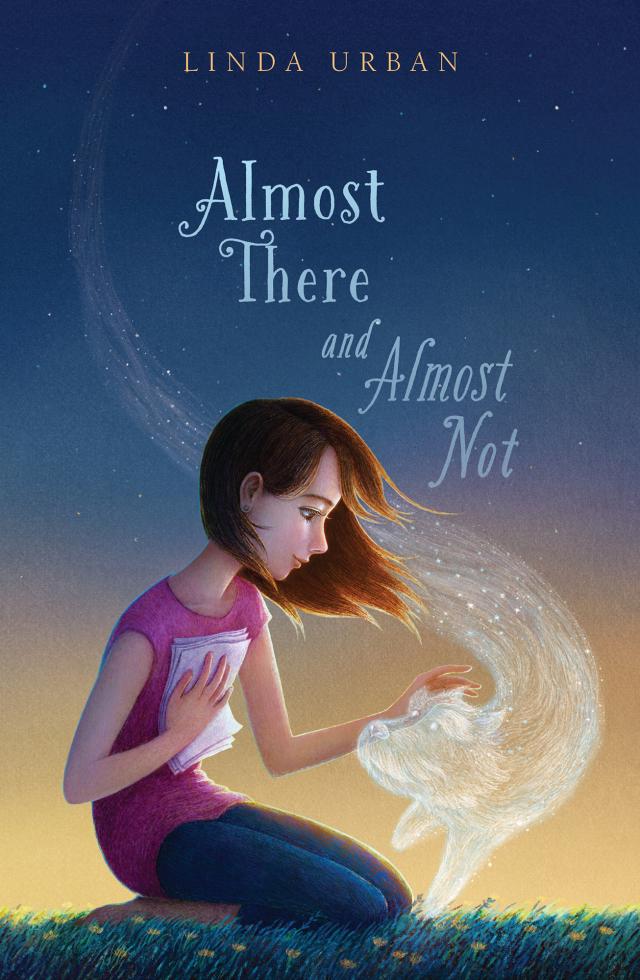
The fluffy, mischievous kind like Dorothy Gale had in the Oz movie, but entirely white, tip to tail. When he finally slowed, I could make out a pair of black-coffee eyes under all that floppy fur, and front paws dark with mud. He was doing a strange thing with his tongue, pushing and pushing at the roof of his mouth like he’d gotten into a peanut butter jar.
“Need some help, dog?” I asked.
The dog cocked his head like I’d surprised him. Like an eleven-year-old girl actually speaking to him was the last thing in the world he’d expected. He spun around a few times, wagged his stump tail, and spit out the thing that had been bothering him.
It was a scrap of paper, rough and torn-edged. In between the soil and the slobber on it I could see writing.
“Have you been in somebody’s trash?” I asked. The dog didn’t answer, of course, just sat there looking pleased with himself. “People get rid of things for a reason,” I told him.
The dog had a shimmery quality that I now understand is part of being from the passed-on world, but right then I thought it was a trick of the light, the sun going down the way it was. I held out my hand to let the dog sniff it, which he did, and to offer an ear scratch, which he dodged.
“I’m not going to hurt you,” I told him, but the dog was not convinced. He barked a few times more and then, tail still wagging, darted away fast as he had come.
I had forgotten all about the flowers by then and bent down to pick up the trash the dog had left. The writing on it was cramped and uneven, like a little kid’s, but there was something old-fashioned about it, too. I studied the page, giving it so much undivided attention my fifth-grade teacher, Miss Tenzing, would have beamed proud.
Which is probably why I didn’t hear Aunt Monica’s front door open or close. Or the trunk of Aunt Isabelle’s car creak open, or any boxes get carried inside the house. If there was an argument between my aunt and hers, I didn’t hear that, either.
I didn’t hear anything until Aunt Isabelle’s car engine rumbled on and her favorite singer, Glen Campbell, started crooning out the speakers, promising that the Wichita lineman was still on the line.
I listened then.
Heard the windup sound of a car in reverse.
The shifted pitch of that same car driving away.
Glen Campbell’s promises getting fainter and fainter.
I listened and listened and listened, long past there being anything to listen to.
4
Aunt Monica called me inside after that. Had me stand up straight in front of her and turn around a couple of times, like she had to see the whole of me to understand what had just happened to her.
“Can you drive a stick shift?” she asked.
“I’m eleven,” I told her. When you are tall and need a bra that is not just for training, a lot of people expect you to do stuff you can’t. Like in fifth grade Miss Tenzing expected me to be a Class Leader and not do all the stupid stuff that other kids do.
I do a lot of stupid stuff.
I feel like I should warn you about that.
Miss Tenzing got impatient with me at first about the stupid stuff, like falling asleep in Language Arts and swiping the good parts out of other people’s lunches, and also about my printing, which she said looked like someone had broken all my hand bones and replaced them with chicken feet.
To be fair, she only said the chicken feet thing once, and that was before the Official Meeting. At the Official Meeting her face turned kind of pale and sorry. And after that she had me eat lunch with her sometimes and showed me this special pen she had with a slanty silver tip and how you could dip that slanty silver tip into a bottle of rich blue ink and make the prettiest letters just by learning a few different kinds of lines and taking your time on it.
Mostly, I’m not so great at taking my time on stuff, but this was different. I learned about making slow downstrokes and slow upstrokes and curves and swirls that look like speed itself, but they take time too. You ever see a picture of the Declaration of Independence and the fancy writing on that? I don’t write as fine as any Founding Father, but by the end of the school year I wasn’t making chicken foot writing anymore. And Miss Tenzing ha
Anyway, I told Aunt Monica how I couldn’t drive. And then I had to answer how I couldn’t cook and wasn’t too good at cleaning, either, and then, for the first time, Eleanor dusted into the room.
“Pray tell, what are your talents?” she said.
Now, I can’t really tell you why, when Eleanor showed up, I didn’t run or jump or scream or say something to Aunt Monica. It’s not like I’d had prior ghost experience.
It’s just that, maybe, living with my dad for so long, I’ve gotten used to strangers popping up out of no place. A lady friend or a guy from work who’d had too many and needed a couch to sleep on. Sometimes my dad introduces me and sometimes he just says “Don’t mind him.” Either way, I understand these people won’t be around long, and once they’re gone, we won’t mention them again. They didn’t even come up during the Official Meeting. We just talked about me cracking against the kitchen counter like the force behind that was my own.
Or maybe Eleanor’s accent was so intimidating I barely noticed her being transparent. Anyway, she showed up and asked what my talents were, and all I could do was answer.
“I can do calligraphy,” I told them both.
Aunt Monica looked doubtful, but my boxes were right there in the kitchen, so I fetched out the pen that Miss Tenzing gave me on the last day of school and the blue bottle ink and the pad of paper with the pale gray lines, and I wrote out the first thing that came to me, which was a few of the words on that scrap of paper the little white dog had dropped at my feet. I wrote them slow and careful and beautiful as a talent show envelope.
Elsie Cooper has nits.
5
People respond to talent in unpredictable ways.
Eleanor saw my writing and lost her composure.
Those were the words she used later. “Forgive me, I lost my composure.”
Which turns out to be another way of saying “dissolved into a pile of dust.”
There’s a lot of things that can make a dead old lady lose her composure. Like if you accidentally forget the word “composure” and say instead that you’re sorry you made her decompose.
Pffffttt! To dust you shall return.
That’s the Bible, if you don’t recognize it. Mostly, I don’t recognize Bible stuff, but that one I know, along with “Do Unto Others” and “Suffer the Little Children” and “Jesus Wept.” I wrote them all out in calligraphy one time on a scroll and gave them to my dad to hang on his bedroom wall. Not sure where that scroll is now.
Aunt Monica, though, she had a whole different response. She didn’t smile or anything, but when I asked if my calligraphy talent might be useful, she ducked her head into something like a nod.
“More useful than meatloaf,” she said. She pushed herself out of her kitchen chair then and made for the room I now know is the study. I followed, not knowing what else to do.
* * *
The study is a dark, brown room with a brown leather sofa and brown leather cushions on the chairs and floor-to-ceiling bookshelves. There was a white cardboard box on the floor under the desk, about the same size as the one I packed my clothes in, except hers had IMPORTANT—FAMILY written on it, and one of the corners was crunched up like it had been dropped from a fair height.
She pointed to a row of books on a high shelf and asked me to take one down, being careful not to disturb anything else. She had particular concerns about me disturbing a gray shoe box, and she held her good hand to it, just in case.
She needn’t have worried. I’ve been getting things off high shelves ever since I sprouted up a year and a half ago. If Eleanor had been there, I might have told her it was another of my talents, but she was still a dust pile on the kitchen floor, so I stayed quiet.
Aunt Monica did another of her half nods toward the book in my hands. “You may consider that copy yours,” she said, “while you are here.”
The book was called Proper Letters for Proper Ladies. It was old, with a pale blue cover and silver title writing, the Ps and Ls of which were so swirly and fine a Founding Father could have written them. Didn’t, though. The inside page says it was first published in 1922, which is a good deal later than the Declaration days. Also, on the inside page it says the author’s name, Eleanor Fontaine, which if you’re smarter than me, you already figured is the name of the ghost lady I’ve been telling you about.
Turns out that Eleanor Fontaine was Aunt Monica’s great-aunt by marriage, and at one time she had been famous for knowing all about letter writing and party throwing and having proper manners, which seems like kind of a strange thing to be famous for, if you ask me. Anyway, Aunt Monica was working on a biography about her. Or was going to, just as soon as she got her cast off. Meanwhile, she supposed, I could help her contact a few libraries to see what materials they might have about Eleanor and her past.
“If you’re going to be of any use to this project, you should be familiar with at least one of the Fontaine texts,” Aunt Monica said.
I guess I had one of my more stupid looks on my face, because Aunt Monica cocked her head at me, like that little Toto dog had. “You can read, can’t you?” she asked.
I can read. I might not be the fastest reader ever, but I can read. “I’m eleven,” I reminded her.
“Yes,” she said. And then she said how it was late and she was tired and could I carry my own boxes down to the guest room and good night.
For a tired lady she was out of that room fast.
“Good night,” I called after her.
When I got my boxes from the kitchen, I also said good night to the dust pile.
I might not be famous for it, but I have manners too. When I need them.
6
I tried reading that book. I did.
I took it to Aunt Monica’s guest room—which, I have to tell you, is sort of no-colored and blank-looking and more like a place you’d have an Official Meeting than someplace you’d want guests settling in. There aren’t any pictures on the walls, or on the bedside table, either, and the bed pillows are angled sharp on each other like a store display.
There’s a little no-color desk in the guest room too, and it seemed like sitting at that would make less of a disturbance than messing with the pillow arrangement, so I sat down there and opened Proper Letters for Proper Ladies to the Foreword page, and I tried reading that book.
Blah, blah, blah, blah insults or betrays the blah, blah, blah, blah, blah Fontaine.
That’s the first sentence.
Okay. Not exactly.
Here’s the real first sentence:
Contemporary correspondence need not spark dread nor send the inexperienced into tizzies, fearing a gaffe in style or custom which insults the receiver or betrays the writer as a rube, since charming, artless, effective letter writing is within reach for all who consult this most recent of Mrs. Fontaine’s guides to poise and propriety.
I had to read that sentence four times before it made any sense at all. Just in case you don’t have patience for four-time reading, it mostly says, “Don’t worry if you don’t know how to write letters, this book will teach you.”
Even if a person does have patience, they should not have to read a sentence four times.
A sentence should be written so a person can understand it right off. Maybe a second read if you get distracted by a television or some talking, or if you can’t help thinking how you’re in a strange room in a strange house and wondering how far away Alaska is.
But not four times.
A four-times sentence like that will set a person to detonate.
That’s what Miss Tenzing used to call that feeling you get where you have to move or shout or throw something. After the Official Meeting we made a whole secret hand signal about that feeling, and if I made the signal, she would send me on an errand to the school office or the library so I could walk it out a little.


