

Defending the Truth, page 1
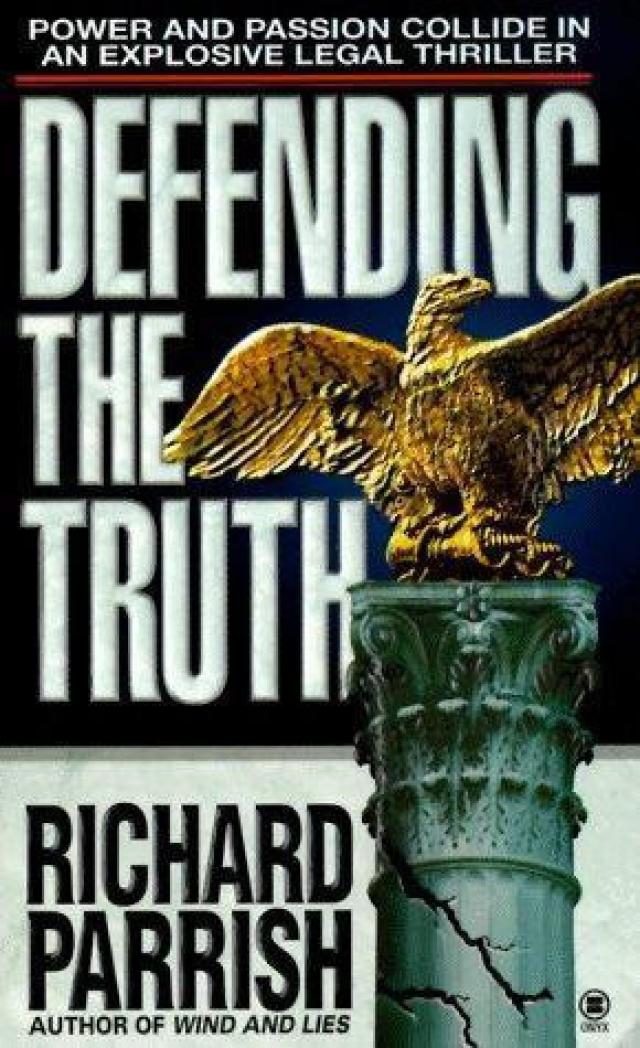


DEFENDING
THE TRUTH
Richard Parrish
First published by
Penguin Books
April 1998
With America caught in the throes of a national crisis, attorney Joshua Rabb goes against the tide of public opinion to take the case of a Tucson professor accused of traitorous activities. As the truth and the law collide, Rabb is swept into a vortex of vicious lies and violent intrigue.
First, a trusted friend dies under suspicious circumstances. Then Rabb’s own daughter is arrested and charged—with the cold-blooded murder of a U.S. marshal. With everyone he loves at risk, Rabb faces his most formidable courtroom challenge yet. In his desperate search for the truth, Joshua Rabb is about to discover that patriotism makes the perfect cover for greed, treachery, and betrayal…and that justice can be the most dangerous ideal of all.
UNDER THE GUN
The two young FBI special agents slowly approached the truck from both sides of the cab, their revolvers drawn and pointed toward the driver.
The students slowly emerged. Hanna climbed off the bed of the pickup, shuddering, and lay facedown on the asphalt with the others.
Joshua ran toward his daughter.
The FBI agents ordered the five students off the ground, to lace their hands behind their heads, and to walk single file into the federal building. Hanna passed by her father, her mouth open, her eyes wide with terror.
“You’ll be okay,” Joshua said, trying to look and sound assured.
Her eyes twitched for an instant, and then she was gone.
Also by Richard Parrish
Our Choice of Gods
The Dividing Line
Versions of the Truth
Nothing but the Truth
Wind and Lies
Abandoned Heart
Dedicated to
Robert B. (“Buck”) Buchanan
Judge of the Superior Court,
Pima County, Arizona (Retired)
Bernardo (‘Bernie”) Velasco
Judge of the Superior Court,
Pima County, Arizona
W. Randolph (“Randy”) Stevens Assistant United States Attorney (Tucson)
Michael Brink
my stepson
Joshua Parrish
my son
whose names I purloined for
five central characters
in the Joshua Rabb novels,
and, of course, to
Pat
ACKNOWLEDGMENTS
The words attributed to Senator Joseph McCarthy are either his actual words or close paraphrases as reported in Robert Griffith’s The Politics of Fear, and Thomas C. Reeves’s The Life and Times of Joe McCarthy.
Quotations from the Hebrew Scriptures are paraphrases of Psalms 94 and 119, an amalgam of the King James version and my own translation, essentially limited to modifying the archaisms.
In June 1950, Senator Margaret Chase Smith (R-Maine) and five other Republican senators published their “Declaration of Conscience” in which they said that they did not wish to see the Republican party ride to victory in the 1952 elections on “The Four Horsemen of Calumny—Fear, Ignorance, Bigotry, and Smear.” They deplored the tactics of Joseph McCarthy, which had “debased [the Senate] to the level of a forum of hate and character assassination sheltered by the shield of congressional immunity.”
The Lord is my defense, my God is the rock of my refuge.
And He shall bring upon my enemies their own iniquity
and shall cut them off in their wickedness.
—PSALM 94
Prologue
“Every man of decency here today should praise God that we have Joseph McCarthy in the United States Senate, our moral guardian, to protect us from the godless Kremlin puppets who are conspiring to corrupt and destroy our great nation from within.”
Senator William “Big Bill” Maitland waited for the roar of approval to die down.
The Republican party leaders had gotten the rank and file out for McCarthy’s stop on his way back to Washington, D.C., and “Big Bill” was milking a willing crowd gathered in the square in front of Arizona’s State Capitol building in Phoenix.
“Tell ‘em good, Bill, you tell ‘em!” came a shout from the crowd.
The late May sun beat brutally down on the men on the dais, dressed in dark wool suits and white shirts, and the scent of starch and sweat hung in the burning air. Senator McCarthy mopped his face with an already soiled handkerchief. Senator Maitland was much more accustomed to the heat, but his two hundred thirty pounds brought beads of sweat rolling down the sides of his face.
“I give you one of the greatest patriots this country has produced since George Washington: Joseph McCarthy.” Maitland clapped as the standing audience of at least five hundred men and a few women erupted in cheers. A small band played “The Star Spangled Banner,” and McCarthy stood beaming out at the crowd from the lectern.
“With great men like Dick Nixon and Barry Gold-water and Big Bill Maitland out here in the West,” McCarthy said, “I’m not needed here. It’s time I get back to Washington and drive the Commiecrats out of the State Department.”
The cheering of the crowd drowned his voice, and he basked silently in the adulation.
“The Communists, dupes, and fellow travelers who are prisoners of a bureaucratic Frankenstein must be ferreted out of the Truman administration and exposed before they turn this country over to Moscow. The parlor pinks and parlor punks must be destroyed before they rot our way of life.”
More cheers and band playing. McCarthy waited patiently. Then he waved an inch-thick sheaf of papers in the air.
“I have here in my hand a list of two hundred and five names that were made known to the Secretary of State as being members of the Communist party and who nevertheless are still working and shaping policy in the State Department. That dilettante diplomat Dean Acheson whines and whimpers and cringes in the face of communism. And those egg-sucking Democrats in the Truman administration, with all their pitiful squealing, hold sacrosanct those Communists and queers who sold China into atheistic slavery. I pledge myself to the task of driving out the prancing mimics of the Moscow party line in the State Department.”
Maitland was on his feet clapping. The crowd bellowed its approval.
Someone close to the dais called out, “Read us some names on that list, Senator.”
The crowd grew quiet.
“These are dupes of the Kremlin who spew its malignant smear,” McCarthy said, waving the sheaf of papers.
“Come on, Senator, let’s hear the names.” It was a newspaper reporter, pen in hand, in the front row of spectators. “You said the same thing in your speech in West Virginia, Senator, but you only came up with fifty-seven names in your Senate speech last February.”
“You sound like one of those reporters who works for the Phoenix Daily Worker or the Los Angeles Urinal.”
The crowd exploded with laughter, and even the reporter joined in.
“Well, boys,” McCarthy said, “I’ve got to be leaving you now. There’s work to do back in Washington. I leave you in the able hands of my friend and colleague Big Bill Maitland.”
Maitland joined him in front of the lectern, and the two men clasped hands and raised them high in the air like victorious presidential and vice-presidential candidates at a nominating convention. The band played “The Star Spangled Banner.”
Chapter 1
The setting sun broke under the curtain of billowy white clouds hovering over the Tucson Mountains, and a spoked wheel of yellow and orange fire ignited the canine-toothed crests. Joshua Rabb drove east on Speedway Boulevard for three or three and a half miles, and everything looked familiar in this town that had been his home for almost exactly five years; small two-story Victorian houses of desiccated wood under cracked and peeling paint, little stucco houses, boxy and painted tan or whitewashed, tiny Mexican-style adobes. Around the houses were drooping petunias, withered purple and yellow pansies, prickly pear and cholla and barrel cacti, eucalyptus trees sloughing off their grayish bark in strips, their leaves turning brown on the tips in the 105-degree heat, and an ornamental orange tree here and there, with parched forest-green leaves and limp limbs barren of fruit or blossoms or buds.
He turned south on Country Club Road, where there was no country club, but the houses began to get pricier. And a few blocks later he turned left on Fifth Street and entered a place that didn’t look at all like the rest of Tucson. It looked like a desert oasis from one of those fanciful Hollywood Arabian Nights movies, lush and verdant, impervious to sun and wind, insulated by wealth and water sprinklers from the rest of the world.
He drove down Camino Español, and suddenly the dust and mold were gone and the smell was of roses and star jasmine and lilac, and he drove past luxuriant lawns of bright green grass in front of massive, two-story redbrick Georgian mansions surrounded by weeping junipers and Elderica pines that looked like huge Christmas trees. There were tall Santa Fe-style ranchitas with huge pine vigas extending through the tops of the white or tan or rust-colored stuccoed front walls, surrounded by carefully coiffured mesquites and palo verdes and red roses and blue and orange and white hibiscus. There were tennis courts behind or beside many homes and olympic-size swimming pools radiant and cerulean in the reflection of the pellucid sky.
In the center of this area on Tucson’s far east side, called El Encanto, the Goldbergs lived in a two-story colonial mansion, like a Louisiana plantation house transplanted from the edge
There were a dozen shiny Cadillacs parked in the asphalt circle drive, two old, distinguished Packard touring cars, a royal blue Cord, a gull-wing Jaguar, and two MG-TDs.
And there was a conspicuous yellow 1946 Chevrolet convertible, snazzy and sharp when it was new five years ago, but now dulled by the inhospitable sun and rain, and rust had supplanted the paint in a few dented places. The once-white top was gray with age. The passenger seat had a burn hole where Edgar Hendly had once dropped his cigarette. The steering wheel was fitted with a special knob that could be latched on to by the stainless-steel prongs of a prosthetic hand.
There was no more room in the circle drive, and Joshua parked on the street. He opened the car door for his wife Barbara, and they walked into the house through a tall cherrywood double doorway. The entry-hall floor was squares of pale peach-colored Italian quarry tile. Off the entry hall was a spacious living room, cream wool carpeted and furnished in beige satin upholstered furniture; the den had polished knotty cherry-paneled walls, a floor of the same wood planks, a stone fireplace, and oak-tanned leather sofas and chairs. A Persian carpet covered much of the flagstone floor of the dining room that seated twenty-four in mahogany Chippendale armchairs with ball and claw feet around a one-piece walnut burl table handmade in Minnesota. The last room off the hallway was a radio and television room with a dozen classic old cabinet radios lining the walls and a TV set in front of a long sofa.
A liveried butler carried around a silver tray with full flutes of champagne. Joshua took one, but Hannah didn’t even notice the tray. She scowled at her father.
“How could you be so blasé?” Her voice was full of hurt.
“So what?”
“Come on, Daddy. You know what blasé means.” She scowled at him.
“Please try to enjoy yourself, honey. Your lower lip is hanging so low, someone’s going to step on it.”
“That’s real cute, Dad. Avoiding the subject as usual.”
“Take it easy, honey. Enjoy the party. We’ll talk later.”
“I can’t take it easy. And how can I enjoy Mark’s graduation party when I’m going to lose him in two days? I want to talk now.”
Joshua frowned and shook his head with frustration. “Okay, let’s go into the TV room where everybody doesn’t have to hear us.”
They walked out of the bustling living room down the hallway to the TV room. Joshua closed the door behind him, switched on the overhead lights, and they sat down on the sofa in front of the television set. It was on, the sound turned down, but neither of them even noticed it.
“If this is the same thing about getting married, I haven’t changed my mind,” Joshua said, his eyes soft and his voice as gentle as he could make it. He took a sip of champagne, but suddenly it had no taste.
“But you’re wrong, Daddy.” Her eyes were filled with tears again, an ever ready spring that had begun flowing when Mark Goldberg had been commissioned a second lieutenant after four years of serving in the Reserve Officers’ Training Corps at the University of Arizona. Just two days later, only a week ago, he had received orders to report to Camp Pendleton near San Diego.
The Korean War had been raging for almost a year, and there was hardly ever any good news about it.
Body bags were arriving back in the States by the tens, the hundreds, the thousands, and the letters from Chuy Leyva were devoid of the heroics and brave talk of a John Wayne war movie. Chuy had been a sergeant in the marines in World War Two and had been recalled to the marines ten months ago, in August 1950, a month after the United Nations “Police Action” began under United States command.
Chuy had been field-promoted to second lieutenant after his battalion had suffered huge losses when the North Koreans and the Red Chinese had captured Seoul, the capital of South Korea, in January. His letters to Magdalena and occasionally to Joshua and Edgar were chillingly filled with uncertainty and foreboding.
“I’m not wrong about this, Hanna,” Joshua said as gently as he could. “I’ve been in a war, and I didn’t know if I was going to come back. You and Adam could have been orphans.”
“It’s not the same, Daddy. All we want to do is get married so we can be together until Mark leaves.”
“And what if you get pregnant, and then you get a telegram from the Defense Department that tells you how much they regret that you’ve just become a widow?”
She wept for a moment, sniffled, and blew her nose softly into the handkerchief that she was wringing in her hands. “At least I’ll have a piece of him for the rest of my life.”
Joshua swallowed and willed away the tears that pressed against his eyelids. “That’s a wonderful, loving idea now,” he said gently. “But you’re only nineteen years old, and it wouldn’t be so wonderful two years from now, three, ten, when you were raising your baby all by yourself.”
She looked at him, her eyes tormented. “I pray to God every night that this is just a bad dream and to keep it from happening. And then I wake up and it’s still real.” She dabbed at her eyes with the handkerchief and sat a moment in silence.
“Why does there have to be a damn war, anyway?” she mumbled. “Everybody says it’s just crazy. Truman replaces General MacArthur two months ago just because he wants to win, and now what do I do? Stay nice and calm while they send Mark over there to get killed for nothing?”
She began sobbing, and Joshua rubbed his eyes hard to force away the tears.
“We have to fight communism,” he said, the words sounding just a bit hollow in his ears, like a politician running for office. But it was nonetheless what he believed, what virtually everyone believed. But still, fighting a war of “containment” that no one any longer expected to win, this was something new, something ominous.
“I know you’re not happy about Mark being sent overseas, and neither are any of the rest of us. But it’s his duty, and it’s for our safety.”
Hanna bit her lip and breathed deeply. “It should never be anyone’s duty to die in a stupid war.”
Joshua put his good arm around her shoulders and held her closely. His own tears fell on her auburn hair. They sat unmoving for minutes.
“He won’t die, Hanna.” But as he said the words that were supposed to comfort her, they rang obscenely in his own ears. Had he magically been blessed with the gift of prophecy? Was he the elect of God who could guarantee good health and a rich life to whomever he chose? Or were the words just hollow bullshit?
“And what if he comes back like you, Daddy?” Hanna said. She looked fearfully at him, and her gray-hyacinth eyes moved to his left shoulder and down to the stainless-steel prongs where once his hand had been. Then they flickered back to his face, and tears came again in a gush. “I’m sorry I said that, Daddy, I’m so sorry,” she said breathlessly.
“Go enjoy the graduation party,” he said, his voice soft.
She sighed deeply to compose herself. Her eyes were bloodshot, and mascara had bled to the tops of her cheeks. She took a compact out of her small handbag, examined her face, and frowned.
“Better go to the bathroom and fix my face before anyone sees me.” She left the room. Joshua sat on the overstuffed sofa and stared at a television show he had never seen before and didn’t know the name of. Only a few wealthy Tucsonans had television sets, since Arizona’s only TV stations were in Phoenix, and to access their broadcasts you had to have an expensive, fifty-foot-high antenna next to your house, which constantly needed expert repair because of wind damage.
Joshua felt nauseated. The chiaroscuro images on the twelve-inch screen of the Zenith television set were only the flickering background figures in his mind’s eye. With his good hand, he touched the aluminum shaft that hung from the leather harness on his left shoulder. He winced and closed his eyes tightly and gritted his teeth, but he couldn’t push away the nausea and despair. Ghosts danced in front of him.





