

The Rebels of Vanaheim, page 1
part #4 of Marvel Legends of Asgard Series


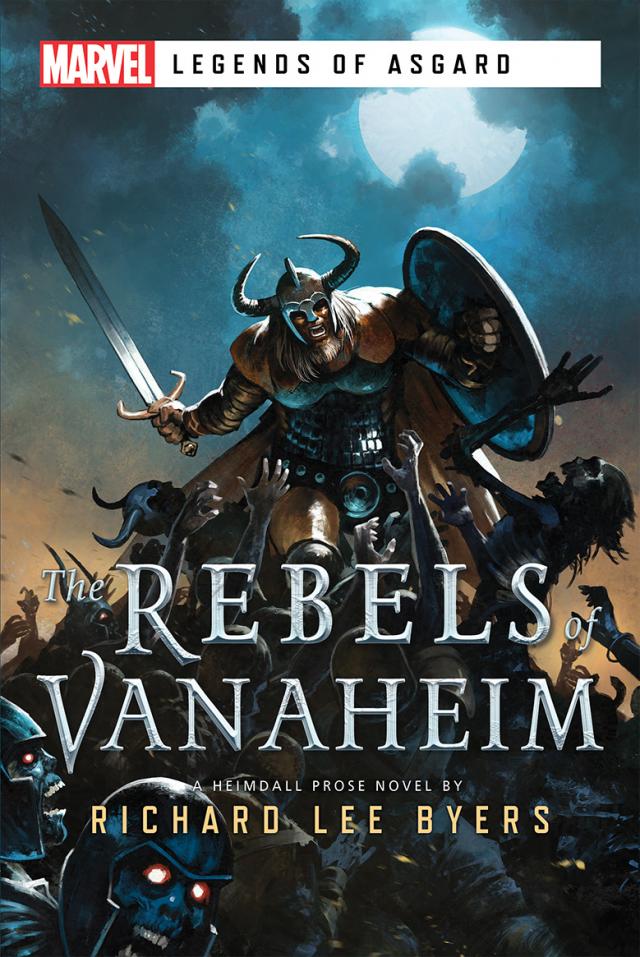
The Rebels of Vanaheim
The draug heaved itself out of the sea. Its flesh was ragged, and in some places bone showed through gaps. Slimy bits of it fell away to patter on the deck along with the seawater dripping from its limbs. Where the head and neck should have been, rising from a ragged hole in the torso, was a clump of seaweed, the lamina stirring as though still floating in some phantom current.
Beholding the bizarre sight, Heimdall faltered. Strings of rotted flesh flopping around its upraised half-skeletal hands, the draug pounced like an arrow flying from a bow.
Only Heimdall’s years of training and battle experience saved him. His two-handed sword caught the dead man in the chest, cracked exposed ribs, and halted its charge. But the draug showed no signs of being hindered by the new wound. Taking a deep, steadying breath of salt air, Heimdall insisted to himself that was no reason for panic…
FOR MARVEL PUBLISHING
VP Production & Special Projects: Jeff Youngquist
Associate Editor, Special Projects: Caitlin O’Connell
Manager, Licensed Publishing: Jeremy West
VP, Licensed Publishing: Sven Larsen
SVP Print, Sales & Marketing: David Gabriel
Editor in Chief: C B Cebulski
Special Thanks to Wil Moss
© 2021 MARVEL
First published by Aconyte Books in 2021
ISBN 978 1 83908 087 4
Ebook ISBN 978 1 83908 079 1
This novel is entirely a work of fiction. Names, characters, places, and incidents are the products of the author’s imagination or are used fictitiously. Any resemblance to actual events, locales, organizations or persons, living or dead, is entirely coincidental.
No part of this publication may be reproduced, stored in a retrieval system, or transmitted, in any form or by any means, electronic, mechanical, photocopying, recording or otherwise, without the prior permission of the publishers.
This book is sold subject to the condition that it shall not, by way of trade or otherwise, be lent, re-sold, hired out or otherwise circulated without the publisher’s prior consent in any form of binding or cover other than that in which it is published and without a similar condition including this condition being imposed on the subsequent purchaser.
Cover art by Tomasz Jedruszek
Distributed in North America by Simon & Schuster Inc, New York, USA
ACONYTE BOOKS
An imprint of Asmodee Entertainment Ltd
Mercury House, Shipstones Business Centre
North Gate, Nottingham NG7 7FN, UK
aconytebooks.com // twitter.com/aconytebooks
For all my friends in the Gen Con Writer’s Symposium
Prologue
The house was built of vertical planks, had a thatched roof, and was supported on the outside by sloping posts. It was one of many such homes that had grown up beyond the towering walls of the royal city of Asgard. Odin’s capital had grown since its founding, and there was no longer room for new homes within. Hogun waited for Gunhild on the gravel path lined with purple rosebay flowers that ran up to the door.
Gunhild was a skinny little girl with narrow, thoughtful blue eyes, a snub nose, and her pale blonde hair done up in braids. When she saw the stranger awaiting her on the path, she faltered.
That, Hogun supposed, was understandable. He knew he cut an intimidating figure with his dangling black mustachios, dark clothing, and the heavy mace in his hand. His appearance was part of the reason people named him “Hogun the Grim”.
“It’s all right,” he said. “I’m a friend. Your mother’s brother was hurt in a hunting accident. A wild boar gored him. Your parents had to run off to see him, and I volunteered to watch you after you came home from your lessons.” He tried to smile, and as was often the case, the expression felt unnatural on his face.
In fact, his account wasn’t quite accurate. He’d been inspecting a section of Asgard’s fortifications with Gunhild’s stonemason father when the man’s wife came scurrying up all in a panic. Once she made it clear she wanted to rush off to see the injured brother forthwith, Hogun had offered to find someone suitable to mind the child.
It should have been easy enough, but somehow wasn’t. If he’d had the household full of personal servants to which his status as one of the Realm Eternal’s finest warriors entitled him, he could have sent one of them. But he preferred to live simply, alone with his thoughts when he retired to his utilitarian quarters, and now he was suffering the consequences. With the end of the school day rapidly approaching, he’d had to come to look after Gunhild himself.
He consoled himself with the reflection that it was only for one night. Surely he could foist off the task on somebody else come morning.
Gunhild eyed him for another moment, and then something, his explanation of his presence or perhaps even his attempt to force a smile, seemed to persuade her of his bona fides. “Is Uncle Varick going to be all right?” she asked.
“Yes,” Hogun said, reckoning that if the man hadn’t died on the spot, it was probably so. Asgardians were resilient, and their healers were skilled. “Come inside.” He tramped to the door, and she trudged after him.
The long structure had twin rows of posts holding up the ceiling, benches along the walls, and chests tucked under the benches for storage. The front half was all one open space, but partitioning provided a measure of privacy toward the back. Hogun took a glance around and then considered the little girl glumly peering up at him.
“Did you bring work home from school?” he asked.
“No,” she said.
“Do you have chores to do?”
“No.”
Inwardly, Hogun winced. For a moment, he wondered if he could send Gunhild to bed, but of course that was preposterous. It wasn’t even suppertime yet, let alone bedtime. He was going to have to try to entertain the child, a task for which he felt ill-suited due to both temperament and lack of experience.
“Do you have a ball?” he asked. “We could go back outside and throw it back and forth.”
She shook her head. “I mean, I don’t feel like it.”
“Well, how about a hnefatafl set? Or dice?”
“I don’t feel like that, either.”
“We could play the question game. What am I thinking of?”
Gunhild sighed. “Is it a mace?”
Hogun gaped at her. “How could you guess it right away?”
“You glanced at the one in your hand as you were talking.”
“Well… very clever. All right, it’s your turn to pick something and mine to guess.”
“Do we have to?”
Hogun scowled in vexation, but after a moment that feeling gave way to puzzlement. As he and Gunhild’s father inspected the royal city’s ramparts, the builder had often chattered about his family. The merry, lively daughter he’d described bore little resemblance to the dour child before him.
“I truly do believe your uncle will be all right,” Hogun said, “and your mother and father will come home as soon as they can.” He paused and continued tentatively, “I think it wise to stay home, in case your parents do return with news.”
“I know,” Gunhild said, but her demeanor remained as cheerless as before.
Hogun’s impatience came surging back, and he took a long, steadying breath in an effort to keep it from showing. “Then what ails you? Tell me, and I’ll help you if I can.”
His words made the child look a bit guilty. “I’m sorry. I just have something on my mind.”
“If it’s not your uncle, then what?” Hogun realized that, despite his attempt to seem otherwise, he still sounded annoyed. He felt his own flicker of guilt for that and tried again to soften his voice. “If you tell me what’s wrong,” he reiterated, “maybe I can help you sort it out.”
She looked him up and down all over again, sizing him up anew. Eventually she said, “You’d have to swear not to tell anyone.”
“I swear it on my honor as a warrior of Asgard,” he replied. “I swear it by Gungnir, the spear of the All-Father himself. Now, come sit down and tell me what’s the matter.” He sat on a bench. She flopped down beside him and frowned as she put her thoughts in order.
“I have these friends,” she said at length.
“Of course,” he said, to encourage her to continue. Even he, as irascible and taciturn a man as he knew himself to be, had friends, and good ones, too: Volstagg, Fandral the Dashing, and even Thor the God of Thunder among them.
“Girls and boys I know from school,” Gunhild said. “There’s also this man named Yonas. He’s grumpy and mean. He won’t let anybody come on his land.”
Well, it is his land, Hogun thought, but what he said aloud was, “Why not?”
“He says it’s because his land borders the edge of the world and he doesn’t want anybody falling off. But we think it’s because he doesn’t want anybody else eating the sloe berries and cloudberries that grow near the edge. Even though we only ever took a few!”
“Well,” Hogun said, “whatever the man is actually worried about, it is dangerous to go too near the edge.”
The Realm Eternal was a vast expanse of land perched on one limb of Yggdrasil the World Tree. It was both flat and finite. It was thus quite possible for unfortunate souls to fall off the edge. Then they would
Gunhild grunted in a way that somehow conveyed her impatience with yet another adult belaboring the obvious. “Anyway, my friends. There’s this boy, Leos. He’s a year or two older than most of us, and he’s sort of like the leader.”
Hogun thought he had an inkling of where the story was going. “And Leos is angry that Yonas chased you all away? He wants to get back at him somehow?”
The girl nodded. “Kind of. If you’re in Yonas’s wood and you look over the edge, there’s a ledge. It’s pretty far down, but it’s there. It has a lot of berries growing on it, and Leos said we could climb down to it and make it our special hideout.”
“And since it’s on Yonas’s land, give or take, that would make it even more fun.”
“Yes. Nobody could find us when we didn’t want to be found.”
In a way, Hogun approved. It sounded as if this Leos had the fearless spirit of a true Asgardian warrior. He and his brothers had undertaken comparable reckless adventures before his siblings and father died and the world seemed a darker place. Still, he knew it was the job of adults to restrain children when the latter’s notions became too harebrained.
“You and your friends mustn’t do that,” he said. “It’s much too dangerous to clamber around over the edge.”
“I know that,” Gunhild said. “But like I told you, Leos is the leader, and he says that anybody who won’t climb down to the ledge is a coward. Nobody wants to be a coward.”
“If you can’t convince the others to give up the scheme,” Hogun said, “then you have to tell someone – their parents, your teacher, maybe even this man Yonas – who can prevent what they mean to do.”
“But that would make me a tattletale! My friends would hate me, and I couldn’t blame them.”
He drew breath to tell her she was wrong and then realized that, according to his own code of honor, she was absolutely right. A person didn’t betray his or her true companions. He could never have found it within himself to betray Volstagg, Fandral, or Thor, no matter what the circumstances.
For a second, he imagined that he himself could inform some responsible party, then recalled Gunhild had sworn him to silence.
Scowling, he pondered, seeking a solution that proved elusive. He was no fool, but he was used to straightforward problems where one side was his own and the other the enemy, and a fellow could drive at the objective without concern for the incidental consequences. In comparison, Gunhild’s dilemma was a muddle.
She watched him for several moments as he sought after the answer, and then the hope in her expression wilted into disappointment. “It’s all right,” she said. “You tried to figure it out.”
Perhaps it was her somber acceptance of the idea he couldn’t help her, couldn’t even help a little girl with a schoolyard problem, that finally shook something loose in his head. If it wasn’t the answer she needed, maybe it contained the answer.
“Don’t give up on me yet,” he said. “You’ve heard of Heimdall?”
“Uh huh.”
“Well, long before the building of the Rainbow Bridge, he was a young thane in service to Odin, and he had a problem like yours. It appeared that the only way to do his duty and stop something awful from happening was to betray people he cared about. Would you like to know what he did and how it all worked out?”
“Yes.”
“Then show me the larder, help me get started making our supper, and I’ll tell you the story.”
One
Heimdall caught his breath as Golden Mane, his winged steed, carried him from the sky of Asgard into the transcendent reality where Yggdrasil, the World Tree, towered in a star-bedizened and nebula-smeared vastness with the Nine Worlds perched up and down its length. He no longer had reason to fear being here. The preternaturally keen senses he’d acquired by smashing the head of Mimir armored him against the mind-withering influence of the void, and his augmented sight revealed the glimmering pathways that kept him from losing his way. But the vista before him still inspired awe even though it wasn’t inordinately perilous anymore.
“I could fly around out here for a long time,” he called to his companion, “just to enjoy the view!”
“Fine by me,” Uschi replied. “I’m in no hurry to get where we’re going.”
Long-legged and with a face that currently wore an expression of grim resignation, Uschi commanded a company of Valkyries. Her training and the rituals of her sisterhood enabled her to endure the space beyond the Worlds as easily as Heimdall did. Save for his color, white to Golden Mane’s black, her stallion Avalanche, with his beating pinions, resembled his own.
Her status as a thane of the Valkyries had been immediately apparent when Heimdall met her during the war with the Jotuns. It had taken years longer, however, to discover she hailed from Vanaheim and had grown up not far from his own childhood home, for unlike him, she rarely spoke of her family. Evidently, they were estranged.
Heimdall considered that a pity, and when his duties allowed him time for a visit home, he’d wheedled until Uschi grudgingly agreed to accompany him. It was, he fancied, a concession she would have given to few, if any, others. They’d become staunch friends in the years since the war with the frost giants, facing extraordinary perils together and saving one another’s lives on more than one occasion.
He had no misgivings about pressuring her into the homecoming, for surely, he thought, if she and her parents saw one another again, they’d reconcile. His friend was such a valiant warrior, had done such mighty deeds in the service of the Realm Eternal, that her kin could only be proud of her.
“It will be all right,” he said. “You’ll see.” He pointed. “And there’s the path to Vanaheim.”
The path twisted and shimmered like the lightest silvery dusting of frost on the ground except that there was no ground underneath. Despite the apparent lack of solid footing, the stallions’ legs worked as steadily as their wings. As Heimdall and Uschi rode along the way, a stag, colossal almost beyond comprehension, nibbled at Yggdrasil’s leaves. The creature was as ghostly as it was huge, and the stars and nebulae glowed through it. It paid the travelers no mind, and after another moment even Heimdall’s eyes couldn’t see it anymore. Several heartbeats later, the riders passed from the void into the sky of Vanaheim, and he spotted the first sign that the world of his birth had changed in his absence.
Thanks to the All-Father’s magic, Asgard was a land of perpetual summer. Vanaheim, however, ruled by Frey, God of the Harvest, subject to Odin’s ultimate authority, had always been an even more verdant and bountiful realm, an expanse of endless green forests of birch, goat willow, and pine, along with foaming, murmuring rivers and blue seas. Mostly, it still was, but there were also patches of woodland where leaves and pine needles had turned brown and fallen, where branches had twisted as if in agony, and cankers on the tree trunks oozed sap.
Heimdall frowned in puzzlement and a bit of dismay and then dismissed the matter from his mind. The blight was troubling, he thought, but surely someone was attending to it, and those people were likely foresters and mages. It was unlikely one of Odin’s warriors, even one possessed of astonishingly keen sight and hearing, had anything to contribute, so he might as well get on with his holiday as planned.
To his relief, the blight hadn’t touched his father’s lands. The woodlands where he’d learned to hunt, the apple orchards, and the rye and barley ripening in the fields all appeared unaffected. Not far beyond the castle, an imposing gray fortress stood as well maintained as it was ancient, the land sloping downward to the sea and the huts of the fisherfolk. He was surprised, however, that no one was trawling or pulling up wicker fish traps to remove the catch within. On the contrary, all the boats were drawn up on the shore, and he wondered if today was some festival, wedding, or other celebration. Unfortunately, when he and Uschi flew close enough to see down into the castle courtyard, he realized it wasn’t that at all.


