

Folk Legends of Japan, page 1


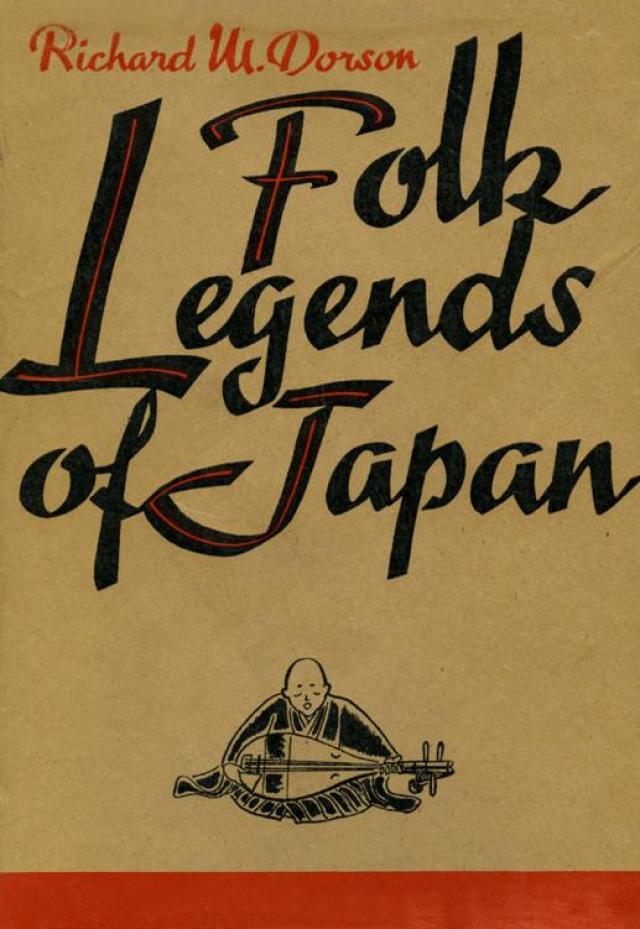
FOLK LEGENDS OF JAPAN
FOLK LEGENDS OF JAPAN
by RICHARD M. DORSON
Chairman, Folklore Program
Indiana University
illustrated by YOSHIE NOGUCHI
CHARLES E. TUTTLE COMPANY: PUBLISHERS
Rutland, Vermont Tokyo, Japan
European Representatives
Continent: BOXERBOOKS, INC., Zurich
British Isles: PRENTICE-HALL INTERNATIONAL INC., London
Published by Charles E. Tuttle Company
of Rutland, Vermont & Tokyo, Japan
with editorial offices at
Osaki Shinagawa-ku, Tokyo 141-0032
Copyright in Japan, 1962
by Charles E. Tuttle Co.
All Rights Reserved
Library of Congress
Catalog Card No. 61-11972
ISBN: 978-1-4629-0963-6 (ebook)
First edition, 1962
Typography & book design
by M. Weatherby
Printed in Japan.
For TOPPER and REIKO
TABLE OF CONTENTS
Acknowledgments: page 13
Introduction: 17
PART ONE. PRIESTS, TEMPLES, AND SHRINES: 31
Saint Kobo's Well: 33
The Willow Well of Kobo: 34
The Kobo Chestnut Trees: 34
The Waterless River in Takio: 35
The Stream Where Kobo Washed His Garment: 36
The Priest's Towel: 36
The Kannon Who Substituted: 57
The Statue of Buddha at Saiho-ji: 40
The Earless Jizo of Sendatsuno: 41
The Red Nose of the Image: 44
The Priest Who Ate the Corpse: 45
The Monk and the Maid: 46
The Shrine of the Vengeful Spirit: 48
The Shrine Built by Straw Dolls: 40
Visit to Zenko-ji Driven by a Cow: 50
The Temple of Raikyu Gongen: 52
The Origin of Enoo-ji: 53
The Origin of Kazo-ji on Mt. Wooden Pillow: 54
PART TWO. MONSTERS: 57
The Kappa of Fukiura: 59
The Kappa of Koda Pond: 61
The Kappa Who Played "Pull-Finger": 62
The Kappa Bonesetter: 63
A Grateful Kappa: 65
Wrestling a Kappa: 66
Memories of Kappa: 67
Tales of Tengu: 68
The Tengu Pine and Takegoro: 70
Burned to Death by a Tengu: 72
The Tengu of Komine Shrine: 73
The Tengu's Sword: 75
The Tengu Who Made Rice Cakes: 77
The Demon's Cave: 77
The Tooth-Marked Stone: 80
Great King with Eight Faces: 81
Mountain Giants: 83
The Mountain Man of Mt. Mitsubushi: 85
The Flute Player and the Shojo: 86
Spider Pool: 88
The Bodyless Horse: 89
Tales of Zashiki-bokko: 89
PART THREE. SPIRITS: 95
The Ghost That Cared for a Child: 97
The Ghost of the First Wife: 99
The Mirror Given by the Ghost: 101
The Dish Mansion in Unshu: 104
Fish Salad Mingled with Blood: 105
White Rice on the Pot: 106
The Seven Blind Minstrels: 106
The Revengeful Spirit of Masakado: 107
The Evil Spirit of Fusataro: 109
The Weaving Sound in the Water: 110
The Phantom Boat: 112
One Hundred Recited Tales: 113
PART FOUR. TRANSFORMATIONS: 115
The Serpent Suitor: 117
The Blind Serpent-Wife: 118
The Serpent Goddess of Amo-ga-ike: 121
The Serpent of Mt. Unzen: 122
Two Daughters Who Became Serpents: 124
Hachiro's Transformation: 126
The Marsh of Tatsuko: 127
The Fox Demons: 128
The Fox Wrestler: 129
The Fox Wife: 132
The Badger That Was a Shamisen Player ; 134
Dankuro Badger: 136
Seventy-five Badgers: 137
Koike's Baba: 138
The God Akiba Revealed as a Beggar: 139
The Hunters Turned to Rats: 140
The Mystery of the Bull-Trout: 142
The Blacksmith's Wife: 143
The Girl Who Turned into a Stone: 144
The Woman Who Loved a Tree-Spirit: 143
Okesa the Dancer: 147
PART FIVE. HEROES AND STRONG MEN: 149
The Child of the Sun: 131
The Jewel That Grew Golden Flowers: 132
The Tale of Yuriwaka: 154
The Story of Kihachi: 156
Koga Saburo: 158
The Heike Refugees: 160
The Last of the Aki: 161
Relics of Benkei: 163
Benkei's Stone Mortar: 164
The Famous Horse Ikezuki: 164
The Faithful Dog of Tametomo: 166
Banji and Manji: 167
Nue the Hunter of Hatoya: 169
The Strongest Wrestler in Japan: 171
The Mighty Wresder Usodagawa: 174
Nasu Kozahara the Strong Man: 176
PART SIX. CHOJAS: 177
The Charcoal Burner Who Became a Choja: 179
Asahi Choja: 183
Sanya Choja: 185
The Camellia Tree of Tamaya: 186
The Gold Ox: 188
The Poor Farmer and the Rich Farmer: 190
The Girl Who Ate a Baby: 191
The Thief Who Took the Moneybox: 194
PART SEVEN. KNAVES: 197
The Origin of Foolish Sajiya Tales: 199
The Crow and the Pheasant: 199
Kichigo Ascends to the Sky: 200
Kitchomu Fools His Neighbors: 202
Whew!: 202
The Wit of Niemonen: 204
Boaster's Wit: 206
Boasting of One's Own Region: 207
The Old Man Who Broke Wind: 207
PART EIGHT. PLACES: 209
Human Sacrifice to the River God: 211
The Princess Who Became a Human Sacrifice: 212
A Mystery at Motomachi Bridge: 216
A Human Sacrifice at Kono Strand: 218
The Bridge Where Brides Are Taken Away: 220
Gojo Bridge in Kyoto: 222
The Mountain of Abandoned Old People: 222
Feather-Robe Stone Mountain: 225
Contest in Height Between Two Mountains: 227
The Mounds of the Master Singers: 228
The Village Boundary Mound: 230
Oka Castle: 231
The Laughter of a Maidenhair Tree: 232
The Discovery of Yudaira Hot Spring: 233
The Spring of Saké: 234
Blood-red Pool: 235
Otowa Pond: 236
Sources of the Legends: 241
Bibliography and Abbreviations for Notes: 245
Index: 249
ACKNOWLEDGMENTS
MY INITIAL DEBT is to the United States Educational Commission in Japan, which awarded me an appointment as Fulbright Professor of American Studies at the University of Tokyo for the academic year 1956-57 and so made possible the present undertaking. The Commission also provided funds for translation and research assistants.
The Japanese Folklore Institute in Seijo-machi, Tokyo, proved a treasure house for me, and I cannot sufficiently express my gratitude to Kunio Yanagita, its founder, Tokihiko Oto, its director, and Toichi Mabuchi, one of its advisors and Professor of Anthropology at Tokyo Metropolitan University, all of whom extended me every kindness. At the Institute, Miss Yasuyo Ishiwara, a graduate of Tokyo Women's Christian College, spent long hours with me translating Japanese legends and giving me the benefit of her training and knowledge as an assistant to Professor Yanagita. Naofusa Hirai, director of the Institute of Classical Studies at Kokugakuin University, acted as interpreter when I first visited the Institute and proved a friend throughout the year. Also at the Institute I met Fanny Hagin Mayer, who generously allowed me to read her unpublished translation of Professor Yanagita's Classification of Japanese Folk Tales (Nippon Mukashi-banashi Meii) and accompanied me on a trip to Niigata. At the KBS Library, curator Makoto Kuwabara aided me in tracking down studies of Japanese folklore in their fine collection of Western-language books and journals on Japan.
My student at Tokyo University, Kayoko Saito, who subsequently studied in the United States on a Fulbright award and is now back at the university as a graduate student, helped me in important ways—by collecting legends from her grandmother, by translating for me, and by introducing me to Professor Masahiro Ikegami, now at Showa Medical University, and interpreting the two private lectures with slides he kindly gave me on the syncretism of folk religion with Buddhism and Shintoism as seen in Japanese mountain religion. Teigo Yoshida, Professor of Sociology at Kyushu University, contributed to my volume a folk legend he had collected during his field work. Authors of collections of Japanese legends who personally or through correspondence have generously granted me permission to publish translations of their texts are Keigo Seki, noted student of the Japanese folk tale; Riboku Dobashi; Kazuo Katsurai; Kiyoshi Mitarai; Chihei Nakamura; and Shogo Nakano; to all of whom I am deeply indebted, as well as to the other authors listed in the sources, who have faithfully recorded Japanese legends. Masaharu Murai generously procured for me a copy ofhis translation Legends and Folktales of Shinshu when I met him in Nagano.
On my return to the United States I was fortunate to meet Ichiro Hori, an outstanding younger Japanese folklore scholar then lecturing at Harvard University and the University of Chicago on popular Buddhism, and Mrs. Hori, the daughter of Professor Yanagita. Professor Hori has graciously read my introduction and given me helpful suggestions. To contributors of the forthcoming Studies in Japanese Folklore which I am editing for the Indiana University Folklore Series, I must express gratitude for a preview of their illuminating articles. My deep thanks go to Professor George K. Brady of the University of Kentucky, who has helped make available in English translation important Japanese folklore studies, and who has aided me in personal ways. Indiana University has bountifully provided me with research facilities.
Both Miss Ishiwara and Miss Saito, named above, and Meredith Weatherby of the Tuttle Company have been most helpful in checking my manuscript and straightening out certain perplexing points.
Finally, I must express my pleasure and good fortune to have as publisher an old friend and classmate, Charles E. Tuttle, who has been so active in the publication of "books to span the East and West."
Bloomington, Indiana, June, 1961
RICHARD M. DORSON
FOLK LEGENDS OF JAPAN
INTRODUCTION
JAPAN POSSESSES more legends than any country in the Western world. So says Professor Kunio Yanagita, who founded the scientific study of folklore in Japan, and who remains today its venerable sage. We cannot say with certainty how many legends a people cherish, but we know that a vast number have been collected from every district in Japan. Even Yanagita-sensei is at a loss to explain just why his culture has produced so many legendary traditions. But volume after volume has appeared in the present century setting down village stories connected with mountains and trees and pools and hot springs, with kappa and tengu and other demonic creatures, with wealthy peasants and doughty samurai, and above all with the grieved and hateful spirits of those who died with anger in their hearts. Altogether some fifty such books of folk legends have been printed in Japan, not to mention the many hundreds of individual legends which have appeared in collections of general folk tales or in topographical and historical works. In the United States not a single book of legends spoken by the folk has ever been published.
The word legend has various meanings in modern usage, and even folklorists disagree on its precise significance. A legend is a particular kind of folk tale, and so belongs to the family of stories passed down by word of mouth over the generations. The best known and most frequently collected type of such stories is the fairy tale, and fairy tales have now been reprinted and rewritten so frequently that they belong to literary as much as to oral tradition. The key difference between fairy tale and legend is that narrator and audience accept the fairy tale as fiction, while they believe the legend describes an actual happening.
The legend is therefore a true story in the minds of the folk who retain it in their memory and pass it along to the next generation. There would be little point, however, in remembering the countless ordinary occurrences of daily life, so the legend is further distinguished by describing an extraordinary event. In some way the incident at its core contains noteworthy, remarkable, astonishing, or otherwise memorable aspects. The presence of a goblin or a giant, a ghost or an apparition, inevitably causes village talk. A strong man may perform some prodigious feat of strength, or a village wag perpetuate some ludicrous prank that endures in local memory. Legends range in length from brief outlines of a dimly recalled event, to a full narrative of strange experiences. Fairy tales, being composed of several adventures arranged in a set pattern and well fixed in the mind of the storyteller, run longer and contain more substance and detail than legends. When the fairy tale becomes anchored in a particular locality, is told as having occurred there, and incorporates the family- and place-names of the neighborhood, it has crossed the line into legendry. More rarely, when a myth of the gods, preserved in an ancient literary manuscript, takes on local coloring and the god is spoken of as having appeared in the vicinity, the myth assumes the form of living legend.
These considerations bring up another point. The legend is believed, it is remarkable, and also it is local. The scene of its action may be the village itself, or some special landmark in the environs. A stunted pine, an ominous cavern, a deep pool, a lofty peak are all customarily endowed with legendary associations. Geographical landmarks keep fresh the memory of events connected with them by power of association, sometimes fixed in the name itself, like "The Mountain of Abandoned Old People" or "The River of Human Sacrifice." Furthermore, since legends, like all other kinds of folklore, are carried from one place to another, they fasten easily onto a similar feature of the landscape in a different part of the country. Man-made structures as well as nature's handiwork become encrusted with traditionary incident over the course of time: bridges, dams, castles, derelict dwellings. In Japan especially, every shrine and temple seems to bear its burden of ancient story. Some dark tragedy of the long ago has caused the erection of yonder Shinto shrine, and the villagers who pass it daily or honor it annually know its message. As legends attach to particular places in the district, so they cling to unusual persons who have lived in or passed through the township. Individuals who stand out from the everyday throng in some peculiar way, because of their physical prowess or roguish humor or occult powers, are talked about by later generations until they take on legendary hues. Or a famous historical figure has traveled briefly through the district, and given rise to a host of apocryphal stories about his actions in the locality. A priest, a saint, a god has performed his miracles and left his traces here. In short, a legend needs anchorage, whether to a person, a place, or an event, or to all three in combination, if it is to persist in the unwritten annals of the community.
The "localness" of legends has a simple explanation. These believed episodes continue to be told by people who find in them a strong personal interest. If interest lags, the legend dies. What maintains interest is the intimate association with family or neighborhood history, or with familiar landmarks. The audience knows the names of the actors, whose descendants live in their midst, and who may indeed include their own ancestors, and they see regularly the sites of the bygone events. While the history of textbooks seems distant and impersonal, the remembered traditions of the community possess the fascination of immediate concern; they happened here, to us. To the appeal of the unusual and arresting incident is thus added the attraction of local interest. Legends represent the folk's-eye view of history.
As a consequence, local traditions flourish most vigorously in hamlets and villages that have endured with little social change for long reaches of time. In such a society one knows his neighbors and shares their sense of a common past; the community has roots, traditions, almost an independent corporate existence. Legends cannot persevere in the big city, save perhaps in local neighborhoods that manage for a space to preserve a sense of identity before the bulldozers desecrate the old landmarks and new swarms of migrants uproot the established dwellers. Nor will too sparse a settlement nourish the seeds of traditionary tales. Enough of a society must exist to set the stage for action, rumor, the play of fancy, and the bubbling currents of excited talk. It is no accident that in the United States New England, the oldest section of the country, and the one chiefly settled in compact townships, contributes the lion's share of American legends. Scarcely a New England town history but contains one chapter on local traditions: a case of witchcraft; a visit from the Devil, whose footprint remains in solid rock; foibles and antics of eccentric townsfolk; a sighting of the sea serpent off the shore: specters in a haunted house that bears an ineradicable bloodstain.
In closely knit communities a legend lives on through constant repetition. This repeated telling of the legend over the generations insures its folklore quality. For even if a story begins immediately after some remarkable happening, in a form fairly close to the facts, it will assume ever more fantastic hues over the years. The Icelandic sagas were first told in the eleventh century by professional saga-men as factual histories of the great chieftains, but when they were finally written down two centuries later, many floating folklore themes and tales had slipped into the narratives. There is indeed one group of scholars who contend that after 150 years of unbroken oral tradition not a vestige of historical truth remains. In more recent times some check is provided on the fanciful growth of oral legends through printed versions, which help to stabilize their form in a local history or topography, or traveler's report. So long as the legend continues to be told, whether or not it has seeped into print, we can call it a "folk legend." If some scribe wrote down the story in an earlier day with stylistic embellishments, in a manner no longer to be found on the lips of the people, we may call such a form a "literary legend." The classic documents of Japanese historical literature, the Kojiki and the Nihongi, contain literary legends of this sort. Or a contemporary writer may select a legendary theme as a basis for his own inventive additions, and this too is a literary legend. While in Japan I met an English couple who were preparing a book of Japanese "legends" for a series of volumes on legends of all lands being issued by a distinguished publishing house, and they planned to elaborate upon themes in the Kojiki and the Nihongi according to their own imaginative fancy. Such a volume may well prove entertaining, but its contents will bear no resemblance to the word-of-mouth traditions of Japanese villagers.


