Painless, page 2
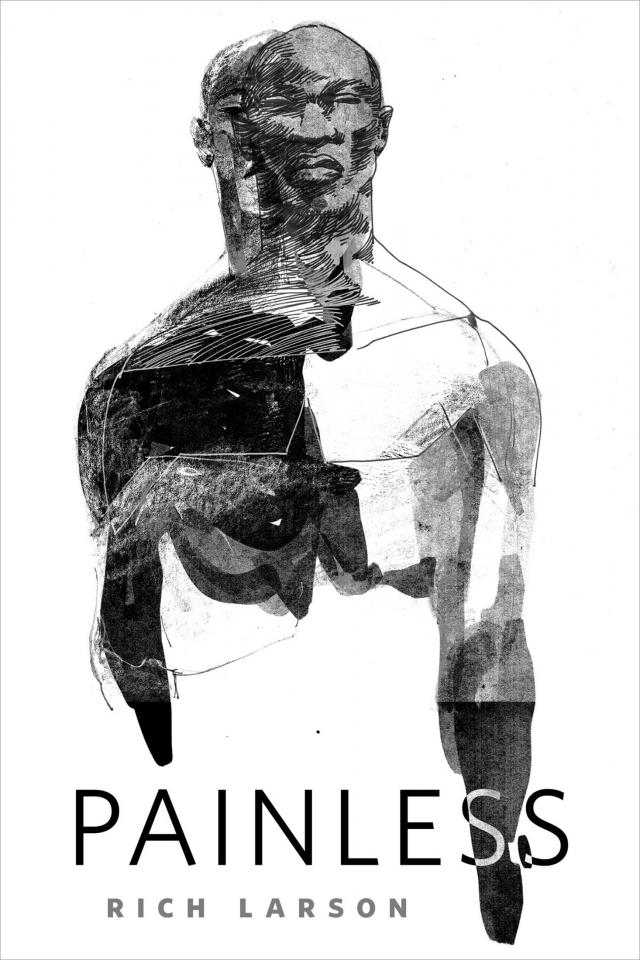


There is good reason for that. From the very start of his accelerated training, Mars can do things no human can do. He can sprint for minutes at a time while the organism laps away his lactic acid and replenishes his cells. His scrawny frame can carry double its weight when the organism weaves itself into his skeletal muscle.
At first the others are scared of him. Then they hate him, for making things seem so easy. They give him cuffs on the back of his head when they pass. They drop a bucket of pinching water scorpions into his shower stall. He does not care. At night he climbs into his cot with a full belly and watches cartoons on the screen of his standard issue phone, a dull black slab that only functions during certain hours.
When they go through anti-interrogation, the water filling his lungs is only a tickling ghost. They pull him out of the tank before he drowns, but he is not sure if he can drown anymore. The other members of his unit, sopping wet, breathing ragged, look at him as if he is a god. Then they look at each other.
That night they invite him to drink. He guzzles the ogogoro until he can fool himself into thinking he feels the same crazy happy way they feel. He shows them his own version of their knife game: Instead of stabbing the spaces between his fingers, he drives the point of the blade into each knuckle in turn, moving like a blur, and by the time one circuit is complete he has already healed.
They howl. The ones who still believe in witch stuff say, Witch stuff.
“Who cares,” says one of the Yoruba men. “He is ours. You are ours, yes, Mars?” And because he knows Mars speaks Hausa: “Dan’uwanmu ne? You are our brother?”
Mars thought he did not care, but now the word makes him into a child again. He starts to weep. The others shift and fidget, uneasy.
In the morning, Mars is transferred.
* * *
They are in the last house of the row, a Western-style construction no doubt built for some European surgeon decades ago. The orchard around it is dead and withered. But there is light in the window, faint music that sounds like kuduro, and a truck and two motorcycles are parked outside. Mars even sees some clothes hanging from a wire laundry line, flapping wings in the night wind.
He circles the house like a shade. From up close, the thumping music is loud enough to send ripples through the screen porch. The bass raises the hairs on his arms. He peers through a window and sees four men sitting around a kitchen table. Playing cards slip and slide over the dusty wood. A heavy black vape sits in the center, belching smoke through the affixed tubes.
Mars guesses that the last two men are with the prisoner. He takes the stolen blockphone from his pocket and thumbs the blinking number, thinking that whoever answers it will be the leader, and the leader he will keep alive to answer questions. None of the men at the table reach for their pockets. Instead, Mars hears a whistling ringtone from behind him and realizes he has guessed wrong just before an autogun tears into him.
The flurry of bullets takes him off his feet; he slams into the side of the house and crumples. Through the keening in his ears Mars realizes the music has cut out. He hears shouts from inside. A clattering door. Voices somewhere above him.
“Kai! Who the fuck is that? Who did you shoot?”
“He was looking through the window, he—”
“Is he one of Musa’s?”
“Then Musa’s trying to rip us off. The man we had out front, he killed him.”
Mars lies very still. He can feel the organism at work, knitting his flesh back together, squeezing the metal out. He reaches for his nanoknife. The autogun sees the movement and gives a bleat of alarm, but there are friendly bodies in the way so it cannot fire, and its owner takes a moment too long to realize his target is somehow alive. In that moment Mars cleaves him open from his hip bone to his sternum.
He whirls on the others, slips under a punch and pulls the man close, making him a shield as another gun goes off. Small caliber this time—a bullet clips his shoulder and he barely notices it. Three quick stabs as he pushes forward; he drops his dying shield and drives the nanoknife into the arm of the shooter. The gun fires one last time and he takes the bullet right in the chest. For a split second his whole body shudders. Sways.
Then he’s moving again, and in less than a minute he is surrounded only by corpses. Their blood pools and wriggles through the sand like anemones. Mars can feel the organism working hard, converting his evening meal into new flesh, fresh skin. The last bullet spirals back out from his heart and drops soundlessly to the ground.
* * *
Six years later, Mars is a bogeyman. He finishes his training half in virtual and half in the field, sometimes with a handler, most often alone. He is given no rank, because he does not exist as anything but a rumor. He is given jobs instead. Most often, targets. The first time he kills, the man sputters and curses and begs and shits himself. Mars had seen people die before, but causing it is different. He does not sleep for a week.
He is told, over and over again, that he is creating stability. That he murders one malefactor to save a thousand innocents. That nobody else can do what he does—the procedure has never been successful since, not once—so he must do it. But he does not feel any higher purpose. He does what he is told because it is his habit. It grinds away at him in places that do not seem to grow back.
On one assignment he triggers an alarm and has to flee on foot. A pursuer’s bullet punches a hole through his back; he survives but a week later he learns that the bullet continued through a tin wall into the skull of a woman leaning down just so, just at the perfect height, to sweep her floor.
One assignment an explosion tears his leg off. He sees his target escaping. He needs both legs to follow. So he eats the corpse beside him, eyes watering, stomach heaving.
One assignment he plants a smartbomb tailored to a general’s DNA, but the general’s son runs into the room instead and the scanner makes a mistake Mars is not quick enough to override. He watches the boy’s body blow apart.
The other operatives, the ones who are not gods, have ways to forget. But Mars’s body flushes the drugs and alcohol from his system faster than he can consume them, and sex is of no interest to him. He knows the procedure left him sterile, but he had no desire before it either, maybe for the same reason he cannot have friendships: Other people are too fragile. When he is around them all he can see are the many ways they might die.
On some of the nights Mars cannot sleep, he stands in front of a mirror and flays himself, as if he can shed the memories with the skin. He decides there are two sorts of pain: the sharp red kind that twists a person’s face and makes them scream, and a slick black kind that coats a person’s insides like tar. He realizes that he has been feeling the second kind for most of his life.
Mars knows there is a way to escape all pain. He has delivered it many times. Long ago, his brother escaped and left him alone. So when his handler sends him north, across the border, he discards his tracker and his identification tag and almost all of his equipment. In the early morning, he goes to the highway.
* * *
Mars opens the screen door, shaking insects off the wire mesh. He steps into the house. The concrete floor is rippled with red sand. He can hear the hum of a generator. The fluorescent tubes in the ceiling are long burnt out; the lighting is sticky yellow biolamp, smeared in the corners of the ceiling and activated by a particular radio frequency.
Now that he is so close to his goal, he feels a mixture of excitement and dread. For the past three weeks, ever since he crawled away from the highway trailing shredded flesh behind him, he has been in hiding. It took him days to grow his legs back, for the new nerve endings to find their way to his spine.
After that he went out into the daji, into the bush. He wandered for a week, staying in villages or moving with the herders who needed strong and tireless backs. Some of the time he was thinking of a hundred surer methods than an autotruck, but some of the time he was just existing, and it was not so bad. Then he heard the rumor.
Mars walks past the kitchen down a dark hallway, following the sound of the generator. He is still not sure he believes. But the possibility has been growing and swelling and pushing out his other thoughts ever since he heard the story, the story of the strange creature some farmers had found on the highway.
The hum is coming from the bathroom. Mars pushes the door open. In the faint glow of the biolamp, he sees a small hooded figure slumped inside the ceramic bathtub. The generator beside the tub is hooked to an industrial drill that is churning on its slowest setting into the prisoner’s stomach. Mars switches it off. He seizes the drill with both hands and drags it backward; the bit comes free with a sucking sound.
The hooded head twitches the exact way Mars’s head twitches. He pulls the black fabric gently up and away. Shock freezes him in place. He thought he was prepared for this, but he is not. The face looking back at him is a child’s, but it is also his.
“Sannu,” he says, because he can think of nothing else to say.
“Yauwa,” the boy in the bathtub says, in a reedy voice hoarse from disuse. “Sannu.”
When Mars crawled away from the highway, he gave no thought to his other half, to the splinter of spinal column and dead legs left in the ditch. He never considered how badly the organism wanted to be whole. It must have fed on carrion, or pulled some unlucky buzzard down into itself, and slowly, slowly, shaped him anew.
But it is not him. Not quite—there was not enough flesh. Instead it is a boy he only ever saw briefly in cracked screens or windows, a boy who once stood on a mat in the marketplace with wires trailing off his skinny arms.
Mars leans forward and unties the boy’s hands. His fingers are trembling slightly. The procedure only worked once, but now he knows there is another way. If they knew, they would make a hundred more soldiers like him. A hundred more gods of war.
“Ina jin yunwa,” his other self says. “Sosai.”
Mars nods, looking at the boy’s stomach where purple scar tissue is sealing shut—he is right to be hungry. The drill must have been at work for days, and they must not have fed him. He is gaunt.
“I saw kilishi in the other room. Come. Eat.”
Mars helps the boy out of the bathtub. They go to the kitchen, and on the table a blockphone is buzzing. Mars picks it up.
“Is he ready to be moved?” the foreign man’s voice asks. “We are two minutes away.”
Mars hears the sound of a rotor in the background. They are coming by air. He looks at the boy, whose new muscle is packing itself onto his bones as he devours the dried meat.
“He is ready,” he says, and ends the call. He turns to his other self. “Some more bad men are coming. They are bringing us a transport. Well. We will steal it from them. And then we can go far away, to be safe from them.”
The boy nods solemnly. “Who are you?” he asks through a full mouth.
“Do you remember the autotruck?” Mars asks back.
The boy shakes his head. “My head is bad. I remember strange things. I think I know you. Who are you?”
For a long moment Mars does not answer. They look at each other, and Mars does not see the expressions he has grown accustomed to: There is no fear or awe on the boy’s face. Only some sadness, some shyness, some hope. It reminds him not of himself, but of someone he had nearly forgotten, someone he remembers more as a smell and a skinny arm slung around his shoulders than as a face.
He realizes he has finally has found someone who will not look at him like he is a god or a devil. Someone who is like him. But Mars can make sure the boy’s life is nothing like his life.
“My name is Mars,” he says. “Like the planet.” He makes a spaceship with his hand and launches it through the air.
The boy’s mouth twitches. Nearly smiles. He raises his smaller hand and does the same, making the noise in his cheeks. “You are so familiar,” he says. “Why?”
Mars feels a third sort of pain, one he does not know, an ache that he doesn’t want to end. “Mu ’yan’uwa ne,” he says.
The boy nods, as if it all makes sense now. “We are brothers.”
About the Author
Rich Larson was born in West Africa, has studied in Rhode Island and worked in Spain, and now writes from Grande Prairie, Alberta. His short work has been nominated for the Theodore Sturgeon, featured on io9, and appears in numerous Year’s Best anthologies as well as in magazines such as Asimov’s, Analog, Clarkesworld, F&SF, Interzone, Strange Horizons, Lightspeed and Apex. He was the most prolific author of short science fiction in 2015. You can sign up for email updates here.
Thank you for buying this
Tom Doherty Associates ebook.
To receive special offers, bonus content,
and info on new releases and other great reads,
sign up for our newsletters.
Or visit us online at
us.macmillan.com/newslettersignup
For email updates on the author, click here.
Contents
Title Page
Copyright Notice
Begin Reading
About the Author
Copyright
Copyright © 2019 by Rich Larson
Art copyright © 2019 by Eli Minaya
Rich Larson, Painless