

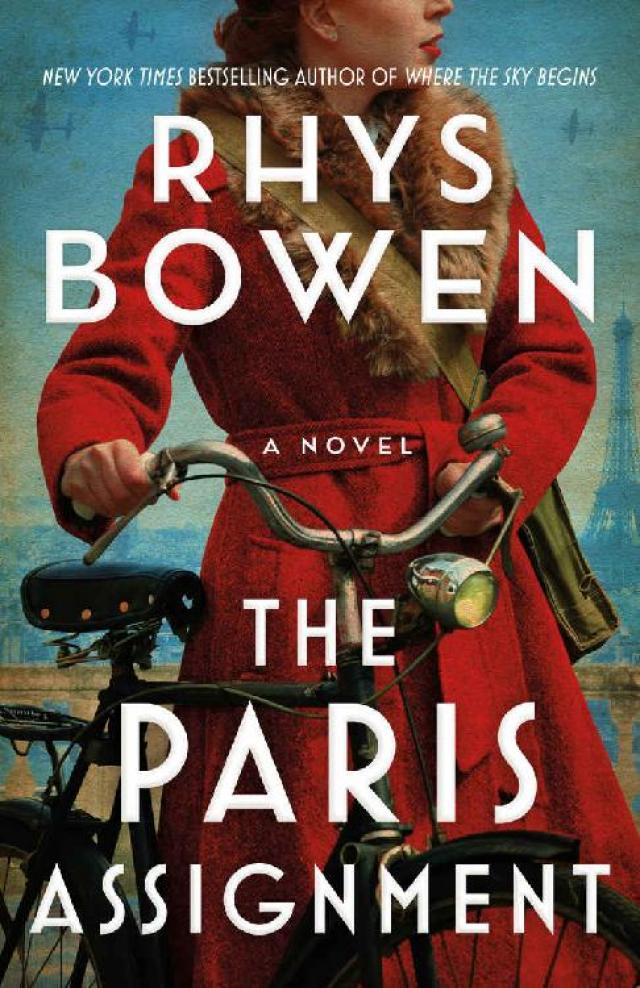
The Paris Assignment: A Novel, page 1


PRAISE FOR THE PARIS ASSIGNMENT
“Rhys Bowen’s multitude of fans will love The Paris Assignment, a story of love and war, of bitterness and brutality, of bravery and forgiveness, woven together with a rich sense of time and place, and characters only a master storyteller could create.”
—Jacqueline Winspear, New York Times bestselling author of The White Lady and the Maisie Dobbs series
“No one writes a wartime historical novel as well as Rhys Bowen. The Paris Assignment is a gripping, evocative, and skillfully plotted read, with a heroine you will root for right up to the satisfying conclusion. I couldn’t put it down!”
—Deborah Crombie, New York Times bestselling author of the Duncan Kincaid / Gemma James novel series
“Gorgeous, authentic, and absolutely riveting. There is no better storyteller than Rhys Bowen! The Paris Assignment, like all her novels, is meticulously researched, brilliantly told, and endlessly captivating. Bowen’s extraordinary ability to synthesize history and present it as essential and heartbreaking human drama is unmatched. I read this in total awe, as it honors reality and cinematically brings it to life again. The Paris Assignment is emotionally and historically immersive, and no reader will be the same after they turn the final page.”
—Hank Phillippi Ryan, USA Today bestselling author, Mary Higgins Clark and five-time Agatha Award winner
“The Paris Assignment is a sweeping story of love, bravery, and ultimately hope. Rhys Bowen masterfully weaves an immersive story that carries us through the crucible of war with characters that capture your imagination and heart. Traveling through Paris, London, and Australia, The Paris Assignment is a story about the things we do when we believe there might be nothing left to lose, about the irrepressible love of a wife and mother, and about courage in the face of great and terrible odds. Historical fiction at its best, The Paris Assignment is a rich and absorbing experience.”
—Patti Callahan Henry, New York Times bestselling author of The Secret Book of Flora Lea
PRAISE FOR RHYS BOWEN
“Rhys Bowen is a gift to all who love great writing, rich and complex characters, and a plot that grabs from first words.”
—Louise Penny, #1 New York Times bestselling author of the Chief Inspector Gamache novels
“Thoroughly entertaining.”
—Publishers Weekly
“A truly delightful read.”
—Kirkus Reviews
“Keep[s] readers deeply involved until the end.”
—Portland Book Review
“Entertainment mixed with intellectual intrigue and realistic setting[s] for which Bowen has earned awards and loyal fans.”
—New York Journal of Books
“[A] master of her genre.”
—Library Journal
“An author with a distinctive flair for originality and an entertaining narrative storytelling style that will hold the reader’s rapt attention from beginning to end.”
—Midwest Book Review
“Bowen’s vivid storytelling style holds readers enrapt.”
—Historical Novel Society
ALSO BY RHYS BOWEN
In Farleigh Field
The Tuscan Child
The Victory Garden
What Child Is This
Above the Bay of Angels
The Venice Sketchbook
Where the Sky Begins
CONSTABLE EVANS MYSTERIES
Evans Above
Evan Help Us
Evanly Choirs
Evan and Elle
Evan Can Wait
Evans to Betsy
Evan Only Knows
Evan’s Gate
Evan Blessed
Evanly Bodies
MOLLY MURPHY MYSTERIES
Murphy’s Law
Death of Riley
For the Love of Mike
In Like Flynn
Oh Danny Boy
In Dublin’s Fair City
Tell Me, Pretty Maiden
In a Gilded Cage
The Last Illusion
Bless the Bride
Hush Now, Don’t You Cry
The Family Way
City of Darkness and Light
The Edge of Dreams
Away in a Manger
Time of Fog and Fire
The Ghost of Christmas Past
With Clare Broyles
Wild Irish Rose
All That Is Hidden
ROYAL SPYNESS MYSTERIES
Her Royal Spyness
A Royal Pain
Royal Flush
Royal Blood
Naughty in Nice
The Twelve Clues of Christmas
Heirs and Graces
Queen of Hearts
Malice at the Palace
Crowned and Dangerous
On Her Majesty’s Frightfully Secret Service
Four Funerals and Maybe a Wedding
Love and Death Among the Cheetahs
The Last Mrs. Summers
God Rest Ye, Royal Gentlemen
Peril in Paris
This is a work of fiction. Names, characters, organizations, places, events, and incidents are either products of the author’s imagination or are used fictitiously.
Text copyright © 2023 by Janet Quin-Harkin, writing as Rhys Bowen
All rights reserved.
No part of this book may be reproduced, or stored in a retrieval system, or transmitted in any form or by any means, electronic, mechanical, photocopying, recording, or otherwise, without express written permission of the publisher.
Published by Lake Union Publishing, Seattle
www.apub.com
Amazon, the Amazon logo, and Lake Union Publishing are trademarks of Amazon.com, Inc., or its affiliates.
ISBN-13: 9781662504242 (hardcover)
ISBN-13: 9781662504235 (paperback)
ISBN-13: 9781662504259 (digital)
Cover design by Shasti O’Leary Soudant
Cover image: © V_E / Shutterstock; © Stephen Mulcahey / ArcAngel
First edition
I am dedicating this book to Mary-Fran McCluskey, who earned the right to appear in this story by being the high bidder in a charity auction to provide scholarships for young women to attend university. Although she was never a courier in WWII, she did go by the name Marier-France when she lived in that country.
CONTENTS
CHAPTER 1
CHAPTER 2
CHAPTER 3
CHAPTER 4
CHAPTER 5
CHAPTER 6
CHAPTER 7
CHAPTER 8
CHAPTER 9
CHAPTER 10
CHAPTER 11
CHAPTER 12
CHAPTER 13
CHAPTER 14
CHAPTER 15
CHAPTER 16
CHAPTER 17
CHAPTER 18
CHAPTER 19
CHAPTER 20
CHAPTER 21
CHAPTER 22
CHAPTER 23
CHAPTER 24
CHAPTER 25
CHAPTER 26
CHAPTER 27
CHAPTER 28
CHAPTER 29
CHAPTER 30
CHAPTER 31
CHAPTER 32
CHAPTER 33
CHAPTER 34
CHAPTER 35
CHAPTER 36
CHAPTER 37
CHAPTER 38
CHAPTER 39
CHAPTER 40
CHAPTER 41
CHAPTER 42
CHAPTER 43
CHAPTER 44
CHAPTER 45
CHAPTER 46
CHAPTER 47
CHAPTER 48
CHAPTER 49
CHAPTER 50
CHAPTER 51
CHAPTER 52
CHAPTER 53
CHAPTER 54
CHAPTER 55
HISTORICAL NOTE
ACKNOWLEDGMENTS
ABOUT THE AUTHOR
CHAPTER 1
Paris, 1931
Madeleine Grant met Giles Martin at the end of her first month at the Sorbonne University in Paris. She was a tall, slender girl with dark, hopeful eyes and unusual red-brown hair that she wore shoulder-length and unpermed. Having been a student at Westfield College, a small residential women’s college of the University of London, she’d only known civilized tutorials with female professors. She had come to Westfield straight from a girls’ boarding school and felt safe and comfortable there amongst young ladies from similar backgrounds. It was, indeed, an extension of her school life. So the Sorbonne, with its large, draughty lecture halls, its loud male students, was a huge shock to her system. She watched groups of young people of both sexes surging between buildings, arguing expansively with much gesticulating, or laughing together at outdoor cafés and wondered if she would ever be part of a group like that. It seemed like another world that could never open up to her. She was beginning to wish she had never come, but at least one term of study abroad was required for her degree in French. And it was heady and exciting to know she was in Paris. But she longed to be one of those confident French girls who smoked and tossed their scarves nonchalantly, laughing and arguing on equal footing with the boys.
Until now she had sat, quiet as a mouse, at the back of a lecture hall, trying to understand the professor’s rapid French, taking copious notes, hoping not to be noticed, terrified of being called upon. At the end of that first month, the lecture was halfway through when a sudden draft announced that the door behind her had opened, and someone slid into the seat beside her.
“What’s this lecture on?” a male voice whispered in her ear.
She looked up, surprised, to see herself staring at a mop of unruly dark hair and a pair of alarming tiger eyes. “Racine,” she whispered. “He’s talking about Phèdre.”
“Oh her.” The eyes flashed amusement. “Horrible woman, wasn’t she? All those ancient Greeks and their guilty passions! Too much time on their hands, if you ask me. And why Racine needed five acts for her to agonize over her passion for her stepson.” He shook his head, grinning. The professor must have sensed a disturbance at the back of the lecture hall because he broke off from his monologue and looked up, frowning. The young man beside Madeleine winked, nudging her. “Do you want to come for a cup of coffee?”
“I should be taking notes,” Madeleine whispered. “There will be a paper to write.”
“How can there be anything new to learn about a play written three hundred years ago? Come on. I have friends who are fourth-year students. They will share the papers they wrote after this class. It’s only the same old stuff rehashed every year.”
Madeleine hesitated, torn between wanting to be the dutiful student, making the most of her time in Paris, and the desire to go with this attractive young man. The latter option won out. She folded her notebook, stuffed it into her bag and crept out after him. Once in the hallway outside, she looked up at him and gave a nervous laugh. “I shouldn’t be doing this,” she said.
“Rubbish. Why does anyone need to study Racine, anyway? How can he be relevant to us in the twentieth century? All those plays about great and noble people who end up killing themselves. We need more plays about real people, with real problems, like how to pay for next week’s rent.”
“So why are you studying French literature, then, if you don’t find it relevant?”
“To tell you the truth, I am not. I just ducked into that lecture hall because I saw a chap to whom I owe some money. I have dabbled in various subjects, but currently I am studying philosophy and politics.”
He put an arm around her shoulder as if it was the most natural thing to do. “Come on. Come and cheer me up. I’ve had a depressing week so far.”
She allowed him to steer her down the echoing stone staircase and out into the brightness of an October day. The buttery yellow stone of the buildings surrounding the courtyard glowed in the slanted sunlight.
“So which is your favourite café?” he asked.
The courtyard was empty, since lectures were in progress. From a tall open window came the droning of a professor’s voice. “And we notice in the year 1357 . . .”
Madeleine gave an embarrassed shrug. “I haven’t really tried too many cafés yet. I get my midday meal at the cafeteria here and my evening meal at the hostel.”
“You’re new? How long have you been here?”
“Yes, I’m new. Only a month. And I have not been brave enough to visit more than a few cafés alone.”
Something about the way she phrased this statement made him look at her critically. “You’re not French?”
She felt herself blushing. “No, I’m English.”
“That explains it. You use words that only professors might use. Or elderly nuns. But your French accent is remarkably good. Usually the English have horrendous accents—quite incapable of blending in.”
This made her smile. “My mother was half-French. When I was a little girl, we used to visit a relative in Paris. And my mother spoke to me in both languages. I understand quite well, and I used to be fluent. But I’m afraid I only have the vocabulary of a child, vous comprenez.” She used the polite form of the word “you,” noting that he had also done this. She still wasn’t quite sure when one verged into the familiar. “More recently I’ve been studying French at school and at university in London, but I’m not familiar with everyday spoken French.”
“Your mother stopped speaking to you in French?”
She looked away. “The Great War came, and we couldn’t go to France any more. And then my mother caught the Spanish flu and died when I was ten. So no more visits to Paris.”
“And now you have a new chance,” he said, beaming at her as if she had given him a present. “How marvellous. You can connect with your French roots again.”
“Yes.” She looked up at him, smiling too now. “A new chance, as you say. I’m very excited.”
They came out to the rue des Écoles and turned towards the bigger boulevard Saint-Michel. “If you have not experienced our Parisian cafés, I should take you somewhere iconic,” he said. “The Café de Flore if you don’t mind a little walk.”
“I love walking,” she said. “I must have walked every inch of Paris already. At home in England, we walk everywhere. My college is near Hampstead Heath, and we young ladies are encouraged to take healthy walks between lectures.”
He looked amused. “You attend a college for young ladies?”
She nodded. “It’s part of the University of London, but most of my classes are within the college—only female professors.”
“Mon Dieu!” He looked appalled. “How unhealthy. How are you supposed to learn how to snag yourself a husband?”
“I don’t think one goes to university to snag a husband,” she said, giving him a reprimanding frown. “Surely an education gives one the option not to get married, if one chooses. Besides, it is comforting to study amongst female friends. Safe.”
“That’s what you want to be? Safe?” He shook his head, making his dark curls dance. “How are you ever supposed to know about life?”
She considered this. “Perhaps you’re right,” she said. “I was at a girls’ boarding school. We were encouraged to apply to ladies’ colleges where we would be safe and protected.”
“But one should never be safe and protected,” he said. “To live with danger is to know that you are fully alive.”
She looked at him with awe. He had said something she had never really considered before. “You are right,” she said. “I’ve been shut away all my life, and now I haven’t even dared to go to coffeehouses on my own. But I want to live. I want to know what danger feels like.” She corrected herself. “I remember what it felt like at the time of the Great War. Bombs fell near us in London. And just when it felt safe, the Spanish flu and Mummy getting so ill and dying very quickly. And I thought I never wanted to go through times like that again. But since then, it’s been a safe little cocoon.”
He grabbed at her arm and yanked her back as she went to step out into the street and a taxicab came hurtling towards them. A horn blared out. “If you wish to stay safe, remember the traffic goes on the other side of the street,” he said, laughing.
Then he seemed to realize he was still holding her. “I should perhaps know your name if I’m to rescue you from passing taxis and take you to cafés.”
“It’s Madeleine,” she said. “Madeleine Grant. My mother wanted a name that was equally good in both French and English.”
“Madeleine.” He pronounced it in the French way and nodded approvingly. “Yes. It suits you. And I am Giles. Giles Martin.” And he held out his hand in proper fashion.
“I’m pleased to meet you, Giles,” she said, her voice suddenly shaky because she was aware of the warmth of his hand and realized he was terribly attractive.
They crossed the boulevard Saint-Michel and continued past the faculty of medicine until they joined the wider boulevard Saint-Germain. Here the leaves of the sycamore trees lining both sides of the street glowed golden to match the buildings. There were attractive little boutiques, and Madeleine glanced into windows as they passed them, recoiling in horror at the price of a pair of shoes.
“Where do you stay?” Giles asked.
“At a women’s hostel that belongs to the university on the rue Saint-Jacques. It’s rather dreadful, actually. Disgusting food and depressing rooms. And mostly foreign students—not much chance to improve my French.”
“Why don’t you find a place of your own? There are many in the city that are not expensive. And you can eat in a café as cheaply as your hostel, I am sure.”
“I wouldn’t know where to start,” she said. “I haven’t been to Paris since I was a small child.” She paused. “I used to have a great-aunt here, who lived in a little flat in the Marais. But I don’t have her address. She must be very old now—if she is still alive.”
“The Marais is where I live,” he said. “A good place. Full of life. Is your aunt Jewish?”
“No. I don’t think so.” She looked confused.
“Because the Marais is the traditional Jewish quarter.”


