Rex Stout - Nero Wolfe 28 - If Death Ever Slept, page 18
part #28 of Nero Wolfe Series


As Wolfe would say, pfui.
Chapter 18
As it turned out, when Otis Jarrell’s private affairs, at least some of them, became public, it was out of his own mouth on the witness stand. While it is true that evidence of motive is not legally essential in a murder case, it helps a lot, and for that the DA had to have Jarrell. The theory was that Susan had worked on Jim Eber and got information from him, specifically about the claim on the shipping company, and passed it along to Corey Brigham, who had acted on it. After Eber was fired he had learned about Brigham’s clean-up on the deal, suspected he had been fired because Jarrell thought he had given the information to Brigham, remembered he had told Susan about it, suspected her of telling Brigham, and told her, probably just before I entered the studio that day, that he was going to tell Jarrell. To support the theory Jarrell was needed, though they had other items, the strongest one being that they found two hundred thousand dollars in cash in a safe-deposit box Susan had rented about that time, and she couldn’t remember where she had got it.
Brigham’s death was out of it as far as the trial was concerned, since she was being tried for Eber, but the theory was that he had suspected her of killing Eber and had told her so, and take your pick. Either he had disapproved of murder so strongly that he was going to pass it on, or he wanted something for not passing it on—possibly the two hundred grand back, possibly something more personal.
None of the rest of them was called to testify by either side. The defense put neither Susan nor Wyman on, and that probably hurt. Susan’s having a key to the library was no problem, since her husband had one and she slept in the same room with him. As for whether they’ll ever get her to the chair, you’ll have to watch the papers. The jury convicted her of the big one, with no recommendation, but to get a woman actually in that seat, especially a young one with a little oval face, takes a lot of doing.
Wolfe took Jarrell’s money, a check this time, and a very attractive one, and that’s all right, he earned it. But that was all he wanted from that specimen, or me either. He said it for both of us the day after Susan was indicted, when Jarrell phoned to say he was going to mail a check for a certain amount and would that be satisfactory, and when Wolfe said it would Jarrell went on: “And I was right, Wolfe. She’s a snake. You didn’t believe me the day I came to hire you, and neither did Goodwin, but now you know I was right, and that gives me a lot of satisfaction. She’s a snake.”
“No, sir.” Wolfe was curt. “I do not know you were right. She is a murderess, a hellcat, and a wretch, but you have furnished no evidence that she is a snake. I still do not believe you. I will be glad to get the check.”
He hung up and so did I.
The World of
Rex Stout
Now, for the first time ever, enjoy a peek into the life of Nero Wolfe’s creator, Rex Stout, courtesy of the Stout Estate. Pulled from Rex Stout’s own archives, here are rarely seen, never-before-published memorabilia. Each title in “The Rex Stout Library” will offer an exclusive look into the life of the man who gave Nero Wolfe life.
If Death Ever Slept
Ever wonder why Nero Wolfe likes orchids so much? Rex Stout answered that question in the April 19, 1963 issue of Life magazine in his piece, “Why Nero Wolfe Likes Orchids.” The article is reprinted in full.
LIFE
4/19/63
ORCHIDS CONTINUED
Why Nero Wolfe
Likes Orchids
by REX STOUT
The world’s most celebrated orchid fancier is private investigator Nero Wolfe, the 270-pound creation of mystery writer Rex Stout, who for 30 rears and through 37 novels has foiled a bizarre and devious assortment of blackguards. He usually does so without leaving the confines of his five-story Manhattan town house, which contains an ornate rooftop greenhouse with a collection of 8,000 orchids. Here Archie Goodwin, Wolfe’s faithful legman and the narrator of his fictional exploits, investigates and explains the deep satisfactions of his boss’s orchid-fixation.
When people ask me why Nero Wolfe grows orchids I ask them which they are interested in, orchids or him. If they ask what difference that makes. I say it makes all the difference. If they are curious about orchids, the best and simplest answer is to take them up to the plant rooms, but if they’re curious about Nero Wolfe, there are a dozen different answers and they are all complicated.
Wolfe’s flowers go all the way from the showiest to the shyest. He has a Cattleya hybrid, bred by him, which threw its first flower last year, that is twice as gaudy as anything you ever saw in a florist shop, and he has a Cymbidium hybrid. ensifelium × Sanderae, bred by him in 1953, so coy that it makes one little flower each year—off-white, the size of a dime, hidden down in the foliage. Once T saw him scowling at it and muttering, “Confound you, are you too timid or too proud?”
If he ever talks to himself he keeps it strictly private, but I have often heard him talk to orchids. He’ll cock his head at a bench of Miltonias in full bloom and say distinctly, “Much too loud. Why don’t you learn to whisper?” Not that he ever whispers.
Wolfe started on orchids many years ago with a specimen plant of Vanda suavis, given to him by the wife of a man he had cleared on a murder rap. He kept it in the office and it petered out. He got mad, built a little shed on the roof and bought 20 plants. Now the plant rooms are 34 × 86, the size of the house. He hasn’t bought a plant from a commercial grower for 10 years, but he sells some—a hundred or more a year.
Of the four hours a day he spends up in the plant rooms—9 to 11 in the morning and 4 to 6 in the afternoon—not more than 20 minutes is spent looking at flowers. First he makes a tour through the aisles, which are 30 inches wide instead of the usual two feet—the tropical room, the intermediate, and the cool—and then on to the potting room. He nods to Theodore the gardener, and says, “Well?” Theodore says either, “Well enough,” or something like, “A pod of Coelogyne will be ready in two days.”
In his rooftop greenhouse Wolfe stares at an orchid with the same grim concentration that has uilted many a crafty criminal.
Then work. It may be real work, like bringing a dozen old plants from one of the rooms for dividing and repotting, or opening a bale of osmunda fiber and inspecting it; or it may be merely getting a tape and going to the cool room to measure the panicles of Odontoglossums. It can be any of the thousand chores that orchids take—mixing fertilizer, labeling, presoaking new pots, checking ventilation and humidity, adjusting shade screens, stripping bulb sheaths, chipping charcoal, and so forth, forever and ever with no amen. Except spraying. Wolfe hates it, and Theodore does it when he’s not there.
Of course, most of the chores are for breeding, not growing. Buying a dozen or so orchid plants and keeping them going and blooming in a house or apartment is no trick at all, but hybridizing is a career. Usually an orchid flower is both male and female, so deciding on father and mother is up to Nero Wolfe. Having cross-pollinated, he waits seven months to a year for the seed pod to mature and ripen. A large pod will have a million or more seeds. They are among the smallest of all plant seeds.
The preparations in a hospital operating room for an appendectomy are nothing compared to the fuss of planting a batch of orchid seed. What Wolfe has to keep out is fungus. If one microscopic fungus cell gets in a bottle with the seed, it goes to work on the nutrient jelly in which the infant flower is planted, and goodby seed. If he does it right and is lucky, in nine or 10 months he scoops the tiny half-inch seedlings out of the bottle and plants them in community pots. A year later he transplants them to individual three-inch pots and in another two years to 4 1/2-inch pots, and crosses his fingers. Then, five or six or seven years since the day he put pollen to stigma, he sees an orchid no one ever saw before. It is different from any orchid that has ever bloomed, including those in the Garden of Eden. The differences may be very slight, or there may be flaws, but about once in five times his orchid will be worthy of dad and mom, and i there is one chance in ten thousand that it will be an absolute I stunner. Since he has seen only a fraction of the many thousands of named and listed hybrids, he can’t be absolutely sure until the day some grower takes a long hard look at his baby and says casually, “Interesting little plant. I’ll give you $400 for it.” Then he’ll know that in a few years orchid catalogues will list one more named for him, or at least by him.
In the past 20 years Nero Wolfe has had that happen 14 times, and he has on his benches a total of 112 unnamed varieties bred by him and good enough to keep. Okay, that’s very satisfactory, and it’s one of the reasons he grows orchids: but it’s not the main one. He grows orchids chiefly for the same reason that he wears bright yellow shirts: for the color.
I said he spends only 20 minutes of the four hours looking at flowers, but that’s a lot. Anyway he gets some special kind of kick from color. He says you don’t look at color, you feel it, and apparently he thinks that really means something.
It doesn’t to me, but maybe it does to you and you know exactly how he feels as he opens the door to the plant rooms and walks in on the big show. I have never known a day when less than a hundred plants were in bloom, and sometimes there are a thousand, from the pure white of dainty little Dendrobium nobile virginalis to the yellow - tan - bronze-mahogany - purple of big and gaudy Laelia tenebrosa It is unquestionably worth a look—or, if you react the same way Wolfe does, a feel.
One question I don’t know the answer to and can only guess at is why he cuts the ones he brings down to the office every morning for the vase on his desk. Why not bring the plant, since then the flowers would be good for another week or more? Because he would have to take it back up again? No; he could just add that to my daily chores. Because he thinks that particular spike or raceme has been around long enough? No; sometimes it will be a very special item, like the dwarf Vanda with green dots that a commercial grower offered him $1,200 for. Because he hates to carry things? That could be, but he carries plenty of them from the growing rooms to the potting room and back again. The best guess is that he doesn’t want to give a plant a shadow of an excuse not to go on blossoming at peak efficiency. If a Zygopetalum has a cluster of eight flowers this year, and next year only six, it could blame it on the day in the office—not enough light and the temperature and humidity wrong; and although you can say pfui to an orchid plant, and Wolfe often does, there’s no real satisfaction in it.
How does he decide each morning which one he will cut for his desk vase that day? I have had various theories, but none of them has stood up. One was that it depended on the bank balance. If the balance was high, say 50 grand, he would pick something extra flashy; if it was low, down to four figures, it would be something subdued like a brown-speckled Dendrobium. That theory lasted three days. When I told him about it he grunted and said. “The flower a woman chooses depends on the woman. The flower a manchoosesdepends on the flower.”
This edition contains the complete text of the original hardcover edition.
NOT ONE WORD HAS BEEN OMITTED.
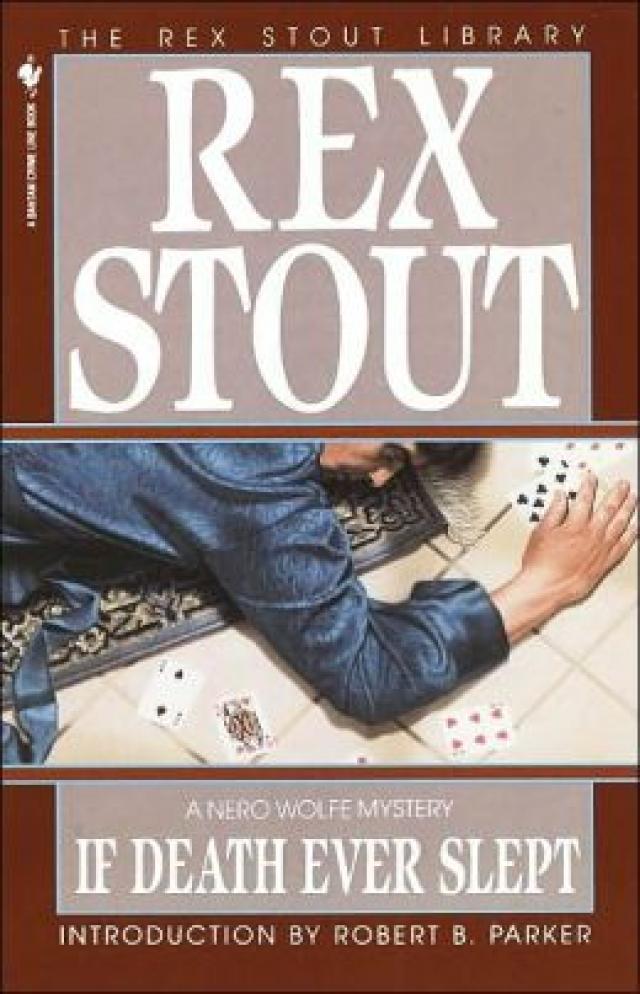
IF DEATH EVER SLEPT
A Bantam Crime Line Book / published by arrangement with The Viking Press
CRIME LINE and the portrayal of a boxed “cl” are trademarks of Bantam Books, a division of Bantam Doubleday Dell Publishing Group, Inc.
All rights reserved.
Copyright © 1957 by Rex Stout.
Introduction copyright © 1992 by Robert B. Parker.
No part of this book may be reproduced or transmitted in any form or by any means, electronic or mechanical, including photocopying, recording, or by any information storage and retrieval system, without permission in writing from the publisher.
For information address: Viking Penguin, a division of Penguin USA,
375 Hudson Street, New York, NY 10014.
eISBN: 978-0-307-75600-8
Bantam Books are published by Bantam Books, a division of Bantam Doubleday Dell Publishing Group, Inc. Its trademark, consisting of the words “Bantam Books” and the portrayal of a rooster, is Registered in U.S. Patent and Trademark Office and in other countries. Marca Registrada. Bantam Books, 1540 Broadway, New York, New York 10036.
v3.0_r2
Rex Stout, Rex Stout - Nero Wolfe 28 - If Death Ever Slept