

Wisteria Cottage, page 1


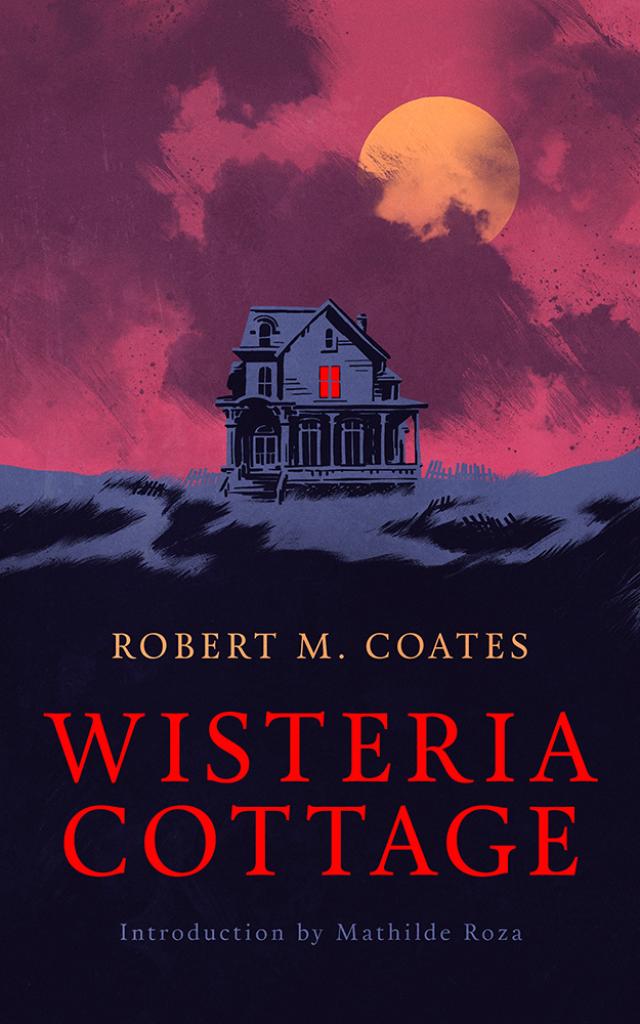
ROBERT M. COATES
WISTERIA COTTAGE
Introduction by
MATHILDE ROZA
VALANCOURT BOOKS
Dedication: TO BOO AGAIN
Wisteria Cottage by Robert M. Coates
First published by Harcourt, Brace & Co. in 1948
First Valancourt Books edition 2020
Copyright © 1948 by Robert M. Coates, renewed 1975
Introduction copyright © 2020 by Mathilde Roza
Published by Valancourt Books, Richmond, Virginia
http://www.valancourtbooks.com
All rights reserved. The use of any part of this publication reproduced, transmitted in any form or by any means, electronic, mechanical, photocopying, recording, or otherwise, or stored in a retrieval system, without prior written consent of the publisher, constitutes an infringement of the copyright law.
INTRODUCTION
Wisteria Cottage: A Novel of Criminal Impulse was published for the first time in 1948. Although more than seven decades have passed, the novel has lost nothing of its remarkable power of taking the reader into a disturbed man’s world. Robert M. Coates’s chilling rendition of protagonist Richard Baurie’s mind—derailed by suspicion, misogyny, and a messianic obsession with power and control—continues to be as sinister as it is compelling: “I could make you remember,” Baurie thinks, and, “I could make you forget, too.” Wisteria Cottage met with rave reviews when it came out. The New York Times Book Review hailed it as a “brilliant tour de force,” while The New York Herald Tribune praised Coates for his “superb imaginative excursion into the mind of a reluctant murderer.” The Saturday Review credited Coates with touching “top peaks of terror” and proclaimed the novel a “Grade-A Psycho-thriller.” Republished in 1985 for the last time, this book certainly deserves to be in print once again.
The novel tells the story of Richard Baurie, a former mental patient who is incapable of forming healthy human relationships. Richard worms his way into a lower middle-class family, consisting of a middle-aged mother and two young adult daughters, and pins all his hopes for a much-desired harmonious family life on “Wisteria Cottage,” an isolated summer cottage in the dunes along the Long Island shore. Richard discovers the cottage by accident and instantly knows this is the place for him: “It was a lovely place, all right, hidden, immaculate, secret, inviolate. It was a place where anything might happen.” He does his utmost to persuade the family to rent it for the summer and succeeds. Over the course of the season Richard descends into ever more frenzied madness, with disastrous, grueling results for the family.
Highly effective today, Wisteria Cottage also strongly reflects the time in which it was created: with World War II barely over, and the Cold War just begun, American (popular) culture developed a great interest in the phenomena of violence, crime, mental disorder and suspicion. These themes seeped into American culture on a large scale; the 1940s saw a rising popularity of crime writing, detective stories and hardboiled fiction. Next to the massive outpouring of dime novels and pulp fiction, the era saw the rise of the American film noir, with its characteristic emphasis on violence, death, troubled men, “vicious” women and nihilistic emptiness conveyed through low-key lighting and ominous shadows. Indeed, the poorly-known filmic version of Wisteria Cottage, the black-and-white, low-budget movie Edge of Fury bears many noir characteristics. The novel (and the film version even more so) also reflects popular culture’s deepening interest in psychiatry and psychoanalysis. The fragments of the “Psychiatrist’s Report” which form part of Wisteria Cottage clearly hint in that direction, as does the detailed description of one of Baurie’s dreams—an element reminiscent of Hitchcock’s inclusion of a dream, famously animated by Salvador Dali, in his noir movie Spellbound (1945), likewise concerned with murder and psychiatry.
Robert M. Coates (1897-1973) had published three novels before publishing Wisteria Cottage, but given the heavily experimental style of these books, most people knew him through his long association with The New Yorker: not only did he review books and visual art for the magazine, many of his short stories were published there. Coates’s stories of the 1930s and 1940s tended to be dark and violent, especially “One Night at Coney” (American Mercury, May 1934); “The Fury” (New Yorker, August 15, 1936) and “The Net,” a study for Wisteria Cottage which appeared in the New Yorker on January 27, 1940. Indeed, Coates had always had a keen interest in the darker recesses of the human mind—his first work, for instance, called The Eater of Darkness (1926), revolved round a futuristic “x-ray machine” which kills dozens of people. His best-known work today is his historical work on the bloody and violent land pirates of the Old Southwest, The Outlaw Years (1930), which continues to be in print today.
Although Coates was aiming at a wider audience with Wisteria Cottage than was usual for him, the writer’s penchant for experimental writing is visible here too. The writer structures his narrative by Richard’s moods and thought processes, and suggests his psychological states by the rhythm of his sentences, as well as by repetitions, rhyming patterns and associations. Also, there is the occasional bout of Coates’s signature use of parentheses, colons and semi-colons to convey the scattering impact of the city on the human mind. In chapter three, for instance, this style serves to convey how the noise of the Third Avenue Elevated, dismantled in the 1950s, weaves itself into Richard’s already restless mind as the trains rumble right past his tenement room window.
To readers familiar with serial killer lore, the name “Wisteria Cottage” might ring a bell; the novel’s title refers to a killing committed by the notorious murderer Albert Fish, who, among many other crimes, choked a girl to death in a deserted house that was referred to in the press as “Wisteria Cottage.” The case received extensive newspaper coverage in 1934, six years after the original killing, when Fish started sending anonymous letters to the murdered girl’s family, and is unlikely to have escaped Coates’s attention. In terms of plot, however, Wisteria Cottage is patterned after another murder case that took place in the early spring of 1937, when a psychiatric patient named Robert Irwin strangled his ex-landlady and one of her two adult daughters, and killed a male lodger with an ice-pick. The case inspired Coates to think about how to describe an act of killing in a literary work: “I began wondering,” Coates told his close friend Kenneth Burke. “If, I wondered, it’s hard for a person to kill just one person, what must it be like, in the sense of physical and mental strain and long-continued effort, to kill two or three?” In relying on actual murder cases, and including material such as the “Psychiatrist’s Report” in his novel, Wisteria Cottage anticipated the “true crime” genre, made famous by Truman Capote’s “non-fiction novel” In Cold Blood (1966). But Coates did not surrender his art to a clinical search for “truth:” what turns Wisteria Cottage into such an engrossing work of fiction is the great skill with which Coates conveys Richard’s distorted mind and sinister worldview. His rendering of Baurie’s deteriorating grip on reality, never hysterical but always low-key, is frighteningly genuine and constitutes the book’s most memorable aspect. Impressed with the quiet confidence of Coates’s approach, Commonweal noted: “No tiled asylums, no mental bedlams are employed to wring the reader’s emotions. Wisteria Cottage is simplicity itself, as direct and frightening as the uncoiling of a serpent.”
Mathilde Roza
Mathilde Roza is Associate Professor of American Literature and American Studies at Radboud University Nijmegen, the Netherlands. She is the author of the literary biography Following Strangers (University of South Carolina Press, 2011), the only available book-length study of the life, career and literary works of Robert M. Coates.
1
From the Psychiatrist’s Report:
“It is usually difficult to determine the exact moment when a criminal intention first enters the subject’s brain. But in the case of Richard Baurie it apparently was at least adumbrated, even though faintly, the first time he saw the house called Wisteria Cottage. . . .”
Richard didn’t know the cottage by that name at first, of course. He had been on a three-day walking trip at the time, a thing he often did when he could get time off from the bookshop where he worked—and he was rapidly learning that he could get time off more or less when he wanted it, by simply taking it. And this time he had taken the train at random out Long Island, getting off again purely on impulse at a likely-looking station that turned out to be the village of Smithtown.
The time was late April, but already the weather was warm. He wore shorts, a brown jersey, a beret, and an old pair of heavy climbing boots. He had a rucksack and blanket roll; and quite unmindful of the slight stir of interest he caused along his passage—or if momentarily mindful, he smiled his thin, indrawn, taunting smile and ignored it—he struck east on the town’s main street and then north along a side road that promised to be less traveled; since he’d started from the city that morning early, it was still only mid-afternoon when he reached the sea.
It was the Sound, of course, and the section where he first came upon it was the cluster of little islands and inlets around Setauket; the sea that day, as far as eye could reach, was absolutely calm and lake-like. It was so still that it bothered Richard a little. He had expected to find sound and movement, the pound and heave of surf and spray flying; that was what he had been in the mood for, and the almost listening calm of the water disconcerted him. It was too quiet, too secret, too observan
It made him nervous, it troubled him, and with Richard nervousness always was a spur to action; there was once when he walked right down to the edge of the water and yelled.
It was a narrow beach, and pebbly, that he happened to be on at the time, and it was bordered by a broken-down breakwater made of pilings, with behind that a roadway and bungalows. But the place seemed deserted, and without really thinking what he was doing Richard walked down to the brink, where the sea’s incessant faint stirrings were made visible at last in a soft, lazy, wavering, fractional reaching and receding among the sand and the pebbles, and yelled.
He yelled meaningless things at first, yowls and catcalls and so on, and then an idea began to take hold of him.
“Hey!” he yelled, “HEY! Is anybody out there? Why won’t you answer?”
There might really be someone or something out there, he thought, devils, maybe, or strange monsters, and they hiding, and that gave him a sense of challenge; he cupped both hands around his mouth and yelled straight out across the water till his face grew flushed and the words he was shouting ran together in a queer kind of rhythm of their own—HEYisanybodyOUTthere HEYisanybodyOUTthere—and he grew suddenly tired of it.
He dropped his hands. He kicked a pebble. “All right, then. All right,” he said aloud, as if in answer to the commands of some inner mentor, and then abruptly he whirled and looked hastily along the row of bungalows behind him. He knew how often and how shamelessly men—yes, and women too—spied on others, and the thought had occurred to him that the watcher might be there, silently observing him.
But there was no one in sight. The beach bungalows—there were only about a dozen of them in the row, and they were almost identical, shingle-sided in the Long Island fashion, shut-windowed, their deep, shadowy porches bare of all furniture and windswept-looking—all stood silent and deserted, gazing bleakly past him out toward the sea.
“There you are, sirs,” he said, and bowed slightly in the direction of his inanimate audience. “The poet. You have seen what the poets do when they’re alone. Try to remember.”
He smiled slightly. I could make you remember, he thought. But he did nothing about it. He remembered what he had been told and he did nothing about it, and after standing awhile looking carefully along the row he walked slowly on his way again. He had come almost to the end of the row, where the beach ran out into rocks and sedge and the shore line curved sharply inland; he had lighted a cigarette and he was breathing easier when, without warning, a small truck appeared around a bend in the road at the last bungalow and came rattling toward him.
Without hesitation, Richard made his way up the beach to the roadside and hailed it.
“Were you waiting around back there?” he said.
The truck was a made-over Ford, loaded down with pipe and other plumber’s supplies, and the driver, a small, worried-looking red-haired man in overalls, looked down at him curiously.
“Waiting? Where?” he asked. “You mean down at the Piersons’? I ain’t been there yet.” And then something in the incongruity of Richard’s appearance seemed to strike him. “You got something to do with the Piersons?” he said.
“Piersons? No,” said Richard. It had flashed across his mind at first that perhaps this man had been the watcher he had suspected; perhaps he had been parked in his truck around the bend in the road, waiting, listening, grinning cynically; he knew how often such things could happen.
But now the man’s manner was beginning to reassure him. He was either very clever or very simple, and in either case Richard decided he didn’t want to go into the matter further. After all, all he wanted was peace, and a chance to do a little walking. “I’m just out for a quiet little walking trip,” he said. “And I thought maybe you’d heard me calling. And I thought . . . Have you seen Johnny Guinan around here?” he added suddenly. “He’s the one I was calling for.”
The driver now was leaning down over the wheel, his red knuckles clamped around it, as if he couldn’t quite believe what his ears were telling him. He was clearly puzzled, and as his puzzlement increased Richard began to enjoy the encounter. “You say, calling?” the man said. “What’s that name again?”
“Johnny Guinan,” said Richard.
“ ’S he live around here?”
“Summers, he does,” Richard said. The name had simply popped into his head. It was a name he had read in the newspapers or had heard somewhere. Now he added another. “Is this Weldon’s Point?” he asked abruptly.
“Weldon’s Point?” the man repeated, more puzzled than ever. “You sure you got your names right, bud?” Then his glance became a little wary. He was being kidded, or something, and the trouble was he couldn’t quite figure out why; and the uncertainty made him uneasy. Richard recognized the signs, he knew the symptoms, and as the fellow’s uneasiness grew his contempt for the man increased. He had always hated fearful people, women or men, and the trouble was that there were so many of them. But if he showed any evidence, it was only that his eyes grew more somber.
“I think that was the name,” he answered mildly.
The man still stared at him. Richard was twenty-eight, not as tall as he thought he was, or as slim or as boyish, but as blond; he was actually rather stocky, of medium height, square-shouldered and heavy-thighed, with an expression that was at the same time impassive and slightly derisive, and to the man looking down at him as he stood on the lonely beach in his shorts and jersey and blanket roll he must have seemed something of an apparition. “Well, you’re on the wrong track somewhere,” he said, this time brusquely, as he slipped the car in gear. “There ain’t no Weldon’s Point around here.”
Richard stepped back smiling and bowed ironically, as a signal for the truck to proceed. “It doesn’t matter,” he said. “I was just walking.” Then he smiled more brightly than ever. “You know, doctor’s orders. And I just thought . . . I remembered a friend of mine . . . But it may be I’m in the wrong locality.”
“You’re on the wrong track somewhere, bud,” the man repeated, and drove off. Richard watched him go, then walked on a short way and looked back again. The truck was drawing up before the farthest bungalow, and as it came to a halt Richard dropped down behind the breakwater and, just peering over the tops of the pilings, watched it.
He saw the man get out and stand for a moment or two looking back up the roadway, as if wondering where Richard had gone. Then, apparently, he dismissed the problem. (I could make you remember, though, Richard thought.) But he seemed in no hurry to start about his work. The one moving figure in the rather barren vista, he walked slowly around to the back of the truck and let down the tailboard, stopped awhile then to light a cigarette and gaze out to sea, and then, lazily, took out some tools or something—it was too far away for Richard to distinguish clearly—and walked up the steps of the bungalow.
There was a glint of sun on glass as the door of the bungalow opened, then the man disappeared inside. But he came out again almost immediately, this time to fetch a length of pipe and some fittings, and again went back into the bungalow.
This time he stayed. He was at work, apparently, somewhere in the silent, winter-dusty bungalow, doing whatever he had come there to do. (And across Richard’s mind there flitted swiftly, glancingly, a vision of the tools on the oilcloth floor and the man in his overalls bending, preoccupied, by the sink; it would be in the kitchen, musty and dusty from long shut-up-ness, and as Richard crept through the door there would only be the faintest creak of the flooring to betray his presence. But it would be enough to make the man turn, and see, and shriek. God! What shrieks! I could make you remember, Richard thought. And then the limp, salt-soused figure, the face oozing blood, and the blood sluicing off on the waves. “I could make you forget, too,” he said.)


