The Avenger of Castle Wick, page 1


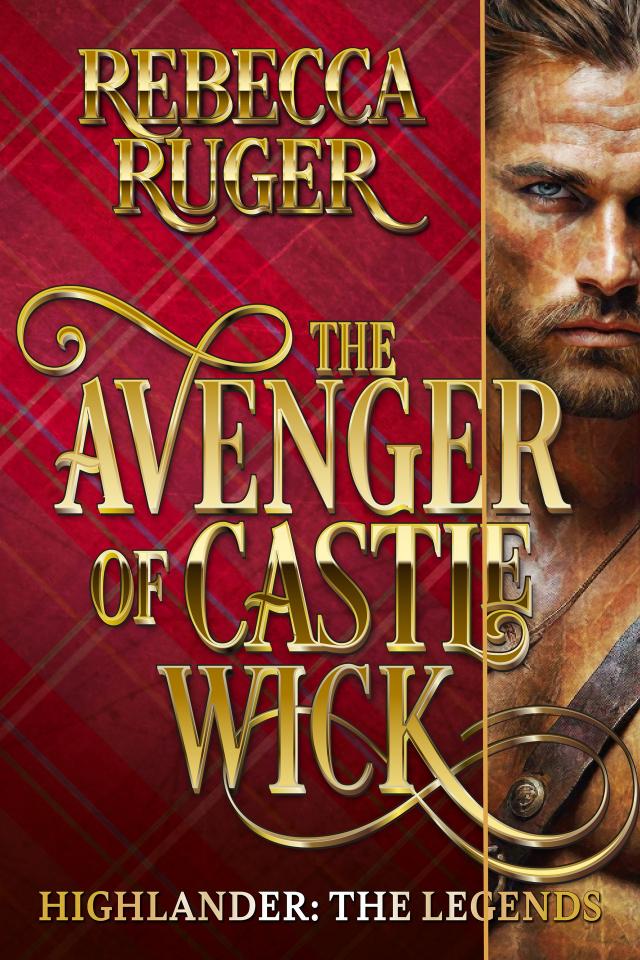
The Avenger of Castle Wick
Highlander: The Legends, Volume 8
Rebecca Ruger
Published by Rebecca Ruger, 2024.
This is a work of fiction. Names, character, places, and incidents
are either a product of the author’s imagination
are used fictitiously, and any resemblance to actual persons,
living or dead, events,
or locales is entirely coincidental.
Some creative license may have been taken
with exact dates and locations
to better serve the plot and pacing of the novel.
ASIN: B0CVYD9WV7
All Rights Reserved.
Copyright © 2024 Rebecca Ruger
Written by Rebecca Ruger
All rights reserved. No part of this publication may be reproduced,
distributed or transmitted in any form or by any means,
or stored in a database or retrieval system,
without the prior written permission of the publisher.
Disclaimer: The material in this book is for mature audiences only
and may contain graphic content.
It is intended only for those aged 18 and older.
Table of Contents
Title Page
Disclaimer
Prologue
Chapter One
Chapter Two
Chapter Three
Chapter Four
Chapter Five
Chapter Six
Chapter Seven
Chapter Eight
Chapter Nine
Chapter Ten
Chapter Eleven
Chapter Twelve
Chapter Thirteen
Chapter Fourteen
Chapter Fifteen
Chapter Sixteen
Chapter Seventeen
Chapter Eighteen
Chapter Nineteen
Chapter Twenty
Chapter Twenty-One
Prologue
Dunraig Castle
Craigroy, Scotland
1292
THE AUTUMN AIR WAS crisp, swirling around Morag and Elspeth as they perched upon two log stumps inside the bailey of Dunraig Castle, their skirts brushing the packed earth. The towering stone wall of the fortress cast a long shadow, in which they sat, speaking in low voices. While the distant sound of clanging swords echoed from the training grounds of the Rose army, inside the bailey the rhythmic whoosh of arrows filled the air as the young Rose lads honed their skill with bow and arrow.
In a far corner of the castle’s yard, a group of washer women bustled about a steaming cauldron under the watchful eye of the laundress, their working song low and droning, the sound as familiar as the creak and groan of the bucket being drawn up the well or the soothing, repetitive cooing of the doves in the cote.
A pair of hawks circled lazily overhead, their piercing cries occasionally punctuating the scene inside the yard below. Here and there, someone or another would cast their gaze toward the sky, tracing the flight path of the hawks.
Between the two women sat a kettle, half-filled, and the lap of their skirts were the remaining beans upon which they worked to trim.
From under a heavy brow, Morag herself cast a glance askance at the sky, though not at the circling predators. “A proper soaking we’ll have ere the day is out,” she predicted.
“Aye, that we will,” Elspeth agreed, looking equally annoyed at the prospect. “Nae beauty in that, in ye and I being forced indoors, putting up with that one.”
That one was Greer Rose, the laird Callum Rose’s new wife. Less than half his age, she possessed not a fraction of his wit or charm, and many thought it nearly criminal that she might taint the bloodline of the legendary beauty of the Roses with her unsightliness. But mayhap those outside watchers worried needlessly. A year and a half they’d been wed and still no bairns coming.
Callum Rose had wanted a mother to his four bairns but got, instead, what the two ancient retainers thought was a harpy, her tongue, according to Morag, sharp enough to split rocks.
Morag harrumphed. “It canna be only me wants to feed her straw in through those big horse teeth.”
Despite the absence of many of her own teeth, Elspeth’s responding wide grin illuminated her weathered face, transforming it to a long-forgotten youth in an instant. Lines etched with countless years softened, and her eyes sparkled with good humor.
“God’s bones,” Elspeth chortled quietly, leaning her upper body toward Morag, “and the first one so bonny, ˈtwas a joy to look upon her. But that one in there now—I canna look directly upon her lest these auld eyes shrivel up and lose sight altogether.”
Morag nodded in agreement as she carried on with her task, her wrinkled hands moving with practiced efficiency. “Proper nuisance she is, always scolding, barking orders so loud as to be heard over the hounds baying.”
“Aye, and mark my words, she’ll be the ruin of this household if the laird dinna rein her in soon enough,” Elspeth predicted, as she had a dozen times in the last year.
“A bairn’d be the best thing for her,” Morag supposed, “keep her oot the kitchen.”
“Aye, but nae guid for the lass, lost already with nae mam, unseen amidst those brothers of hers.”
Covertly both women glanced up and across the yard, where the laird and his armorer watched and encouraged the three Rose sons—the oldest of whom had just marked four and ten years—as they continued with their archery practice. Beyond that group, her small frame barely visible against the backdrop of the fortress’s shadowed wall, stood Fiona Rose, the youngest of the laird’s bairns. Born seven years ago to Callum and Catriona Rose, breathing her first breath as her mother took her last, Fiona was imbued with much of the Rose temperament, being spirited and intelligent, but lacked what some might argue would most benefit her, the Rose confidence. On so many occasions in her father’s company, she stood in the background, only waiting and hoping to be noticed.
Long-tenured retainers of Dunraig Castle, Morag and Elspeth could recall many generations of Roses and had watched the last of the line at this point, Fiona, grow from a babe in arms to an occasionally feisty lass. The child possessed a wisdom surpassing her years, often overshadowing even her stepmother in matters of sense, and displayed a resilience that outshone at least two of her brothers. Yet beneath her wee outward strength lay a profound and unspoken longing for the tender affection that eluded her within the austere walls of her home, where her stoic father looked through her and her cold stepmother ruled without the tiniest hint of warmth.
Cheerless were there hearts, Morag and Elspeth’s, for it seemed an injustice that a child born to such lineage should find herself at the mercy of indifferent guardians, without the advocacy or tenderness of a mother to guide her.
“Och, but ˈtis all suspect,” said Elspeth, “that hair of hers. Nae a strand of black to be found.”
“Hush,” Morag chastised. “Dinna go on with that nonsense. Aye, the Roses now and as far back as our recalls stretch were all black of hair with skin as pure as sweet cream. And so this one’s nae got either of those things and wot ye want to make of it? Dinna be saying what I ken ye—”
“I’m nae saying anything,” replied Elspeth, who then did go on to say, “but that it dinna follow reason.”
“I dinna like when ye insinuate that,” Morag hissed. “Was nae her mam a saint and dinna we ken it? She’d nae have forsworn her laird.”
“More the pity, then,” Elspeth returned with just as much vehemence. “if she is of his bluid, all the more shameful for how he regards her. Or, to be more precise, how he dinna regard her at all.”
“Aye, poor lass,” Morag remarked with a click of her tongue, her heart heavy with sympathy. “Ye’d ken with eyes like that, she could have whatever she wanted. Like her mam’s only brighter, the green. But nae, a wee bird trapped in a cage, she is, chirping for any morsel from the laird.”
“He’ll have to do,” Elspeth remarked, inclining her head toward the soldier, Fraser, who had a soft spot for the lass. “If’n she resembled him at all,” she went on, her tone hushed, “I’d wager he’d been the one who sired her, with the way he coddles her.”
'Twas no secret among the retainers and household staff that Fraser MacHeth, cousin to the lass’s late mother, had been the one to first put the lass atop a mare, teaching her to ride. On occasion, he had even allowed her to join her brothers' training, though always in the laird's absence.
“Bah, Fraser would nae ever have betrayed the laird. A proud clansman is he, guid heart an’ all, and is the lass nae better for it?”
They sat in silence briefly, each with their thoughts, until Elspeth commented, “Too young yet to understand herself, but aye, she’ll find her voice one day.”
“Wot she needs is wings,” Morage suggested, “so that she might fly.”
“Nae wings for that lass. Look at her eyein’ them weapons in the hands of her brothers. Like gold they are to her, which she’ll nae doubt use to buy the laird’s attention or affection, whatever wee piece he’ll give her. She’ll want a sword and her own bow, ye mark my words.”
Chapter One
Near Auldearn, Scotland
Early Summer 1307
AN EARLY MORNING MIST clung to the hills in front of them, blurring the boundary between earth and sky. The first light of dawn revealed a procession of men and horses, the constant drum of hoofbeats rumbling through the stillness. The air was damp and cloying and carried with it the scents of pine and damp earth, blending on this morn with a tang of salt as they neared the sea.
Austin Merrick, son of the mormaer of Dalcross, Dougal Merrick, rode at the helm of his army. Though his father was keen of mind, his body was not so agreeably robust, failing him more every day so that he could not, now and for the last year, even sit a horse. Austin served in his stead, leading the Merrick army into battle on countless occasions, continually amazed that he lived yet, having survived as he had when his brothers, better prepared and trained for just this role, had not.
The Merricks of Balenmore Keep in Dalcross traced their lineage back to Norman conquerors who had eventually settled primarily in Wales two centuries ago before a few of those Merrick ancestors, fierce and ambitious, had come not by land but by sea to carve out a new life in the rugged Scottish terrain.
Before the Merrick army had begun their march three days ago from Perth, he’d made the mission clear to his army.
“We ride for Auldearn,” he’d called out to a force greater than one hundred in number that had stood at the ready before him. “There, we meet with Sir John Urry and his militia. Our task is clear and comes directly from Robert Bruce: seize Castle Wick and secure the River Nairn for transport. We will oust Sir Gervaise de Rathe from the castle and thereby extinguish English power in the north!”
More than one hundred warriors, their spirits as rugged as the land, answered with hearty shouts and a clanging of weapons, knowing well the stakes. Castle Wick was a strategic cornerstone, a stronghold that would allow them to control the vital supply routes along the Moray Firth and the River Nairn. It was a bold move, but necessary, at a time when too many Scottish nobles kept faith with the English, refusing to support Robert Bruce as their true monarch.
On this, day three of their march, his army followed in disciplined silence, their faces set with grim determination.
At length, the sun rose higher, burning away a great majority of the fog, save for that which swayed in a wispy fashion over the tallest mountains, revealing a landscape that was as harsh as it was breathtaking.
The path to Auldearn stretched before them and Austin Merrick tightened his hold upon the reins. As sometimes happened, he was filled with a wee bit of pretender’s burden, having never expected to lead much more than his mates into rabblerousing trouble, or his shuffling feet into his sire’s domineering presence, awaiting punishment for what his father deemed his derelict behavior.
Such was the plight of the third son, having few to no expectations, only to be thrust into a role for which he felt distinctly unqualified. His brothers, Andrew and Alexander, had been educated and trained in excess, the heir to the thanedom and his replacement should he fall. Clearly, his father had never imagined losing two sons before his own interment in the crypts, and thus had not subjected Austin, several years younger than his stalwart brothers, to the same stringent standards. He’d had to learn fast the ways of leadership and effective warfare, thrust into the crucible of responsibility as he’d been in the last few years. Each action, decision, and idea weighed heavily on his shoulders, the expectations of his sire and the memory of his fallen brothers a constant presence.
When they were still a good dozen miles south of Auldearn and marching through what was known as safe territory, the land unclaimed by any clan because of its inhospitality, the barren hills and rocky soil unsuitable for farming or even sheep raising, a marching song was begun by Ioan. Others promptly joined in, and the rousing melody carried across hill and glen.
Austin did not sing along but did grin with some amusement, likening the bawdy lyrics and jaunty tune to one better suited to a taproom after several rounds of ale had been consumed.
Shortly after noon, they crept stealthily into Auldearn, quiet now in the hopes that their arrival went unnoticed, being fairly close to Castle Wick and the enemy. Scouts sent ahead to survey the area returned to Austin, reporting the precise location of John Urry and his militia, and the Merrick army approached cautiously until their banner was recognized.
Austin rode through the Urry camp, which was situated near a fresh water stream, ensuring a reliable supply for the men and horses. Dense clusters of pine trees provided cover for the large presence and a ready source of firewood. He noted the orderly arrangement of tents and the well-trodden paths between them, suggesting Urry and his army had been here for some time. Urry’s private bell tent, easily identified by its central supporting pole and the banner flying above it, stood at the heart of the camp, surrounded by a cluster of smaller tents belonging to his officers and guards. Though of considerable size, Urry’s tent was pitched low to the ground with sturdy stakes and ropes in an effort to withstand strong Highland winds.
John Urry stood directly in front of his tent, a figure of nobility whose presence seemed more suited to a banquet hall than a battlefield. His sharp brown eyes scanned the arriving troops with an air of detached curiosity rather than command. Paunchy and unfit, his posture lacked the rigidity expected of a military leader. He wore a thick, luxurious woolen cloak draped over his shoulders, fastened with an ornate silver brooch that glinted in the sunlight, more a symbol of his wealth than his competence.
His hair, a tousle of dark waves with early streaks of gray, framed a face that bore the soft lines of indulgence rather than the hard edges of battle. Years of enjoying the finer things in life had left their mark, and the fierce Highland winds seemed to have weathered him less than the comforts of nobility had. He exuded an air of authority, but it was the kind born of status rather than seasoned experience.
Austin dismounted and approached, extending his hand to Urry, his grip firm and steady.
"Merrick," the man greeted, his voice high and light, "ye made good time, lad. Welcome to Auldearn."
“How do we stand?” Austin inquired, getting right to the matter at hand.
He would have much preferred to be at the king’s side rather than under Urry's command. Urry's authority and fighting acumen were largely unknown to Austin, and the decorative sword on the man’s hip did little to inspire confidence. It was clear that the weapon was more for show than for use, a questionable indication of his competence.
“Better now,” Urry answered. “It will nae come easy, the taking of the castle.”
“Who do we have?”
John glanced around the expansive camp, the immediate area thinly veiled by the pine trees but appearing to stretch quite a distance in every direction.
“Me and mine, the MacLarens, and ye and yours,” he said. He pointed vaguely toward the northeast. “And the Roses have come,” he informed Austin, “or what remains of them.”
“Christ,” Austin seethed, his teeth grinding at the very mention of the name Rose.
The Merricks had long shared an animosity with the Roses, the origins of which were still talked about.
Many decades ago, his great grandfather had courted a Rose daughter. A betrothal was contracted, and the wedding and feast planned but only days before they would have wed, the Rose daughter eloped with a suitor from her own clan—a tanner no less. Austin’s jilted ancestor, humiliated and heartbroken—ˈtwas rumored he adored the Rose lass—vowed vengeance, thus igniting a generational feud. Not unexpected, the betrayal sparked the flames of discord between the two families, and a constant fanning of those flames over many years ensured the fire never died. Each generation found new reasons to keep the feud alive: suspiciously lost sheep, an evidently poisoned well, a brawl at a market, slights that were magnified by the long memory of collective animosity, each side convinced of their righteous indignation. Hatred became a legacy, passed down like an heirloom, with each new generation taught to stoke the embers of spite, ever awaiting any opportunity to know even the tiniest bit of retribution.
Urry stiffened and frowned. “I dinna care about yer feud, lad, of which everyone is familiar,” he said, using the term lad incorrectly since he wasn’t but a handful of years older than Austin. “The king has set us a task and to that we will keep. And ye, my friend,” Urry said pointedly, “will refrain from introducing your personal quarrels into my campaign.”
“Aye,” Austin agreed, though it sat unwell with him.
He was to some extent mollified by the fact that the auld laird, Callum Rose, lived no more—self-righteous bastard he was, Austin’s father had always indicated. Last he’d heard, to his delight and for which he felt no shame, the Roses had lost everything—father, a few sons, and their fortress Dunraig Castle, the keep overtaken by clan Mackintosh within the last year. He wasn’t sure what the Roses could possibly bring to this combined army, as it was rumored their own had been reduced so greatly that they could offer hardly more than a few score of men to any fight.