

The Map Colorist, page 1


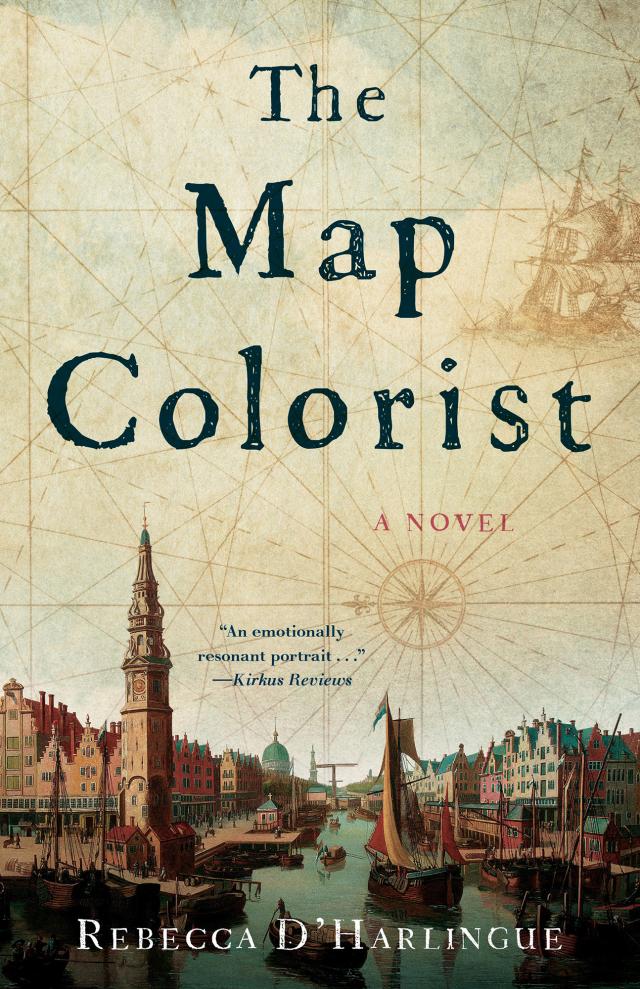
Also by Rebecca D’Harlingue
The Lines Between Us
Copyright © 2023, Rebecca D’Harlingue
All rights reserved. No part of this publication may be reproduced, distributed, or transmitted in any form or by any means, including photocopying, recording, digital scanning, or other electronic or mechanical methods, without the prior written permission of the publisher, except in the case of brief quotations embodied in critical reviews and certain other noncommercial uses permitted by copyright law. For permission requests, please address She Writes Press.
Published 2023
Printed in the United States of America
Print ISBN: 978-1-64742-547-0
E-ISBN: 978-1-64742-548-7
Library of Congress Control Number: 2023907751
For information, address:
She Writes Press
1569 Solano Ave #546
Berkeley, CA 94707
Interior Design by
She Writes Press is a division of SparkPoint Studio, LLC.
This is a work of fiction. Names, characters, places, and incidents either are the product of the author’s imagination or are used fictitiously. Any resemblance to actual persons, living or dead, is entirely coincidental.
For my beloved grandchildren, Lily and Oliver, as promised
Historical Notes
The Atlas Maior, printed by the Blaeu printing house, was the largest and most expensive publication of the seventeenth century.
The Dutch East India Company (Vereenigde Oostindische Compagnie) is generally referred to as the VOC. The Dutch West India Company (West-Indische Compagnie) is referred to as the WIC.
Prologue
Amsterdam
June 1699
Anneke
If he had known how it would end, my father would have struck the paintbrush from my young hand. Even so, my mother would have quietly retrieved it, saying she was teaching my brother and me a useful skill. What she would not have said was that the income she made from map coloring allowed us to live a more comfortable life, concealing the fact that my father was not as successful an artist as our circumstances might imply.
The coloring meant different things to each of us. To my mother, it was not only a chore that she carried out as part of her housewifely duties. It also allowed her to, in some small way, take part in the artistic world to which she had aspired. To my brother, it was a spark for his imagination. Where were these places that we so tirelessly transformed? What kind of people lived there?
For me, the task itself was sheer joy. The colors, the beauty I could create, insured that I never resented the work asked of me. I even dreamed of drawing my own maps. This desire would come into play in the unraveling of our lives, but I embraced it, and with it, all that was to come.
Chapter 1
1646
Every night before drifting off to dream, Anneke and Lucas prayed, snuggled into their box bed, and listened to their father’s tales of Africa. Sometimes he spoke of the different peoples his group had come across and of the houses on stilts he had seen. Sometimes he spoke of the heat and the quick, heavy rain. Sometimes he spoke of the terrain, difficult and beautiful. Then he would stop speaking, as though he were there again, and the children often wondered whether he wished himself back in those lands, so different from their home of Holland with its dikes and windmills in a never-ending battle to keep the sea at bay.
When Anneke and Lucas asked him to describe the food, he always spoke of the fruit: bananas, coconuts, melons, and tamarinds.
“It is not just the taste, my children, but the feel of them in your mouth.”
“And what is that like, Papa?” they would always ask.
“Like the cool of the night and the warmth of the sun. Like biting into everything sweet in life.” Anneke would whisper to herself, “tamarind,” and she felt those sensations within the beauty of the word.
“But what do they really taste like, Papa? Name something we have that is like them,” seven-year-old Lucas would insist, and his sister, all of a year older, would roll her eyes. But the only answer Isaac ever gave his son was, “Like nothing you have ever eaten.”
Most of all, the children loved to hear of the strange beasts. There were large cats with spotted coats that ran faster than any horse, and those that seemed a strange breed of horse with black-and-white stripes.
“There are mysterious enormous creatures with long tubes connected to their heads where one would expect a nose to be!” their father would say, and the children would gleefully cry out, “But that is just an elephant, Papa—an elephant with a trunk!”
“Just an elephant!” he would say. “But you cannot imagine what it is like to see one.”
“We’ve seen pictures, Papa. You’ve even drawn pictures for us.”
“So I have, children,” he would say, and his mind would wander to the suspicion he always felt that his drawings might not accurately portray things he held only in his memory.
“Still,” he would continue, “you cannot imagine how thrilling it is to see a real elephant! Before you were born, before I went to Africa, there was a real elephant brought to Amsterdam. Her name was Hansken. The great artist Rembrandt van Rijn himself made many drawings of her, so fascinating did he find her. She was brought from Ceylon and so was a bit different from the elephants I saw in Africa. Even having seen her, I was not prepared for the first time we came across elephants, some using their trunk to pull branches from the trees to feed themselves, some taking up water with their trunk to drink. These elephants were larger than Hansken, with much bigger ears, and they had huge curved tusks coming from their mouths.”
“Were you frightened, Papa?” Anneke always asked, though he had answered her many times.
“No, sweet one. I wasn’t, but I don’t know why.”
The children were vaguely aware that there was a hint of obsession in their father’s tales, though they would not have known how to name it. They had been very young when their father had left them and their mother, Lysbeth, for Africa. He had been part of the 1642 expedition when Jan van Herder had gone to meet with the king of Congo, Nkanga a Lukeni, called Garcia II by the Portuguese. They had gone to Mbanza Congo, called San Salvador. When his mission there was completed, van Herder had pushed his group further, and they had traveled inland to the river Kwango, proceeding in a northeasterly direction.
It had been like a new world opening to Isaac. Everywhere there were wonders, and sometimes terrors. His task had been to make sketches of the land and of the animals and of the peoples. And he had done so at a frenzied pace for weeks on end. There was so much to see and record, and Isaac wondered how God had created lands so different from all he had known that they seemed not to belong to the same world at all. Isaac had used his talents to record all that he could. He wanted his countrymen to see what he had seen. But he also wanted more. He wanted to be recognized for what he would bring home. He wanted to be accepted as an artist, and perhaps even to be respected by the scholars of the day. He, who had come from a humble background, longed for this. Perhaps he could gain fame.
Fate would not have it so, however, and he consoled himself that it must not have been God’s will. On the ship’s journey home, they were caught in a storm. Isaac had brought his satchel with all of his drawings onto the deck when he had gone up to sketch some of the sailors. The storm approached quickly, and he ran to help the seamen as best he could. After the storm, he searched for the bag everywhere, but his efforts were fruitless. Abandoned, it must have been swept overboard.
When he went below deck to the area he shared with some of the other skilled men, there were papers scattered on the floor near his hammock. Picking one up, he saw that it was a page of the copious notes he had written about the land itself. They must have fallen from his satchel when he had gone on deck before the storm and so were saved from oblivion. So distraught was he at the loss of his drawings that he barely looked at the pages he gathered up. He guarded them for the rest of the journey, but gone were his dreams of glory. Who now would know the name of Isaac van Brug?
Chapter 2
July 1652
As did so many in the city, Isaac and Lysbeth worked in their home. Isaac did his paintings, and Lysbeth colored maps. Like most colorists, she worked anonymously. No buyer would know whose hand had applied the hues that brought a map to life.
From the time their children were very young, Lysbeth and Isaac had believed that they should be educated. Isaac had especially insisted that this should be the case for Lucas, and Lysbeth had adamantly argued that Anneke should not be left behind. Lysbeth’s coloring helped to pay for better schools so the children would become proficient at reading and writing, and even learn mathematics. For their part, the children did well in their studies and enjoyed their lessons.
When Anneke and Lucas reached the ages of fourteen and thirteen, Lysbeth decided that she would add more to their education by teaching them to color. She explained which colors to use on each part of the map. Yellow and occasionally crimson defined the outline of the map. Roadways were red and white, or yellow shadowed with burnt umber. Red or yellow, or sometimes green, marked the borders of places. Lysbeth’s plan was to get Anneke and Lucas to such a skill level that they could do the basics and she could devote herself to the more elaborate, and more satisfying, decorations found on most maps: cartouches, scrollwork, botanicals, gargoyles, costumed figures, scenery, the compass rose. In this way, they would increase the family’s income and security, for
At first, Lysbeth drew simple maps for Anneke and Lucas to color. Sometimes she would copy the major parts of a map that she was working on, but more often she would draw a map of a fantastical place: the land of the green men, the land of the purple cows, the land of the giant trees, the land of magical creatures. Though Anneke and Lucas sometimes felt that their mother thought of them still as young children to be amused in this way, they happily forgave her this common mother’s error, and the tedium of the work was eased for all three of them. Anneke and Lucas would ask their mother to draw decorative elements that went with the names of the places, and sometimes they suggested imaginary places.
“Draw the land of the eels, Mama,” Lucas would say, and they would all laugh since Lysbeth had a particular aversion to eels and would never cook them.
“You know that they live in water anyway, Lucas,” she would say, and he would reply that she could draw a map of the sea.
“How about a map of the land of handsome men, Mama,” Anneke would ask, and their mother would raise her eyebrows, smile, and set to work.
When Lysbeth thought it was time to practice on real maps, she spoke to the pressman at the printshop. Might she have some maps that had to be discarded, perhaps some that had been wrinkled in the press? They were just for practice for someone she was teaching to color, she assured him, and she would destroy them once they had served their purpose. She was rewarded with several prints of a map of Portugal.
Anneke and Lucas hovered next to her when she unfurled the defective maps, as though she were revealing a treasure. Following their mother’s lead, Anneke and Lucas began by covering the hills of Portugal with a thin layer of tincture of myrrh. For the woods, every tree was marked with a fine pencil dipped in grass green, made of copper green tempered with gamboge. As they worked, Lysbeth praised or gently guided her children, reminding them to mimic her work as closely as they could.
They painted the names of the cities and towns in red to make them stand out. When that was dry, they worked on the border of a province, again using the green, making sure the paint was no thicker in one spot than in another. To refine the line, when the paint was almost dry, they took a clean pencil dipped in water and went around the line again, until giving the illusion that it grew fainter at the edges. Then they repeated the process with another province, this one yellow, and the next a crimson made from cochineal.
When Lysbeth compared the three completed maps, she found that each was slightly different. “We will begin again, children. Yours must look the same as mine. There is a required uniformity to this work.”
“But you didn’t color everything according to the general guidelines you had told us before, Mama,” Anneke protested.
“That is true, child, but each map is unique. You will learn what is called for with more practice.”
“Will we never be able to use our own ideas, Mama?” the girl persisted.
“You have just started, Anneke! How can you even have notions of your own? Perhaps someday you will have the wisdom and freedom to stray a bit from the usual color schemes, but for now, you must learn to do exactly what is expected.” Then, turning to her son, she said, “What do you say, Lucas? How do you feel about coloring your first real map?”
“Where is Portugal, Mama? I would like to go to Portugal,” Lucas responded. His mother noted both that he had not answered the question and that he was anxious to leave her for a place totally unknown to him.
“Perhaps someday you will venture out, Lucas. For now, let us try again.” With that, Anneke and Lucas turned to the paints that Lysbeth had prepared. There would be no income from their use this day, but she told herself that she was investing in their future.
They practiced thus for several months, some days passing more pleasantly than others. At times, the discipline required to sit working for hours after they returned from school caused Lucas to complain, and Anneke’s patience with the standard color scheme waned. But the atmosphere was never greatly tainted by these protests, and for the most part, concentrating on a common task seemed to bring the three closer together.
After six months of practice, Lysbeth deemed her students ready and got up the courage to speak to Heer Alders at Blaeu’s printing house, whose maps she painted. She told him what she had been doing and held her breath until he asked, “Why are you telling me this, Vrouw Plettenburg?”
“Because I would like to start them on coloring maps for the House of Blaeu, Heer Alders.” She had hoped that her value as a colorist would weigh in her favor in this request, but she was just about to look down and admit that her idea was unreasonable when Alders replied. “Very well. You may begin them on some simple maps for which they can do just the basic, prescribed coloring, and which we sell to those who can afford no better.”
“Thank you, Heer Alders!” Lysbeth said, smiling while he informed his assistant of the new plan.
Over the next year, Lysbeth became ever more aware that each of her children was developing a particular style, and so she decided that it would be more satisfying, and in fact more efficient, for each to work on a project from start to finish. This precluded any disagreements on how to proceed, for under her tutelage, Anneke and Lucas had gained confidence enough to sometimes question their mother’s plan, though they did not stray far enough that she needed to correct them. If they did their own maps, the work would feel more integrated in its presentation, though few others would have the sensibility to discern this.
Lysbeth noticed that while Anneke gave meticulous attention to all parts of the map, she excelled at coloring the decorative elements, whether it was scrollwork, plants, animals, human figures, or buildings. After a time, she began to use colors other than the conventional ones for the map itself, choosing hues to match the scheme of the embellishments.
Lysbeth feared that Anneke’s fanciful plans risked her work being rejected, and each time it was not, Lysbeth questioned her own technique. Still, she told herself that she, too, incorporated artistry into her work. After all, she believed that she could have been an artist in her own right if she had ever been given formal training. She looked at her husband’s creations and felt that she could at least have equaled his efforts, although she loyally kept these thoughts to herself.
Even though Isaac did sell some paintings and was a member of the St. Luke’s Guild for painters, his work was not admired enough to attract any apprentices, who would not only have paid a fee but also helped with tasks such as preparing the canvases and mixing the paints, eventually working on the simpler parts of a painting which the master would then finish. This extra income and aid to efficiency were what allowed other artists to earn more than Isaac ever could.
The family could have survived on what Isaac earned, but Lysbeth wanted the comfort and security that the coloring allowed them. She knew that Isaac held himself the true artist of the family, and he poorly concealed the disdain he felt for the efforts of his wife and children. However, the extra income gave people the impression that Isaac was more successful than he was. This result, he did not disdain.
Chapter 3
January 1655
As his family labored over their maps and colors one dreary afternoon, with less light than they might desire, Isaac interrupted them.
“I have an announcement.” Lysbeth and Lucas immediately looked up from their tasks, Lysbeth from care for her husband and Lucas happy to take a break from work that to him had become tedious. Anneke, however, was so immersed in her map that her mother nudged her to get her attention, and it was clear that she only reluctantly raised her head. Noticing for the first time that her father had entered the room, she said, “Oh, hello, Papa.” They all indulgently smiled, accustomed to Anneke’s ability to shut out the world around her.
“As I was saying,” Isaac continued, “I have an announcement.”
“Yes, husband, and what is that?”
“I have decided that Lucas will go to the cartography school in Leiden to be trained as a surveyor and mapmaker. Thanks to the sacrifices we have made to give the children a good education, I feel that he will succeed. One of my patrons has been kind enough to see to it that he will find a place there, and I believe that it would be a reliable and respectable way to make a living.” Having uttered the few sentences he had prepared, Isaac waited to see how his family, especially his wife, would react to this news.


