

The Mahabharata: A Modern Rendering (2 Vols.), page 1


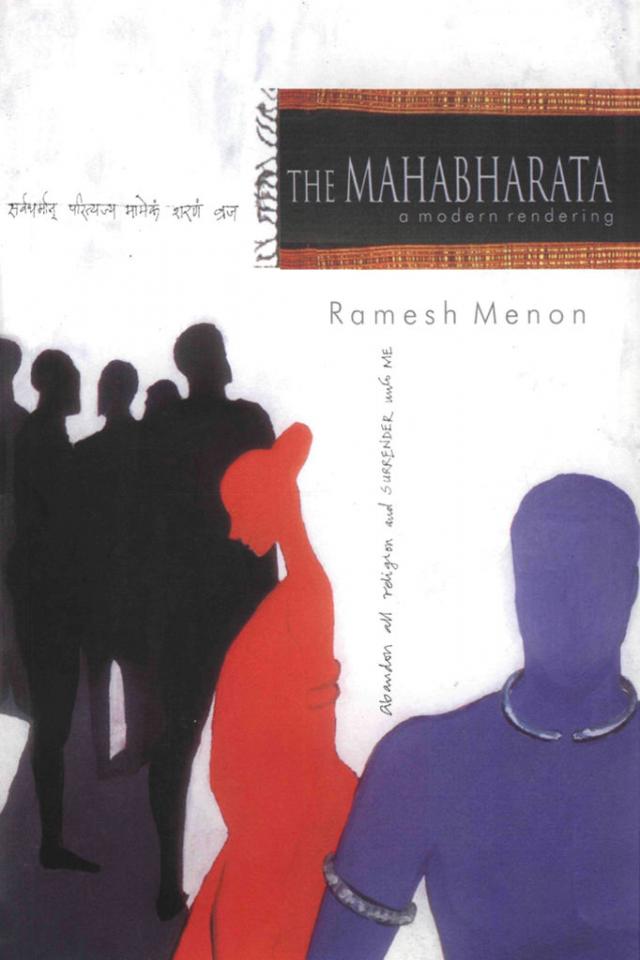
The Mahabharata is the more recent of India’s two great epics, and by far the longest. First composed by Maharishi Vyasa in verse, it has come down the centuries in the timeless oral tradition of guru and sishya, profoundly influencing the history, culture, and art of not only the Indian subcontinent but most of south-east Asia. At 100,000 couplets, it is seven times as long as the Iliad and the Odyssey combined: far and away the greatest recorded epic known to man.
The Mahabharata is the very Book of Life; in its variety, majesty and, also, its violence and tragedy. It has been said that nothing exists that cannot be found within the pages of this awesome legend. The epic describes a great war of some 5000 years ago, and the events that led to it. The war on Kurukshetra sees ten million Kshatriyas slain and brings the Dwapara Yuga to an end, and ushers in a new and sinister age: this present Kali Yuga, modern times.
At the heart of the Mahabharata nestles the Bhagavad Gita, the Song of God. Senavor ubhayor madhye, between two teeming armies, Krishna expounds the eternal dharma to his warrior of light, Arjuna. At one level, all the restless action of the Mahabharata is a quest for the Gita and its sacred stillness. After the carnage, it is the Gita that survives, immortal lotus floating upon the dark waters of desolation: the final secret!
With its magnificent cast of characters, human, demonic, and divine, and its riveting narrative, the Mahabharata continues to enchant readers and scholars the world over This new rendering brings the epic to the contemporary reader in sparkling modern prose. It brings alive all the excitement, magic, and grandeur of the original-for our times.
THE MAHABHARATA
THE MAHABHARATA
A MODERN RENDERING
Volume I
RAMESH MENON
In memory of my grandparents
Copyright © Ramesh Menon 2004
First Published 2004
Fifth Impression 2009
Published by
7/16, Ansari Road, Daryaganj
New Delhi 110 002
All rights reserved.
No part of this publication may be reproduced, stored in a retrieval system, or transmitted, in any form or by any means, electronic, mechanical, photocopying, recording or otherwise, without the prior permission of the copyright publishers.
Typeset in 11 pts. Simoncini Gramond by
Mindways Design
1410 Chiranjiv Tower
43 Nehru Place
New Delhi 110 019
Contents
Foreword
Acknowledgements
Preface
BOOK ONE: Adi Parva
On the banks of the Ganga
A tale of two curses
The river’s son
A scent of heaven
A solemn vow
Two princes
Three princesses of Kasi
Bheeshma and Amba
Amba
The solemn oath
Satyavati’s other son
The blind night and the pale one
In the dark
The three princes of Hastinapura
Kuntibhoja’s daughter
The blazing Deva
A curse in the forest
Pandu’s yearning
Kunti’s unworldly lovers
The sons of Pandu
The sinister night
Sweet, deadly spring
The Pandavas come home
The seeds of envy
At Pramanakoti
Under the river
A master for the Kuru princes
Drona’s story
The brilliant pupil
At the river
Ekalavya
A young man’s dreams
Karna finds a master
The exhibition
The golden warrior
Drona’s revenge
A father and his son
To Varanasi
The palace of lac
Fire
The tragic news
Flight through the jungle
A change of heart
Ghatotkacha
A sleepy town
A strange story
Encounter in the night
The spinning fish
‘Share the alms you’ve brought’
The unusual wedding
Anxiety in Hastinapura
The council at Hastinapura
Vidura in Kampilya
A desolate gift
Miracle in the wilderness
Narada visits Indraprastha
Ulupi and Chitrangadaa
The crocodiles
The Raivataka hill
The holy yati
The yati and the princess
Cure for an illness
Balarama’s anger
Draupadi’s anger
The Yadavas come to Indraprastha
The hungry brahmana
The burning of the Khandava vana
BOOK TWO: Sabha Parva
Mayaa
Mayaa’s sabha
Narada, the messenger
Yudhishtira’s quandary
Krishna arrives in Indraprastha
Jarasandha
Girivraja
The blade of grass
The four quarters
The Rajasuya yagna
A cousin’s anger
Dark omens
The green monster
Shakuni’s plan
An anxious messenger
The game of dice
Shame
‘Am I a free woman?’
The miracle and the oaths
Dhritarashtra’s fickleness
The second game of dice
BOOK THREE: Vana Parva
The Sun’s gift
The king’s brother
The rishis’ warning
Krishna swears an oath
Dwaitavana
The trials of Yudhishtira
Vyasa’s advice
Arjuna’s quest
The vetala
The Lords of light
Amravati
The weapons of Indra
The apsara Urvashi
The curse
The Muni Brihadaswa
Tirtha yatra*
To Badarikasrama
An old monkey
Where the saugandhika grows
Arjuna returns
Arjuna’s story
The wondrous city
Hiranyapuri
Bheema’s adventure
The riddles of Nahusha
Markandeya’s lore*
The four yugas
The foolish brahmana
Duryodhana’s ghosha-yatra
The shaming of Duryodhana
Despair
The powers of darkness
The Rishi Durvasa
Jayadratha
The lake of death
Yaksha prasna: the yaksha’s riddles
BOOK FOUR: Virata Parva
The thirteenth year
Kanka, the gambler
Ajnatavasa
The cook and the wrestler
Karna’s dream
The brahmana at noon
The queen’s sairandhri
The besotted Keechaka
Ballava’s night visitor
The long day
The angry gandharvas
Duryodhana’s spies
Virata’s battle
The prince and the eunuch
Uttara Kumara
Unearthly weapons
Dissension
The Kuru army
Arjuna
A gambler’s blood
The Pandavas
A wedding in Upaplavya
Glossary
Appendix
FOREWORD
A note on Hindu time and the Mahabharata
‘THREE HUNDRED AND SIXTY-FIVE HUMAN YEARS MAKE ONE YEAR OF the Devas and the Pitrs, the Gods and the ancestors.
Four are the ages in the land of Bharata: the krita, treta, dwapara and kali. The krita yuga lasts for 4800 divine years, the treta for 3600, the dwapara for 2400 and the kali for 1200; and, then, another krita begins.
The krita or satya yuga is an age of purity; it is sinless. Dharma, righteousness, is perfect and walks on four feet in the krita. However, from the treta yuga, adharma, evil, comes to the world and the very fabric of time begins to decay. Finally, the kali yuga, the fourth age, is almost entirely corrupt, with dharma barely surviving, hobbling on one foot.
A chaturyuga, a cycle of four ages, is 12,000 divine years, or 365 x 12,000 human years long. Seventy-one chaturyugas make a manvantara; fourteen manvantaras, a kalpa. A kalpa of a thousand chaturyugas, 12 million divine years, is one day of Brahma, the Creator.
8,000 Brahma years make one Brahma yuga; 1,000 Brahma yugas make a savana and Brahma’s life is 3,003 savanas long. One day of Mahavishnu is the lifetime of Brahma ...’
The Great War, the Mahabharata, is fought at the very end of a dwapara yuga, the third age, just before the sinister kali yuga begins. Once, in time out of mind, the Gods created the kshatriyas to establish dharma, justice, in an anarchic world. Most royal kshatriya bloodlines can be traced back to the Devas themselves: in the most ancient days, the Gods came freely to the earth. But in time, generations, the noble race of warrior kings has grown arrogant and greedy. By the end of the dwapara yuga, they have become tyrants, and they are still practically invincible.
Krishna, the Avatara, and his cousins, the Pandavas, are born to destroy the power of the kshatriyas of Bharatavarsha (India) forever. This is what the Mahabharata yuddha, the war on the crack of the ages, accomplishes; and thus, ushers in the kali yuga, modern times. By the Hindu calendar, the Great War was fought some five thousand years ago.
The House of Kuru is one of the oldest and noblest royal houses. It traces its origins to Soma Deva, the Moon God. Timeless Hastinapura, the city of elephants, is the capital of the Kuru kingdom and one great king after another has ruled from here. The legend of the Mahabharata begins with King Shantanu of the Kurus, and how a son is born to him. But that prince, Devavrata, will never sit upon his father’s throne. Instead, Shantanu’s blind grandson, Dhritarashtra, will become king.
The main theme of the Mahabharata is the story of Dhritarashtra’s sons, the Kauravas, and his brother Pandu’s sons, the Pandavas, and the enmity between them. Dhritarashtra’s hundred boys are evil princes, led by the eldest of them: the ruthless Duryodhana, who is a demon. Pandu’s five princes are Devaputras, Devas’ sons, born to fight for dharma in the world.
They are Yudhishtira, Bheema, Arjuna, Nakula and Sahadeva.
Almost every king in Bharatavarsha takes one side or the other in the Great War and ten million kshatriyas are killed. Dharma is established again on earth; but an age has ended and another has begun.
The Maharishi Vyasa, the poet of the Mahabharata, himself wanders in and out of the story. Unearthly beings—Devas, yakshas, gandharvas, nagas and apsaras—find their way into the story, as do demonic ones, asuras and rakshasas. The Mahabharata is set in a pristine and magical time of the earth. Its heroes and villains are all larger than life. The war itself is fought with occult weapons: the astras of the Gods.
Just before the war begins, the third Pandava, Arjuna, the greatest archer in the world, loses his nerve on the field of Kurukshetra. That perfect warrior cannot bear the thought of killing his cousins. Krishna, who is Arjuna’s charioteer, expounds the eternal dharma to him. This exposition is the Bhagavad Gita, the Song of God. The Gita is the heart of the Mahabharata, its real treasure. At one level, all the rest of the restless action of the epic is a quest for the precious Gita and its stillness. The Gita is the Hindu’s New Testament.
Senayor ubhayor madhye... between two immense armies, on the brink of a savage war, the Avatara sings his wisdom. To this day, Kurukshetra is holy ground for the Hindu because it was here that Krishna sang his immortal Gita, and here that he revealed his Viswarupa, his Cosmic Form, to Arjuna.
The original Mahabharata in Sanskrit is an epic poem of 100,000 couplets: seven times as long as the Iliad and the Odyssey combined. To record his epic for posterity is such a daunting task that Vyasa begs the elephant-headed God, Ganesha, to be his scribe. Ganesha has one stipulation: Vyasa must never keep him waiting, for even a moment, during the narration. The poet agrees and manages to keep ahead of his quicksilver writer, often with long digressions from his main story. Ganesha writes down Vyasa’s legend with a tusk he breaks from his own face.
This is a modern prose version of Vyasa’s timeless epic—the legend of the sons of Pandu.
Acknowledgements
THE LATE KAMALA SUBRAMANIAM’S MAHABHARATA IN ENGLISH WAS one of my main sources for this version of the epic. Her devotion was exceptional, and my debt to her is great.
After finishing my book, I discovered Kisari Mohan Ganguli’s 12-volume translation. I have added some details from his work, which I found interesting and relevant – as footnotes, to the text of my book, and in an Appendix.
I must thank Vasantha Menon, Jayashree Kumar, Saugata Mukherjee, and Atreyee Gohain for their wonderful copyediting, and my publisher, Mr. R.K. Mehra of Rupa & Co., for his enthusiasm and support.
PREFACE
The Birth of a Poet
ONCE , IN MORE GRACIOUS TIMES, WHEN THE KSHATRIYAS OF THE earth were like gods, there was a devout sovereign of Chedi called Uparichara. Indra of the Devas gave him a marvellous vimana, a crystal ship that flew anywhere at his very thought. That king became known as Uparichara Vasu; for like the Vasus, he ranged the sky in his vimana.
Uparichara’s wife was Girika, and she bore him five excellent princes. One morning, when she was in her fertile time, Queen Girika came to her husband and asked him to make love because she wanted another son. But he had to go into the forest to hunt some meat for a sacrifice to his fathers in heaven. Uparichara set out with his bow in his hand.
Earlier, his queen had come to him wearing the sheerest robe; the king did not realize how much she had aroused him, until he missed two red stags with his arrows. Uparichara came to a lotus-laden pool in the depths of the forest and, with Girika’s lush body before his mind’s eye, ejaculated onto a banyan leaf.
He folded the leaf, chanted a potent mantra over it and called his hunting falcon down from the sky. ‘Fly friend, take this to my queen as swiftly as you can.’
As the falcon sped towards Chedi, a fishing eagle perched in a tree on the banks of the Yamuna saw him. The eagle mistook the banyan leaf for a shred of meat and flew at the falcon. The birds fought briefly in the air and the leaf fell out of the falcon’s beak, down into the river.
Now, a year ago the apsara Adrika had flown down from Devaloka to swim in the Yamuna. It was the twilight hour, and when the nymph had been in the water for a while she saw a sage at the river’s edge, at his sandhya vandana, his evening worship. The austere one sat motionless, his eyes shut fast. Adrika saw how radiant he was and lusted after him.
She swam close to where the rishi sat and playfully seized his ankles. Adrika thought that on seeing her beauty and naked body he would make love to her. She could not have been more mistaken.
The hermit’s eyes flew open and he cursed Adrika, “You dare disturb my dhyana? Be a fish from now!”
At once the apsara had golden scales and a fish’s body. The rishi rose and strode away. Neither of them realized that fate had a deep purpose to fulfil by their encounter. Adrika stayed in the river, devouring smaller fish when she felt hungry. She grew bigger and bigger. Soon she forgot she was an apsara and thought of herself as just a fish.
When the eagle set on Uparichara’s falcon the banyan leaf plunged down into the midnight-blue Yamuna. Adrika swam lazily in the river. She saw the leaf strike the water and the king’s seed being washed off. As it sank, shimmering, with a flick of her tail the fish darted forward and swallowed that seed. At once she became pregnant.
In ten months she was so big she could hardly swim and only lay on the bed of the river. One day she was snared by a fisherman in his net. He drew her from the water, and she lay heaving in his boat. The fisherman cut the golden fish open with his knife. There was a flash of light and he saw the spirit of a nymph fly into the sky.
The man was blinded for a moment. But when he looked into the fish’s belly, he saw two human infants: a boy and a girl lay there and gazed serenely back at him. The next day the fisherman arrived in the king’s palace and told Uparichara Vasu how he had discovered the children. The man begged to keep one of them.
The king guessed how those twins had been conceived, and his queen still wanted another son. Uparichara Vasu kept the little boy and allowed the fisherman to take the girl. That prince born from a fish’s belly was named Matsyaraja; in time, he would rule his father’s kingdom as ably as Uparichara had. The fisherman raised the little girl in the wilderness as his daughter. A fortune-teller who read the lines on her palm said that, one day, she would become the queen of a great kingdom. The fisherman lived with that prophecy clasped close to his heart.
That dusky child’s body always smelled of fish, and her father called her Matsyagandhi.
Some years later, the celibate Parashara, another immortal rishi on his pilgrimage, arrived on the banks of the Yamuna. It was a crisp winter morning. The sun shone pale and ethereal, and the river sparkled as if a million jewels had been strewn across her water. The fisherman in his hut sat at his morning meal of last night’s fish and rice, when the austere figure loomed suddenly in his door.
“Take me across the river, I am in a hurry!” said Parashara ungraciously.
It was not the first time the profound one had passed this way and the fisherman recognized him. He called out to his daughter.
“Matsyagandhi, take our Muni Parashara across.”
She appeared at the corner of the hut, sixteen and bright as a bit of winter sun. Breast buds strained like young lotuses against her green blouse; eyes like saucers set wide in her lean dark face gazed frankly at Parashara. Without a word, Matsyagandhi led the illustrious one to the wooden boat tethered to the riverbank.


