

Real Americans, page 1


Also by Rachel Khong
Goodbye, Vitamin
this is a borzoi book
published by alfred a. knopf
Copyright © 2024 by Rachel Khong
All rights reserved. Published in the United States by Alfred A. Knopf, a division of Penguin Random House LLC, New York, and distributed in Canada by Random House of Canada, a division of Penguin Random House Canada Limited, Toronto.
www.aaknopf.com
Knopf, Borzoi Books, and the colophon are registered trademarks of Penguin Random House LLC.
Library of Congress Cataloging-in-Publication Data
Name: Khong, Rachel, [date] author.
Title: Real Americans : a novel / Rachel Khong.
Description: First edition. | New York : Alfred A. Knopf, 2024.
Identifiers: LCCN 2023009880 (print) | LCCN 2023009881 (ebook) | ISBN 9780593537251 (hardcover) | ISBN 9780593537268 (ebook) | ISBN 9780593802373 (open market)
Subjects: LCSH: National characteristics, American—Fiction. | LCGFT: Domestic fiction. | Novels.
Classification: LCC PS3611.H66 R43 2024 (print) | LCC PS3611.H66 (ebook) | DDC 813/.6—dc23eng/20230310
LC record available at https://lccn.loc.gov/2023009880
LC ebook record available at https://lccn.loc.gov/2023009881
Ebook ISBN 9780593537268
This is a work of fiction. Names, characters, places, and incidents either are the product of the author’s imagination or are used fictitiously. Any resemblance to actual persons, living or dead, events, or locales is entirely coincidental.
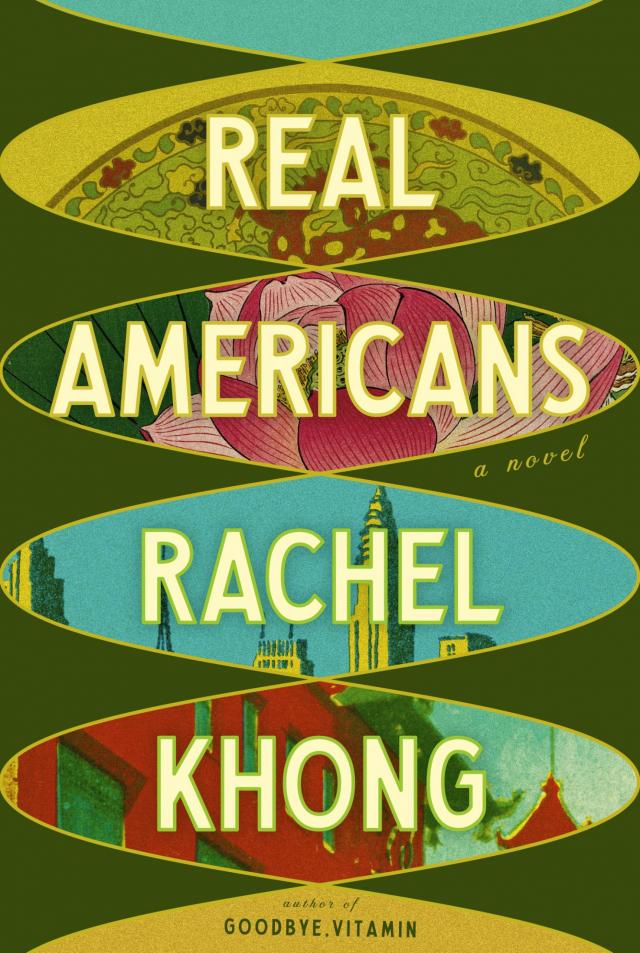
Cover images: (top to bottom, details) Chinese Ornament. The Metropolitan Museum of Art, N.Y.; Lotus by Ohara Koson. Photo: © Minneapolis Institute of Art / Bridgeman Images; Skyline. CSA-Printstock / Getty Images: Chinatown, San Francisco. Photo: © Look and Learn / Bridgeman Images
Cover design by Linda Huang
ep_prh_6.3_146884328_c0_r0
Contents
Cover
Also by Rachel Khong
Title Page
Copyright
Dedication
Epigraph
Beijing, 1966
Part One: Lily
Chapter 1
Chapter 2
Chapter 3
Chapter 4
Chapter 5
Chapter 6
Chapter 7
Chapter 8
Chapter 9
Chapter 10
Chapter 11
Chapter 12
Chapter 13
Chapter 14
Chapter 15
Chapter 16
Part Two: Nick
Chapter 1
Chapter 2
Chapter 3
Chapter 4
Chapter 5
Chapter 6
Chapter 7
Chapter 8
Chapter 9
Chapter 10
Chapter 11
Chapter 12
Chapter 13
Chapter 14
Chapter 15
Chapter 16
Chapter 17
Chapter 18
Chapter 19
Part Three: May
Chapter 1
Chapter 2
Chapter 3
Chapter 4
Chapter 5
Chapter 6
Chapter 7
Chapter 8
Chapter 9
Chapter 10
Chapter 11
Chapter 12
[Darkness has fallen…]
[In the morning,…]
Chapter 13
Chapter 14
[Nick placed his…]
[Lily held the…]
Chapter 15
Chapter 16
Chapter 17
Chapter 18
[The rain began…]
[Whenever it rained…]
Chapter 19
[I am in…]
Acknowledgments
A Note About the Author
_146884328_
For my family
Like you, I was raised in the institution of dreaming.
—Cameron Awkward-Rich
BEIJING, 1966
She isn’t afraid, but he is. They stand, in the darkness, before a glass case of old things. A Ming dynasty inkstone. A chrysanthemum carved from horn. A Song painting stamped with ruby-red collector’s seals. And on a silk pillow, so slight it could be missed: an ancient lotus seed with a legend behind it.
The story goes like this: One night, long ago, a dragon emerged from the sky and dropped this seed into the emperor’s open hand. His advisors huddled near to examine it. What fortune! they remarked. This seed would grant the emperor his greatest wish. Unfortunately, he died that night, while contemplating his options. He might have asked for immortality.
She takes a hammer from her knapsack. With all her strength, she strikes the glass. It makes a beautifully clear sound as it shatters. Quickly, the two get to work, securing the relics. It is an attempt to spare them from the Red Guards’ destruction—an act of protest, small, against a movement she’s no match for.
The seed is unspectacular, so old it resembles a stone. Yet she’s aware it contains an entire future: roots, stems, leaves, blooms, to seeds once more—encoded, like she is. Her heart pumps blood, her lungs take in air, she sleeps, wakes, eats, excretes. Will her life be long or short? What has she chosen, she wonders, and what has chosen her? She likes the fragrance of gardenias, but not the scent of lipstick. She doesn’t mind the rain. She is in love, which feels, to her, at once easy and hard, elemental and ungraspable—like vanishing and eternity at the same time. She wants to ask of every person she meets: Is it this way for you?
“Hurry,” her companion says.
A door slams, loudly. Someone is here. The footsteps draw closer. They flee.
Outside, she opens her fist. On her bleeding palm rests a stolen seed. The story is fiction. And yet: Why shouldn’t the wish be hers?
PART ONE
Lily
CHAPTER 1
1999
My alarm rang at seven and I pressed snooze as usual. The second time I awoke, it was still seven. This happened occasionally, these blips in my existence. I got blank stares whenever I tried explaining them, so I didn’t anymore. The feeling I had was that time wouldn’t move. A second would refuse to pass as it usually did, and I would find myself trapped in a moment—unable to progress beyond a minute or two.
My bathroom mirror, flecked white with toothpaste, reflected me to myself. Lines from the pillow were pressed into my cheek. I ran my fingers over the indentations. The toothpaste flecks gave the effect of being in a shaken snow globe.
In the kitchen, the same drain flies circled the sink, unless they were new ones—the former ones’ progeny. Debbie never washed her dishes, and her lipstick-rimmed mug sat balanced on the edge of the sink, like a dare to raise the issue. Warily, I ate a piece of toast with blueberry jam. The toast crunched as it always had. Some jam got on my cheek, and in swiping it from my face I removed some blush. Now there was a void in my coloring. I would have to redo the makeup, but it relieved me to see that the regular laws of physics continued to apply.
Outside, I regarded my surroundings with suspicion, as though they were a dream I might wake up from. Like everyone, I had recently watched The Matrix. Would it be so bad to discover that life until now, or some portion of it, had been illusory—an advanced society’s highly realistic simulation? It might actually be a relief.
Downstairs, Mrs. Chin restocked the key chains of her souvenir shop. She was arguing with Mr. Peng, who owned the salon next door. Seeing me, they paused their quarrel.
“Lei hou, Lily,” Mrs. Chin said with a wave, pronouncing it lee lee. She’d taught me exactly three words of Cantonese: Lei hou ma? How are you?
“Lei hou ma!” I called back. “I’m okay,” I added, in English.
Mrs. Chin’s hair, newly permed, shimmered with auburn highlights—Mr. Peng’s handiwork. From a plastic bag with a happy face on it, she pulled out a bun. The yeast smelled sweet. Did I want one? I shook my head. Not today.
* * *
—
The bell on the café door gave its meek ring. I ordered my regular latte—the latte I shouldn’t have been buying, because I didn’t make any money. I sat to drink it. A dark-haired man held a bagel to a child’s small mouth, waiting for the child to accept a bite. I followed his gaze to the New York City street, where nothing appeared out of the ordinary: people, pigeons, bags of trash. Holding the bagel steady, the father’s mind traveled elsewhere. It was a look I remembered my mother wearing when I was a child—one I resented. How dare she think of anything but me?
The father and child began to speak in another language I couldn’t make out. Then the man turned, suddenly, catching me in my stare. I dr
There were the regular café sounds: the low rumble of milk being steamed, the crinkling of paper bags when pastries were slid in. A man in his fifties, a Wall Street type, ate a cookie noisily and peered at his pager.
I returned to the register to order the coffee I brought to my boss every day. It was a dark roast stirred with two pink packets of Sweet’N Low, made paler with half-and-half, until it was “the color of Halle Berry,” he’d instructed proudly on my first day, as if that wasn’t a terrible thing to say.
On the four blocks to the office I dodged tourists wearing backpacks and bucket hats, holding red bags from the discount designer store. They moved slowly, their faces stupid with awe. I walked fast, with purpose, gripping the cup of coffee, which burned through its cardboard sleeve, proud to be inured to a cityscape that instilled marvel in everyone else. When I entered the immense glass building, I did so with a sense of importance and authority: I worked here. I was an unpaid intern, but still.
* * *
—
Our building was new, a futuristic marvel of glass and steel that curved slightly upward. The elevator was a point of pride. It took me to the twentieth floor within minutes, where I handed Jerry his coffee, which he accepted in his sausagey pink fingers without a word. The flesh on his ring finger bulged around his wedding ring, the way trees grew around old signs or objects. I remembered a photo from the magazine, from somewhere in the Pacific Northwest—a tree growing bark over a boy’s bicycle, as though swallowing it. The boy who’d owned the bicycle was an old man by now. Jerry nodded, to indicate the coffee was to his liking.
I spent the next four hours brightening images. When Jerry left early, as he did every evening, I opened Usenet. I had never posted before, so I created a username: TimelessinNY. I typed out my question: Does anyone ever feel like time gets stuck? I have these moments when time won’t move. A minute lasts forever. Awaiting responses, I searched for “jobs for art history major.” Curator, docent, teacher. It was difficult to picture myself as any of those things. I would be graduating in the spring, and what I wished for was some clear way forward—some passion, like my parents had, that would give my life meaning. I had not inherited their gift for science or, sometimes it seemed, for anything at all.
Before I left for the day, I checked the message board for replies. There were none.
* * *
At the company’s holiday party, the tree was false and towering. The Santa was Latino, his red velvet suit emblazoned with the company’s logo. A boy band’s Christmas album played too loudly. Our larger parent company had rented out a floor of a hotel in Chelsea, lined with windows, giving us a 360-degree view of Manhattan. With money they weren’t paying me, I thought. Before leaving for the party, I’d noticed a run in my only pair of black stockings. I drew a line on my calf in Sharpie, a trick my freshman-year dorm-mate had taught me, to make the stocking appear intact.
I picked up a triangle of toast, black beads of caviar clumped on it. The city offered wealth to us in glimpses: Even a college student could eat caviar, or drink wine from crystal. We’d be reminded that we weren’t—rich, that is—the moment we returned to our minuscule apartments, where we slept in loft beds and shared closet-sized bathrooms. Even the put-together people—the people who dressed exquisitely, expensively—I had come to learn, didn’t necessarily inhabit livable places. Often they dug their elegant clothing from piles on chairs that were their only furniture.
I’d have to be vigilant if I wanted more caviar. Media employees mobbed the stressed young server holding the silver tray. I wondered what this party was doing for their morale. It was obvious who worked in fashion, food, celebrity gossip. My own coworkers wore skin-baring dresses—we’d seen little skin all winter—and ladled punch out of a fountain that frothed uncontrollably.
My fellow interns lingered as a pack by the hors d’oeuvres, finding strength in numbers. Seeing me, they waved, beckoning me over. Most, like me, went to NYU; a few went to Columbia or SUNY. All of them were drinking the alcoholic punch, though many were underage. This went uncommented on, because it was implicit: This was our salary. The other interns were uniformly blond, round breasted, affable. It was plain to see that Jerry, who had done the hiring, had a type. I was the anomaly.
I picked up a shrimp and swiped it through cocktail sauce. It was cold and tasted only faintly of the sea. Shrimp cocktail involved a disorienting amount of chewing, and there was always a moment, eating it, when I thought, Too much flesh. But I had this amnesia about the shrimp-cocktail-eating experience: I forgot how I felt until I was in the act of eating my next one.
I scanned the room for a trash can, not noticing Jerry approach. I’d have preferred to avoid him tonight, but now it was too late. Beside him stood a man, tall and golden haired, who looked to be in his twenties.
“Lily, this is my nephew,” Jerry announced, with some pride.
Jerry had cocktail sauce at the edge of his mouth, crusted like blood.
“And this is Lily,” he said to the nephew.
He slapped the nephew on his back. I held up the shrimp tail and shrugged at the nephew, like, Sorry, wish I could, but I can’t shake your hand at the moment.
“She’s Korean,” my boss added.
I wondered why he said that—with such confidence, and as though it would be of interest. I felt instantly weary.
“Chinese,” I clarified to the nephew, once my boss was gone.
Jerry migrated to the flock of blond interns, where one by one they brightened at him, as though he were a god. He had the power to transform any of us from unpaid to paid interns, so, in a way, he was. In the past he’d also introduced me as Thai. We worked in travel, but he couldn’t manage to keep it straight.
“Sorry,” the nephew said. “That was weird.”
He was distractingly hot—athletic but not vacant, a muscular nerd. Unlike the other men at the party, media types wearing T-shirts that were loose around their collars, he looked at home in his suit, which was fitted. He didn’t appear as though he’d borrowed it for this occasion. He was definitively not my type. Muscles intimidated me. I deliberated how much more to drink. I inched toward the punch fountain and he followed.
“I’m Matthew,” he introduced himself, scratching the back of his neck, which I couldn’t help but admire. “What do you do here?”
“I’m an intern,” I said, filling a glass with punch. “In the art department. Mostly I search for stock photographs. Or collect invoices from photographers.”
I pressed my hand to my punch glass. Cold. I moved it to my neck. Hot. It was likely I was not dreaming; it was likely this was reality. I’d been wary in the wake of the morning.
A gaggle of gossip magazine staffers glanced over at us, interested in the handsome nephew’s movements.
“What’d you work on today?”
Matthew appeared genuinely curious, as though he wanted to continue the conversation, which surprised me. I was used to people looking around for someone more interesting once I told them what my position was.


