

Maureen, page 1


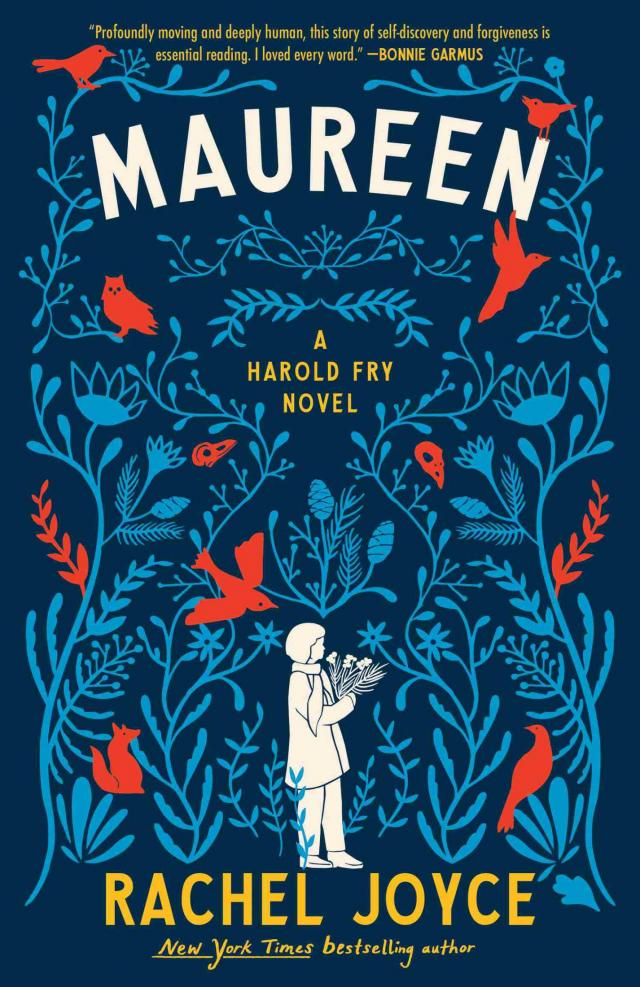
PRAISE FOR
Maureen
“Profoundly moving and deeply human, this story of self-discovery and forgiveness is essential reading. I loved every word.”
—Bonnie Garmus, New York Times bestselling author of Lessons in Chemistry
“I was enthralled from the first page of this short, powerful book. Maureen is a wonderful, frustrating character—so rigid, and so frightened of what she might learn about herself and her own past. We all have some Maureen inside us, and so the journey we take with her across England and into her own personal tumult is a satisfying, visceral one.”
—Ann Napolitano, New York Times bestselling author of Dear Edward
“This book is a perfect gem. Fans of Olive Kitteridge and Eleanor Oliphant will love Maureen Fry, and it’s a brilliant coda to the Harold Fry series.”
—J. Ryan Stradal, bestselling author of The Lager Queen of Minnesota
“This is a quiet miracle of a book. I loved the absurdity of some scenes and the tenderness of others, and then I was met with the kind of gasp-able (truly—I gasped!) transcendent experience that only the best books can deliver. Rachel Joyce has been a favorite of mine since The Unlikely Pilgrimage of Harold Fry, and Maureen only reinforces my idea that she is a master at mixing humor and pathos, and at showing hard truths about life and living that nonetheless make us grateful to be here.”
—Elizabeth Berg, author of The Story of Arthur Truluv and Earth’s the Right Place for Love
“I adored Harold and Queenie, but who knew Maureen waited in the wings to steal my heart? A testament to just how exquisitely Rachel Joyce understands people, and written with kindness and such perception. I can’t recommend it enough.”
—Joanna Cannon, bestselling author of The Trouble with Goats and Sheep and A Tidy Ending
“Rachel Joyce has a genius for creating the most damaged and difficult characters and making us care deeply about their redemption. Maureen is a powerful finale to her classic trilogy of heartbreak and healing.”
—Clare Chambers, author of Small Pleasures
“At last it’s Maureen’s turn! It may only have the physical heft of a novella but Rachel Joyce’s angry-sad latest packs the weight of a long marriage into the space of several well-ironed handkerchiefs. Just brilliant.”
—Patrick Gale, author of Take Nothing With You and A Place Called Winter
“Maureen is so beautifully and unflinchingly portrayed—a complex contradiction of brittle and prickly with an underbelly of fragility and fear. Her journey, both physical and psychological, is compelling and profoundly moving and leaves the reader feeling fully satisfied and just a little lighter.”
—Ruth Hogan, author of Madame Burova and The Keeper of Lost Things
“Rachel Joyce is deeply attuned to the complex rhythms of life and love and she sublimates this understanding, sentence by delicate, powerful, glistening sentence, into an unforgettable story. It’s beautiful all through, but the closing chapters are just astonishing, transcendent and hope-filled and life-affirming. I’ll never forget this wonderful novel or the sunny, slightly teary day I spent reading it.”
—Donal Ryan, author of The Queen of Dirt Island and Strange Flowers
“Beautifully written and endlessly touching, Rachel Joyce once again captures what it means to be human in the final book of her wonderful trilogy.”
—Phaedra Patrick, author of The Book Share and The Library of Lost and Found
“This book is short but very special. As fans of Rachel Joyce might expect, it’s funny, touching and quite beautiful. It’s also packed with wisdom about love and loss—and is sure to provide comfort to anyone who’s known grief.”
—Matt Cain, author of The Secret Life of Albert Entwistle
“In this slender, lyrical novel, Rachel Joyce offers a story as epic and encompassing as that wide-armed Angel of the North. A journey of redemption, forgiveness and love. A journey you don’t want to miss.”
—Helen Paris, author of Lost Property
“Maureen is the sort of person we pass in the street every day, every hour, and probably give little thought to. She is difficult, perhaps, a little brittle, unable to engage successfully with the world, and maybe hard to warm to—an embattled figure often lost against the vast opera of life. But Rachel allows us to see into her complex universe, feel firsthand her fears, the profound longing, the grim phantoms of the past, the ordered rebelliousness, and strange, dark sense of humor—and of shame. This story also happens to tie three life-affirming, vital, and unpredictable novels together into a perfect, never-ending dance.”
—Damian Dibben, author of The Color Storm
“Rachel Joyce writes with incredible depth, beauty and heart. Reading her prose is like listening to great music—sometimes soft and sweet, sometimes heart-rending, always beguiling. This is an emotional story about loss, resilience and reconciliation. Maureen Fry is a prickly kind of star…but wow, how she shines!”
—Hazel Prior, author of Call of the Penguins
“This is a deceptively simple story of love, forgiveness, fulfilment and hope. I can’t think of any other novelist quite as tender and compassionate as Rachel Joyce, who understands that miracle of transformation when human fragility becomes strength of spirit.”
—Bel Mooney, author of Lifelines
“This is a fitting and deeply moving end to the trilogy of Harold Fry. A portrait of a woman adrift in grief, it is as fragile as a songbird and just as beautiful.”
—Sarah Winman, author of Still Life
PRAISE FOR THE HAROLD FRY TRILOGY
“A gentle adventure with an emotional wallop.”
—USA Today
“A cause for celebration.”
—The Washington Post
“Beguiling…[A] modest-seeming story that…enthralls and moves you as it unfolds.”
—People
“Gorgeously poignant.”
—O: The Oprah Magazine
“Tender and profound, fresh and funny.”
—Marie Claire
“It will stick with you, this story of faith, fidelity and redemption.”
—Minneapolis Star Tribune
“A comic and tragic joy.”
—The Plain Dealer
“Almost unbearably moving.”
—The Sunday Times (UK)
“[Joyce has an] unerring ability to convey profound emotions in simple, unaffected language…An original, quietly courageous testament to the inhuman effort of being normal.”
—The Guardian
“Wonderfully evocative…uplifting and moving.”
—The Daily Express
“A wonderful read.”
—The Independent
“Joyce addresses the themes that occupy us all: love and death, loyalty and betrayal. Big subjects treated with empathy in a story that goes straight to the heart.”
—Financial Times
“Funny, tender and with a heart-stopping twist to boot.”
—New Zealand Woman’s Weekly
“Rachel Joyce probes questions that are as simple as they are profound: Can we begin to live again, and live truly, as ourselves, even in middle age, when all seems ruined? Can we believe in hope when hope seems to have abandoned us? I found myself laughing through tears.”
—Paula McLain, New York Times bestselling author of The Paris Wife
“This funny, poignant story moved and inspired me.”
—Nancy Horan, New York Times bestselling author of Loving Frank
“Marvelous!”
—Helen Simonson, New York Times bestselling author of Major Pettigrew’s Last Stand
Maureen is a work of fiction. Names, characters, places, and incidents are the products of the author’s imagination or are used fictitiously. Any resemblance to actual events, locales, or persons, living or dead, is entirely coincidental.
Copyright © 2022 by Rachel Joyce
Book club guide copyright © 2023 by Penguin Random House LLC
All rights reserved.
Published in the United States by The Dial Press, an imprint of Random House, a division of Penguin Random House LLC, New York.
The Dial Press is a registered trademark and the colophon is a trademark of Penguin Random House LLC.
Random House Book Club and colophon are trademarks of Penguin Random House LLC.
Originally published in hardcover in the United Kingdom as Maureen Fry and the Angel of the North by Doubleday, an imprint of Transworld Publishers, a division of Penguin Random House UK, in 2022.
The interview comes from an original recording for BBC Radio 4’s Bookclub program, presented by James Naughtie and recorded in 2021. Used by permission.
ISBN 9780593446423
Ebook ISBN 9780593446430
Illustrations by Andrew Davidson
randomhousebooks.com
randomhousebookclub.com
Book design by Caroline Cunningham, adapted for ebook
Cover design and illustration by Kimberly Glyder
ep_prh_6.0_142441835_c0_r0
Contents
Cover
Title Page
Copyright
Epigraph
Opening Sticky Closet Doors
Chapter 1: Winter Journey
Chapter 2: The World’s Guest
Chapter 3: Fried Egg
Chapter 4: Human Mouths
Chapter 5: Sea Garden
Chapter 6: Accident-Accident
Chapter 7: North and Further North
Chapter 8: Truck
Chapter 9: Garden of Relics
Chapter 10: A Bad Night
Chapter 11: Anna Dupree
Chapter 12: Coffee Beans
Chapter 13: Moonlight Sonata
Chapter 14: Winter Bouquet
Dedication
Acknowledgments
By Rachel Joyce
About the Author
A Book Club Guide
_142441835_
The corpse you planted last year in your garden,
Has it begun to sprout? Will it bloom this year?
The Waste Land, T. S. Eliot
I thought I saw an angel in an azure robe coming towards me across the lawn, but it was only the blue sky through the feathering branches of the lime.
Kilvert’s Diary, July 21, 1873
OPENING STICKY CLOSET DOORS
We have a closet door that is always sticking. It’s the kind of closet where we shove in things that we don’t want to deal with, but can’t yet throw out. And part of the deal with the stickiness of this door is that you know its difficulty will make it even easier to keep closed and ignore what’s behind. To me, writing is about opening those kinds of sticky doors. The kind of doors your characters will do everything they can to convince you are not there. Closed closets, complete with wallpaper over the top.
More than ten years ago, Harold Fry stepped into my imagination and transformed my world. He had been around me since my father’s death. Writing about his journey to save his dying friend in The Unlikely Pilgrimage of Harold Fry helped me in some way to bear my own grief. He also helped me fulfill my deeply held longing to finish writing a book that someone might consider for publication. I have a lot to thank Harold for. And after that, he made his way, without me, into the minds of other people, who read his story and met him within their own imaginations. There were crazy times. Whistle-stop book tours that took me all over the world, including China. One day twenty Spanish journalists pitched up outside our house. But there were many quiet meetings, too. I am thinking now of a man I was introduced to who was staying in a shelter for the homeless where the book had been available as a free gift. This man warmly told me it was the best book he’d ever read. This was quickly qualified as being the only book he’d read. Followed by the fact that he hadn’t read it because he couldn’t. Other people from the shelter had told him the story, chapter by chapter, as he held the book in his hands. That was a gift. For me, I mean. When someone is so generous as to tell you why your story means something to them, it is as close as I come to understanding why I keep doing it. Why I keep trying to find the moment where the ordinary spills outward and acquires a more numinous quality, like a kind of halo.
When the book was first published, another reader, a very well-read woman this time, came up to me at a book-signing and said, “You do know this is a trilogy?” (Actually, what she said was, “You do know this is a triptych?”) In some ways, this was music to my ears. I was missing the characters so much, I felt sort of bereaved all over again. And I could see there were characters who had not been fully realized in Harold’s story because they could not be. But I also knew that I had no intention of doing what she was asking me to do. She pointed out that as far as Maureen—Harold’s difficult wife—was concerned, there was still, in effect, a closet door I had left closed. But the problem was that I shared Maureen’s point of view. I didn’t wish to open it. I wasn’t ready to face what Maureen has to face. I write about characters with a complexity I recognize I need to know better, but Maureen was a step too far.
What I did do was tackle the second book. I wrote The Love Song of Miss Queenie Hennessy as a companion story, neither a sequel nor a prequel, but a free-standing novel you might read without having picked up the first one, or that you could—if you so desired—read side by side with Harold, finding little juxtapositions and echoes along the way. I had spoken a lot about Queenie when doing book events and signings, and it seemed right to give her a voice. Not just her back story—the story of how she came to be working in a brewery as an accountant in the first place. (Queenie was not a properly trained accountant, I always knew that.) There was the story of her friendship with David and how her unexpressed love for Harold drove her to a compromised place with his son. There was the story, too, of what happened to her after she left Harold. But the books and characters that interest me are those that challenge my own way of thinking—and here was an invitation to explore the world of the hospice where Queenie was dying, a world which had frightened my father when he was dying, and consequently frightened me, too.
So there. Queenie had been brought into the open. I had faced my own insecurities and misconceptions about the hospice. After that, I happily got on with other books, other characters, other questions and ideas.
But I left Maureen’s closet door closed.
And, mostly, I would say I got away with it.
Except I knew I hadn’t.
Then came the COVID-19 pandemic and, with it, lockdown. We all experienced what Maureen experiences when Harold begins his walk to Queenie: that sense of existing within the confines of the same four walls, that strange disabling of time and boundaries that occurs when routine is taken away and you are left alone with yourself. And I thought a lot about Maureen. I thought how grief and loss can become our identity, one that can keep us out on our own, not with the dead but not with the living either. I thought about how hard it is to move on without feeling deep down that you have betrayed the person you have lost. I thought about my own relationship with my father, and how, even fifteen years after his death, I had never really allowed myself to say goodbye. I realized I was ready to try to help Maureen make that difficult journey of reconciliation that she needs to make, alone and apart from Harold. I thought, if these characters are still so strongly in my mind, then why not write about them?
So here we pick up Harold and Maureen in 2022, ten years after the walk that changed Harold’s life, and Maureen’s, too. They have lived through the pandemic. Harold is at ease with himself. The walk has brought him a kind of peace. He and Maureen had been living in a kind of cold void, unable to talk about the terrible loss that left them estranged, and now they are able to reconnect. But even though their marriage has been healed by his walk, Maureen knows that something inside her still has not healed. She has not been out. She has not made that solitary journey into the unfamiliar. Besides, I felt I had set something up with Harold’s pilgrimage—something about the kindness, the beauty of strangers, I suppose—that I needed to test. To see if it was the same ten years later, given how much the world has changed. And the result is this book.
So my reader was right (as readers generally are). It was a trilogy, after all, and maybe even a triptych. This is the end of the journey for me and Harold and his wife, Maureen, and his old friend, Queenie, and it is the end, too, of the tragedy of the young man they loved, all three of them. The closets have been opened and we have looked at what was inside, and let it go. It was not so daunting, after all.
The moment I handed in the final draft of this book, I went into the garden and something happened. I saw—in the shadows of my imagination—a new set of characters, a new set of questions. It was as if they had been politely standing out of view for a long time, each with a suitcase—which is a kind of portable closet, after all—ready to talk to me as soon as I was ready.
So I kept gardening and I began to listen as new doors opened.
June 2022
1


