The Recruit: A post-apocalyptic tale, page 1
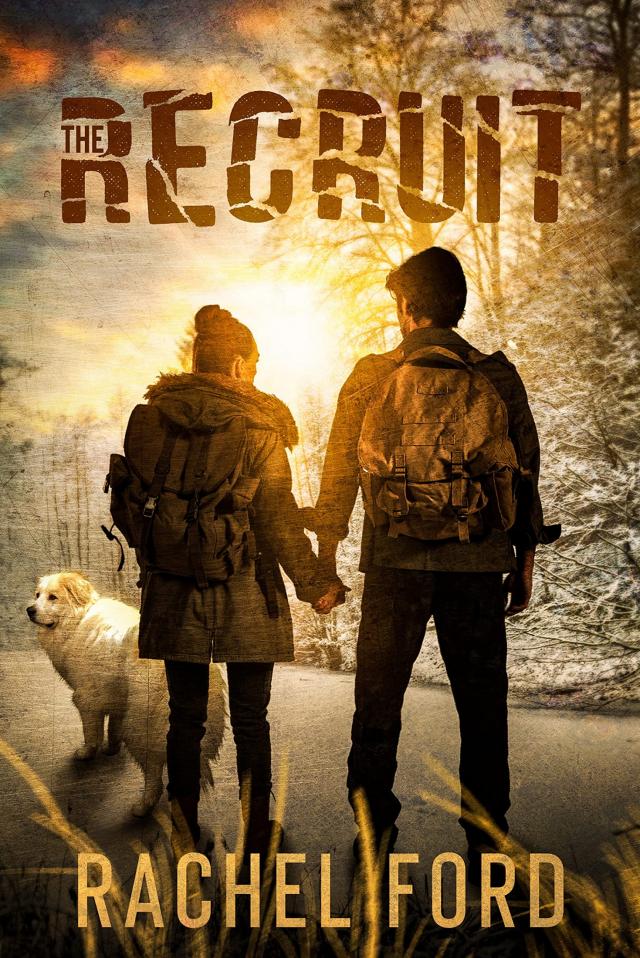


The Recruit
By Rachel Ford
© 2020, Rachel Ford
Cover by GetCovers
This is a work of fiction. Names, characters, places and incidents are either the product of the author’s imagination or are used fictitiously.
Except the dog, who is inspired by, named after, and looks like my actual dog. Yes, that’s his picture on the cover. (And yes, he’s definitely a very good boy :-) ).
Any resemblance to persons living or dead, events, locales etc. is entirely coincidental.
All rights reserved. No part of this publication may be reproduced in any material form through any means without the express written permission of the author.
This story was originally published in the Kyanite Press Journal of Speculative Fiction, as “The Plague.”
Chapter One
Hindsight is twenty-twenty. That’s what they say.
But the truth is, we didn’t need hindsight. Not really. It was all there, all in front of our faces for years. Rising sea levels, erratic weather patterns, and worldwide poverty made a climate ripe for destruction. Add to it new killer bugs appearing, old killer viruses waking up, and generations of science skeptics?
The signs were there. We’d built a world that teetered on the edge of disaster. And all it took for the proverbial shit to hit the fan was one simple mutation: a new strain of flu. The plague, they called it.
Deadly. Merciless. Swift.
That was five years ago. Eighty-five percent of the world’s population died in two months. That, of course was just the beginning.
Mass death on such a scale overwhelmed every aspect of society, from transportation to sanitation. Months after they’d died, bodies lay where they’d fallen. No one had the manpower to dispose of that many dead all at once. No one wanted to go near the dead, for fear that they’d join them. Some towns resorted to mass graves, or great pyres. But most cities were ghost towns, littered with rotting corpses.
Disease and starvation followed. Governments broke down. There were no militaries left to enforce law and order. Regional militias and bands of brigands sprung up. International communication networks fell too, as raiders and opportunists seized broadcasting equipment and dispatched the remaining news crews.
How many died, when all was said and done, I didn’t know. We’d built a world that was ready for a plague, and in 2030, nature delivered.
God’s judgement. That’s what my grandpa said, anyway, back when he was alive. But he’s dead now. These days, it’s just me and Elim.
Elim’s my dog. The funny thing about the plague is, it didn’t hurt dogs. It didn’t hurt anything except people. God’s judgement. That’s what Grandpa Craig figured was behind it. Dogs didn’t do nothing to piss God off. Why would he kill them?
I didn’t know about that. I didn’t rightly know about God, either. My mom and dad hadn’t done anything to deserve the plague, as far as I could tell. Neither had Grandma, or my sister Jo.
But the plague killed them, just like it killed everyone else. So I didn’t think it was God’s judgement. Not, leastwise, if there was any kind of justice to his judgement.
It had been eight months since Grandpa died, and eight months since I’d buried him out by the crick. It had been eight months since I’d talked to another human being. These days, I talked to Elim a lot.
Elim was a funny kind of dog. He must have weighed a hundred pounds easy, and a good sight more when food wasn’t scarce. His fur was white as snow, and long. When he shed, the whole place was covered in tufts of white, like when dandelions went to seed. He tended to bark a lot and listen only when he felt like it.
My sister named him after a spy in some old TV show she liked.
God, it seems like a thousand years ago now, to think of electricity and television and streaming shows. Or the internet.
Anyway, it was a show about space. I didn’t care for that sort of thing, but Jo did. Star Wars, Star Trek, Stargate, Battlestar Galactica…if it had star in the title, chances were, she loved it. What it had to do with a dog, I never rightly figured out.
But Elim was her dog, back when she was alive, and she picked his name. Now he was mine. And considering that I talked to him like a person, well, I suppose I had no room talking about what she called him.
So Elim Garak he was. Elim for short. Elim slept by me. That was a nice thing about having a big, fluffy dog. He was a big, drooling space heater. And though I could have lived without the drool, you couldn’t have enough heaters in the winter.
Winter wasn’t always so cold in these parts. When I was little, we rarely got snow. That was before we fucked everything up, though. Now, the summers were hot, and we didn’t get much rain. The winters were cold, and we got too much snow.
Elim didn’t mind the snow, on account of his fur. He hated the summers and loved the winters. He’d hide in the kitchen on the stone tile in the heat of the summer. But I had a hell of a time getting his stubborn, fluffy ass in the house in winter.
One good side of that was he was a hell of a hunter. He was probably a better hunter than I was. He was big and brought down any coyotes or deer that came anywhere near our house. He’d come home covered in blood, and I’d follow him out to find his kill. And we’d eat well, and smoke whatever was left.
Eating coyote was like chewing on the sole of your shoe. But I liked venison. Grandpa taught me how to cook it right, so it was tender and flavorful. Not that that mattered much when you’d gone without food for too many days in a row. But when things worked out right, and you set enough by to eat steady, well, it was good to know how to cook.
I was telling Elim that over a roast we were sharing. He stared at me with transfixed golden eyes. I suppose it was the food and not the conversation. But I kept on talking. “Cooking on a wood fire, never figured how hard that would be. It’s so easy to burn it. But you look at this? Perfect, isn’t it?”
He must have agreed, because a stream of drool trickled from one of the corners of his mouth.
“Yeah, I’m hungry too. Here you go.” I sliced him a thick chunk, and he caught it midair as I tossed it. “Good boy.”
Then, I cut myself a piece, and tore into it. It was still hot, and my fingers and mouth burned. But I didn’t care. I hadn’t eaten since breakfast, and that’d been about ten hours earlier. For a few minutes, we ate in silence, each trying to wolf it down as quickly as we could without scorching our mouths.
Finally, my appetite somewhat sated, I shook my head. “Well? Who’s the best damned cook in these parts, eh?”
Elim ignored me. He’d finished his chunk of meat, and now was licking up every bit of drippings he could find.
“That’s right. It’s me.”
Now, he’d finished his cleanup, and turned his attention to the remaining roast. He stared at it with the same hungry eyes he’d first turned my way.
“Let me finish my piece. I’ll give you the bone.”
I finished eating and carved most of the meat off the leg bone for myself. I’d pack it on ice and eat it for my next few meals. But I left plenty for him, too.
Elim fell on the bone with gusto, and I made myself eat a potato and a roasted onion. I needed to make the meat last. The vegetables would fill me. And they tasted alright too. Food was food.
When grandpa had been alive, we’d play cards or cribbage by firelight after dinner. These days, I talked to Elim until one or both of us fell asleep. Tonight was no different. I packed my extra food in ice, and secured it in an old cooler in one of the backrooms. Without central heat, those rooms were as cold as outside, excepting the wind chill. Still, it was plenty cold enough to keep food.
Then, I came back to the fire, and talked to the dog. He wasn’t much of a conversationalist, but he sure was a good listener. I’d been thinking of TV, and we talked – or, rather, I talked and he listened – about my favorite shows. I wondered what happened to the folks who used to play in them.
“Suppose they must have died like everyone else.”
By now, the dog was snoring softly. That never stopped me. I kept talking, until I fell asleep too.
When I woke, it was Elim’s turn to talk. He was yelling, and loudly. I blinked, shielding my eyes from something bright. Damn. Light flooded the room, and I figured I must have overslept. But it was a strange light, washed out and pale.
“Stop barking,” I protested. “I’m up, I’m up.”
Then, though, I heard something else, and I understood why he was barking: a voice. A man’s voice, coming from…somewhere in the house. I couldn’t tell quite where.
Fuck. I grabbed the shotgun over the mantle and raced for the other room. I was vaguely aware that the whole house was cast in that strange light, and that it seemed dark outside. But my heart was pumping too fast to allow me to stop and think. There was an intruder somewhere in the house. I had to find him and figure out what the hell he wanted. Hopefully before I ended up dead.
I raced into the kitchen, and then the living room. And I froze, stiffer than one of the icicles hanging outside the windows. The TV was on, and the voice I heard – the voice Elim heard – was coming from it. “What in the hell?”
All of a sudden, the odd lighting made sense. It wasn’t daybreak. This wasn’t sunshine. The lights were back on. “But how?” I glanced between the fixtures above my head and the dog. I don’t know what I was expecting. He was just a dog, after all. Then again, I was a man, and I had no more clue what was happening
I turned back to the television. The man I’d originally seen was still speaking, and I took a good look at him. He was youngish – older than me by one or two decades, I would have guessed, but younger than grandpa had been, by at least twice as many decades. He wore some kind of camouflage uniform, but I didn’t recognize the insignias.
“We are seeking recruits for the North American People’s Army,” he was saying. “But we don’t just need soldiers. We need settlers: farmers, hunters, builders. If you’re willing to work hard, pull your own weight, and pitch in, join us. Let’s rebuild our world.”
The picture faded now, and I stared at the darkened screen. “What the hell? Join them? Where? How? Who are they?”
I sprang backwards as an image burst onto the screen. It was the man I’d just been watching, sitting as he’d been sitting before, staring into the camera with the same sober expression. A voice, some kind of disembodied narrator, said, “This is a message from General West of the North American People’s Army. It will repeat at its conclusion.”
Now, the man spoke. “People of Dunham County, I am General Kyle West, of the North American People’s Army.
“We have restored your county power plant and will continue to work at restoring downed power lines as the weather allows.
“Our mission is to rebuild our nation. We come in peace. We have no desire to harm you or yours. We are only here to help.” Now, he smiled. “I’ve been all over this country, and I know the words ‘army’ terrify some.” His smile faded. “I’ve seen what’s happened in some quarters: bandits, raiders, slavers and worse things.
“I promise you, we are not here to harm you. We are here to restore your way of life. If you want our help, it will be here. If you prefer to stay in your homes, and ignore us, we will move out when we are finished. We ask nothing of you, except that you allow us to work in peace.
“However, if you want a better way of life, if you feel you would be stronger among a community governed by law and order, you are welcome to join us.
“Our base is at the old power plant. If you want to learn more, if you want to find out how we can rebuild your community, join us there. If you’re interested in doing more, come talk to us.
“We are seeking recruits for the North American People’s Army. But we don’t just need soldiers. We need settlers: farmers, hunters, builders. If you’re willing to work hard, pull your own weight, and pitch in, join us. Let’s rebuild our world.”
Chapter Two
I stared at the TV so long I probably could have recited General West’s message word for word. Somewhere along the way, I was aware that the heat had kicked in. The heat. God, how long had it been since we’d had heat?
I turned the thermostat off. I only had whatever was left in the propane tank worth of gas left. Part of me wanted to crank the heat and remember what it was like to be warm. But another part cautioned that this little bit of fuel was all I had. I couldn’t squander it.
I paced the house in a sort of daze. Everywhere I went, the lights were on, bright and beautiful. I wondered sometimes if I was in a dream. Other times, I wondered who and what this North American People’s Army was. Were they good guys? They sure seemed like it. Why else turn on the lights – and furnaces – for a bunch of strangers?
Then again, what if they were just here to rob us?
Of what? my mind kicked in. What do you have that anyone could want?
It was a fair point. There were plenty of empty houses, their inhabitants far too dead to stop anyone from squatting. So it wasn’t grandpa’s house. Sure, I’d put up some vegetables for the winter – me, and anyone else who was going to survive until spring. But it wasn’t like we had enough food to make it worth a trek here, much less in the middle of winter.
By time the sun rose, I was almost delirious with thought, excitement, activity and cold. I’d been pacing through frozen, empty rooms for hours. Elim trailed behind me dutifully, though I think even he began to doubt my sanity after a while.
“The old power plant,” I said, to him or myself – I wasn’t sure which. “They said to meet them at the old power plant. Maybe I should do it. But what if it’s a trap?”
Back and forth I went, over the same ground – literally and metaphorically – until midmorning. Finally, famished and no closer to a solution, I fed myself and Elim from the leftover roast. And, with food in my system, a kind of clarity came over me.
I’d been without human contact for months. Before that, I’d barely seen anyone but my grandfather. I was going to go nuts – if I wasn’t already nuts – living out here by myself, with just Elim for company. I didn’t let myself think what would happen in a few years, when old age took the dog.
I couldn’t think of it. I might truly have gone to a point of no return if I spent too much time considering that. “I’m going to go,” I said abruptly.
The dog looked up at me, and I nodded. “You heard me. I’ve got to see what they’re up to. Who knows, Elim. We might find a new home. Or at least, some people to talk to. That’d be good for both of us, wouldn’t it?”
I waited until the sun rose a little more before heading out. The power plant was a good fifteen miles from where I lived, and in the snow that was going to be a long walk. I didn’t want to make it in the early morning hours.
Mostly, I followed the old roads, cutting across country only where I knew my way. The snow buried the pavement. Though we’d driven here for years, back when we still had fuel, there were points where it was difficult to make out what was road and what was flat field. Here, the random, stranded cars that littered the highway served as a kind of a marker.
Years ago, grandpa and I had gone from vehicle to vehicle, checking for survivors first, and abandoned goods second. We’d siphoned some fuel from the tanks and were able to power his old truck a little longer with it. But that was years ago, and we hadn’t been the only scavengers. Now, the old bones of those who had died behind the wheel were long picked over, the remnants of their vehicles rusted old husks. Now, they served as nothing but waypoint markers, a signal that I was still following the old highway.
Here and there, where the road rose a little above the fields, the wind had stripped it of its snow. Stretches of black pavement peeked out. I liked those stretches. They were a hell of a lot easier to cross than the ones buried under a foot and a half of winter precipitation.
Elim didn’t seem to mind what the conditions were like, though. He pranced along, tail held high, catching the breeze now and then and pausing to bark at something.
I had grandpa’s revolver tucked away under my coat, so I wasn’t particularly worried about trouble. Even if we did run across a critter, between the gun and Elim, I figured we’d be okay. I told him as much as we walked.
I pointed out the lights in the houses we passed, too – most of which had been empty for years. There was the old Rucker place. That had been empty since the plague hit. Grandpa and I had cleared the cellar of supplies once our own started running low. Not that the Ruckers would have cared. The sickness took them all in a week.
But now, the porch lights blazed in the midday sun, all welcoming, like there was someone at home. There was something eerie about that, something that kind of gave me the heebie-jeebies. I knew well enough no one lived there. Grandpa and I had buried the bodies when we found them. No one had lived there since.
I didn’t remember the lights being on then. I suppose someone must have paid the old place a visit in the intervening years. That wasn’t out of the ordinary either. There were always vagrants and nomads, and folks heading somewhere or just passing through. They’d find old places like the Ruckers’, and scavenge what they could, or at least crash some place that afforded them a roof over their heads.
The Yoder place was dark, but that was no surprise. They’d been Amish, so they’d never had electricity, not even when all the rest of the lights were on. I never knew what happened to them. One day they’d been there, and the next they were gone, them and their buggies. I suppose they must have packed up and tried to outrun the plague.
I don’t suppose they got very far. No one did.
One by one, I passed the homes of old neighbors. Only a few still housed occupants, but I didn’t see anyone today. All I saw were lights, lots of lights on.