Promise, page 1


Promise is a work of fiction. Names, characters, places, and incidents are the products of the author’s imagination or are used fictitiously. Any resemblance to actual events, locales, or persons, living or dead, is entirely coincidental.
Copyright © 2023 by Rachel Eliza Griffiths
All rights reserved.
Published in the United States by Random House, an imprint and division of Penguin Random House LLC, New York.
Random House and the House colophon are registered trademarks of Penguin Random House LLC.
Library of Congress Cataloging-in-Publication Data
Names: Griffiths, Rachel Eliza, author.
Title: Promise: a novel / Rachel Eliza Griffiths.
Description: New York: Random House, [2023]
Identifiers: LCCN 2022032273 (print) | LCCN 2022032274 (ebook) | ISBN 9780593241929 (hardback; acid-free paper) | ISBN 9780593241936 (ebook)
Subjects: LCGFT: Novels.
Classification: LCC PS3607.R5494 P76 2023 (print) | LCC PS3607.R5494 (ebook) | DDC 813/.6—dc23/eng/20220707
LC record available at https://lccn.loc.gov/2022032273
LC ebook record available at https://lccn.loc.gov/2022032274
Ebook ISBN 9780593241936
randomhousebooks.com
Frontispiece art: Adobe Stock/konoplizkaya
Book design by Susan Turner, adapted for ebook
Cover design: Rachel Ake Kuech
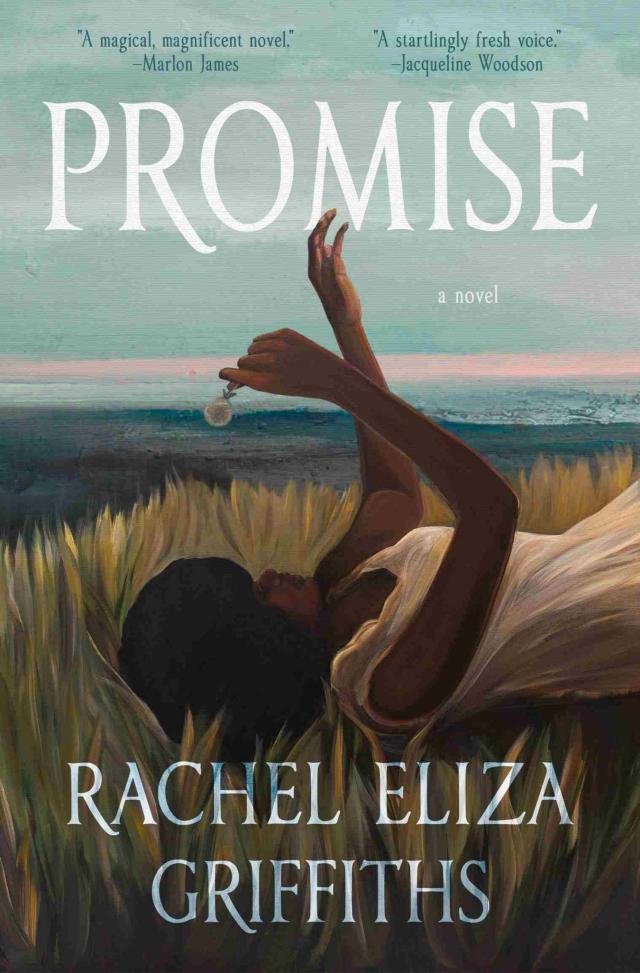
Cover images: Megan Gabrielle Harris (foreground and figure), arteria.lab/Shutterstock (background sky)
ep_prh_6.1_144236902_c0_r0
Contents
Cover
Title Page
Copyright
Epigraph
Part One
Chapter 1
Chapter 2
Chapter 3
Chapter 4
Chapter 5
Chapter 6
Chapter 7
Chapter 8
Chapter 9
Theodore and Calliope Kindred
Chapter 10
Chapter 11
Chapter 12
Chapter 13
Jonah Reuben Scaggs III
Chapter 14
Part Two
Chapter 15
Alma Elizabeth Kindred
Chapter 16
Chapter 17
Chapter 18
Chapter 19
Chapter 20
Chapter 21
Virginia “Ginny” Abbott
Chapter 22
Chapter 23
Chapter 24
Chapter 25
Part Three
Chapter 26
Chapter 27
Chapter 28
Chapter 29
Chapter 30
Dedication
Acknowledgments
By Rachel Eliza Griffiths
About the Author
_144236902_
“How, then, could I not answer her life
with mine, she who saved me with hers?”
—Natasha Trethewey
“Real gods require blood.”
—Zora Neale Hurston
ONE
1
The day before our first day of school always signaled the end of the time Ezra and I loved most. Not time like the clocks that ticked and rang their alarms every morning; we knew that time didn’t really begin or end. What we meant by time was happiness, a careless joy that sprawled its warm, sun-stained arms through our days and dreams for eight glorious weeks until our teachers arrived back in our lives, and our parents remembered their rules about shoes, bathing, vocabulary quizzes, and home training.
More than anything, we prayed that the air would remain mild for as long as possible, mid-October even, so that we could retain some of our summer independence, free to roam the land we knew and loved. We weren’t yet grown, but even the adults could pinpoint when time would tell us we would no longer be young.
We mourned summertime’s ending and made predictions about autumn and ourselves. Mostly we repeated all the different ways that summer was more honest than the rest of the year. It was the only time we could wear shorts and cropped tops with little comment from our mother. Ezra and I were allowed to walk nearly anywhere we wanted—in the other seasons, we needed permission even to walk to the village docks. And the eating! How we could eat! Mama loosened her apron strings about salt and sugar. Each day, it felt like we were eating from the menu of our dreams—fresh corn, ice cream, sliced tomatoes with coarse salt and pepper, chilled lobster, root beer floats, watermelon, oysters, crab and shrimp salads, fried chicken, homemade lemon or raspberry sorbet, grilled peaches, potato salad, and red ice pops.
In the summer, the wildflowers returned, even in the village square. Some dead local official once believed the square, arranged around a small pond with a handful of benches, was a civil idea. Indeed, it would have been charming except there was the sea. Steps away from the square, down the narrow central passage of our village, the main street opened into a slender, shining pier where everything happened.
God faced the water.
A lone church, St. Mary Star of the Sea, stood high enough to tempt staffs of lightning that flashed during wonderful summer heat storms. Its coarse doors were carved with fishes, dolphins, angels, pilgrims, and afflicted saints. The sea mocked the salt-stained bells that rang each hour, while villagers prayed against the clapping of waves.
The church kept a well-tended public garden with flecked benches and a stone statue of the Virgin that was painted each year after winter ended. Winters pulled the paint away from the Madonna’s profile, leaving a flaked heap of aging stone that resembled something primitive. The villagers never thought to cover the statue when the ice and snow began. Instead, they seemed to feel an odd pride at what the elements had done to the mother of God.
Our mother and father had little faith when it came to the village. We’d never prayed or celebrated holidays at St. Mary Star of the Sea. For years, Mama and Daddy had repeated that they’d only settled in Salt Point, Maine, because of my father’s good job. He was a teacher. Our parents had been able to purchase a few acres that nobody else wanted, set farther inland, away from the sea.
But I knew there were other reasons too. After my older sister Ezra’s birth, my parents wanted to leave Damascus for a place that knew nothing of the Kindred tragedy.
In Salt Point, no one would remind my father of his grandparents’ ambitions. They would not bother to question the loss of Daddy’s left arm, because there were fishermen in the village who were also missing legs, arms, faith, and eyes. My father’s headstrong youth somewhere in the South would be of no interest to anyone in New England, nor would they connect it to his lack of capacity for rage or trouble of any kind.
My father believed that grace and dignity must be earned by the life a man lived. He scorned the idea of an unknown father whose face he had never glimpsed except in fire and brimstone. Perhaps my father didn’t know how to look for such a father since he’d never met his own. Daddy had to recognize his own face. Still, he couldn’t make up his mind about heaven or resurrections. We lived in a place where our faces wouldn’t have been welcomed by the villagers at Mass on Sunday mornings.
There were whole years when my father refused to kneel to a god who’d taken his arm and the life of his young brother, whom he refused to speak about. We’d only heard our uncle’s name spoken when my father shouted himself awake from his nightmares. Our mother said Daddy blamed himself, even though anyone would’ve chalked up the tragedy to foolishness. The only place my father was not fearful was inside the pages of the books he loved and taught.
Beyond the church, the village consisted of incomplete, asymmetric rows of houses, most of which shared small yards filled with wild chickens, iridescent cocks, goats tied to posts, sagging clotheslines, and stingy vegetable patches.
At the farthest end of the main street, away from St. Mary Star of the Sea, was another cluster of essential buildings—the bar, the beauty parlor, and a small plaza of rented offices. These blanched buildings faced a lot that was transformed into a fresh air market on Saturdays. During the summers, the lot was sometimes used for carnivals, antiques fairs, and a traveling circus that featured a marvelous freak show. When the lot wasn’t being rented, it was a place where teenagers raced cars and scowled, aware that more than likely they’d all eventually marry one another.
Beyond the empty lot, the land curved like a bony finger towards the sea. This wild ground was ash and gravel. Away from the main street and church, it was where villagers yielded their true selves to the raw air. It was the ideal place for picnics, lovers, children’s games, arguments, and solitary hours of determined fishing and drinking. At the very end of the point was a squat, cement lighthouse that no longer functioned. Rheumatic trees, blown backwards by sea winds, marked the length of the bluffs. The physical meanness of the land gave no warning of its steep cliffs, which was something my parents were always nervous about.
We lived where the land was only
Previous incarnations of this property included an opulent private residence, a monastery, a convent, an asylum, an orphanage, and a soldiers’ hospital. All of the village children who could be spared from domestic work attended for free.
* * *
•••
When my father was hired at Hobart, many of the villagers had objected. They disliked the idea of a Negro man living amongst their families and teaching their children. When the townspeople finally understood that my father would keep to himself, and that he would not force any integration beyond a curt nod from the wheel of his car, they let us be.
By 1957, our family was one of the only two Black families that lived on the outskirts of the village. The other Black family, the Junketts, were our only true neighbors and friends.
Caesar and Irene Junkett, and their four children, Ernest, Lindy, and the twins Rosemary and Empire, had arrived in Salt Point when I was nine years old. Our families befriended each other with a southern and warm familiarity. My parents were born in Damascus, a barely incorporated community buried inside Sussex County, Delaware. The Junketts hailed from a place called Royal, nestled in deep rural Virginia. Each of these towns boasted a soulfulness that we children only understood from what was and was not said about what it meant to leave those lush, hand-carved cradles. Mr. Junkett, whom we called Mr. Caesar, had taken a job at Hobart as the chief custodian of the school. Mr. Caesar spoke often about his decision to relocate far north, explaining that it would’ve been unlikely for him to earn as much if he had remained, as his father had, in the South. The other issue, Mr. Caesar said, was that the northern white men he’d encountered were mostly far more agreeable than southern white men when it came to leaving him and his family to themselves.
Some villagers speculated that the hiring of my father and Mr. Junkett was related to Mr. Benedict Hobart’s well-known reputation for crookedness and his shunning of unions. Because we lived in the most northern part of the country, there were no nearby organizations for Negroes to resolve issues regarding wages or labor. Had those spaces even existed, it was unlikely that my father would have joined. He tended to avoid anything that endangered his need for silence, logic, and order. It was ironic to me that he’d believed that Salt Point was a home that could provide these things for us.
As it was, my father and Mr. Caesar took care to stay away from anything that could attract attention. When he was angry, Mr. Caesar called Salt Point a sundown town, and though I never asked any of the adults what that was, I knew that it wasn’t good. The tendency for individuals to enforce their own sense of justice menaced the most innocent misunderstandings, helped along by the visible ammunition that was part of ordinary life. Mr. Caesar laughed a booming laugh about the way the fishermen in our village carried a fishing rod in one hand and a shotgun in the other. And Miss Irene, Mr. Caesar’s wife, rolled her eyes at the village women who carried their grandmothers’ guns to the bakery; then she spoke to us kids of how white people needed to constantly perceive themselves to be under threat in order to value their lives. Ain’t nothing but birds and bears and rocks up here to harm them, she once said, sucking her teeth. They never got to think of what the trees must feel like down home when our bodies be swinging from their branches.
The people of Salt Point could indeed be fearsome about the world beyond themselves; most of them would be born and die without ever having gone more than twenty or thirty miles from houses that were crammed with generations of their families.
This is how things had been for a very long time in Salt Point. But something was shifting at the end of summer 1957. As news from other corners of America began to cover conflicts over freedom, equality, and justice for Negroes, our presence started to agitate the villagers more and more. At the same time, grown men began pausing silently to take in the sight of Ezra, barely fifteen, and me, thirteen, in our cutoffs. At nightfall, both Mr. Caesar and my father made sure our families were locked inside our homes.
* * *
•••
School would begin the next day, and my sister and I savored our last lunch of freedom. Between bites, I noticed Ezra’s eyes darting to the clock on our kitchen wall. I knew that her secrecy had something to do with our neighbor Ruby, her best and only friend, as it always did. Ruby was white, but because she was poor, she was viewed on a level not too far above our own position.
I followed Ezra into her bedroom upstairs, begging her to let me come, having no last-day-before-the-first-day-of-school adventure of my own. The plight of baby sisters all over the world.
Sighing, Ezra took my hand while leading me through the bathroom we shared back into my own bedroom.
“We’re doing something,” said Ez.
“Something what?”
“Come on then, Cinthy. Put a dress on and hurry up. Don’t take all day to do it either.” She made my name sound like a snake on her tongue, instead of how she usually said it, softly, the way Mama always said it because she’d named me after her favorite kind of flower—Hyacinth.
“It’s hot. I want to wear shorts.”
“Dress,” said Ezra in a flat, nonnegotiable voice as she fixed her eyes at me, her fingers working through tangles to tame her hair into a single braid that twisted between the blades of her shoulders.
Sighing, Ezra plopped herself down on a faded cushion arranged on the sill in the large window of my bedroom. “Put on that dress or stay here and read one of those gigantic books you love. Don’t make no difference to me.”
“Any,” I said. “Any difference.”
Looking out the window, I could see the shining green leaves of my beloved oak, which made my room glimmer as though we were in an underwater room with flowered wallpaper.
Across from us, there was a charred house set back from the road, its black face nestled like a rotting skull in wild grass. Growing up, we’d never had a tree house, but I thought we were luckier because we had a haunted house.
From my window, I could see white-green wings hovering above the butterfly bush that nearly obstructed the original entrance to the ruined house. The porch and front door were sooty heaps of wood and plaster where sometimes we discovered kittens or snakes, or found ourselves confronted by what we really feared—the ghost of the woman who’d purposefully set her house on fire, a mother-ghost who refused to leave the earth until she was reunited with her three daughters. The girls, trapped inside tubes of smoke, had climbed down the side of the house in their nightgowns. There was no longer a single living member of their family left to describe the tragedy, which had happened long before our arrival. In spite of us never having had anything to do with this story, the village crowned us ghosts anyway. My sister and I were spoken of as spooks, haunted nigger girls who were capable of withstanding flames, smoke, and death. These perceptions allowed the village to see right through us. We could be blamed for anything. We inherited the village’s discomfort for the inexplicable. Some of the elders, who despised hearsay and embellishment, said that the girls never actually made it out of the house and had burned to their deaths. Other village rumors insisted that the girls had either fallen from the bluffs into the sea or that, lost and overwhelmed by their mother’s madness, they had crawled, afire, across the narrow length of Clove Road where they had then drowned in our pond.