

A Chance Meeting, page 1


RACHEL COHEN is the author of three books of nonfiction: Austen Years: A Memoir in Five Novels, Bernard Berenson: A Life in the Picture Trade, and A Chance Meeting, which won the PEN/Jerard Fund Award and was a finalist for the Guardian First Book Prize. Cohen’s essays have appeared in The New Yorker, The Guardian, The London Review of Books, The Believer and The New York Times, among other publications, and her work has been included in Best American Essays and Pushcart Prize anthologies. She is the recipient of fellowships from the Guggenheim Foundation, the MacDowell Colony, and the New York Foundation for the Arts, and is Professor of Practice in the Arts in the Creative Writing Program at the University of Chicago.
VIJAY SESHADRI is the author of five books of poetry, including the Pulitzer Prize winner 3 Sections and, most recently, That Was Now, This Is Then. He lives in Brooklyn.
A CHANCE MEETING
American Encounters
RACHEL COHEN
Foreword by
VIJAY SESHADRI
NEW YORK REVIEW BOOKS
New York
THIS IS A NEW YORK REVIEW BOOK
PUBLISHED BY THE NEW YORK REVIEW OF BOOKS
207 East 32nd Street, New York, NY 10016
www.nyrb.com
Copyright © 2004, 2024 by Rachel Cohen
Foreword copyright © 2024 by Vijay Seshadri
All rights reserved.
First published as a New York Review Books Classic in 2024.
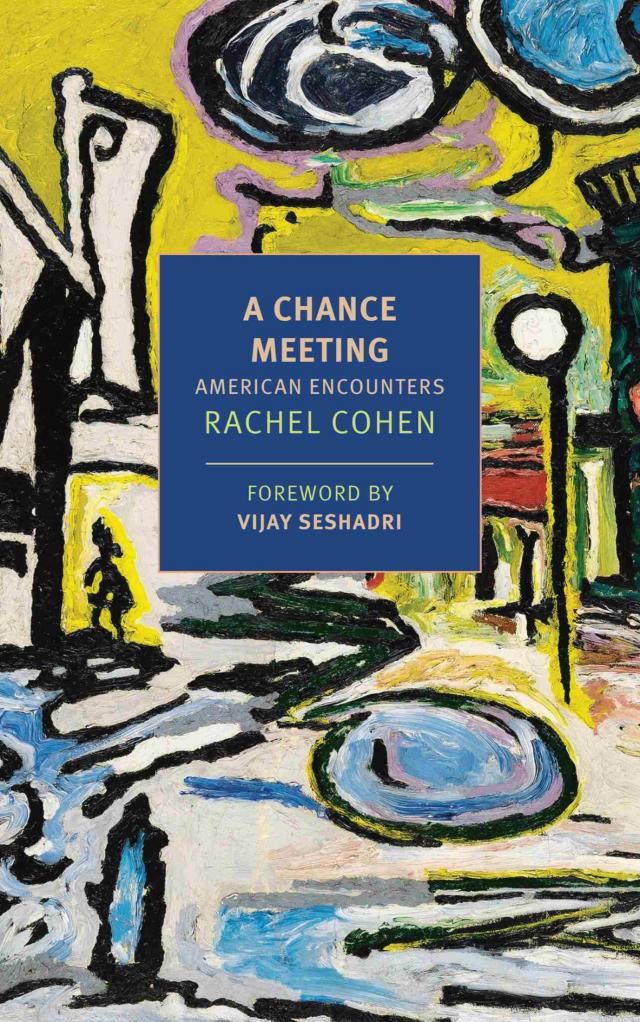
Cover image: Beauford Delaney, Untitled (Village Street Scene), 1948; © Estate of Beauford Delaney
Cover design: Katy Homans
Library of Congress Cataloging-in-Publication Data
Names: Cohen, Rachel, 1973– author.
Title: A chance meeting : intertwined lives of American writers and artists / by Rachel Cohen.
Description: New York : New York Review Books, 2024. | Series: New York Review Books Classics
Identifiers: LCCN 2023027566 (print) | LCCN 2023027567 (ebook) | ISBN 9781681378107 (paperback) | ISBN 9781681378114 (ebook)
Subjects: LCSH: Authors, American—20th century—Biography. | Artists—United States—Biography. | Authors and artists—Biography. | Friendship—United States—History—20th century. | Arts, American—20th century. | United States—Intellectual life—20th century.
Classification: LCC PS129 .C56 2024 (print) | LCC PS129 (ebook) | DDC 810.9/005 [B]—dc23/eng/20230615
LC record available at https://lccn.loc.gov/2023027566
LC ebook record available at https://lccn.loc.gov/2023027567
ISBN 978-1-68137-811-4
v1.0
For a complete list of titles, visit www.nyrb.com
CONTENTS
Cover
Biographical Notes
Title Page
Copyright and More Information
Illustrations
Foreword
Introduction to the First Edition
1. Henry James and Mathew Brady
2. William Dean Howells and Annie Adams Fields and Walt Whitman
3. Mathew Brady and Ulysses S. Grant
4. William Dean Howells and Henry James
5. Walt Whitman and Mathew Brady
6. Mark Twain and William Dean Howells
7. Mark Twain and Ulysses S. Grant
8. W. E. B. Du Bois and William James
9. Gertrude Stein and William James
10. Henry James and Annie Adams Fields and Sarah Orne Jewett
11. Edward Steichen and Alfred Stieglitz
12. Willa Cather and Mark Twain
13. Willa Cather and Annie Adams Fields and Sarah Orne Jewett
14. Edward Steichen and Alfred Stieglitz and Gertrude Stein
15. Carl Van Vechten and Gertrude Stein
16. Marcel Duchamp and Alfred Stieglitz
17. Willa Cather and Edward Steichen and Katherine Anne Porter
18. Alfred Stieglitz and Hart Crane
19. Hart Crane and Charlie Chaplin
20. Langston Hughes and Zora Neale Hurston
21. Beauford Delaney and W. E. B. Du Bois
22. Hart Crane and Katherine Anne Porter
23. Elizabeth Bishop and Marianne Moore
24. Zora Neale Hurston and Carl Van Vechten
25. Joseph Cornell and Marcel Duchamp
26. Beauford Delaney and James Baldwin
27. Joseph Cornell and Marianne Moore
28. James Baldwin and Norman Mailer
29. Robert Lowell and Elizabeth Bishop
30. John Cage and Richard Avedon
31. W. E. B. Du Bois and Charlie Chaplin
32. Langston Hughes and Carl Van Vechten and Richard Avedon
33. Richard Avedon and James Baldwin
34. Marianne Moore and Norman Mailer
35. John Cage and Marcel Duchamp
36. Norman Mailer and Robert Lowell
Author’s Afterword
Acknowledgments
Notes
Bibliography
Index
Credits and Permissions
ILLUSTRATIONS
Henry James, Sr., and Henry James, Jr., by Mathew Brady
Mathew Brady by the Mathew Brady Studio
William Dean Howells
Annie Adams Fields by Southworth and Hawes
Ulysses S. Grant by Mathew Brady
Walt Whitman by Mathew Brady
Mark Twain
Henry James and William James
Edward Steichen, self-portrait
Alfred Stieglitz by Edward Steichen
Sarah Orne Jewett
Carl Van Vechten, self-portrait
Gertrude Stein by Carl Van Vechten
Willa Cather by Edward Steichen
Katherine Anne Porter
Hart Crane by Walker Evans
Charlie Chaplin by Edward Steichen
Langston Hughes by Carl Van Vechten
Zora Neale Hurston by Carl Van Vechten
Joseph Cornell
Beauford Delaney by Carl Van Vechten
Norman Mailer by Carl Van Vechten
Robert Lowell by Richard Avedon
Elizabeth Bishop
John Cage and Merce Cunningham and Robert Rauschenberg by Richard Avedon
W. E. B. Du Bois by Carl Van Vechten
Charlie Chaplin by Richard Avedon
Langston Hughes and Carl Van Vechten by Richard Avedon
James Baldwin by Richard Avedon
Richard Avedon, self-portrait
James Baldwin and Richard Avedon by Richard Avedon
Marianne Moore by Richard Avedon
Marcel Duchamp by Richard Avedon
FOREWORD
As if a river should carry all
the scenes that it had once reflected
shut in its waters . . .
IN THE middle of A Chance Meeting, Rachel Cohen tells us exactly where she got her title and, maybe, the germ of the idea, for her unique and beautifully written book of cultural history. The chapter is Chapter 17. Sixteen previous chapters have brought us person by creative person, link by human link, and overlap by temporal overlap from the Civil War to the middle of the twentieth century of these United States. Concentrating on the intersections between her subjects’ lives, Cohen has given us acquaintanceships, friendships, rivalries, and loyalties among those who have made America’s art and carried forward its meaning. These relationships, quietly accruing along the channels of time, come to reflect the changing character of the country and its imaginative identity.
Chapter 17 concerns itself with two photographs, with Willa Cather, with Edward Steichen’s way of working, with Katherine Anne Porter and her relationship to fact and fantasy, and with the ghost of Gustave Flaubert. Cataloged like this, the association of these various elements might seem unlikely, but the force of Cohen’s imagination and the depth of her research are such that this association is by the end of the chapter not only not unlikely but inevitable. Chapter 17 finds Cather in Provence, where she meets Flaubert’s niece. In gratitude for Flaubert, she kisses the niece’s hand. The essay in which Cather tells us about this kiss is called “A Chance Meeting”; and Cohen’s allusion to it is another of those moments of subtle conceptual playfulness—like the playfulness of a Renaissance painter who puts himself at the edge of a crowded composition and gazes not at the Annunciation or the Wedding at Cana but, instead, at the viewer outside the frame—that pervade her own Chance Meeting.
This playfulness springs from the delight that runs just under the surface of A Chance Meeting. There are works of literature—often found near the beginning of careers—in which the exhilaration of the writer is so palpable and the joy of writerly self-discovery so evident that these become a part of our reading pleasure. A very famous example is The Pickwick Papers. Another is “A Chance Meeting.” Like Dickens, Cohen has found a fresh and liberating idea that allows her to run across the fields of American history the way he runs across an imagined England. Energy produces eternal delight. Constructive power emerges fully grown from the forehead. Young, up until now anticipatory, episodic, fragmentary (Dickens has made a small mark with a miscellaneous collection of urban sketches; Rachel Cohen has published interesting essays in quarterlies), the authors of these books suddenly arrive at a unique fusion of form and sensibility. They couldn’t be happier. The world glistens with the morning dew.
Because she’s writing history (and because she is who she is), Cohen can’t let her delight bubble over the way Dickens does, but it’s always there, like the murmur of an underground river. And Cohen has other Dickensian properties alongside the miraculous beginning. She’s capacious: she likes and can manage a teeming canvas. She’s inclined to soft-heartedness and is a touch sentimental, and so, like Dickens, requires her strong mind and a counterbalancing realism to space these impulses properly, keep them in check, and get the most use out of them. She has an appreciative eye for human idiosyncrasies. She can, within the small latitudes allowed her by the rigors of scholarship, be a fierce moralist. Here is a passage from the account of a chance meeting between Hart Crane and Charlie Chaplin:
The dinner between Crane and Chaplin didn’t come off; the two men never met again. Chaplin avoided Crane—or at least didn’t respond when Crane attempted to see him in California some years later. Crane sent Chaplin his first book of poems, White Buildings, which included “Chaplinesque,” and, writing his memoirs thirty years after Crane’s death, Chaplin mentioned being glad to receive it. Chaplin was always gracious about the dead.
The flicker of disapproval in the last sentence does a few things. It establishes Cohen’s partialities—which orient slightly but unmistakably toward the vulnerables (the Cranes) rather than the cast-iron survivors (the Chaplins). It establishes the limits she imposes on the expression of those partialities. Finally, by emphasizing, however flickeringly, her moral presence, and thereby adding another daub of paint to the subtle self-portraiture that is a half-hidden beauty of her book, Cohen gives us one more glimpse of the intense fictive elements of her factual enterprise.
When A Chance Meeting was first published, at the beginning of the millennium, it was admired for what it represented itself as being—an ingenious, writerly, inventive work that without violating the imperatives of scholarship managed to accommodate the local and intimate realities, the densities of human contact, at the heart of history. What readers took from it was mostly what it advertised rather than what it withheld—a new but straightforward perspective on how culture is made. To see the young W. E. B. Du Bois with William James at the end of the nineteenth century and then to see him a quarter of a century later as an established figure inciting an anxiety of influence in the young Zora Neale Hurston and the even younger Langston Hughes was to acquire an understanding of the American unfolding that was as unexpected as it was crucial. This kind of historical knowledge, deriving primarily from composition—from the just and lucid arrangement of figures and forces—rather than new interpretations, was what Cohen promised and what she delivered.
Reading it now, overflowing imagination seems more and more the motive and the experience of A Chance Meeting. Why these artists and thinkers and not others, for example? Cohen deflects and begs the question. She says in her preface that she wrote about “people whose company I had an instinct for.” Given the breadth of her instincts and sympathies, though, there are at least a dozen others she could have taken up. Why not Stephen Crane, say, or Ralph Ellison or Loie Fuller or Paul Strand?
A more plausible, though still evasive, explanation of Cohen’s principles of selection might be that A Chance Meeting is a chance operation (John Cage takes the stage late in the book), like the divinations of the I Ching. The yarrow stalks of American cultural history are thrown down on the ground and form this pattern. A Chance Meeting doesn’t feel aleatory, though. It feels like the opposite—unified, purposive, even visionary. A capital “I” Idea seems to be shining down from a huge distance, orienting everything to itself and, especially, illuminating the in-between spaces, the gaps in the historical record where speculation becomes possible. The writer’s imagination settles itself there and thrives. People we know from our reading about the past as nothing more than figures in outline become characters intersecting with other characters. Stories are generated at intersections that were previously inaccessible to documentation. Cohen’s fluid mastery of conditional and subjunctive moods (if . . . , perhaps . . . , possibly . . . , he might have been . . .) allows her to flow into the minds of her people, to re-create their inner lives and to possess them the way a novelist does.
Another thing Cohen shares with Dickens is a passion for the coincidental. She isn’t allowed to manufacture coincidences, the way he is, but when she finds them in the record—like Ulysses S. Grant with his generals, for example, Cage insists that performers in his pieces synchronize their watches—she jumps on them with glad cries of joy. Coincidentality is the very atmosphere of A Chance Meeting, though, and it points to the book’s deeper enterprise and metaphysics. Dickens’s coincidences often reveal a hidden pattern in the world. They are, when they become crucial to the plot, ex machina and redemptive—their ultimate source being the pattern of redemption underlying history, which derives from the central myth of Western culture, and which tells the story of the triumph over time.
Cohen has her own triumph over time. She sees her own redemptive purpose and pattern in history. Time may be linear, but art and culture are circular. They are one with themselves. They live in the eternal present. They return and return to their sources, and those sources are the simple ones—companionship, comradeship, simple affections, and loves, in some cases asymmetrical, in some cases tragic. Not being a maker of propositions or a purveyor of lessons but, rather, a keen observer of phenomena, Cohen can’t step out of her magic circle and tell us what she means, but it’s nice to think of her inside it and to think of her subjects—the Mailers and Baldwins, the Grants, Whitmans, and Twains, the Bishops—flocking to her. They enjoy her friendship. They’re as pleased with her as she is with them.
—VIJAY SESHADRI
INTRODUCTION TO THE FIRST EDITION
THE THIRTY people gathered here met in ordinary ways: A careful arrangement after long admiration, a friend’s casual introduction, or because they both just happened to be standing near the drinks. They saw each other first in a photography studio, or a magazine office, and they talked for a few hours or for forty years. Later it felt to them, as it often does, entirely by chance that they had met and yet impossible that they could have missed each other.
Some of their encounters left a memorable impression, though they never spoke again; on other occasions strong and altering loyalties emerged, permanent conditions of influence were established, and acts of rebellion were set in motion. Writing of their own lives, they very often identified the crucial shifts as having happened in the moment of going through a new door or in the grasp of an unfamiliar hand.
A suggestion of what passed between them was sometimes recorded in a single photograph and other times in the long history of a friendship. As they knew each other better, they wrote encouraging letters, edited each other’s novels, went swimming, fought bitterly, dedicated poems to one another, and played chess.
They came and went over the course of a century—the fruitful, difficult period that held two related struggles, the Civil War and the civil rights movement. Once in a while they met behind the lines or on the field of protest, but war and politics were also in their minds when they sat together in someone’s library or in a taxi.
•
Many of these people began keeping me company ten years ago, during a solitary year I spent driving around the United States. I had in my trunk two crates of books, by Henry James, Mark Twain, and Ulysses Grant, Willa Cather, Katherine Anne Porter, James Baldwin, Marianne Moore, and Elizabeth Bishop. I was reading books, as I had not before, to know their authors. I watched these writers responding to love, solitude, religion, the natural world, history, reading, and their families, but I cared most to know how they felt about friendship.
I started to read collections of essays and letters and I realized that many of the writers in my trunk had known one another. Mark Twain had been the first to publish Ulysses Grant’s Personal Memoirs. Willa Cather had written beautifully about her debts to other writers in her memoirs of Annie Adams Fields and Sarah Orne Jewett and in the essay from which, after long thought, I borrowed the title, “A Chance Meeting.” It turned out that Katherine Anne Porter had practically thrown Hart Crane out of her house in Mexico; Elizabeth Bishop’s poem for Marianne Moore had hundreds of letters behind it; and James Baldwin had finally stopped speaking to Norman Mailer after a prizefight.


