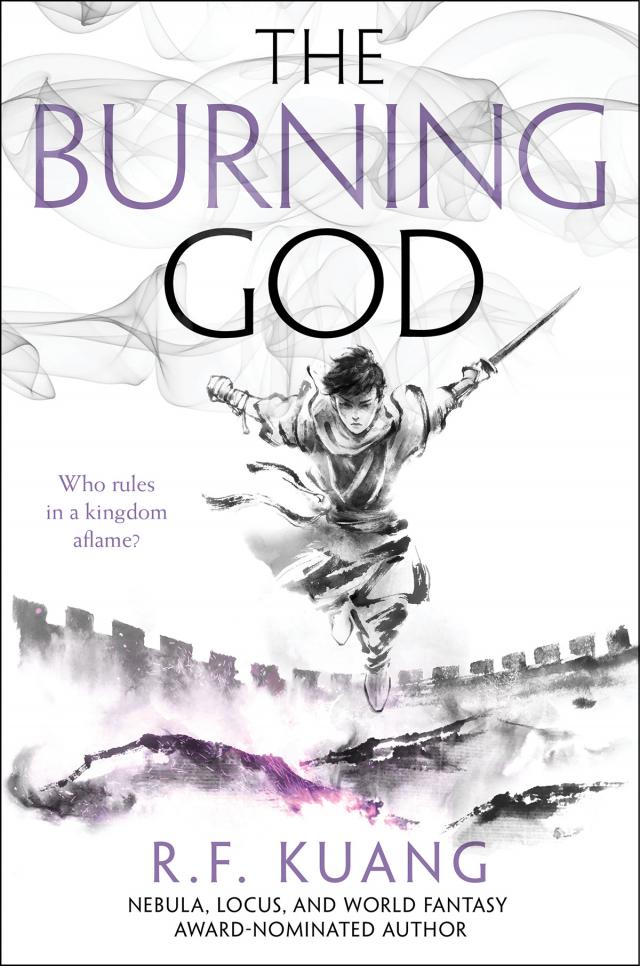
The Burning God, page 20
part #3 of The Poppy War Series


“And who are you?” Souji asked. The question didn’t sound like a challenge. He sounded confused, rather, like a man who had just awoken from a deep slumber to find himself in unfamiliar forest. Souji was groping through the mist, trying desperately to catch hold of clarity.
Daji gave a low chuckle. “Only an old woman who has seen a fair bit of the world.”
“But you don’t . . .” Souji trailed off. His question dissipated into nothing. Rin wished she could see his face.
“The Young Marshal will want to see her first,” said the first of Nezha’s envoys, the one who had put his boot on Rin’s neck. “He’ll want to know that she—”
“Your Young Marshal will be content with your report,” Daji said smoothly. “You are his loyal lieutenants. He’ll trust your word. Wait any longer and you risk that she wakes.”
“But we were tasked to—”
“Yin Nezha is weak and ailing,” Daji said. “He cannot face the Speerly right now. What do you think he will do if she strikes? She will burn him in his bed, and you will be known as the men who brought this monster to his lair. Would you murder your own general?”
“But he said she’d lost the fire,” said the soldier.
“And you trust this man?” Daji pressed. “You’ll wager the Young Marshal’s life on the words of a guerrilla commander?”
“No,” the soldier murmured. “But we—”
“Don’t think,” Daji whispered. Her voice was like gossamer silk. “Why think? Don’t trouble yourself with such thoughts. It’s much easier to obey, remember? You only have to do as I say, and you’ll be at peace.”
Another meek silence descended over the room.
“Good,” Daji cooed. “Good boys.”
Rin couldn’t see Daji’s eyes, not from this angle, but even she felt drowsy, lured into the soft, comforting undulations of Daji’s voice.
Daji bent over Rin and smoothed the hair away from her face. Her fingers lingered over Rin’s exposed neck. “Now, you’ll want to sedate her for the trip.”
The trip.
This wasn’t all just a ploy, then. They really were taking her to the Chuluu Korikh. The stone prison, the hell inside the mountain, the place where shamans who had gone mad were taken to be locked in stone, trapped forever, unable to call their gods and unable to die.
Gods, no. Not there.
Rin had been to the Chuluu Korikh once. The very thought of returning made her feel as if she were drowning.
She tried to lift her head. Tried to say something, to do anything. But Daji’s whispers washed over her thoughts like a cool, cleansing stream.
“Don’t think.” Rin barely heard distinct words anymore, just music, just tinkling notes that soothed her mind like a lullaby.
“Give up, darling. Trust me, this is easier. This is so much easier.”
Part II
Chapter 11
“Before humans lived on this earth, the god of water and the god of fire quarreled and split the sky apart,” Riga said. “All that shiny blue ceramic cracked and fell to Earth, and the Earth in its greenery was exposed to the darkness like yolk inside a shattered egg. That’s a nice image, isn’t it?”
Daji moved cautiously toward him, fingers outstretched as if she were approaching a wild animal. She didn’t know what to expect from him. Nothing Riga did was predictable anymore; these days she couldn’t tell from second to second whether he was about to kiss her or hit her.
She would have been less surprised if he were shouting, slamming things and people against the walls because things had gone wrong, had been going wrong for weeks.
But Riga was reading. Everything they had built over the past few years, every rock of their castle, was falling apart around them, and he was standing by the window with a book of children’s myths, flipping idly through its pages, fucking reading out loud like he thought she needed a bedtime story.
She kept her voice low so as not to startle him. “Riga, what’s happening out there?”
He ignored her question. “You know, I think I’ve figured out where you get all that self-righteousness.” He flipped the book around to show her the painted illustrations. “Nüwa mends the sky. You’ve heard this myth, haven’t you? The men wreck the world, and the woman has to piece it back together. The goddess Nüwa patched up that rift they’d made in the sky, rock by rock, and the world was right again.”
Daji stared at him, casting wildly about for something to say.
She never understood what he was talking about anymore. She didn’t know when the changes had begun—perhaps after Lusan, or perhaps since the Hinterlands. It had started so gradually, like little dribbles of water that eventually burst forth through a dam, and now Riga had transformed into an utterly different person, a person who lashed out and hurt those around him and delighted in torturing her with riddles he knew she couldn’t answer.
He used to only inflict his strength on others. Now the person whose fear he seemed to enjoy the most was hers.
Come back to me, she wanted to cry every time they spoke. Something had broken between them, some invisible wound. It had started with Tseveri’s death and grown like gangrenous rot, and now it loomed behind every word they spoke, every order they gave.
One will die, one will rule, and one will sleep for eternity.
“You’re rambling,” she said.
He just laughed. “Isn’t it obvious?” He nodded toward the window. “Our stories move in circles. The Classics predicted how this whole thing is going to go. Ziya and I are going to break the world. And you’re going to mend it.”
Daji could glimpse the burning shore from where she stood. She didn’t need General Tsolin’s powerful astrological scopes to see what was happening across the strait. A simple spyglass was enough.
Spots of orange lit up the night. If she didn’t know better, she would have thought they were firecrackers.
She wondered, because she couldn’t help it, if any of the children Shiro hadn’t taken had at least made it off the island, if their parents had packed them away in boats and told them to row on, never looking back. But she knew better than to hope. The Mugenese were too thorough.
She knew that by morning, no one on that island would be left alive.
Riga’s doomed us.
This was the end. She knew this like a fundamental truth, as certain as the Earth’s rotation around the sun. They would suffer dearly for their sacrifice of Speerly blood. This kind of evil would not go unpunished—the gods would not allow it.
Everything they’d fought for, everything they’d built—gone up in smoke. All for some stupid, stupid gamble.
“Do you like what you see?” Riga approached her from behind and put his hands on her hips.
Did he find this erotic? He would.
She lowered the spyglass, trying to mask the frantic pounding of her heart. She turned around and attempted a smile. Riga liked her so much better when she smiled.
“Does Ziya know yet?” she asked.
“He’ll be here soon enough,” Riga said. “Didn’t think he’d want to miss this.”
“That’s cruel.”
He shrugged. “It’ll be good for him. He’s going too soft, we’ve got to whet that edge.”
“And what happens when that edge turns against you?”
“He’d never.” Riga squeezed her waist, chuckling. “He loves us.”
The door burst open. Ziya stormed in, right on cue.
“What’s happening?” he demanded. “They said Speer’s under attack.”
“Oh, Speer’s been attacked.” Riga gestured at the window. “This is just the aftermath.”
“That’s impossible.” Ziya grabbed the spyglass out of Daji’s hands. He tried to train it on the shore, but his hands trembled too badly to hold it still. “Where were Vaisra’s ships?”
Riga, looking smug, didn’t answer.
Daji put a hand on Ziya’s arm. “You should—”
“Where were Vaisra’s ships?” Ziya shouted. He was shaking, barely in control. Daji could see the faint silhouettes of inky creatures under his skin, straining to pour out from within him.
“Come on, Ziya.” Riga sighed. “You know what we had to do.”
Ziya’s mouth worked soundlessly. Daji watched as his eyes darted between Riga’s face and the window.
Poor Ziya. He’d always been so fond of Hanelai. There were moments when she’d feared he might try to marry that spirited little Speerly general of his. Riga wouldn’t have allowed it, of course—he’d always been a stickler about Nikara purity, and he loathed Hanelai besides—but Ziya might have forced it anyway.
Misguided love. Jealous friends. She longed for the time when those were their biggest problems.
“I have to get to Speer,” Ziya said. “I have to—I have to find her.”
“Oh, come now. You know what you’ll find.” Riga gestured grandly at the burning shore. “You can see the island clearly enough from here. They’re all dead, every single one of them. The crickets are nothing if not thorough. It’s already over. Whatever fighting is happening now is just cleanup. Hanelai’s dead, Ziya. I did tell you it was foolish to let her go.”
Ziya looked as if Riga had taken a dagger and twisted it into his heart.
Riga clapped him on the back. “It’s for the best.”
“You didn’t have the right,” Ziya whispered.
Riga laughed a deep, cruel laugh. “Now is when you grow a spine?”
“Their blood is on you. You killed them.”
“‘You killed them,’” Riga imitated. “Don’t speak to me about killing innocents. Who leveled the Scarigon Plateau? Who tore Tseveri’s heart out of her chest?”
“Tseveri wasn’t my fault—”
“Oh, it’s never your fault,” Riga sneered. “You just lose control and people accidentally end up dead, and then you wake up and start whining about the people who are bold enough to do what’s necessary while fully conscious. Get a grip, brother. You murdered Tseveri. You let Hanelai go to her death. Why? Because you know what’s necessary and what’s at stake, and you know that in the grand scheme of things, those two little whores of yours were obstacles not worth mentioning. Think of what happened as a kindness. You know it probably was. You know the Speerlies would have botched self-rule the moment they got it, would have probably started butchering each other the moment we let them take charge. You know people like Hanelai were never particularly good at being free.”
“I hate you,” Ziya said. “I wish we were all dead.”
Riga lifted a hand and casually backhanded him across the face. The crack echoed through the room.
“I freed you from your shackles.” Riga advanced on the cringing Ziya, slowly unsheathing his sword. “I dragged both of you out of the occupied zone. I found the Hinterlanders, I took us to Mount Tianshan, and I brought you to the Pantheon. And you dare to defy me?”
The air thrummed, thick with something powerful, suffocating, and terrible.
Just bow, Daji wanted to cry at Ziya. Bow and it’ll be over.
But she was mute, rooted in place by fear.
Ziya hadn’t moved, either. The sight was bizarre, a grown man cowering like a child, but Daji knew what made him do it.
Fear was inscribed in Ziya’s bones, just like it was in hers. Blow by blow, cut by cut—over the last decade, since they were children, Riga had made sure of it.
She realized that both of them were glaring at her. Demanding a response. But what was the question? What could she possibly do to fix this?
“Nothing?” Ziya demanded.
“She won’t say anything,” Riga scoffed. “Little Daji knows what’s best for us.”
“You’re a coward,” Ziya snarled at her. “You’ve always been.”
“Oh, don’t bully her—”
“Fuck you.” Ziya slammed his staff against the floor. The sound made Daji jump.
Riga laughed. “You want to do this now?”
“Don’t,” Daji murmured, but the word came out in a terrified squeak. Neither of them heard.
Ziya flew at Riga. Riga opened his palm and immediately Ziya dropped to the ground, howling in pain.
Riga sighed theatrically. “You would lift your hand against me, brother?”
“You’re not my brother,” Ziya gasped.
A void opened in the air behind them. Shadowy beasts poured through, one after the other. Ziya pointed. They surged, but Riga sliced them down like paper animals, fast as they came.
“Please,” Riga said. The smile never dropped from his face. “You can do better than that.”
Ziya raised his staff high. Riga lifted his sword.
Somehow Daji found the strength to move. She flung herself into the space between them just before they rushed each other with enough force to split cracks in the stone floor, a force that shattered the world like it was an eggshell. Decades later she would wonder if she had known what she was doing back then, when she threw her hands against their chests and spoke the incantation she did. Had she known and accepted the consequences? Or had she done it by accident? Was everything that happened after a cruelty of chance?
All she knew in that moment was that all sound and motion stopped. Time hung still for an eternity. A strange venom, something she’d never summoned before, seeped through the air, rooted itself into all three of their minds, and unfurled to take a shape none of them had ever seen or experienced. Then Riga collapsed to the floor and Ziya reeled backward, and they both might have shouted, but the only thing Daji could hear past the blood thundering in her ears was the ghostly echo of Tseveri’s cold, mirthless laughter.
Chapter 12
Private Memorandum on the Nikara Republic, formerly known as the Nikara Empire or the Empire of Nikan, to the Office of Foreign Affairs of the Republic of Hesperia.
Open trade in the Nikara territories continues to reveal assets justifying the Consortium’s investment, and efforts to acquire these assets proceed smoothly as anticipated. The Consortium has secured the rights to several critical mining deposits with surprisingly little struggle (in truth, I imagine the Nikara are ignorant to the riches beneath their feet). Beyond tea and minerals, our agents have discovered a number of local goods that will find an eager market at home. Nikara porcelain has a shine and translucency that, quite honestly, bests our domestic wares. Nikara carved jade figurines will no doubt attract customers looking for novel interior decoration (see Box 3, attached). The local textile craftsmanship is impressive given their lack of automated looms—their artisans have developed particularly clever mechanisms to harness the power of water to spin cloth far faster than a single weaver could. (I expect our ladies will be parading the streets in silk robes and parasols before too long!)
The Gray Company representatives of the Order of the Holy Maker have encountered more significant difficulties. Indigenous opposition to conversion proves thorny (see the attached letter from Sister Petra Ignatius of the Second Spire). This is not so much because of an existing religion that defies replacement—indeed, most of the natives seem to be quite indifferent to the question of religion—but because of the social discipline that religion entails. They find regular weekly worship a waste of time and resent being corralled to chapel. They are used to their squalid, superstitious ways and seem unable to accept the blinding proof of the Maker’s eminence, even when laid out slowly before them in their own language. But our efforts will continue, surely if slowly; our duty to the Architect to bring order upon every corner of the world necessitates no less.
We find minimal risk that Nikara natives could mount a concentrated armed uprising. Our studies of the Empire have long indicated that their strategic culture is made pacifist and stagnant by an Empire with no inclination to territorial expansion. The Republic has never mounted a seafaring expedition to conquer another nation. Save for their conquest of the Isle of Speer, the Republic has only ever absorbed foreign aggression. Now that Yin Vaisra has finished quelling the remnants of Su Daji’s regime in the north, we expect that over a five-year timeline our fears of domestic warfare can be put to rest.
The greatest threats now are the indigenous guerrilla movements in the south, whose bases are concentrated in Rooster and Monkey Provinces. Their perceived trump card is the Speerly Fang Runin, whose pyrotechnic displays have convinced them of a pagan shamanistic belief that rivals the Order of the Holy Maker. (Our liaisons in the Gray Company believe these shamanic abilities to be heretofore unseen manifestations of Chaos—see Addendum 1: Nikara Shamanism.) This threat should not terribly worry the Consortium. The numbers of shamans are few—aside from the Speerly and Yin Vaisra’s heir, the Gray Company have identified no others on the continent. The southern rebels are still centuries behind even the old Federation of Mugen on every front, and they attempt to fight dirigibles with sticks and stones.
Their so-called gods will not save them. Sister Petra assures me that in addition to improved opium missiles, which we have confirmed negates shamanic ability, research efforts to devise countermeasures proceed smoothly, and that in several weeks we will have weapons even the Speerly cannot best. (See Addendum 2: Research Notes on Yin Nezha.) The south will fall when the Speerly falls. Absent some divine intervention, we shall promptly produce upon this barbarous nation every effect we could desire.
In the Name of the Divine Architect,
Major General Josephus Belial Tarcquet
Chapter 13
When Rin awoke, her head was fuzzy, her mouth felt like it had been stuffed with silkworm cocoons, and a throbbing ache snaked from the scars in her back through every muscle in her lower body. She heard a roar so loud it seemed to envelop her, drowning out her thoughts, making her bones thrum with its reverberations.
Her gut dropped; the floor seemed to lurch. Was she in a dirigible?
Something cool and wet rubbed against her forehead. She forced her throbbing eyelids open. Daji’s face came gradually into focus. She was wiping Rin’s face with a washcloth.