

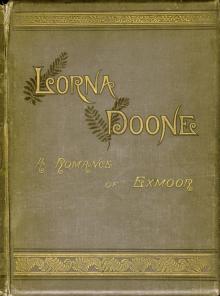
Lorna Doone, page 18


But for all that, Uncle Reuben was none the worse nor better. He looked down into Glen Doone first, and sniffed as if he were smelling it, like a sample of goods from a wholesale house; and then he looked at the hills over yonder, and then he stared at me.
“See what a pack of fools they be?”
“Of course I do, Uncle Ben. ‘All rogues are fools,’ was my first copy, beginning of the alphabet.”
“Pack of stuff, lad. Though true enough, and very good for young people. But see you not how this great Doone valley may be taken in half-an-hour?”
“Yes, to be sure I do, uncle; if they like to give it up, I mean.”
“Three culverins on yonder hill, and three on the top of this one, and we have them under a pestle. Ah, I have seen the wars, my lad, from Keinton up to Naseby; and I might have been a General now, if they had taken my advice”—
But I was not attending to him, being drawn away on a sudden by a sight which never struck the sharp eyes of our General. For I had long ago descried that little opening in the cliff through which I made my exit, as before related, on the other side of the valley. No bigger than a rabbit-hole it seemed from where we stood; and yet of all the scene before me, that (from my remembrance perhaps) had the most attraction. Now gazing at it with full thought of all that it had cost me, I saw a little figure come, and pause, and pass into it. Something very light and white, nimble, smooth, and elegant, gone almost before I knew that any one had been there. And yet my heart came to my ribs, and all my blood was in my face, and pride within me fought with shame, and vanity with self-contempt; for though seven years were gone, and I from my boyhood come to manhood, and all must have forgotten me, and I had half-forgotten; at that moment, once for all, I felt that I was face to face with fate (however poor it might be), weal or woe, in Lorna Doone.
CHAPTER XVI.
Having reconnoitred thus the position of the enemy, Master Huckaback, on the homeward road, cross-examined me in a manner not at all desirable. For he had noted my confusion and eager gaze at something unseen by him in the valley, and thereupon he made up his mind to know everything about it. In this, however, he partly failed; for although I was no hand at fence, and would not tell him a falsehood, I managed so to hold my peace that he put himself upon the wrong track, and continued thereon with many vaunts of his shrewdness and experience, and some chuckles at my simplicity. Thus much, however, he learned aright, that I had been in the Doone valley several years before, and might be brought upon strong inducement to venture there again. But as to the mode of my getting in, the things I saw, and my thoughts upon them, he not only failed to learn the truth, but certified himself into an obstinacy of error, from which no after-knowledge was able to deliver him. And this he did, not only because I happened to say very little, but forasmuch as he disbelieved half of the truth I told him, through his own too great sagacity.
Upon one point, however, he succeeded more easily than he expected, viz. in making me promise to visit the place again, as soon as occasion offered, and to hold my own counsel about it. But I could not help smiling at one thing, that according to his point of view my own counsel meant my own and Master Reuben Huckaback’s.
Now he being gone, as he went next day, to his favourite town of Dulverton, and leaving behind him shadowy promise of the mountains he would do for me, my spirit began to burn and pant for something to go on with; and nothing showed a braver hope of movement and adventure than a lonely visit to Glen Doone, by way of the perilous passage discovered in my boyhood. Therefore I waited for nothing more than the slow arrival of new small-clothes made by a good tailor at Porlock, for I was wishful to look my best; and when they were come and approved, I started, regardless of the expense, and forgetting (like a fool) how badly they would take the water.
What with urging of the tailor, and my own misgivings, the time was now come round again to the high-day of St. Valentine, when all our maids were full of lovers, and all the lads looked foolish. And none of them more sheepish or innocent than I myself, albeit twenty-one years old, and not afraid of men much, but terrified of women, at least, if they were comely. And what of all things scared me most was the thought of my own size, and knowledge of my strength, which came, like knots, upon me daily. In honest truth I tell this thing (which often since hath puzzled me, when I came to mix with men more), I was to that degree ashamed of my thickness and my stature, in the presence of a woman, that I would not put a trunk of wood on the fire in the kitchen, but let Annie scold me well, with a smile to follow, and with her own plump hands lift up a little log, and fuel it. Many a time I longed to be no bigger than John Fry was; whom now (when insolent) I took with my left hand by the waist-stuff, and set him on my hat, and gave him little chance to tread it; until he spoke of his family, and requested to come down again.
Now taking for good omen this, that I was a seven-year Valentine, though much too big for a Cupidon, I chose a seven-foot staff of ash, and fixed a loach-fork in it, to look as I had looked before; and leaving word upon matters of business, out of the back door I went, and so through the little orchard, and down the brawling Lynn-brook. Not being now so much afraid, I struck across the thicket land between the meeting waters, and came upon the Bagworthy stream near the great black whirlpool. Nothing amazed me so much as to find how shallow the stream now looked to me, although the pool was still as black and greedy as it used to be. And still the great rocky slide was dark and difficult to climb; though the water, which once had taken my knees, was satisfied now with my ankles. After some labour, I reached the top; and halted to look about me well, before trusting to broad daylight.
The winter (as I said before) had been a very mild one; and now the spring was toward so that bank and bush were touched with it. The valley into which I gazed was fair with early promise, having shelter from the wind, and taking all the sunshine. The willow-bushes over the stream hung as if they were angling with tassel’d floats of gold and silver, bursting like a bean-pod. Between them came the water laughing, like a maid at her own dancing, and spread with that young blue which never lives beyond the April. And on either bank, the meadow ruffled as the breeze came by, opening (through now tufts of green) daisy-bud or celandine, or a shy glimpse now and then of the lovelorn primrose.
Though I am so blank of wit, or perhaps for that same reason, these little things come and dwell with me, and I am happy about them, and long for nothing better. I feel with every blade of grass, as if it had a history; and make a child of every bud, as though it knew and loved me. And being so, they seem to tell me of my own delusions, how I am no more than they, except in self-importance.
While I was forgetting much of many things that harm one, and letting of my thoughts go wild to sounds and sights of nature, a sweeter note than thrush or ouzel ever wooed a mate in, floated on the valley breeze at the quiet turn of sundown. The words were of an ancient song, fit to cry or laugh at.
“Love, an if there be one,
Come my love to be,
My love is for the one
Loving unto me.
“Not for me the show, love,
Of a gilded bliss;
Only you must know, love,
What my value is.
“If in all the earth, love,
You have none but me,
This shall be my worth, love,
To be cheap to thee.
“But, if so thou ever
Strivest to be free;
’Twill be my endeavour
To be dear to thee.
“So shall I have plea, love,
To thy heart and breath;
Clinging still to thee, love,
In the doom of death.”
All this I took in with great eagerness, not for the sake of the meaning (which is no doubt an allegory), but for the power and richness, and softness of the singing, which seemed to me better than we ever had even in Oare church. But all the time I kept myself in a black niche of the rock, where the fall of the water began, lest the sweet singer (espying me) should be alarmed, and flee away. But presently I ventured to look forth, where a bush was; and then I beheld the loveliest sight—one glimpse of which was enough to make me kneel in the coldest water.
By the side of the stream she was coming to me, even among the primroses, as if she loved them all; and every flower looked the brighter, as her eyes were on them. I could not see what her face was, my heart so awoke and trembled; only that her hair was flowing from a wreath of white violets, and the grace of her coming was like the appearance of the first wind-flower. The pale gleam over the western cliffs threw a shadow of light behind her, as if the sun were lingering. Never do I see that light from the closing of the west, even in these my aged days, without thinking of her. Ah, me, if it comes to that, what do I see of earth or heaven, without thinking of her?
The tremulous thrill of her song was hanging on her open lips; and she glanced around, as if the birds were accustomed to make answer. To me it was a thing of terror to behold such beauty, and feel myself the while to be so very low and common. But scarcely knowing what I did, as if a rope were drawing me, I came from the dark mouth of the chasm; and stood, afraid to look at her.
She was turning to fly, not knowing me, and frightened, perhaps, at my stature, when I fell on the grass (as I fell before her seven years agone that day), and I just said, “Lorna Doone!”
She knew me at once, from my manner and ways, and a smile broke through her trembling, as sunshine comes through aspen-leaves; and being so clever she saw, of course, that she needed not to fear me.
“Oh, indeed,” she cried, with a feint of anger (because she had shown her cowardice, and yet in her heart she was laughing); “oh, if you please, who are you, sir, and how do you know my name?”
“I am John Ridd,” I answered; “the boy who gave you those beautiful fish, when you were only a little thing, seven years ago to-day.”
“Yes, the poor boy who was frightened so, and obliged to hide here in the water.”
“And do you remember how kind you were, and saved my life by your quickness, and went away riding upon a great man’s shoulder, as if you had never seen me, and yet looked back through the willow-trees?”
“Oh, yes, I remember everything; because it was so rare to see any except,—I mean because I happen to remember. But you seem not to remember, sir, how perilous this place is.”
For she had kept her eyes upon me; large eyes of a softness, a brightness, and a dignity which made me feel as if I must for ever love and yet for ever know myself unworthy. Unless themselves should fill with love, which is the spring of all things. And so I could not answer her, but was overcome with thinking and feeling and confusion. Neither could I look again; only waited for the melody which made every word like a poem to me, the melody of her voice. But she had not the least idea of what was going on with me, any more than I myself had.
“I think, Master Ridd, you cannot know,” she said, with her eyes taken from me, “what the dangers of this place are and the nature of the people.”
“Yes, I know enough of that; and I am frightened greatly, all the time, when I do not look at you.”
She was too young to answer me in the style some maidens would have used; the manner, I mean, which now we call from a foreign word “coquettish.” And more than that, she was trembling from real fear of violence, lest strong hands might be laid on me, and a miserable end of it. And, to tell the truth, I grew afraid; perhaps from a kind of sympathy, and because I knew that evil comes more readily than good to us.
Therefore, without more ado, or taking any advantage—although I would have been glad at heart, if needs had been, to kiss her (without any thought of rudeness)—it struck me that I had better go, and have no more to say to her until next time of coming. So would she look the more for me and think the more about me, and not grow weary of my words and the want of change there is in me. For, of course, I knew what a churl I was compared to her birth and appearance; but meanwhile I might improve myself and learn a musical instrument. “The wind hath a draw after flying straw” is a saying we have in Devonshire, made, peradventure, by somebody who had seen the ways of women.
“Mistress Lorna, I will depart”—mark you, I thought that a powerful word—“in fear of causing disquiet. If any rogue shot me it would grieve you; I make bold to say it; and it would be the death of mother. Few mothers have such a son as me. Try to think of me now and then and I will bring you some new-laid eggs, for our young blue hen is beginning.”
“I thank you heartily,” said Lorna; “but you need not come to see me. You can put them in my little bower, where I am almost always—I mean whither daily I repair to read and to be away from them.”
“Only show me where it is. Thrice a-day I will come and stop”—
“Nay, Master Ridd, I would never show thee—never, because of peril—only that so happens it thou hast found the way already.”
And she smiled with a light that made me care to cry out for no other way, except to her dear heart. But only to myself I cried for anything at all, having enough of man in me to be bashful with young maidens. So I touched her white hand softly when she gave it to me, and (fancying that she had sighed) was touched at heart about it, and resolved to yield her all my goods, although my mother was living; and then grew angry with myself (for a mile or more of walking) to think she would condescend so; and then, for the rest of the homeward road, was mad with every man in the world who would dare to think of having her.
CHAPTER XVII.
To forget one’s luck of life, to forget the cark of care and withering of young fingers; not to feel, or not be moved by, all the change of thought and heart, from large young heat to the sinewy lines and dry bones of old age—this is what I have to do ere ever I can make you know (even as a dream is known) how I loved my Lorna. I myself can never know; never can conceive, or treat it as a thing of reason; never can behold myself dwelling in the midst of it, and think that this was I; neither can I wander far from perpetual thought of it. Perhaps I have two farrows of pigs ready for the chapman; perhaps I have ten stones of wool waiting for the factor. It is all the same: I look at both, and what I say to myself is this: “Which would Lorna choose of them?” Of course, I am a fool for this; any man may call me so and I will not quarrel with him, unless he guess my secret. Of course, I fetch my wit, if it be worth the fetching, back again to business. But there my heart is and must be; and all who like to try can cheat me, except upon parish matters.
That week I could do little more than dream and dream and rove about, seeking by perpetual change to find the way back to myself. I cared not for the people round me, neither took delight in victuals; but made believe to eat and drink, and blushed at any questions. And being called the master now, head-farmer, and chief yeoman, it irked me much that any one should take advantage of me; yet everybody did so as soon as ever it was known that my wits were gone moon-raking. For that was the way they looked at it, not being able to comprehend the greatness and the loftiness. Neither do I blame them much; for the wisest thing is to laugh at people when we cannot understand them. I, for my part, took no notice; but in my heart despised them as beings of a lesser nature who never had seen Lorna. Yet I was vexed, and rubbed myself, when John Fry spread all over the farm, and even at the shoeing forge, that a mad dog had come and bitten me, from the other side of Molland.
This seems little to me now; and so it might to anyone; but, at the time, it worked me up to a fever of indignity. To make a mad dog of Lorna, to compare all my imaginings (which were strange, I do assure you—the faculty not being apt to work), to count the raising of my soul no more than hydrophobia! All this acted on me so, that I gave John Fry the soundest threshing that ever a sheaf of good corn deserved, or a bundle of tares was blessed with. Afterwards he went home, too tired to tell his wife the meaning of it; but it proved of service to both of them, and an example for their children.
Now the climate of this country is—so far as I can make of it—to throw no man into extremes; and if he throw himself so far, to pluck him back by change of weather and the need of looking after things. Lest we should be like the Southerns, for whom the sky does everything, and men sit under a wall and watch both food and fruit come beckoning. Their sky is a mother to them; but ours a good stepmother to us—fearing to hurt by indulgence, and knowing that severity and change of mood are wholesome.
The spring being now too forward, a check to it was needful; and in the early part of March there came a change of weather. All the young growth was arrested by a dry wind from the east, which made both face and fingers burn when a man was doing ditching. The lilacs and the woodbines, just crowding forth in little tufts, close kernelling their blossom, were ruffled back, like a sleeve turned up, and nicked with brown at the corners. In the hedges any man, unless his eyes were very dull, could see the mischief doing. The russet of the young elm-bloom was fain to be in its scale again; but having pushed forth, there must be, and turn to a tawny colour. The hangers of the hazel, too, having shed their dust to make the nuts, did not spread their little combs and dry them, as they ought to do; but shrivelled at the base and fell, as if a knife had cut them. And more than all to notice was (at least about the hedges) the shuddering of everything and the shivering sound among them toward the feeble sun; such as we make to a poor fire-place when several doors are open. Sometimes I put my face to warm against the soft, rough maple-stem, which feels like the foot of a red deer; but the pitiless east wind came through all, and took and shook the caved hedge aback till its knees were knocking together, and nothing could be shelter. Then would any one having blood, and trying to keep at home with it, run to a sturdy tree and hope to eat his food behind it, and look for a little sun to come and warm his feet in the shelter. And if it did he might strike his breast, and try to think he was warmer.



_preview.jpg)
_preview.jpg)
_preview.jpg)


