Last Chance, page 1



About the Book
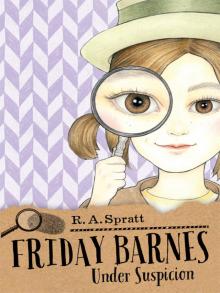
CRIME IS AFOOT IN THE CITY OF LOVE!
Someone stole the Mona Lisa. Okay, it was over a hundred years ago, but a recently uncovered letter reveals that the thief forged a copy. That means the painting in the Louvre now is a fake. And the real Mona Lisa could be anywhere!
Friday Barnes needs to find the truth – and the real painting. She’s going undercover as an art student, along with her partner-in-crime-solving, Melanie, and her staggeringly good-looking boyfrenemy, Ian.
As they watch the comings and goings of France’s most famous art gallery, they see some very strange things. Amid digital pickpockets, guerrilla graffiti and projectile perfume, Friday soon discovers that the Paris art scene is a hotbed of crime.
Contents
Cover
About the Book
Title Page
Dedication
Previously in Friday Barnes
Chapter 1: Delay
Chapter 2: Getting There
Chapter 3: The Missing Mrs
Chapter 4: The Mission
Chapter 5: The Skinny
Chapter 6: Fitting In
Chapter 7: Their New Roommate
Chapter 8: In the Room
Chapter 9: The Most Famous Painting in the World
Chapter 10: No
Chapter 11: Secret Admirer
Chapter 12: Fake Date Night
Chapter 13: Uncle Bernie in Italy
Chapter 14: Venus de Milo
Chapter 15: Still in New York
Chapter 16: Science
Chapter 17: Oh So Quiet
Chapter 18: Chaos
Chapter 19: Siege Mentality
Chapter 20: The Bowels of Paris
Chapter 21: Denouement
Friday Barnes: Collision Course
Extract from Friday Barnes: Girl Detective
About the Author
Books by R. A. Spratt
Friday Barnes: Collect Them All . . .
Have You Read the Peski Kids?
Have You Read Nanny Piggins?
Have You Read the Short Story Collections?
Imprint
Read More at Penguin Books Australia
In memory of Pam Swain
On a fateful day in 1997, Pam agreed to let me be an intern at Good News Week, the TV program she produced. When I arrived, she made me a cup of tea (with lumpy milk past its use-by date) and gave me a script to read. When I told her I wanted to work with the assistant director she informed me that the AD wasn’t there that day and I’d have to work with the writers instead. The rest is history. I have been a writer ever since. I will be forever grateful for Pam’s kindness, humour and generosity.
Friday, Melanie and Ian were sitting in the customs shed at Svalbard Airport. Binky, Princess Ingrid and Uncle Bernie were with them. Friday had just solved the mystery of a major European art smuggling operation. The suspects were handcuffed to a bench at the far end of the room and now, they were all waiting for their transport flight back to the mainland.
‘So, what are you going to do now?’ asked Ian. ‘Are you coming back to Bilbao with us? Or are you going to stay here and take over the Norwegian Police Service?’
‘I’m sure Father would be very happy to arrange an appointment for you, if that’s what you’d like,’ said Ingrid.
Friday didn’t know what to say. She was still in shock from the attack at the Seed Vault, being kidnapped and confronting a polar bear. She wasn’t really in the mindset to make major life decisions.
‘You’re not doing either,’ said Uncle Bernie.
‘I’m not?’ said Friday. For a horrible moment, she thought Uncle Bernie meant that she wasn’t welcome to join his family. She’d had enough rejection from her own immediate family. She didn’t think she could take any more.
‘No, because we’re not going back to Spain either,’ said Bernie.
‘What?’ exclaimed Ian.
‘That job is done,’ said Uncle Bernie. ‘We’ve got all the culprits arrested right here – aside from the buyer. Our Russian office is going to try to nab him for that. Although I think we’re more likely to get him for misuse of a submarine.’
‘Then where are we going next?’ asked Ian.
‘Do you know anything about the Mona Lisa?’ asked Uncle Bernie.
‘Everyone knows something about the Mona Lisa,’ said Ian. ‘It’s the most famous painting in the world.’
‘Well, it was stolen,’ said Uncle Bernie.
‘No way!’ said Ian. ‘When?’
‘In 1911,’ said Uncle Bernie.
‘That’s over a hundred years ago!’ said Ian.
‘I’m explaining the background,’ said Uncle Bernie.
‘I’ve read about that,’ said Friday. ‘It was found two years after it was stolen. It was hidden in the apartment of Vincenzo Peruggia, an Italian artist who had worked at the Louvre. It was returned to Paris.’
‘That’s right,’ said Uncle Bernie. ‘But here’s the twist – new evidence has turned up. We have reason to believe that, during that two-year absence, it was copied. The painting that has been in the Louvre ever since is a fake. If that’s true, we’ve got to find the real one.’
‘So we’re going to Paris?’ said Ian.
‘Yay!’ said Melanie. ‘That’s the perfect place for you two. The city of love!’
Friday and Ian looked at each other.
‘I’m game if you are?’ said Ian.
‘Well . . . I have always wanted to see Madame Curie’s laboratory,’ said Friday.
‘Of course,’ said Ian. ‘Because when you think of Paris, you think of radiation.’
‘Marie and Pierre Curie were the first married couple to win a Nobel Prize together,’ said Friday. ‘That is romantic.’
Ian smiled. ‘I guess so. I guess if you can find radiation romantic, then there is hope for you after all.’
One week later.
Friday was not in Paris. She was lying in bed in the hypothermia ward of Oslo University Hospital. And she was feeling very sorry for herself. Her boyfriend, Ian (she was pretty sure she could call him her boyfriend now. Like most boys, Ian did not seem keen on commitment. And commitment to using the word ‘boyfriend’ was apparently more terrifying than taking on a team of heavily armed Russian art thieves. But Ian was definitely her friend who was a boy, and he seemed to hold her hand often enough. And he had kissed her at least five times. She was pretty sure that would be covered by any reasonable person’s definition of the term ‘boyfriend’.) . . . anyway, Ian was in Paris, without her.
This was upsetting. It was not that Friday didn’t trust Ian. It was just that she knew what she looked like. She also knew what French girls looked like. And she was well aware of the concept of probability. Her heart might tell her one thing, but the mathematical part of her brain was making calculations. It was just a statistical fact that the probability of Ian meeting someone better looking than her, coming to his senses and forgetting about her was high.
If Friday had been able to go to Paris, at least he wouldn’t be able to forget she existed. But Friday wasn’t going anywhere. She hadn’t realised she had hypothermia until she got off the plane in Oslo and face-planted on the tarmac of the airport. Friday falling over was not an unusual occurrence. She was a deeply clumsy person. But when the airport paramedics checked her and discovered that she had an atypical heart rhythm they flew into action. Norwegians take hypothermia very seriously. When your average winter temperature is below zero, your medical professionals get to see a lot of it. Hypothermia can have some weird and nasty symptoms, so Friday was whisked off to the top teaching hospital in the country and given the latest exothermic treatments, which consisted of warmed IV fluids, whirlpool baths and constant heart monitoring. If her organs were going to fail, the doctors wanted to know at the first sign.
Friday was sharing a room with Mrs Philipson, an elderly Alzheimer’s sufferer who had locked herself out of her house in -10°C conditions, then sat down in her garden for two hours because she thought she was on a dinner date with one of her garden gnomes. Mrs Philipson enjoyed hospital. Her favourite bit was disassembling medical equipment, because she liked the pretty coloured wires inside.
‘This is ridiculous,’ grumbled Friday from inside her cocoon of blankets that had been specially warmed to the optimal forty degrees centigrade.
‘It’s lovely,’ said Melanie. The nurses liked Melanie, because she was always nice and polite and she brought in muffin baskets. So one of the nurses had given her a warmed blanket too, even though she was just a visitor. Now they were waiting for lunch. Melanie liked the sandwiches best because they were cut into four, just like her nanny had done when she was little.
Friday didn’t mind the medical treatment so much. She was a scientist. She appreciated that everything the medical staff was doing for her was an appropriate response to her symptoms and based on the latest clinically proven treatments. But Friday did not like being shut in. She’d spent eleven months in juvenile detention earlier that year for a crime she didn’t commit (well technically, she had inadvertently advised a conspiracy to commit a crime, but she hadn’t known that was what she was doing at the time). The whole thing had left her more than a bit traumatised. Being shut in a hospital ward clawed at her soul, no matter how well intentioned the shut-in order was.
Friday also resented the rules. The head nurse was very strict that there should be no excessive mental stimulation or stress. This meant that patients were not permitted to do work of any kind. Most patients were so d
When Interpol had sent over some background files with Agent Christianson, the head nurse had loudly told him off and banned him from returning to the ward. And when she had caught Friday taking the bandages off her hands so she could write down some notes while talking to Uncle Bernie on the telephone, the head nurse had confiscated the phone and banned Bernie from calling back.
Friday had to just lie there. The only thing she was allowed to do was watch television, which wasn’t terribly stimulating. Reality TV was bad enough, but reality TV in Norwegian was just plain confusing. Melanie was allowed to bring in gossip magazines and read them to her and the saddest part was, after four days in hospital, this was becoming the intellectual highlight of her day.
‘According to this,’ said Melanie, ‘you can lose ten kilos in three weeks if you only eat watermelon.’
‘That’s because you’ll have early-stage malnutrition,’ said Friday. ‘Keep it up for another nine weeks and you’ll be dead, or develop scurvy or perhaps rickets. Whichever one gets you first, your hair will definitely fall out. Then I suppose you’ll lose even more weight because a full head of hair must weigh one hundred grams, perhaps more if your hair is thick and long.’
‘Do you want to see what celebrities look like without their makeup?’ asked Melanie.
‘No,’ said Friday. ‘I never go to the movies and I barely watch TV. I don’t know what celebrities look like with their makeup. I’d have no basis of comparison.’
‘Basically, they look like real people,’ said Melanie. ‘I know it shouldn’t be shocking, but it’s profoundly disappointing.’
‘You’re sad because extremes of archetypal human beauty don’t really exist?’ asked Friday.
‘I’m sad because if this is what celebrities really look like . . .’ said Melanie, ‘. . . the most famous, beautiful people in the world are secretly puffy and wrinkly. Then that means – there’s no-one who knows what to do for a good skin care regime.’
‘I think I’m going to die of boredom,’ said Friday.
‘You’re not bored,’ said Melanie. ‘You just miss Ian.’
‘What?’ said Friday.
‘You’re a great intellectual,’ said Melanie. ‘You spend most of your time caught up in your own thoughts, so if you’re bored – it’s because you can’t concentrate on your thoughts. And the reason you can’t concentrate on your thoughts is because you’re thinking about Ian.’
‘I am not,’ said Friday.
‘If you’re not, then the frozen water must have caused brain damage,’ said Melanie. ‘Ian is seriously dishy. You would be a fool not to lie around daydreaming about him.’
Friday would have blushed, but the heated IV fluids and hot blankets had already given her flushed cheeks so it was hard to tell.
‘I feel like a burrito,’ said Friday.
‘Yum, a burrito,’ said Melanie as she continued to flick through her magazine. ‘Do you think Interpol will send us somewhere with good Mexican food next? Does Mexico have a big art crime problem?’
‘I hope so,’ said Friday. ‘At least if I fell in the ocean there, I wouldn’t get hypothermia.’
‘Oh my gosh!’ said Melanie, suddenly sitting up. She was staring at her magazine in shock.
‘What?’ said Friday. She wanted to look over Melanie’s shoulder to see the magazine, but she could barely move, she was so swaddled.
‘Ian!’ said Melanie.
‘What about him?’ said Friday.
‘He’s in this gossip magazine,’ said Melanie. ‘They’ve got a four-page spread from the Giorgio exhibition in Paris.’
‘Well, he is meant to be investigating the Paris art scene,’ said Friday.
‘But what is he doing?’ said Melanie to herself.
‘I don’t know! You tell me,’ said Friday. ‘What’s in the picture?’
Melanie looked at Friday. Her friend still looked sick. It was days since she had fallen in the water, but Friday was still frail.
‘It doesn’t matter,’ said Melanie. ‘I’m sure it’s nothing. A misunderstanding.’
‘Show me,’ said Friday.
Melanie didn’t want to, but she knew there was no way of avoiding it. She handed the gossip magazine to Friday. The main picture was of Giorgio, a celebrity street artist who had made a name for himself with guerrilla art in cities across Europe, but now made a fortune selling shocking avant-garde art to millionaires with more cash than sense. He was a striking figure. A tall, olive-skinned man in a bright red suit and black shirt unbuttoned to the navel. He was so arrogant it was hard to pull her eyes away from him.
That was until Friday noticed who was in the background. Then she couldn’t see anything else. It was Ian. Looking impossibly glamorous, beautiful even, in exactly the opposite way to Giorgio. Ian was blond, wearing a classic tuxedo and exuding arrogance himself. But the most shocking thing about the photo was what Ian was doing. He was holding hands with someone. She couldn’t see who because they were blocked by Giorgio. But Friday was pretty sure it wasn’t her, because she was in a hospital bed in Oslo 1500 kilometres away.
‘He’s probably holding the hand of an elderly lady who struggles to walk because she’s got a poor sense of balance and she left her walking stick in the taxi,’ said Melanie.
Friday looked at her friend. They both knew she was lying.
‘I have to go to Paris,’ said Friday.
‘Yes,’ agreed Melanie. ‘But your doctor said a week and you’ve got two days to go. You can’t leave early. Heart arrhythmia is a serious business.’
‘I could fake my death, then sneak out when they took me to the morgue,’ said Friday.
‘I’m pretty sure a hospital is the worst place to try to fake your death,’ said Melanie. ‘There are lots of people here with advanced degrees in knowing whether patients are dead or not.’
Suddenly, on the other side of the room, Mrs Philipson’s heart monitor started emitting a deafening alarm.
‘Mrs Philipson!’ called Friday. ‘Are you okay?’
A team of nurses rushed in with a crash cart. A young doctor followed close behind barking orders. ‘Prepare the pads, administer ten mils of epinephrine, start compressions!’
‘She just wants her pudding,’ Friday called over, but the medical staff ignored her.
‘The patient is in cardiac arrest,’ said the young doctor as he rubbed the pads of the defibrillator together, ready to apply to the patient’s chest.
‘No!’ cried Friday. ‘That could kill her. Mrs Philipson is just hungry. She pressed the call button twice and nobody came, so she pulled off her heart monitor, licked a battery and held it to the sensor.’
The doctor looked up at his patient for the first time. The elderly woman smiled at him.
‘But she’s got dementia,’ said the doctor.
‘She’s senile, not stupid,’ said Friday. ‘Mrs Philipson was an electrical engineer when she was younger. She’d know all about how to overload a circuit.’
‘You’re not in cardiac arrest?’ the doctor asked Mrs Philipson.
The elderly lady kept smiling.
‘Mrs Philipson,’ said one of the nurses. ‘Would you like some dessert?’
The elderly lady nodded enthusiastically.
‘You mustn’t fake cardiac events,’ scolded the young doctor. ‘Haven’t you ever heard the story of the boy who cried wolf.’
‘She’s ninety-four and senile,’ said Friday. ‘I think she’s more interested in the story of the old lady who got her pudding.’
‘Is there anything else you’d like?’ the head nurse asked Mrs Philipson kindly.