

The Crimson Peril, page 1
part #3 of Star Rim Empire Series


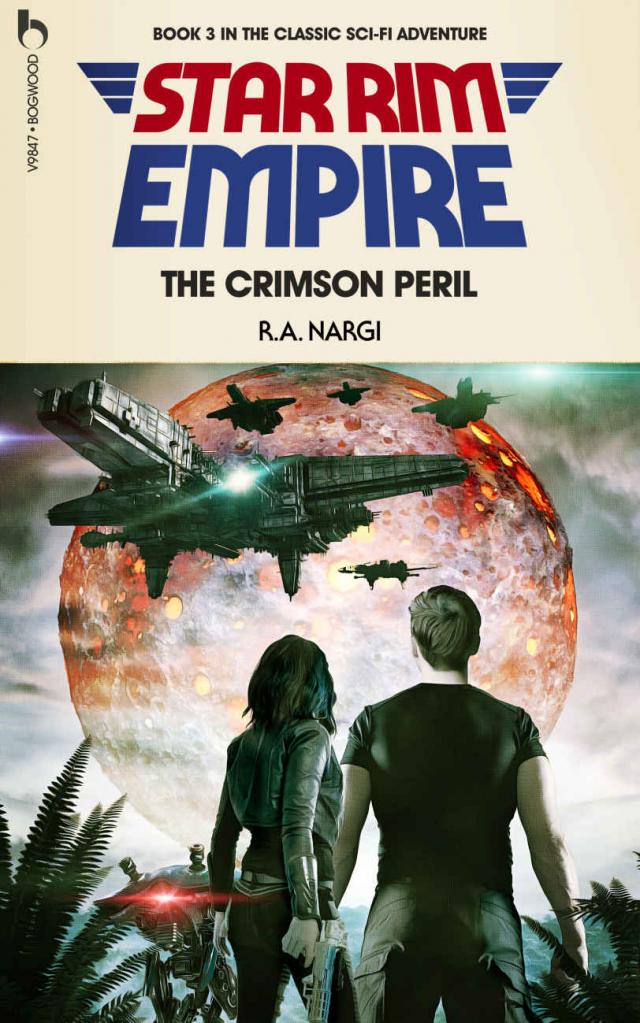
The Crimson Peril
Book 3 of the Star Rim Empire Adventures
R.A. Nargi
Contents
Chapter 1
Chapter 2
Chapter 3
Chapter 4
Chapter 5
Chapter 6
Chapter 7
Chapter 8
Chapter 9
Chapter 10
Chapter 11
Chapter 12
Chapter 13
Chapter 14
Chapter 15
Chapter 16
Chapter 17
Chapter 18
Chapter 19
Chapter 20
Chapter 21
Dear Reader
The OmniWorld Adventures
Also by R.A. Nargi
1
“Our truest life is when we are in dreams awake.”
Henry David Thoreau
The Vostok was completely deserted.
After I had landed the ship, I spent nearly two hours combing every inch of it, but there was no sign of Ana-Zhi, Chiraine, Narcissa, or the Sean bot. I couldn’t comprehend it. Where had everyone gone?
The launch was still there, all of the exosuits were accounted for, and when I reviewed the surveillance logs I saw all of us in the bridge—right up until a few seconds after the Sean bot returned to the bridge. Then the ship turned upside down and everything went black.
There was a gap in the logs, but it was less than a second.
What had happened? And where did everyone go? This didn’t make sense.
As I made my way down to check life support, the lights flickered and the ship lost power for a few seconds.
Crap. Not this again. The discharge retainer couldn’t be broken. Panic welled up inside of me at the thought of trying to figure out the ship’s isolator module myself. That was way above my pay grade.
I pushed the thought out of my mind. I was going to sort this out.
The first thing I needed to do was figure out where the hell I was. The exterior cameras showed that I had set down upon a grassy plain strewn with boulders. Mountains loomed in the distance to the north and a lush valley stretched out to the southeast. The air was clear and the sky was blue, with just a smattering of wispy clouds.
Wherever I was, it certainly wasn’t Yueld. And it wasn’t either of Yueld’s moons. I tried to remember what else was in the Nymorean system. All I could recall was a bunch of asteroids, a small ice planet named Usteron, and Arai—another planet which was nearly all water.
This place didn’t seem like it could be any of those.
As I made my way up to the science station near the bridge, the Vostok lost power again—for a good sixty seconds.
This was not good. Why wasn’t aux power kicking in? I checked life support and learned that all of the CO2 scrubbers were offline. Yeah, not good at all.
I initiated external scans, including environmental readings. If I had to go outside, I needed to know what I was dealing with.
Next, I accessed the navsys, trying to identify where exactly I was. But the system was completely scrambled. I couldn’t tell if it had been messed up by a power surge or something else, but it was definitely stuck in some sort of loop, with the status displaying ‘SEARCHING…’ and nothing else.
The one bit of good news was that the environmental scan showed that the atmosphere was breathable, the temperature was a balmy 300 K, and there were no dangerous radiation levels detected. The gravity was 7.172 m/s²—a bit less than the gravity back on my home world of Anglad. According to the computer, I’d be able to go out without a suit. Not that I was planning to.
I left the comm shut down. I could have sent a distress call over the FSOC, but I had no idea if the Mayir Carrier was orbiting this planet, waiting for me to make a peep.
After I finished up in the science station, I went down to engineering with the idea of running the cognitive tracers to figure out why the power was still on the fritz. I didn’t get very far.
The power died again.
Dynark’s blood! I slammed my fist into the bulkhead and then spent the next several minutes cursing this piece of shit ship.
When all the rage was out of my system, I slumped to the floor in despair.
I barely noticed the emergency lights blink on, mostly because my head was in my hands and I was taking deep breaths in order to calm myself.
This was ridiculous. It really was.
But I needed to just chill out and think through what was going on.
The Sean bot had found something called the Levirion, an ancient Marimoran relic stolen by the Yueldian Sky Reavers. When energized by a powerful enough source, the Levirion acted as a dark space jump gate. And, as impossible as it seemed, the Sean bot had succeeded in activating the Levirion.
Supposedly the jump gate was going to send the Vostok to one of four locations programmed into the artifact. With our limited knowledge of how the Levirion worked, we had no idea where we’d end up, though.
What no one expected was that the Levirion might have side effects—like only transporting one person along with the ship.
And then there was the strange matter of my dream—if it really was a dream, that is.
After I had lost consciousness, I woke up back in New Torino. But I couldn’t tell if I had really returned home or if it was just in my mind. The timeline was all messed up, and I had nearly two weeks’ worth of memories that seemed to be impossible. Oh, and when I had contacted Chiraine, she had no memory of me.
What did this all mean?
A blaring klaxon interrupted my thoughts.
What now?
The ship’s alert system announced that there was a breach on level 3, but it didn’t make sense. How could there be a hull breach when we were parked?
I didn’t bother with the lift, just slid down the access ladder into the level 3 hold. There I saw a trio of maintenance bots frantically spraying catafoam on a gaping hole. But the hole wasn’t in the hull, it was on the floor of the hold.
How could that be?
I moved closer, trying not to get run over by the maintenance bots, who were wheeling around the meter-wide hole in the deck, placing temporary struts in place and spraying everything down.
I looked up at the ceiling above the hole, but it was completely intact. Likewise, the walls of the hold appeared undamaged. If a meteorite or some other projectile had punched through the hull and then through the floor of the hold, I should have been able to find some evidence. But there was nothing.
While the bots worked on the repairs, I climbed down to the lower hold on level 4 and positioned myself right below the hole. There was nothing down here either: no other breaches, nor any foreign bodies.
I climbed back up to three and inspected the stack of crates piled up high on the far edge of the main hold. What if some weirdo artifact had come alive or something?
But there weren’t any broken crates. Nor did I see any puddles of acid. Everything appeared to be—
I froze.
Out of the corner of my eye, I saw something impossible.
A section of the interior wall near the lift area began to lose its color and turn transparent.
I moved closer, trying to make sense of what I was seeing.
An oddly shaped section of the wall plating was now completely transparent—revealing the wall supports, data conduits, ducting, and various other tubes, wires, struts, and sensors behind the wall.
Before my eyes, the color drained from everything else in that section of wall. Now everything in that two-meter area was transparent. And within seconds, it started crumbling away.
Another klaxon sounded and the maintenance bots sped over to the wall section, trying to triage the structural damage.
I just gaped in disbelief as more of the wall crumbled into nothingness.
What could be causing this? It was like some sort of localized molecular breakdown.
Maybe there was some sort of hull breach and the atmosphere here really was toxic—toxic enough to destroy the ship.
A tightness gripped my chest and a surge of adrenaline rushed through me.
I needed to get into an exosuit right now. Unfortunately mine was down in my cabin on the lower level. My eyes darted around the hold until I saw the door to the cargo bay. There would be extra suits stored in the equipment room near the airlock. Weapons too.
I dashed towards the door just as the ship lost power again. Emergency lights flickered on, barely providing enough illumination for me to find an exosuit that would fit.
There was just one suit remaining in my size and I yanked it out of its case and started pulling it on.
This was insane. I had just managed to secure my helmet and initiate startup when the ship jolted to one side with a loud, deep screech of metal. I was thrown across the room and smacked into the wall near the airlock door. Thankfully the suit absorbed most of the impact and as I flailed around, the magtouch unit kicked in and I managed to anchor myself to the wall, which was rapidly becoming the ceiling as the ship twisted.
Maybe the planet’s surface was unstable. But surely the gyros should have kept us upright.
The power stuttered back on, but I knew it wouldn’t last. I needed to get out of here while I still could.
I grabbed a radiant blaster from the weapons locker and hit the airlock release.
This couldn’t be happening, but it was.
I stood fifty meters away from the Vostok and watched in horror as the ship collapsed.
Fi
I sat there, on a large rock, for hours—transfixed. Bit by bit the ship dissolved away into nothingness. And I had no clue what was going on.
Then I noticed that the same thing was happening to my exosuit. First the shin sections of my suit began to discolor. It was like a greyish-white stain that spread throughout the deep crimson-colored armor. Soon other parts of the exosuit were covered with milky blotches. And these blotches started to expand.
Just like what happened with the ship, sections of my exosuit turned translucent and then just kind of flaked away into nothingness.
My brain hurt trying to figure this out. Something was disrupting the molecular structure of all man-made materials. But whatever agent was causing the destruction, I couldn’t detect it in any way.
Within an hour my suit—and clothes—had completely disintegrated and I found myself shivering, naked, on a rock. I had no shelter, food, weapons, or water. I had nothing.
The Vostok had long since broken down into dust. The debris field initially stretched out over two hundred meters, but even that was shrinking, as the dust itself dissolved into nothingness. By the time the sun of this odd planet sank below the horizon, there was absolutely nothing left of the Vostok.
2
I spent the night huddled against a large boulder for warmth. It worked for a few hours, but as the night passed, the rock grew colder and colder and I ended up just pulling myself into a ball and trying to conserve my own body heat.
At most I dozed off for a few minutes here and there. My mind wouldn’t stop racing, trying to make sense of what had happened to the ship. All night long I found myself checking my arms and legs and fingers by the light of the immense planet that shone in the night sky. I half expected to see my own appendages turn transparent and flake off into nothingness.
When the first rays of the sun lit up the grassy plain where I had spent the night, I inspected my body. Thankfully, other than being cramped and frozen, I seemed to be okay.
I stood up and tried to rub some life back into my arms and legs. The sun felt good on my skin and once I started moving around, some of the chill left my bones.
It looked like I had survived whatever had attacked the ship. But I still had no idea where the hell I was.
The plain I stood upon was littered with huge boulders, most of them taller than me. They looked like they had been dumped here by glaciers a long time ago. Far to the north I saw a massive mountain range with snowy peaks. It was hard to tell, but they might be a good fifty or a hundred klicks away.
I turned in a slow circle, trying to find the valley I had seen from the ship. I ended up having to climb on top of one of the boulders in order to catch a glimpse of a swathe of green to the southeast. The valley was definitely closer than the mountains and if I was going to find food, water, and shelter, that was my best bet.
It was fairly easy hiking across the plain, especially since the gravity here was less than I was used to. The air seemed rich with oxygen, as well, and I could smell a dampness in the air, very much like the smell of a summer rain back on Anglad.
A few times I caught a glimpse of some small mammals hiding near the boulders, but even after three hours of hiking I didn’t see a single bird.
The sun was high overhead by the time I made it to the edge of the plain. A sloped cliff overlooked a valley filled with lush vegetation.
I worked my way down the cliff fairly easily, switchbacking along game trails. This lesser gravity thing was definitely working in my favor. I had covered at least twenty klicks so far and wasn’t even really tired.
The air grew warmer and thicker as I descended towards the jungle. In the distance, maybe a dozen kilometers away, I could see a serpentine break in the treetops that indicated a river. That was good news—for two reasons. I might not die of thirst, and if I followed the river, it might eventually lead to civilization. That is, if there was any civilization to be found on this planet. So far, I hadn’t seen any evidence of aircraft, satellites, drones, skimmers, or even any terrestrial vehicles.
Still, why would the Levirion dump me out on an uninhabited planet? If it was a four-way jump gate, you’d think that all four of its connections would be significant.
Towards the bottom of the cliff, vegetation was sparse, with a few low bushes dotting the landscape. But less than a kilometer away, everything changed. The edge of a dense jungle rose up, like some massive green curtain of tropical-looking trees. Some had leaves bigger than my body. And, judging from the sounds emanating from the jungle, this was where this planet’s birds all dwelt.
As I drew closer to the jungle’s edge, I searched for a natural entrance, but the vegetation looked uniformly thick for as far as I could see. This valley reminded me a little of Castareen, but less swampy—thankfully.
It was still slow going, as I pushed my way through the vine-choked trees and broad-leafed bushes. But the shade of the jungle felt good after trudging through the bright open landscape of the plains.
As my eyes adjusted to the gloom, I saw all kinds of creatures—flying, scurrying, climbing, and slithering their way through the jungle.
Shafts of light that had managed to penetrate the canopy acted like waypoints and provided enough illumination for me to navigate through the jungle. And some of the broad leaves acted like basins which provided me with water to drink and splash my face with.
As I pressed on, I kept my eyes open for signs of large predators—footprints, droppings, bones. So far, I hadn’t seen anything like that, but I wanted to be prepared. Based on the travel of the sun, I guessed that I might have five or six more hours of light remaining. That meant that I’d probably be spending the night in this jungle.
After a few hours, I began to pick up the faint sound of the river and I knew I was heading in the right direction. If I could make it there before nightfall, I might be able to find a tree to climb up on the river’s edge. That very well could be the safest place for me to spend the night.
Eventually I made it to the river’s edge, but it wasn’t what I had expected.
I stood on the edge of a rocky gorge. Thirty meters below a fast-moving river flowed. The gorge itself was only a few dozen meters wide and it looked like the jungle continued on the other side.
Then my heart jumped.
There, in the distance to the south, a bridge spanned the gorge.
When I finally arrived at the bridge, I saw that it was made of immense stone blocks encircled by a shaggy mat of vines. The narrow span arched over the river and was supported by several stone pillars. Unfortunately, the bridge wasn’t completely intact. A collapsed section eight or nine meters wide made it impossible to cross.
Leading away from the bridge was the remnants of a primitive road. I tried to follow it into the jungle, but a few meters in the vegetation had completely obscured any trace of the road. Still, it was an encouraging sign. This planet must have some sort of civilization on it. Unless, of course, the builders of the bridge had died out. The structure did appear to be a few centuries old. Who knew?
I carefully ventured out onto the span, cautiously checking for any sign that the bridge might collapse under my weight.
So far, so good. The wind whipped at my body as I moved farther out. Cautiously, I chanced a look over the edge and saw that the river had etched a deep groove between the cliffs. It was wild and beautiful as it churned and foamed through the narrow canyon.
Still moving carefully, I inched out as far as I dared. I wanted to inspect the broken section and get a sense of what the bridge looked like on the other side of the gap.
As far as I could tell, the span was intact on the other side. That meant that if I could somehow get across the nine-meter gap, I’d be able to get to the other side of the river. I couldn’t be sure, but it looked like there was a clearing on the far side of the river, with a more defined path leading away into the jungle.




