

Beyond What Separates Us, page 28


I ran up the stage, grabbing him from behind. “What are you doing?” I asked.
He shoved me off. “What’s necessary,” he said, then he turned and continued to issue orders. More of the crowd rushed the stage. Ares pulled out his weapon and fired at the first person to leap onto the stage. The body fell lifeless to the ground. I got up, darting at Ares. He flung me off again, turning his gun at me as Nadie knocked him to the ground from behind. I could hear Elizabeth in my ear again, telling me to get to Zone 1 immediately. Ares and most of the other Civic Guardians were being subdued by the crowd at this point. I grabbed Nadie and a weapon from the ground.
“We have to go!” I shouted.
We ran to the transit hub, which was jammed with people. The trams were still not moving. I used my card to enter the surveillance offices, which led to a special passageway to get to the underground transit line.
“I’m in the underground transit tunnel with Nadie, but I don’t know how to operate it or when the trains run,” I shouted to my earpiece. Nadie was following me, but she seemed dazed.
“A train will be there soon,” the voice in my ear explained.
There were four Civic Guardians on the platform where the train would come. Because they were focused on the main access point that civilians would use on the other side, they didn’t spot us. I walked slowly out toward the tracks, holding Nadie’s hand and hiding the weapon. Two of the Civic Guardians turned. It was Tyra and Van.
“Don’t worry, we control all the underground line access points now,” Van said.
“Of course we do,” I said, shaking my head.
The train arrived empty and we got on. When we got to Zone 1, more Civic Guardians there escorted us to the street. Things were quieter in Zone 1. The main square was lined with incredibly tall and beautiful buildings. At the end of the square, the tallest building was all silver glass piercing the sky in a point that radiated light. Our escort told us to take cover behind some trees. We could hear gunshots. As I looked into the square, I saw several bodies.
Our escorts motioned for us to move. At the entrance to the silver building, there were more bodies, mainly Civic Guardians. As we entered, an explosion shattered some glass at the far side, and I saw Civic Guardians on an opposite street in a gun battle with more Civic Guardians.
We got on an elevator and headed for the top floor. Elizabeth was waiting in a room overlooking the city. Beside her stood an old man; his head was down, and his hands were bound behind his back.
“Kelowna, Nadie, this is Alexander Green, the man in charge of the Civic Administrators,” Elizabeth said.
“What the hell is going on?” I screamed. “People are dying. You promised me this wouldn’t happen.”
“I’m sorry, Kelowna. I hoped this wouldn’t happen, but Mr. Green refuses to go on screen to calm things. I’d considered doing it myself, but I think you would have more of an effect.”
“Me? Why?”
“You’re from here and part of the movement. You can calm both sides before more people are hurt. Please, Kelowna.”
Nadie grabbed my hand. “You were right, Kelowna. Now help us stop this.” She was crying. This wasn’t what either of them had wanted.
“Kelowna, Mr. Green here is the man that gave the order to kill your parents,” Elizabeth said.
I looked at him. “Why?” I asked him.
He slowly lifted his head. “To prevent this.”
“Bullshit.”
“People can’t be trusted to choose the right course; history has proven that. We established control and order, which led to peace and stability. Your parents and these people here are trying to destroy that, and look at the result. You witnessed it as you came in. I did what was necessary.”
“I heard that not that long ago from someone on the other side. The ends don’t justify the means. You don’t have the right to dictate how others live. If they choose wrong, so be it.” I was furious at both sides and, turning to Elizabeth, stated, “I’ll do it.”
She nodded and a young woman came in with a camera. “This will be broadcast across the city,” Elizabeth told me.
I turned to the camera. I nodded. A green light came on. “Good evening. My name is Kelowna. I grew up in this city. My parents were killed by the Civic Administrators because they believed that all the wars, all the diseases, the history of humanity had led us to the point where we could finally build a better society. They believed that better society depended on the freedom to choose your own path. The Civic Administrators disagreed. They believed peace and order were more important. The movement is global. The images they showed you earlier are true. I didn’t believe it at first myself. I spent my life in Zone 4. Bored with life here, I ventured to the no-go zone and encountered members of the movement. I’ve been to their communes, seen what life is like. It’s a good life. But it’s a good life here too. We’re not enemies, so please, everyone, end the violence. I know you want answers, and you’ll get them. No one is trying to destroy anything. Those that have instigated violence will be punished. But stop now. There’s no going back; there’s only forward.”
I moved to stand between Mr. Green and Elizabeth, astounded at the clarity and vigour with which I spoke. The camera panned to face all three of us. “This is Alexander Green, the face of the Civic Administrators. A prisoner right now of Elizabeth, one of the council members of the movement. What happens next doesn’t depend on them. It’s your choice. Lay down your weapons and let’s figure this out together. Let’s try to build a better world.”
I left the room as Elizabeth continued to talk. Down the hall, Nadie and I held each other. Hours later, Elizabeth joined us.
“Things are calm in all zones now. Thank you, Kelowna.”
“At what cost?”
“I’m not sure yet. Mr. Green has agreed to set up a transitional government. People that showed leadership in each zone are being brought to Zone 1 to set up a council to decide what happens next. Things will return to normal shortly. I’m sure you’re both hungry and tired.”
Nadie and I spent the next few weeks in the city together, and things slowly returned to normal. Over six thousand people were dead. Things went about the same in Michigan, which was slower to regain the peace, but both cities were in constant communication now. Trials were being set up for those accused of crimes on both sides. Ares had been killed in the ensuing chaos in Zone 4. A provisional ruling council, with representatives from each zone had been established. Mr. Green was to stand trial as well. Many of the other Civic Administrators had handed over information showing that Mr. Green ruled with an iron fist. Most were willing to move toward a more egalitarian governance structure. People were given the choice of whether to stay in the city or establish communes. Those who stayed would get to vote on major changes. Most decided to stay and help establish a new system. People were genuinely excited to see what was going to happen next.
Elizabeth asked Nadie and me to stay as part of the provisional government. We both declined. A week later, we returned to the bunker. A week after that, we headed to the small house on the island where we’d first kissed.
Epilogue
Katherine has a soothing yet authoritative voice. “Stories are powerful tools. They can unite us or divide us. They can make us cry, laugh or smile. Human history is full of stories. Told the proper way, they have the power to change the world. Each one of you has a story to tell.” Katherine pauses, scanning the room, lovingly pointing at people, with a wide smile. “I’ve spent the last decade documenting the stories of people from around the world. As our movement grows in every corner of this world, more stories will be chronicled.”
The room erupts in applause and cheers. “As I look around this room, I can’t help but feel immense pride. This room is a representation of the diversity of our own species. Every day, newcomers around the world join the movement. Some are more organized than others, mind you. Some living in vibrant, sustainable cities, others in small villages. There are even groups researching, developing and using new technologies to restore, reclaim and bring balance back to the natural world. The movement goes by many different names, but the one thing we have in common is a desire to prevent the mistakes of the past from ever happening again.”
Katherine is dignified in her speech, raising only a finger in emphasis for the one thing we have in common, as she continues pensively. “These last years have been the best of my life, knowing that a new ethos is emerging. Nature is our shrine, temple and cathedral. Remember that! Science and traditional knowledge, our foundation of thought and understanding. Embrace and nurture rational thought.”
She gives the room a moment to ponder her last statement as she slowly nods her head and continues. “When humanity climbed out of the trees and stood on two legs, our only advantage was our cranial capacity. We weren’t the fastest, strongest, biggest or most agile. Our skin offers little in the way of protection. Our brains are what sets us apart. All species exist to better themselves, to evolve. An intelligent species is no different. We forgot that somewhere along the road of our evolution. We forgot to better ourselves and leave behind a better world for those that come after us.”
Katherine is less animated and dramatic than the boss, but she’s more engaging. She speaks with a restrained eloquence. The room gazes, enthralled. “No one is ever remembered by the things they owned in life. When you’re staring down your own mortality, it’s experiences that matter. The deeds and intangible accomplishments of a life are memorable. Too many spend their last days, when they know they’re near the end, focusing on regrets. An individual that lives each day to the fullest, on their own terms, has no regrets.”
Katherine pauses, once again scanning the room and smiling. She moves her hands out in front of her and swings them slowly outward, gesturing at everyone in the room. “So, live an inspired life, live for the moment, live to bring joy and happiness to others, live to leave the world a little better.”
She takes a sip of water, still scanning the room. “My home is on the shores of Lake Victoria, where I spend the evenings listening to the symphony nature provides. I listen to the leaves rustling in the wind, waves gently caressing the shores, birds singing their songs, and the insects buzzing about their days. All of this under the tapestry of innumerable stars that remind me of my singular luck. To be born a human on planet Earth — now that’s luck. One planet, orbiting one star that happens to contain a plethora of life in a galaxy made up of millions of possibilities. You could have been an ant or an eagle, a blade of grass or a large tree, but you were born a human. Think about that.”
She gives everyone a moment. The only sounds are the occasional creak of a rickety bench and the whir of the ceiling fans. “Our imaginations created stories to give us purpose. Our curiosity sought to answer the mysteries of the universe and the point of our existence. The point of life is simple. It’s a symbiotic circle. We grace this Earth for a short span to give and return. Why does there need to be a higher purpose? Why does there need to be an afterlife?”
Katherine pauses, but no one answers her questions. “We’re here to learn from the wonders around us, to see the beauty in every detail of nature, to impart that wisdom to those who come after and leave the world in a better state than what we found. Share your stories, write them down, pass them on. The Chronicles must be a tool with which we impart knowledge to future generations and remind them of our past mistakes. As I collect the stories of individuals like each of you from around the world, I’m amazed at how singular the human experience truly is.”
Katherine points to a stack of paper behind the chair she is sitting in. She is louder now, almost giddy. “Those stories are the human experience. Individuals that overcame great odds, witnessed terrible things. Individuals that sought answers, hoped for a better life. Individuals that tested their own limits, changed their beliefs. We’re all unique, yet the same. That isn’t a contradiction. That makes me proud. It’s up to each of you to add your own part to the Chronicles. As I look around this room, I believe we may have finally moved beyond what separates us.”
Acknowledgements
I’d like to thank the team at Iguana Books for publishing my first novel. Greg, Meghan and Lee for the support and help through this process. Paula, my editor, for your patience and valuable input to improve the final product. Holly for reviewing the first manuscript and the final one. Finally, Ruth for the cover design.
Thank you to my good friend Laura for being one of the first people to read earlier versions and all the helpful advice you provided along the way.
I’d also like to thank all my family and friends that contributed to making this novel a reality: Meghan, Mom, Melissa, Ben, Keelen, Justin, Kent, Carly, Charlotte, Ned, Emily, Ryan, Lindsay, Andre, Vanessa, Tim, Angela, the Jacobs family, Darren and Ariel. I couldn’t have done it without you!
While this novel is a work of fiction, the stories are entirely plausible based on current societal trajectories. So, I’d like to also acknowledge the countless scientists, conservationists, environmentalists, social justice activists and others around the world striving to build a more equitable and sustainable world.
About the Author
R. A. Morris was raised in Ancaster, Ontario and holds a Master of Environmental Studies from York University. After graduate school he spent a year teaching science in Honduras before heading back to Canada to work in the environmental sector. He has lived in the small remote community of Fort Good Hope and the territorial capital of Yellowknife in the Northwest Territories. He currently lives in Toronto.
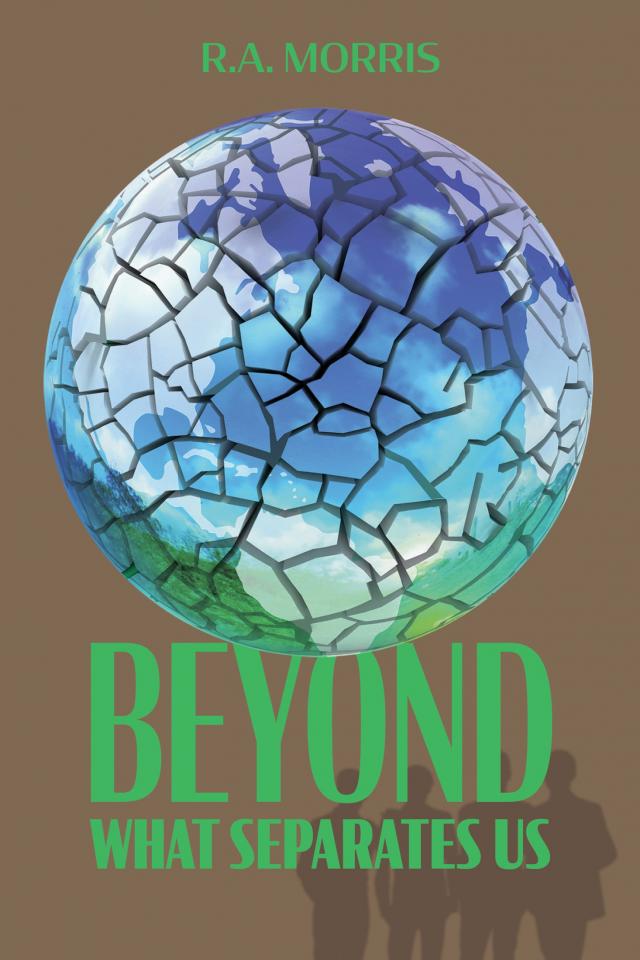
His first novel, Beyond What Separates Us, is a timely work of speculative fiction that offers a glimpse of what societies may look like if we continue on our path of ecological degradation.
R.A. Morris, Beyond What Separates Us


