

Silent Victory, page 1


06-10-2023
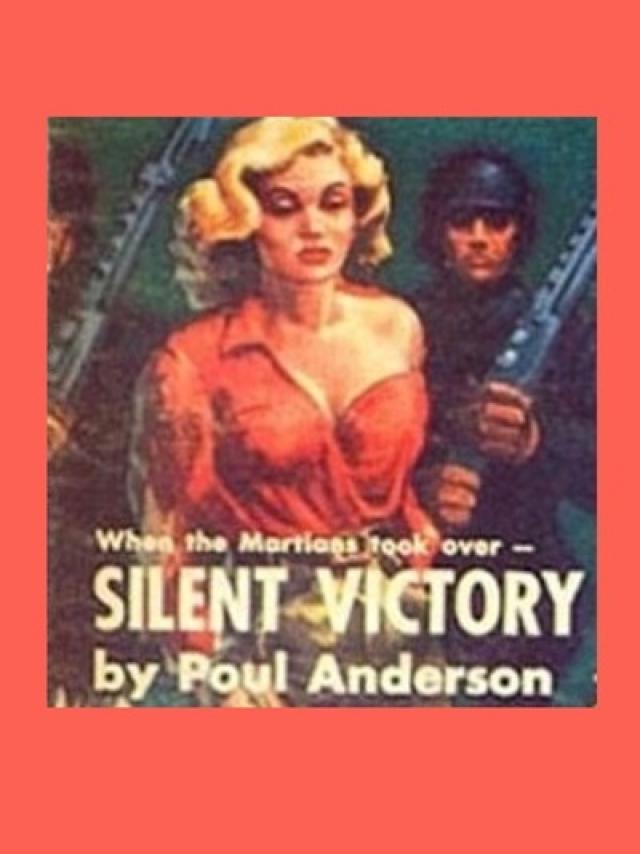
SILENT VICTORY
By POUL ANDERSON
From: Science Adventure Books - Winter 1953
The bitter defeat-dust of Earth whorled around the star-tanned
spaceman and the sleek Martian conqueror. Small protection as
they stalked the grotesque monster of the spaceways with grim
death-terror and the lovely Christine their only companions.
SUNDOWN was brief, night came swiftly out of the Atlantic and flowed across the world. A few lamps blinked on in the city, but most of it lay in darkness; there was more light overhead, as the stars came forth. Intelligence Prime, lord of the Solar System, opened the window and leaned out to watch the constellations and breathe the warm air that sighed in from the endless Brazilian lands. A lovely world, he thought, a broad fair planet, this Earth—one to fight for, to seize and hold like a beloved mate.
It was not risky for him to appear at the window. His secret office was so high above darkened Sao Paulo that the very noises were lost.
Up here there was only the slow sad wind, quiet and loneliness everywhere.
He sighed, turning away as the lights strengthened automatically in the room. Weariness lay like a weight on his shoulders.
The hunt was over, yes, this last episode was finished—but was it? And what would come after? So much to do, so terribly few to do it; he himself, chosen ruler of his people, was a slave to their own conquest. What would strike at them next, and how soon? When could they ever know peace under friendly stars?
He sat down at his desk, shoving the vague despair out of his mind with an effort. Overwork, nervous strain, it was no more than that, he thought irritably. And there was no place for it in this enormous age. He took up some papers, reports from Mars, and began studying them.
A chime sounded, jarring him in the great quiet. When would they ever let him get his work done? “Come in,” he said. The annunciator carried his voice to the antechamber, and the door opened.
Intelligence Prime looked up as the sub-officer entered. “What do you want?” he asked. “I’m busy.”
The sub-officer halted, and one arm rose in a rubbery motion, a salute. “It’s more on the Arnfeld case, lord,” he said. “Some new material, just brought to me.”
“Well, let’s see it, then. Don’t just stand there. Death and corruption, this business was the tightest spot we’ve been in since the Exodus.”
THE sub-officer moved slowly across the floor and laid the book on the desk. “They found it while taking that cabin apart, lord,” he said. “Apparently Arnfeld was making a last attempt to tell the story to his people—he’d hidden it under the floorboards.”
“Pathetic, in a way,” said Intelligence Prime. “I can admire that creature and his friends. They were a brave group. Even the woman who betrayed them at the last did so for a selfless reason.”
Tire cold light of the flouros gleamed off his great crested head as he bent over the relic. It was a school notebook, torn and dirty, and the first few pages held a child’s scrawl, a few arithmetic sums, a clumsy drawing. Then the adult hand began, and the rest of the book was filled with it—a firm masculine writing, small and close together, obviously done in haste.
“Rather long,” he said. “Must have taken Arnfeld several days to finish this, at least.”
“They had several days in the cabin, didn’t they, lord?” asked the sub-officer.
“Yes, I suppose so.” The bleak eyes studied the first sentences: This is being written by David Mark Arnfeld, a citizen of the United States of America, planet Earth, on 21 August 2043.1 am of sound mind and body, and investigation of my service psychiatric record will show that l can hardly have gone insane as has been claimed. I wish only to tell the whole truth in a matter that concerns all of my race and all of Mars.
“Hm.” Intelligence Prime looked thoughtfully up. “We’ll have to see about altering his record, just in case somebody does think to check it.” He grinned. “I have Mr. Arnfeld to thank for reminding me of that!”
“It seems to be an account of—”
“I can see that for myself. Bring me the woman, I want to question her about this.”
“Yes, lord. At once.” The sub-officer glided from the room.
Intelligence Prime continued his perusal. In order to overlook no detail which will give verisimilitude and which can be checked to confirm my story, l will tell everything that has happened, down to minute details of conversation and subjective impressions as nearly as 1 can remember or reconstruct them. If this lends my work the appearance of fiction, I regret it, but implore anyone who reads this to take it secretly—I cannot overemphasize the need for secrecy—to Rafael Torreos, formerly colonel of the U. N. Inspection Service, in Sao Paulo, Brazil, and give it directly into his hands.
And l must be allotted a little latitude anyway. I once wanted to be a writer, and have whiled away many hours by scribbling. Since this is probably the last writing I shall ever do, you must let me tell the story in my own way.
“Torreos,” mused Intelligence Prime. “The woman did not mention his name …
Oh, yes. He’s been working with the Martians … Hm, yes, we’d better take care of him pretty soon, just in case.”
The chime sounded again. The door opened, silently, and two guards accompanied the sub-officer into the room. Between them was a woman. She could have been a good-looking creature in happier circumstances, thought Intelligence Prime; even now, her hair was a tangled web of gold that caught the light in a thousand shimmers. But her face was thin and white, her eyes were reddened, and she trembled unceasingly.
“CHRISTINE HAWTHORNE,” he asked without preliminary, “have you seen this book before?” His voice was quiet, toneless, and he shaped his vocal cords to speak unaccented English.
“Where is my child?” she answered harshly. “What have you done with her?”
“The child is being well cared for,” he said. “It will be restored to you in due course, if you cooperate with me.”
“Haven’t I done enough?” she asked dully. “Wasn’t it enough that I sold out Dave and Reggy and my whole race?”
“What you cannot seem to understand,” said Intelligence Prime with a chill in his words, “is the finality of our victory. David Arnfeld and Regelin dzu Coruthan are dead. The bodies are in our possession, what is left of them. Why—you killed them yourself!”
“I know,” she said.
“Their story, such little of it as ever came out, has been totally refuted, buried, forgot-en. You, the last survivor, are our prisoner —officially dead yourself, and we will never let you go. It behooves you to act accordingly. Now, have you seen this book before?”
She came closer and looked down at it. “Yes,” she said at last. “It was lying in the cabin when we got there. Dave wrote in it, day after day, and finally he hid it, just before the end. He didn’t tell me or Reggy where he was going to hide it, so we couldn’t tell you if we should be captured alive.”
“He might have known we would make a thorough search. Still, he had nothing to lose.” Intelligence Prime jerked his thumb.
“Take her away.” As the group reached the door, he added with an impulse of kindliness: “You might as well give her the child, too.”
“Thank you,” she whispered.
The door closed behind them. Intelligence Prime sighed and leaned back, the tiredness flowing into him again. It had been a long hunt.
Well—he’d better read this thing himself. The full account of the episode, told from the enemy’s side, might contain some useful hints.
He skimmed briefly over the autobiographical paragraph. Those details he knew. David Arnfeld had been born in 2017 in upstate New York, of an old and wealthy family. He had been only five years old when the war broke out; at twelve he had been selected for Lunar Academy, at sixteen he had graduated directly into spatial service, and since then most of his time had been spent as officer on various spaceships and interplanetary bases. At twenty-five he had been exec of Pallas Base, and then the war had ended and he had come home.
Intelligence Prime squinted, cursing the close handwriting, and began to read with more interest
I
WE GOT the news from a courier boat, several weeks after the event, because the radio had been out for quite a while. We’d been expecting to hear of Earth’s defeat, the end had been in sight when the Martians took Lima, but nevertheless the word left a hollowness in us. Many men wept. I couldn’t cry, somehow, but I went through my duties in a mechanical fashion, and my inward self seemed to have withdrawn. It was worst during sleep-period, lying there in the dark and loneliness, and staring at nothing.
There was plenty to do, and I was glad of that, it kept me from thinking. I was virtual commander of the asteroid, the Old Man had gone into an unspeaking numbness and we hardly ever saw him. I had to wind up the paper work, of course, and there was a lot; I had to oversee the engineers and make sure they didn’t sabotage the installations. Once I caught a man at that, he was deliberately wrecking the safety controls on our main power pile so it would blow, out sooner or later. When I put him on the carpet, he was truculent. “Are we going to turn this over to the Marshies?” he demanded. “Are we just go* ing to give it to them, and kiss their skinny bums into the bargain?”
“The proper form of address for a superior officer is ‘sir,’ ” I answered wearily. “We have orders from HQ, which is acting under the armistice agreement, to yield this base in good condition, and I’m going to see that those orders are carried out.” Loosening up a bit, I added: “Mars has us by the throat. If we don’t do as they say, it’ll go hard with Earth. You have a family there, don’t you?”
“Maybe,” he said. “And maybe they were killed in the bombardment.”
“We gave them a good fight,” I said. “Twenty years of it. Maybe we can get our revenge later, but that won’t be for a long time yet. Meanwhile, yes, we will kiss the Martians if it’s necessary to keep our people alive.”
I let him off with ten days in hack, but posted a warning that the next offense meant a summary court-martial. By and large, the men knew I was right. Something had gone out of them, they were beaten, and it was not a pleasant tiling to see. I invented jobs for them, games, exercises, anything to jerk them bade toward life, but it went slowly.
We had a four months’ wait without a sign from HQ. I began to worry, we’d been on short rations for a long while and now our supplies were terribly low. I wondered if I shouldn’t violate orders myself, commandeer a rocket, and go after help. Hilton’s Planetoid wasn’t far away now, as astronomical distances go, and they had hydroponics and yeast vats there.
The asteroid spun swiftly through a great cold dark, between a million frosty stars and the glittering belt of the Milky Way. The sun was remote, a tiny heatless disc whose light was pale on the cruel jagged rocks. Outside the base proper, it was always silent, your breathing felt thick inside the helmet.
The relief came at last, without warning: four great troopships orbiting up with a vivid splash of rocket flame, and the lean black form of a Martian cruiser for convoy. We lined up as smartly as we could and received the officers with all due ceremony. For we were Pallas Base and the fighting men of Earth’s United Nations, we had beaten off three murderous attacks in a year and we had lasted out the long grinding wait between them. I think the Martian commander was pleased at our appearance. He didn’t offer to shake hands, which was tactful of him, but he bowed his seven-foot body stiffly from the waist in the best manner of their military aristocracy.
“Are you in charge, Commander?” he asked. He spoke in Portuguese, and did it better than I. The Brazilian dialect may be the dominant tongue of Earth, but we were mostly Britons and Norte americanos here and had used English.
“AT THE moment, Sevni,” I answered as formally. “Captain Roberts is— indisposed.” As a matter of fact, I knew the Old Man was in bed with a bottle, probably crying as he often did these days, but there was no reason to admit it.
“I am sorry for the delay in relieving you,” said the Martian. “But there has been much work to do, as you will understand. The ships here will discharge our men, and then take yours back to Earth. We will set you all down at Quito, and provide you with tickets to whatever major cities are nearest your homes.”
“You are very kind,” I said.
“Thank you.” The Martian waved one lean hand. I was struck anew by the odd fact that it isn’t the six fingers or their extra joint or the smooth, leathery-brown skin which makes a Martian hand look unhuman to me, it’s the peculiarly squared nails. “There has been too much strife. It is time for friendship between our peoples.”
Friendship? I thought. After what you did to Earth?
We were embarked and settled down for the long run homeward. Most of the time, of course, we orbited, and I forced the men to excercise regularly. After the long time of low asteroid gravity, and now the many weeks in free fall, we wouldn’t be used to Earth-weight. I think I got all of us into pretty good shape—underfed, naturally, but
hard and supple, darkened by the harsh spatial sunlight.
The officers and crew aboard were Martian, but they kept to themselves, we hardly ever saw them, and the trip went without incident. Toward the end of it, I noticed the apathy breaking in our men and in myself. Defeated or not, we were going home! The old worn photographs came out again, the torn and smudged letter flimsies, voices were heard in argument and reminiscence and even song. There were plans made for an annual reunion, and out of my bitterness I began to see that there had been some good times, now and then, in all these lost years.
WE took orbits around Earth, and I spent a long while at the viewport, staring at her as she turned, blue and beautiful, against the stars. There was no sign of the war on her serene face—man ana Martian were small things, after all, and space and time were very big.
Ferries took us down to Quito in relays. It had been heavily blitzed, it was still one vast ruin, full of broken rocks and dead men’s bones, but the radioactivity was gone by now and the mountains were as lovely as I remembered them. A new spacefield had been built, with a huddle of shacks around it that might eventually become a reborn city. I didn’t kneel to kiss Earth, as many did, but I stretched my muscles against the glorious massive feel of her pull and I drew the clean sharp air deeply into my lungs, and my eyes blurred for a while.
Terrestrial liaison officers met me and I spent a couple of days in the routine of disbanding my unit. The men got their tickets and back pay, with a bit extra to make up for the inflation that was putting the knife into our dying economy; they got ration books appropriate to the areas where they lived, and a printed pamphlet describing the new laws and enjoining obedience to the occupation authorities. They got their discharge papers too, but what with the clothing shortage we were allowed to wear our uniforms sans insignia. I looked at the Winged Star for a long time after it was off my tunic, before wrapping it up and slipping it into my pocket.
The human district commander, Gonzales, saw me off. “Won’t you stay for a while?” he invited. “I would not advise going to New York. It was badly hit. Conditions are hard.”
“Things are bad everywhere, senor,” I answered.
“Aye, so. We are thrown back to a primitive economy which cannot support our population.” He grimaced. “You are fortunate to have arrived almost a year late. Last winter and spring—ugh!”
“Famine?”
“And plague. The Martians could do little to hap us, though I must admit they tried. But millions are dead already, and still it goes on.” He looked grayly across the held. Our Globe and Olive Branch still flew, but Mars’ Double Crescent banner was on a higher staff. “It is the end of human independence,” he said. “From now on, we are cattle.”
“We’ll come back,” I said. “Give us twenty years to recover, and we’ll rearm and—”
He winced. “I think I would almost rather have Martian rule than the kind of fascism that would entail, Commander,” he said. “However, they do not intend to let us try. We are to be de-industrialized and made a province. They will keep us that way forever—you know the Martian nature. They are not vindictive, but they are careful, farseeing, and very patient.”
I thought it was a Draconian measure. Our population would likely have to be halved before we could return to an agricultural economy—and then there would be unending centuries of humans turned into peasants, handicraftsmen, fishers and loggers and miners; at best we could only become lesser bureaucrats in the Martian imperium. We would stay here, shackled by ignorance, while science and industry and the soaring starward adventure went to Mars.
Still—in their place, I’d have done the same! We had so many natural advantages, we’d come so close to annihilating them— oh, if there’d been some brains on the General Staff, we could have taken Mars in five years! Instead, we made one ghastly blunder after another, and only the fact that the Martians made almost as many had kept us going. Of course, this was the first space
war in history, one couldn’t expect to foresee everything, but it was weird how both sides had fumbled it and turned what might have been a sharp, clean blow into twenty ruinous years of attrition.
Well—too late now. Too late forever.
“Farewell, Commander,” said Gonzales. “And good luck to you.”
“And to you,” I said, shaking his hand. “To all of us.”
“We’ll all need it, Commander,” he said.
The rocket flight to New York was uneventful. My fellow passengers, all human, all shabbily clad and grim about the mouth, plied me with questions about the space war, and I was as eager to learn about what had happened at home. I hadn’t been on Earth for five years. Well, the last several months had been rugged—atomic bombardment from space, capitulation, famine and plague. Our transportation and manufacturing centers haa been so thoroughly wrecked that it hadn’t been possible to feed the huge urban majority, or take care of them in any way. Crime and anarchy had risen out of the ruins and still snarled around the world, though the Martian occupation forces were now cooperating with U. N. and local police to smash that violence.


