

Shallcross: The Underwater Panthers, page 1


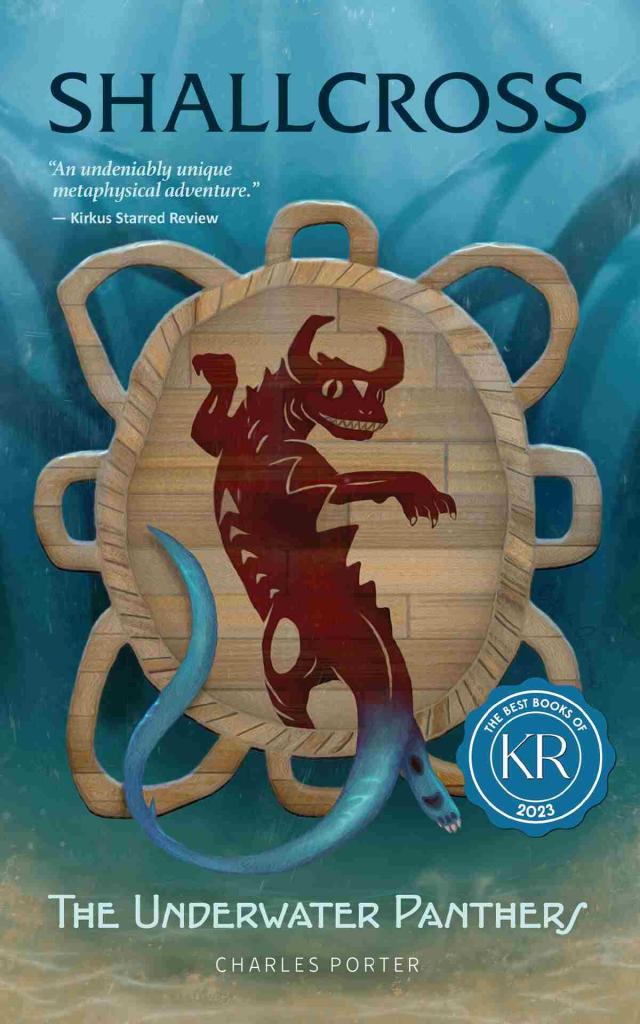
© 2023 Charles Porter
Cover art, graphic design, and layout by Belinda Arozarena, Green Group Studio®, Lake Worth, FL | greengroupstudio.com
Illustrations by Kathy Von Ertfelda and Gisela Pherdekamper, Loxahatchee, FL | artbygisela.com
All rights reserved. No part of this publication may be reproduced or transmitted in any form or by any means electronic or mechanical, including photocopy or recording or any other information storage and retrieval system, without permission in writing from both the copyright owner and the publisher.
charlesporterauthor.com
Library of Congress Cataloging-in-Publication Data
Porter, Charles
Library of Congress Control Number: 2023915291
Charles Porter, Loxahatchee, Florida
ISBN: 978-0-9894256-8-1 (trade paper)
ISBN: 978-0-9894256-9-8 (ePub)
“And the purer the storytelling the better—where purity is the embrace of shear occurrence, unburdened by deeper meaning.”
—James Wood
Introduction
This is a series—the fourth book. Background from the previous books, especially the third one, Shallcross: Animal Slippers, could improve your appreciation of its content. Maybe. The books do tend to stand alone. This particular book’s story, The Underwater Panthers, is told somewhat through the eyes of a young Seminole boy and a constant trinity that inhabits itself: The Arch Slipper,Triple Suiter, Aubrey Shallcross, and me, Charles Porter.
The Shallcross novels are history for some nostalgia for others. They are Florida, film, music, love, family, religion, crime, country, horses, and decades of Rolling Stone. They are American stadium for fifty years of Aubrey Shallcross’s life.
Aubrey is a voice hearer, as are people in populations everywhere; other words for this are “audio hallucinations” or “schizophrenia.” Aubrey has heard Triple Suiter’s voice in his mind since he was very young, yet he, like a lot of voice hearers, appears normal and is afraid to tell anyone lest he be considered mentally ill. He calls these voices, “slippers.” No one has ever been able to explain their origin. Science implies that the brain manufactures them, but science is silent as to how or where in the brain they are created, which begs the question—What if the voices are separate from the brain and just live there? I believe they are the surviving spirits—the revenants of those who have died, left their corporeal states and slipped to others both human and animal, something like the transubstantiation of Catholic sacramentary. No one seems to know where the voices come from in the brain, any more than they know if God is out there behind the moon or inside it somewhere. There will always be enough room and real estate for slippers in the brains of the living, because the birth rate is much higher than the death rate, so the new rising souls of the dead can’t keep up.
This series of books is dedicated to the Hearing Voices Network, a world-wide organization that provides solace for voice hearers, both those in a very bad state, and those who function so well in society they are invisible, and have found peace. The three of us in the trinity mentioned above, are not committing theft from this community by telling these stories, because we belong to the same hold.
Preamble
I, Triple Suiter, a slipper, ride in the saloon of the psyche and stand in its eye. I am the vapor of Abel, the murdered shepherd, and the counsel of Cain. On the black Underwood I type the True magazine. I have been known by many names throughout history and possess knowledge and verstand from other times; sliding blood to blood, brain to brain, as noumenon and then phenomenon, you hear and sometimes see, but does not bleed.
I live in the subconscious; other than a deep dream state, the clearest view you have of that land is when I move into the conscious mind as the go-between when you are awake, then I am wrongly called a figment of the imagination, a maggot, a muse, a daydream, schizophrenia, and other invented terms. Aubrey Shallcross is one who can hear and see me from his conscious side. I am not a product of his mind. I exist. I am, as much as you are and he is.
He, Aubrey, and most voice hearers, usually conceal this from other people. In Africa, voice hearers are considered divine; in the West, they are called mental, kaleidoscopic—psychotic talk-walkers. The audible events and visual figurines of slippers have inhabited the spaces of humanity’s conscious and subconscious for eons as the brain strained to change and evolve over time. True, there are two worlds, but they cannot be explained by Plato—only schizophrenia. This book, Shallcross: The Underwater Panthers, follows the other books and stories in the series. Charles Porter, Aubrey, and I, gave those books to Sonny’s Book Store in Stuart, Florida, years ago. They tell the Tom Sawyer and Julian Jaynes truth—some things are stretched, but mostly, they tell the truth.
Introduction
Preamble
Gathered
PART ONE
Ch 1: THE BANNER
Ch 2: THE GRIEVING
Ch 3: THE UNDERWATER PANTHERS
Ch 4: PLANS AND STORMS
Ch 5: THE ROAD NORTH
Ch 6: THE BARLEY BARBER SWAMP
PART TWO
Ch 7: DEER TRACK FARM
Ch 8: EIRA
Ch 9: NORTH AGAIN WITH THE GATORS
Ch 10: THE WHITE CALF
Ch 11: SEAN
Ch 12: SERMON AND KONG
Ch 13: THE OWL AND METACOM
Ch 14: AN OCEAN BATTLE
PART THREE
The VOICE of the ARCH SLIPPER: TRIPLE SUITER
Ch 15: SEAN’S PLANS AND THE SLIPPER SHOW
Ch 16: THE TEENS
Ch 17: LIFE SAVERS, ARM WRESTLERS, AND THE MOON
Ch 18: THE SEAGULL SLIPPER: IN 19TH CENTURY STYLE
Ch 19: THE NORTH
Ch 20: THE RAPINE OF THE WHALE
Ch 21: NOTHING SPOILS LIKE THE FUTURE
Epilogue
Gathered
Aubrey Shallcross: the main character of the series Christaine: Aubrey’s love and partner
Drayton: Aubrey and Christaine’s fourteen year old son
Triple Suiter (Trip): Aubrey’s slipper and other voice that lives in his mind
Freddie Tommie: a black Seminole man said to be magic Yuchee Tommie: Freddie’s fifteen-year-old son
Nell Kitching: Aubrey’s childhood friend who lives on Aubrey’s farm
Arquette Orlander: Aubrey’s longtime friend from Massachusetts
Speedy Tanks: a motorcycle stunt man with the carnival
Roberta: The Woman With No Legs in the carnival, and Speedy’s wife
Roy: a slipper who inhabits Roberta’s coachwhip snake
Captain Nemo: the slipper who inhabits The Dragon, a fourteen-foot alligator
Osceola: the slipper who inhabits Two-toed Tom, another fourteen-foot alligator
Martha: a slipper who inhabits an armadillo and another coachwhip snake
A.M. Sermon: a land developer who quit, and became an environmentalist
Kong: a large male chimpanzee, and adopted companion of A.M. Sermon
Half Track: a mentally challenged man from the Harris Ranch Sean Iponovitch: the captain of a Russian fishing fleet Osip: the first mate of the Russian fishing fleet
Metacom: a Pokanoket Indian chief and a slipper, who lives with an owl
Horatio: a slipper who lives with a seagull
Eira: a fourteen-year-old girl with a condition called albinism
Sharon: the fourteen-year-old fraternal twin of Eira
Part One
When he got up that morning like most of us the day we die, he couldn’t have known his silver cord would be broken.
“Am I ready?” he said to the mechanic at the airport.
“Yes. You are ready.”
He opened the door of the old crop duster, sat where he should, did what he should—took off, circled, lined it up, and went into a shallow dive back down to the tarmac, the grappling hook trailing behind him. Snap! He felt it and it felt right, so he climbed to two thousand feet over Ft. Lauderdale south towards the town of Dania.
When he could see the land cleared for the new casino owned by the Cow Creek Seminole Indians, he dropped to one thousand feet. Behind him streamed the white aerial banner rented by a powerful evangelical church against gambling. The seven-foot-high letters read, JESUS PAID FOR OUR SINS. Today was Good Friday. The church wanted the banner over the casino site at three in the afternoon, the time it is said Jesus died on the cross.
On the second pass the plane began to cough and the reciprocating engine quit. He could not restart it. If he jettisoned the banner, he might glide the short distance to the ocean and survive. He pulled the lever and let it go.
At first the banner nosedived so the emergency parachute would open, and when it did, it fluttered over the casino like a powerless kite.
As the time approached Jesus’s time of three o’clock, the plane never made it to the ocean and crashed into the ground, the banner caught a breeze and landed on the windshield of Sally Tommie’s car passing on the nearby Florida Turnpike. Sally, a Seminole woman, was killed after her car flipped over five times. It was now one minute after three. Sally and the pilot had seen the white hallway and the famous white light. They slumped forward in their seat belts like Jesus did, dead as He was in his.
Sally had a fifteen-year-old son, Yuchee, her only child. Her ex-husband Freddie Tommie, the boy’s father, was a hero man in the Seminole tribe, well known for feats of bravery and magic among the Indians, the whites, and animals of t
The day after Sally’s death, Freddie took his son deep into a swamp northeast of Lake Okeechobee, where the Indians say the Giant People live disguised as huge cypress trees, and where a man named Billie Monday went secretly to camp. Billie was a worshiped yaholi, or medicine man, rumored to be able to turn himself into an alligator and back into a man. Freddie and his son found him by a dark water pond in a beautiful grotto of flowers and cypress towers. A small fire was burning. Freddie told his son to sit next to the yaholi, and the alligator man whose face was old and wrinkled as dried nut meats, would explain the journey his mother’s soul was taking.
Billy took a piece of cardboard and bottled ink, placed them on his knees, and with a buzzard feather pen, began to draw the build of the tribe’s understanding of their souls and eternity.
“Each person has two souls,” he said to young Yuchee. “This is the way our two souls travel. When we are alive and we dream at night, it looks like this.” He began to draw. “One of the body’s souls goes up north and likes it there, then comes back to you before dawn to be with your other soul again.
“When we die, the final journey, the journey your mother’s two souls will take, looks like this. One of her souls stays home for a while, the other soul goes up north, around to the east, then west over the white Milky Way to the City of the Dead.”
The boy raised his head and stopped staring at the fire. “But what will happen to her other soul? Does it stay here in the ground with her?”
“No,” Billie Monday told him. “Your yaholi must chant for four days around this fire and purge himself with the black tea to call her other soul, send it north, then east, then west, over the white and misty Milky Way to join her first soul in the City of the Dead. There she will hear the voices of the Old Beloved Ones and see the glow of the Fortunate Fires. Then the death is complete, and she will be in a wonderful place at peace.”
“What is there in the City of the Dead? Is it like heaven?”
“It is like here, where we are now, this is our heaven, this beautiful grotto we are surrounded by with a fire and flowers that never go out.”
“I will see her again?”
“Yes. When your two souls go to the City of the Dead. But before I begin to chant and call your mother’s other soul, and because you are who you are, the son of a great Seminole man and warrior, and because you are a descendent of the old alligator clan on your mother’s side, whose last direct descendent died many years ago, you must now meet
your relatives.”
“My relatives? But you said they are all dead, aren’t they?”
“No.”
Billie Monday threw a blue dust on the fire, pointed to the water, and started to chant, “Coo-wah-chobee, coo-wah-chobee.”
Freddie told his son to watch the water and to not be afraid. There were large swirls at first, like a monster bass or tarpon makes under the surface, then two wide black heads appeared, their eyes moving towards the men by the fire until they broke slow out of the water, and onto the bank came the rest of the huge bull alligators known as The Dragon and Two-toed Tom.
“Good morning. My name is A.M. Sermon, I’m here to see the old tugboat you have for sale.”
“Alright sir. Just follow my truck down to the water.”
“Right behind you.”
“This boat was abandoned by the original contractor on this job and seized by the bankruptcy court, they only want twenty thousand for it cause it’s so old and in bad shape,” the man in the truck said.
“Does it run?”
“Yeah, it’ll start. Needs rings, pistons—the works, but it’s got enough compression left to get it outta here. Probably run about eight or ten knots on the water until it don’t. Say, is that some kinda ape sitting in your car.”
“Yes. Some kind. A male chimpanzee. His name is Kong. He’s my companion.”
After Sermon walked the boat, he told the man he’s offering ten thousand, that’s it; and in one week it was his. He managed to get the tug from Juno Beach to a Marina in Stuart, twenty miles north up the Inland Water Way on the southeast coast of Florida, and here the story changes to remembrance.
THE BACK PEAL
I’ve been thinking about the book before this one, me, Charles Porter, and the group of eco-warriors—some of whom are voice hearers who have become legion in these stories—Aubrey, Christaine, Freddie, Nell Kitching, Roberta The Woman With No Legs, and Speedy, her husband who rode a motorcycle inside the carnival’s Globe of Death.
And there were the animal warriors: The Dragon and Two-toed Tom, monster alligators fourteen feet long, each inhabited by the venerable slippers who live inside them—Jules Vern, from the eighteen hundreds, who now calls himself Captain Nemo, and Osceola, the immortalized Seminole warrior from the same century. And there was the armadillo and the snake, whose slipper was a gypsy woman named Martha, and there was Roberta’s snake, inhabited by a slipper named Roy.
I’ve been thinking how this animal-human group, or what Aubrey likes to call “The House,” mixed their skills to disrupt destructive land projects, and how the human group discovered the decomposed body of a man they knew named Sonny, buried in a refrigerator with the bottle of Freon he liked to huff. It was then they knew Sonny was the town’s infamous Tin Snip Killer from years ago, his story told in the Flame Vine book, the second book in the Shallcross series.
It has been eight years since that discovery, and eight years since those powerful gators smashed through the floor of the The Blue Goose bar on the river and grabbed Big Jim Lovill and his man Greely by the legs, drowning them in front of everyone. After that, the gators and their slippers went into the Everglades until those hunting them had stopped, and the national press had run the story out.
Five years passed, and the gators came back when the group became active again. The House has a new member now, a former imperious land developer and old enemy, A.M. Sermon, released early from prison for mail fraud, a man that has flipped and now has a convert’s fervor for environmentalism. Sermon saved a large male chimpanzee from the carnival named Kong; Kong, who has a slipper named Julian inside him, goes everywhere with Sermon.
Over the last three years the group became more daring, and worked their stuff on badly planned developments with toxic trails; secretly opening and closing locks and weirs, vandalizing certain equipment to do what they thought was right; all of them getting older, braver, and more determined to harry and remind the government they won’t take it, sending a message to the Army Corps of Engineers to clean up the St. Lucie River after the Corps ran the dirty water from Lake Okeechobee into its pristine estuary—an estuary once as green as the ocean that fed it, now dark and befouled.
At the head of all this is Aubrey Shallcross, fifty-eight years old. He has had an abundant life of everything joyful and imaginable, that either he made happen, or was thrown at him. He made a lot of money when he was young and is well off. There have been tumults and hard times too: he was married once, now divorced; he survived the burn out of drugs and clubs when he was a singer in the rock band called Cricket Jar; he has buried his father and watched his mother die of a long disease. When the other shoe fell further, he was shot in the head and saw his love, Christaine, the mother of his child, assaulted. Together they overcame their attacker and the scarifying experience.
Aubrey has always been able to close his eyes and slip away into another world through the capillary action and grand soliloquies of his film-like mind. He belongs to the trinity of me, Charles Porter, and Triple Suiter, the slipper who has been with Aubrey since he was a child. We, this trinity, gave the Shallcross books to Sonny’s Book Store in downtown Stuart, Florida, years ago.
THE PRESENT
“Can’t believe we’ve got it,” Aubrey said, standing on the stern of the old tugboat with Freddie Tommie and A.M. Sermon. “Think it’ll make there? It’s seven miles.”
“I think so. Though that certainly will be its last seven miles with this engine,” Sermon answered, holding the hand of his Kong, the male chimpanzee in blue jean shorts.


