

Strands of Time and Magic: An Epic Fantasy Adventure, page 1


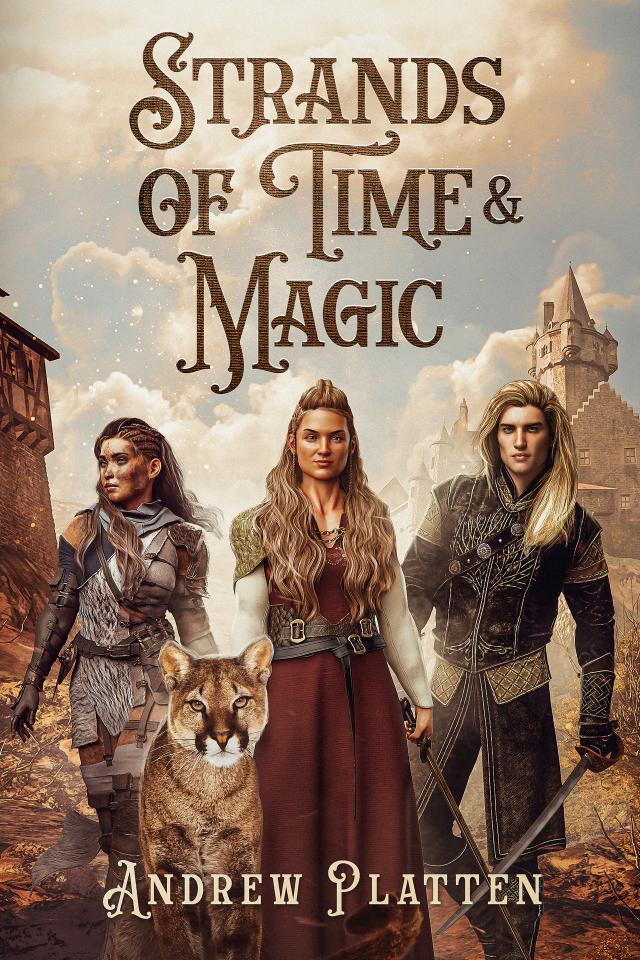
Strands of Time & Magic
Andrew Platten
Copyright © 2023 Andrew Platten
All rights reserved
The characters and events portrayed in this book are fictitious. Any similarity to real persons, living or dead, is coincidental and not intended by the author.
No part of this book may be reproduced, or stored in a retrieval system, or transmitted in any form or by any means, electronic, mechanical, photocopying, recording, or otherwise, without express written permission of the publisher.
ASIN: B0CJC65PCV
Inquiries to aplatten.author@gmail.com
To Darielle, my wonderful wife who supports all my crazy projects and who helped me make this one better.
Contents
Title Page
Copyright
Dedication
Prologue
Chapter 1
Chapter 2
Chapter 3
Chapter 4
Chapter 5
Chapter 6
Chapter 7
Chapter 8
Chapter 9
Chapter 10
Chapter 11
Chapter 12
Chapter 13
Chapter 14
Chapter 15
Chapter 16
Chapter 17
Chapter 18
Chapter 19
Chapter 20
Chapter 21
Chapter 22
Chapter 23
Chapter 24
Chapter 25
Chapter 26
Chapter 27
Chapter 28
Chapter 29
Chapter 30
Chapter 31
Chapter 32
Chapter 33
Chapter 34
Chapter 35
Chapter 36
Chapter 37
Chapter 38
Chapter 39
Chapter 40
Chapter 41
Chapter 42
Chapter 43
Chapter 44
Chapter 45
Chapter 46
Chapter 47
Chapter 48
Chapter 49
Chapter 50
Chapter 51
Chapter 52
Chapter 53
Chapter 54
Chapter 55
Chapter 56
Chapter 57
Chapter 58
Chapter 59
Chapter 60
Chapter 61
Chapter 62
Chapter 63
Chapter 64
Chapter 65
Chapter 66
Chapter 67
Chapter 68
Chapter 69
Chapter 70
Chapter 71
Chapter 72
Chapter 73
Chapter 74
Chapter 75
Epilogue
What’s next?
Acknowledgements
About the Author
Prologue
The 470th year of the Morde Dynasty (Winter, the year of the end of things)
The cat froze, lifted her head, and sampled the air. If cats could frown, she would have. Her hackles spiked, and her back arched. Her claws worried the ground, and she was ready to run. She sensed a predator lurking along her deeply shadowed path home.
Edging backwards, favouring her gammy back leg, she carried the morsel caught for her person deep into the darkness beneath the stone horse trough. From that vantage point she could make out that the thick darkness beside the smithy concealed a hooded man. He stood so motionless that the cat wondered if he was, in fact, stonework.
I can wait, she thought. I can be as patient as... well, a cat.
A distant scraping swivelled her ear to better distil the low rumble of a cart’s approach. Wooden wheels grinding on wet stone and the plodding steps of an ox and two tired men. Its slow pace meant the cart was laden. As for its contents, she could only smell woodsmoke, as the breeze was blowing the wrong way to reveal what the cart was carrying.
The man in the shadows was taller than average, and his cape was tailored so that it nearly touched the ground. It spread around him unnaturally, unaffected by the elements. He wore heavy boots under his cape, and they were dry.
I’ll bet it’s warm and cosy under there, she thought.
The figure’s face was upturned, fixated on the roof of the Barrow Building across the street. Human ears don’t swivel, so the cat couldn’t discern if the man was merely staring into the low, heavy clouds or eavesdropping on the distant rooftop hubbub. His head was tilted just a fraction. Listening, she decided. Hunting. The cat had stalked prey on every ridge and gable in Haxley except the cathedral spire and the giant storehouse before her, which was three times taller than any other building and had straight, flat walls, which made it impossible for her to climb. Was this man yearning for the tasty birds perched out of reach too?
As the snow thickened the air, a subtle breeze kept the flakes away from the man, as if even the air sensed the danger in him.
No, her feline intuition whispered, not a hunter of birds—or cats.
The cart emerged from the swirl, piled high with ale hops, likely brought up from farm storage. The desire for beer did not respect the seasons. One man was old and crooked and, like the ox, indifferent to the cut of the wind. The other man had a grim expression on his teenage face, and his hands were wedged into his armpits for warmth. His fluffy attempt at a beard gave no protection from the wind’s bitter bite.
Once the youth has some years behind him, he will be able to afford a better coat and grow better whiskers, the cat thought as she groomed her own.
“You’re makin’ the delivery, Joff.” The older man coughed as he reached under his winter coat. “I’ll have nuttin’ to do w’ that place.” He pointed his other wrinkly hand at the loading bay, with its sign clearly stating “Country Side” in carved and painted script. The northern set of doors took in over 800 wagon loads a day from the farms while the buildings’ southern doors, labelled “City Side,” focussed on shipments to be sent onwards to the regional capital, the city of Rostal.
Joff sighed. “You’re daft, Old Grob. I’ve said before, you can’t catch magic from an evercold. Just help me unload, w’ ya? It will be quicker, and we can get away to the inn.” Joff had wasted breath on this point a hundred times before, and both men knew it was merely a protest, not an argument.
Old Grob walked away to terminate the discussion regarding his fear of magic and took up a position in front of the smithy, oblivious of the unseen shadow a mere six feet behind him. Grob’s practised hand shaded his pocket flint from the light breeze as he struck a small flame and lit his finger of barr root, sucking quickly to help it catch. The sulphur flare illuminated the hooded man’s face, but he seemed uninterested in the comings and goings of the street and continued his soundless vigil. Grob’s first puff sent a cloud into the air to challenge the snow and sent his body into a fit of coughing.
Joff shook his head, then turned and walked hunch shouldered to the large delivery doors, where he rang the bell. He didn’t wait for an answer, just trudged back to the cart. With so many deliveries each day, the warehouse required efficiency, so the oxen could be tied at a trough while the cart was unloaded. A bowl was available for feed too, and Joff sprinkled four handfuls into it from a tiny sack tied to his belt. Any more and old Dolly would turn as stubborn as Grob.
“If you could catch magic from an evercold, Old Grob, no man in his right mind would work here, would they?” Joff said. “I saw a girl have her magic skriked right out of her by a full mage once. He pinned her with hardened air and consumed every drop while she screamed like a rat’s nest on fire. Then he left her to die. I still witness it in my dreams, I do. But you ain’t gonna catch magic from an evercold.” He enunciated the last sentence as if talking to a child. Everyone with any smarts knew that if they developed affinity, they had best keep quiet about it. Either that or find a way to become strong enough to fight off the predators seeking to boost their power by taking yours.
Joff’s grumbling was lost in the snow—Grob was puffing and looking away—so the teenager turned back to the cart, resigned.
As the cat watched the spectacle, she sided with the old man. You don’t do any work you don’t want to do, she thought. Just like me.
The loading bay’s heavy wooden doors opened so quietly on their well-oiled hinges that Joff didn’t turn until the night porter warily stuck out his lamp, followed by a bald, tattooed head. Spilling out with the light were a thousand complex fragrances from the warehouse’s five floors of storage and processing benches.
“Cautious! Who’s there?” Jake shouted. He was an Abbonite, marked by his prefacing sentences that verbalised his emotions—or suggested emotions for others—as much as his inkwork.
“Late delivery of hops, Jake,” Joff said. “Dolly got stubborn and refused to pull the cart for hours, Ag curse her. We thought we’d be sleeping in a field tonight. Then she got o’er herself, and we’ve struggled to keep up ever since. It’s like she was stung on the arse by a hornet.”
“Calm! The cycling elevator’s not available for deliveries at this hour, so I’ll help you unload just inside the door here, and the day shift will see your hops upstairs in the morning. But you’ll need to get your proofer next time you co
Jake snorted. “Reassuring and slightly offended! Mage Wickham made Haxley’s evercold. Dangerous to question his workmanship. It won’t leak and turn you into a charmer, Grob. We have to keep things fresh for the Rostal’s gentry, don’t we? A minor mage can heat or chill somethin’, but as soon as they stop, it returns to its natural temperature. Only a full mage like Wickham can tie off magic to leave a thing so it stays warm or cold or light or dark or floating with no wires. And they do it so they never leak! Ever.”
Another bell rang, summoning Jake away from his attempt to convert Grob to a door on the city side of the warehouse where patrons of the Crow’s Nest Tavern entered after deliveries had concluded for the day. The city side doorman signalled that the three men and a woman who were removing their heavy coats had paid their door fee, so Jake walked them over to the cycling elevator.
As one of the twelve large loading platforms rotated up from the shaft below, three of the patrons stepped aboard as it passed floor level. The fourth shied, his eyes wide. It reminded Jake of his cousin’s horse, Charlie, bailing out of a jump at the last second. The man had rushed in and hung one leg out over the platform, then lost his nerve and pivoted, crossing himself and huffing as he stepped back with a curse on his lips.
Jake knew what to say, as he said it to most people who rode the paternoster for the first time. He calmed the man down and stepped onto the next platform with him. He rode it for a floor and a half, explaining to the patron that he would be met at the top. Then Jake hopped across to a descending platform and rode back to ground level.
The first three patrons had ascended past openings on each floor, peering at the vast array of goods that awaited sorting and shipment before stepping off at the rooftop tavern to await their friend. Their platform looped over the top and began its rumbling descent. The paternoster’s ability to move goods quickly had revolutionised trade and made the recently deceased Jin Barrow his fortune and elevated him (a frequent pun) to the Haxley Council of Aldermen. Jake gave the donkey powering the paternoster a carrot and then returned to help Joff, who already had several bushels unloaded and stacked inside the doors.
The Crow’s Nest attracted locals and travellers alike; even the occasional member of the gentry came to enjoy it. Raegan Fenn had created and operated the one-of-a-kind rooftop pub in a space rented from Modwyn Barrow, the late Alderman Barrow’s daughter and heir. The unparalleled views, keenly priced and excellent fare, along with entertainment as good as anything in Haxley, were a draw in themselves. Another alluring feature in the winter was that the heat created as a biproduct from the evercold was diverted up through vents to warm the rooftop patrons when the chill set in. In the summer it could be used to warm the kitchen’s water. The two log fires set among the pub’s tables burned primarily for atmosphere, most of their heat escaping into the night from under the canvas awnings.
After a sweaty hour of two men doing the work of three, the hops were unloaded. Dolly was fed and well-watered and showing signs of wanting to be off to her next feed. Joff got to ride on the cart while Grob led the ox, at least for a while.
“The least I could do,” Old Grob said. Throughout it all the snow had thickened, the cat had dozed, and the shadowed figure remained motionless.
Grob led them just one building north before stopping against the stonework of the monastery. He banged on a one-foot-square solid wood panel set deep into the wall. After a moment the panel opened, and a pink, bearded face peered out. No words were exchanged, the ritual common and the night cold. Old Grob pushed a grubby coin into the monk’s hand and received a growler of ale in return. The panel snapped shut, protection from the weather and any potential muggers, and the cart rolled onwards with enough lubrication on board for the evening.
As the street returned to silence, the cat considered the hooded figure and her chances of sneaking by it unnoticed. The man hadn’t moved an inch or made a whisper of noise, but he still radiated his unusually disturbing nature. Suddenly eager for the warmth of her hearth, the cat picked up her morsel, made her legs long as if to tiptoe through the deepening snow, and limped back the way she had come, circling the long way around the danger by the smithy.
An hour later, had the cat been there to watch, she would have seen the figure lower his head, refocus his blue eyes on the scene around him, and take a long step forward. However, his foot never reached the ground. Instead, the man trod into nothingness, swallowed by thin air, vanishing with his cape bone dry. Where he had stood for hours, there were no marks in the nearby snow other than that of a cat with a limp that had passed through on her way home.
Had the man been there at all?
Chapter 1
City folk regarded Rostal as the jewel of the region of Lanthe, and few dared argue with city folk, at least within earshot, as the customer was always right. But the lack of a good argument did not amount to agreement. Most townies, even those from other townships, asserted that the jewel of Lanthe was Haxley. It was bigger than other towns, more affluent, had a cathedral, and boasted several establishments otherwise found only in the city: a glassblower, a bookseller, a dentist, and a locksmith. And if one still harboured doubts, some would point to Haxley’s small, tidy garrison as proof of something worth protecting. But the down-to-earth farmers know Lanthe’s true gem was Plainhand Estate.
Rambling over the most fertile one-fifteenth of Lanthe’s landmass, the roughly rectangular estate was 80 percent arable, growing barr root mainly except for a sliver used for crops to feed the estate’s 800-strong workforce. The remaining 20 percent was grassland and buildings for the horse stock. With stables and barns aplenty, as well as farriers, coopers, smithies, and all the skills required to maintain horses and farming, including growing their own hay and grain, Plainhand’s core business was independent of most suppliers.
Plainhand had invested in quality accommodations, not just bunkhouses but also a general store for the staff and a small stage that troupers and entertainers could use as they passed through. They even brewed a good ale, lovingly called Plainhand Sludge, due to its heavy, hazy nature.
If one was to walk the length of the estate, it would take two full days, and they would encounter folk who kept their spaces tidy and productive, who would welcome visitors to their hearth and table in exchange for news, a story, or some simple chores.
At the northern end of the estate was the transportation compound, owners’ and management accommodations (which were no grander than those of the workers), and central kitchen, which ran from early to late, turning out hot meals for those within easy distance, perhaps half of the estate’s population.
That particular morning saw a quarter moon winking through thinning grey clouds, which were drifting south on a wind that seemed exhausted from blowing through the past week and was ebbing at last.
Heavy overnight snowfall meant a few would start work at fourth bell, an hour earlier than the majority of the community. The road to Haxley needed to be cleared ahead of the daily procession of wagons and carts. The market town lived and died by its reputation, and the Plainhand family’s Wispy Weed brand was pivotal to Haxley’s success. It would not be late.
Leaving first, with reheated stew and yesterday’s bread in their bellies, were two men driving four plough horses of a breed known for their strength, reliable nature, and most of all, their keenness to work. Unlike oxen, which were stronger but often uncooperative, the horses were ideal snow pushers.
Pushing rather than pulling a plough was a skill in itself, and they were an experienced team. They were well out of sight before the fifth bell roused the Plainhand workforce en masse, and soon all the kitchen stoves and ovens were hot and productive. A similar plough team would have left Haxley heading south to the farm, leading the empty carts back to refill, and everyone wagered on where on the road the two processions would meet.
Since war was looming between Lanthe and its southern neighbour, Backalar, all the main roads had seen a sharp increase in banditry. In hard times, when the guard—Lanthe’s rangers who policed the rural areas—were thinned to support the army, the dross slipped out from the rocks they’d hidden under to prey on honest folk. Losses had been high for some, but the Plainhands had invested early and retained the Mobi’dern. They were expensive, assuming one could hire them at all, but they offered the best security. As a result, Plainhand Estate was the only business not raided by bandits. In fact, there had been few attempts, as the reputation of the Mobi’dern was fierce.


