

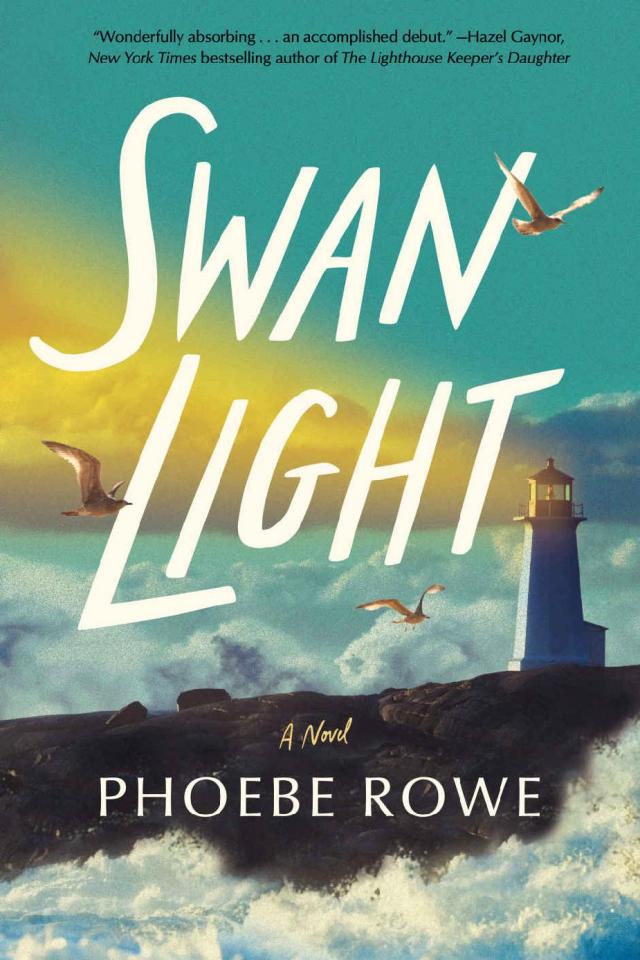
Swan Light: A Novel, page 19


She rubbed at her forehead, Keya’s note and Hector’s clashing in her mind. Was this how it was meant to be? To come so far only to be foiled by a long hull and a group of treasure hunters? To have the one thing you needed always barely and hugely out of reach? Mari felt her years of certainty quaking on their foundation, and in a flash she was back in her childhood nightmare, right after her mother’s death, a shipwreck watching her from the darkness like a monster she could feel but couldn’t see. A monster that didn’t care whether or not she found it. It didn’t care about her at all. And this time, she was in far too deep to find the sun.
“Okay, Keya’s right,” Julian said, returning, pocketing his phone. He stopped at the look on her face. “What’s wrong?”
“My other wreck,” she said, trying to rearrange her face. “We found out our prime target can’t be Californian. The wreck site is too long.”
He leaned forward, eyes taking in her face. “Are you okay?”
“I just . . . we found this target five years ago,” she said. “Ursula. And this whole time, I’ve been so sure that it was Californian. I was fine doing my due diligence, searching our other hits, but I knew. And I was wrong.”
Julian considered that for a moment, then sat down beside her on the ruined windowsill. “Maybe you weren’t.”
“Maybe Californian somehow grew twenty feet underwater?”
“No.” He shifted toward her. “You said you had to leave another target before you finished searching it, right? Because Evangeline needed you here?”
She was surprised that he remembered that. She barely remembered telling him, their first day on the water. “Yeah.”
“So maybe it doesn’t matter how promising this one was,” he said. “Maybe it’s just proving you need to revisit an old target instead. Like Edison.”
“Edison?”
“Yeah.” He nudged his shoulder against hers. “The whole inspiring quote about lightbulbs: he didn’t fail a thousand times to make one, it just took a thousand steps. You found the wrecks that were wrong. Now go find the ones that weren’t.”
Mari nudged back, grateful. He was right. She’d spent so long engrossed in Ursula that she’d almost forgotten the day Skyline had appeared on their sonar, not even a week later. And she’d written off Cherry, maybe too soon. There were so many reasons to stop looking, to stop caring, to give up. But maybe there were more reasons not to.
Then she realized something else: how odd it was that she’d brought this up with Julian at all. Back in Greece, she hadn’t told any of Mercury’s crew about Stuart Noble pulling their funding. They’d been interchangeable, indistinguishable, all of them only there to do their jobs. Her fully included. Her at the top of that list. But working with Julian had been different from the start. He approached it differently than she did, true, glued to the ship while she talked to Gerald Cooper, still and steady while she raced along as usual. But unlike with Mercury’s crew, it hadn’t even occurred to her to hide her bad news from Julian. He felt like a teammate in a way that none of her other salvage partners had, not even Tim. In his own way, this wasn’t just a job for him either. “Why did you agree to work with Evangeline again?” she asked.
If he was thrown by the change in direction, true to form he didn’t show it. He rubbed his chin, thoughtful. “I like Evangeline,” he said. “She’s what I hope I’m like at her age. She’s never stopped asking questions. And I was a little too distracted by my personal life on my last dive for her to answer those questions as well as I could have.” He shrugged. “This was a chance to do it right.”
“I get that,” Mari said. “I don’t think she feels you owed her anything, though.”
“I know she doesn’t,” Julian said. “But I do.”
“How so?”
He shifted his weight on the wall, his jacket brushing against hers. “When my marriage was ending,” he said, “on Evangeline’s last project, I wanted to give up on diving completely. It just seemed so . . . trivial, I suppose, compared to this real-life stuff that was happening. What you said about feeling as though you had to do everything quickly after your mom died—I had the opposite reaction. I almost shut down.”
Mari nodded, listening closely, and for a flickering moment as Julian took a breath to keep talking she thought back to herself at her mother’s funeral, hands full of other people’s food, numb and aimless. The speed had come later. The shutting down had come first.
“I thought about that dive a lot afterward,” Julian continued. “Evangeline’s had a hard life; I don’t know how much she’s told you. She was sick for a long time. And to her, funding these projects is a way to pay it forward. To give other people the chances she didn’t get. I used that mentality to get back on track. I guess this dive is my way of thanking her for it.”
Maybe it’s just proving you need to revisit an old target instead. Julian was right, Mari mused as she ran her eyes along the gray horizon. There was no right way to do this. And that meant there was no wrong way either.
“Thanks for telling me all that,” Mari said. “I needed it, I think.” He leaned his shoulder against hers again, hard, a beat too long. And there was that feeling again, the racing in her bones. “And thank you for not pointing out that I could have avoided this by just moving more carefully with the Californian targets.”
He grinned. “You’ll find it,” he said. “No matter how fast or slow you need to move. I really believe that.” His phone chirped, and he glanced down at it. Mari tried to ignore the fissure of disappointment that bubbled up when his eyes left hers.
“What were you going to say before?” she asked, nodding at his phone. “What was Keya right about?”
He tilted the phone toward her. “15 Salt,” he said. “Teach’s headquarters. It’s a corporate workspace; I have a friend in the same building. He said it will be closed this weekend because his company is hosting an event there, some kind of gala, which is a bummer. I was thinking about calling Teach to see if we could pay them for the photos and diary or something, but if it’s closed they might not have—”
But Mari’s pulse was quickening again, an idea blooming fully formed. A fast idea, a reckless one. So reckless it just might work. “Julian,” she said, cutting him off. “Do you trust me?”
He met her eyes. “Yes.”
“Okay.” She stood and held out her hand, and he took it. “If you get to suggest something careful, then I get to suggest something wild. How far are we from the airport?”
Swan, 1913
To Swan’s annoyance, though not entirely to his surprise, both of his guests had extended their stay.
As with Clara, he’d expected Lou to leave the morning after he’d arrived. And as with Clara, he hadn’t. Instead, they were both making themselves quite at home. The cliff now skittered constantly with their comings and goings, the icebox packed with the misshapen berries Clara took pity on and brought back from the woods, the kitchen table covered in driftwood from the cove, the kitchen perpetually loud with their arguments about how close was too close to the sea. They brought books and sundries from town, the most distressing of which was a boxlike camera Clara had wheedled from Dr. Wright and now took joy in snapping in Swan’s face when he least expected it. If it weren’t for how happy Stay and the tower seemed to be at all the new attention, Swan would have barred the doors on them long ago.
Clara was the most energetic person Swan had ever met. Newfoundland prided itself on slow and steady, on measured, on thoughtful, and even its most stormy-headed sailors didn’t run around the way she did. Swan was convinced that one day she was going to run right off the edge of the cliff and even more convinced that, if she did, she’d simply pop back up at the bottom and try to do it again. Lou was her opposite, quiet and watchful, wary of the water and the light and the cliff. They made an odd pair. But their extra hands, at least, were helpful. With the two of them taking on the maintenance of his property, Swan found himself sleeping earlier and later and better every day, though his body kept its reflex of waking throughout the night to check the oil. Clara fixed the oil shed and the broken side-room window, and Swan was amazed at how much more light it let in. She navigated the tower’s wilting iron with caution and care, and in return its stone hummed more lightly than it had in years. She’ll know, Swan thought. When the end comes, she’ll feel it as much as I do.
Because there was no saving it now. He’d caught himself thinking it a few days ago, sitting in his chair on the back porch, pressing his fingertips into its wooden whorls, and he’d wondered idly where he was meant to go after the tower fell. Would he stay here and watch the sea without it? Could he bring this chair to Peter’s? Could he stomach living anywhere else?
Then he’d realized it was the first time he’d thought after, not if.
He hadn’t been able to stop thinking it since, and for once the light didn’t protest. Maybe some part of both of them had known it for years, even as Swan wrote letter after letter to Norman Bank. Maybe some part of both of them was tired of pretending. It was simply too late. The tower was going to fall. And Swan found that accepting it made the remaining days sweeter, even with his two new guests.
It was nice, near the end, not to be alone.
And so two weeks passed and Swan learned to live around them, gruff and guarded and waiting for the moment when the tower finally tired of their constant ruckus and sent them all plunging into the sea.
One evening he found himself sitting in his chair while Clara lit the tower. It was nice, too, to watch this from a greater distance, to see the flame flicker and leap and the lens start churning. He didn’t notice Lou Roland sliding into Peter’s chair until the boy cleared his throat. “Am I interrupting you?”
“No more than usual,” Swan said, and Lou grinned.
“Good,” he said. “I have something to tell you, but you can’t tell Clara I did.” Swan squinted at him.
“I don’t like the sound of that.”
“No, it’s a good thing,” Lou said. “When she goes into town every day, she’s been talking to everyone she can find about helping move the lighthouse. So you won’t need the bank at all. She wants it to be a surprise, and I haven’t said anything because I don’t want to get your hopes up in case it doesn’t work. But I . . .” He picked at his hem. “I just thought you should know how many people love you down there. How many people are on your side. She’s very convincing; I think she’s even got Gable Strauss warming up to you.”
Swan watched the tower, torn between feeling humbled and heartbroken. A moment ago he’d been resigning himself to the end. Now, Lou was right. A stubborn flare of hope. Inside the tower Clara called something out, unintelligible, and she and the stone both laughed. A moment later she skipped out the door toward them. “One of the muntins is about to break,” she said. “I’ll talk to the smith tomorrow about a new one while I’m in town.”
Still overwhelmed, Swan could only nod, and as Clara looked between his face and Lou’s sheepish one, understanding dawned on her own. She reached out and smacked Lou in the arm. “Lou! What did I tell you?”
“I’m sorry,” he said. “I thought he should know.”
“I’m glad to know,” Swan said. He looked up at Clara. “And I’m very glad for you to try. But why?” The tower tutted at him in reprimand. “Why are you doing any of this?”
She stared at him, uncomprehending. “Because I owe you. You saved my life.”
“You don’t owe me anything for that,” Swan said.
“Yes, I do,” Clara said. “I wasn’t even supposed to be on Saint Gray. I snuck on because my father hurt my friend, to punish me. I didn’t stay and help her. I just ran. But if I left only to let someone else get hurt too, what was the point? I should sit back while it happens again?”
She was so very young, he thought, so fierce. So very much like Nico. And maybe that was what this cliff had always needed. I’ll get it, Soph.
Maybe this cliff had always belonged to people like her.
“You can’t stop every bad person in the world,” Swan said after a moment. “Or every bad thing. But it’s very admirable that you want to try.”
“I don’t need to stop every bad thing,” Clara said. “Just this one. If I don’t, I abandoned Mags for nothing.”
Swan didn’t need another stray. He emphatically didn’t need two. But now Clara had her head on Lou’s shoulder, these two children who didn’t fit their worlds, who had made the tower their home the same way Silvy Swan had so many years ago when everything else around him had fallen apart. Who knew without being told that these cliffs were so much safer than they looked, that as long as the tower stood shining nothing else could hurt them, no matter how the storms came in. Swan didn’t need a stray, but maybe they weren’t so different after all, Silvy and Clara and Lou. The light would fall, or maybe it wouldn’t. For now it was swinging around above them and the waves were crashing against Saint Gray below. And in this single dusk-drenched moment, it was enough.
Mari, 2014
Mari’s gala dress, rented sight unseen from a shop in Boston, looked like it had been made for this very occasion. It was silver-black and sequined, inky and fluid, and as she examined herself in the hotel mirror, nerves jangling and stomach tense around the protein bar she’d forced herself to eat, she considered that if she had to carry out a heist in the impracticality of a dress, at least it was one that made her feel like a sea creature.
Julian was equally tense in his dark green suit, drumming his fingers against his phone throughout their several-block walk from the hotel to Teach’s headquarters. Mari was as shocked that he was still going along with this as she was sure to her core it would work. She couldn’t explain it, this throwing caution to the wind. It had been easy so far, to get Julian’s friend’s building card, to rent the clothes. This brick building was all that stood between her and Clara Vettrey’s story. It was born of frustration at Teach and Californian, of the thrill of throwing something just to see it fly. And it was a dozen photos and a diary—how long could they take to read?
And as the elevator door opened onto the seventeenth floor, Mari felt herself fly even higher.
Because this was her kind of gala.
The company hosting the event, Dodd Seawhether, was a maritime equipment manufacturer. On a normal night this room in their corporate headquarters was probably a typical banquet ballroom: an open floor with beige walls and a scatter of high-top tables, a shiny square dance floor at the end, floor-to-ceiling windows looking out into the heart of Boston. But tonight the overhead lights were masked with blue glass, the floor strewn with sequins, the tables met by delicate golden spirals that draped down from the ceiling. And the windows had been covered end to end with fish tanks glowing an eerie teal, shimmering every few feet with the city lights behind them. More tanks had been set up in pillars sitting throughout the room, and Julian nudged Mari and pointed at the closest one as they stepped into the room. “I think we’ve been out-shipwrecked,” he said.
Mari leaned close to peer into the water. Instead of toy castles or treasure chests, the pebbled bottom was covered with three startlingly realistic miniature ships, a schooner and a sailboat and a steamship. Some of the other tanks held similar replicas, but some went a step further, full of what might be real wreck artifacts. Mari spied a pocket watch, and an arrowhead, and the curling lettering of a passenger manifest encased in a plastic sleeve. The hundred or so other guests seemed to have gotten the theme memo. Mari saw men wearing vintage-looking first officer epaulettes, women in early-1900s-style dresses, and multiple attires patterned with Jolly Rogers. Mari grinned watching one man refasten the fake parrot tied to his shoulder, then realized that she knew him. “He’s worked with Scripps before,” she said to Julian, turning her face away in case he recognized her. “He’s looking for Mount Temple. She was one of the ships that came to help Titanic, but she was too far away.”
“Not as scandalous as Californian,” Julian said.
“Not quite,” Mari said. “She’s a cooler wreck, though. She sank with all these dinosaur fossils on board.”
“You’re kidding.”
“Nope,” Mari said. “Twenty boxes of million-year-old bones on their way to the British Museum, scuttled and sent to the bottom of the sea in World War I. Along with seven hundred live horses.”
Julian winced. “Damn. They must have been terrified.”
“Yeah. Whoever finds Mount Temple is going to have a really weird time.”
The man didn’t even glance her way as he passed, too intent in his conversation, but still Julian stepped closer to block her. Mari had to forcibly restrain herself from reaching out to touch him, the muscle of his arm a soft swell under the green of his suit. It looked good on him in a way it wouldn’t have on most people. They’d hardly exchanged more than a glance on the flight here, a wordless agreement to focus on the task at hand. But under these swiveling lights it was harder, the shape of him a comfort as much as a thrill. It was the fact that if she were to start talking about Silvestre Swan and Bergy Bits and Mettle House he’d be the only person in the room who would know what she was talking about. The only person who knew the way the moonlight caught on the foam of the sandbar, the way the weather changed without warning, the way the water pulled things into the cove. She was astonished how quickly and fully Norman Cliffs had started to feel like a home to go back to. That Julian was here meant that all of it was real.
Soon a woman stood up and signaled the DJ, who let out a pulse of sound and then cut it off for a low background track. “Good evening, everyone,” the woman said into the mic. “And thank you for being here as we celebrate twenty years with Dodd Seawhether Enterprises, and our first annual CQD Ball!”
“Showtime,” Julian whispered.
Every eye was on the woman speaking. No one even looked over as Mari and Julian slid into the stairwell. And Mari’s nerves roared to life as the applause faded into silence.


