

The Fate Unfollowed, page 1


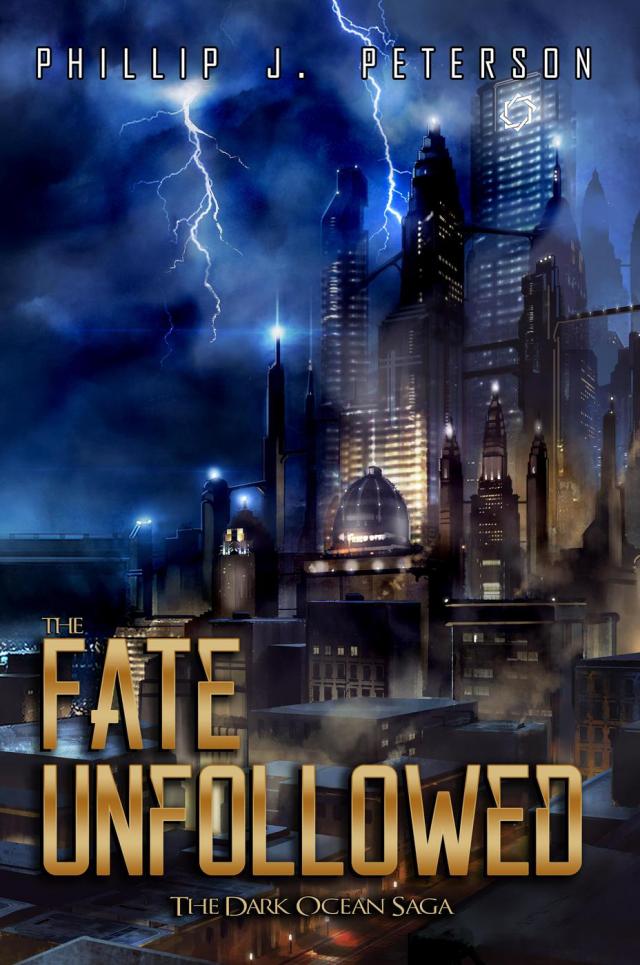
The Fate Unfollowed
The Dark Ocean Saga, Volume 1
Phillip J. Peterson
Published by Pillar 4 Entertainment, 2022.
This is a work of fiction. Similarities to real people, places, or events are entirely coincidental.
THE FATE UNFOLLOWED
First edition. February 14, 2022.
Copyright © 2022 Phillip J. Peterson.
ISBN: 979-8985617801
Written by Phillip J. Peterson.
Table of Contents
Title Page
Copyright Page
Dedication
Chapter 1
Chapter 2
Chapter 3
Chapter 4
Chapter 5
Chapter 6
Chapter 7
Chapter 8
Chapter 9
Chapter 10
Chapter 11
Chapter 12
Chapter 13
Chapter 14
Chapter 15
Chapter 16
Chapter 17
Chapter 18
Chapter 19
Chapter 20
Chapter 21
Chapter 22
Chapter 23
Chapter 24
Chapter 25
Chapter 26
Sign up for Phillip J. Peterson's Mailing List
For my mother.
Chapter 1
Daemon Pramoore was as close to being a god as anyone could be in a world without heavens, in a city without sky.
Even in a dead world, people will still look up. Their eyes will seek out the highest point and they will plead for direction. They’ll beg for subjugation. In the city of Mallis Two, that highest point was Daemon Pramoore, standing stoic at the window wall of his office on the eightieth floor of Pramoore Tower, a ziggurat of black steel and mirrored glass.
Beneath his feet, the city spanned for miles in every direction. It was a glittering tarp of shadows, moving lights, and capitalist ads. Mallis was a tightly packed metropolis that seemed desperate to burst and sprawl outward forever, but it was restrained inside a monolithic wall that encircled its borders. Like muddy water crashing against shoreline rocks, when the city could grow no wider, it grew higher. It was a bundle of bricks and steeples that were bound together in the middle of a derelict world, and beyond the wall there was nothing.
Mallis Two was the only city in the world, the last city, built atop the ruins of a forgotten age that was now boiled down to the bare and embellished tales of mythology. Outside its mighty wall was the gray and umber barrens, a world of cracked deserts and brittle mountains. The sparse trees that had survived the planet’s final days were huddled in tangled charcoal forests. Their gnarled roots wound deep beneath the dry and crumbling crust into the subterranean layers of silt and clay. Across the arid land, red dust twisted in sour trails of wind, and the only things that moved through the biting haze were the unnatural beasts of the badlands. They were larger than horses and weighed as much as two. They bristled with large, black scales and lumbered on four thick legs, with clawed, reptilian feet that raked the desert floor.
Above it all, above the barren desert, the black forests, and the bound city, there was the endless storm. Dark, torrential clouds filled the sky and encased the world in a shell of leaden dust. It made the nights as black as tar and smothered the days in eternal dusk. It was a fierce storm that covered the world and reached back further than any surviving record or living memory. Jagged arcs of lightning leapt between the sky’s churning plumes and cracked whips of white fire down to the surface, marring the desert with scars of burnt glass, and shattering any structure that dared to rise too high.
Pramoore Tower was one such brazen building, as were the four towering obelisks that Daemon’s ancestors had constructed at the corners of the border wall. They were built to defy the storm, to make a statement. The towers were there to prove to the population of twenty million souls that the Pramoores were beyond reproach. For as much as it mattered, the statement worked. Throughout a century of lording over the city, no Pramoore had ever been defied or denied. Their regal lineage had gifted the people with safety and security in an otherwise deadly world. But comfort grants people time to reflect, and the citizens of Mallis Two were beginning to think back and think ahead. They were beginning to reconsider the power they’d given to Daemon. They were beginning to want it back.
Frenzied light built in the clouds above the city and with an eruption of thunder like crashing boulders, it spit out a lash of lightning against Pramoore Tower. The brilliant light crackled at its peak and was immediately channeled into blue lines of speeding light that raced like ancient and magical runes down its face. They lit up around Daemon’s office window, humming an electric hiss of defiance and coloring him in a pale-blue halo before fading into shadow a half-hundred stories below.
Daemon was an unflinching oil slick of a man with porcelain skin, black eyes, and black hair. His expression was hardened and stern, as though he had been sculpted as an angel of death and judgment. His face would have been right at home beneath a dark cloak with a sickle in his hands, but he instead wore a black three-piece suit with a purple silk shirt underneath. Every fold, every thread was perfectly fitted and perfectly pressed. He tolerated nothing less.
“How many will we have?” he asked with a deep and silken voice.
“Twelve,” a man answered from the sofa across the room. Valen Kirsch was a finely tuned sample of posture and silver poise. He was long into his sixties with high cheekbones, a pointed nose, and beady eyes, giving him the appearance of a tall and wiry eagle. Even his soft wisp of snowy hair looked like thinning, feathery down.
“Twelve?” Daemon repeated as he turned from the window and leveled a predatory gaze at the old man. “You promised me twice that.”
“That was more than a week ago, sir.” Valen lifted his arm and tapped at the silver disk wrapped like a watch around his wrist. The face of the disk lit up and projected a series of holographic images into the air. They were medical scans of hulking silhouettes, plotting out bone structures, nervous systems, and cerebral maps. “One of the creatures is ready now, but brain activity in the others has yet to fully develop. These new energy restrictions have slowed our progress more than we had anticipated.”
Daemon moved to a mirrored wall and examined the square shoulders of his suit then craned his neck against its snug collar. “The Energy Distribution Act,” he groused. “The law hasn’t even been enacted yet and it’s already a thorn in my side.”
“It’s unlikely to improve. Even with the new restrictions, there are rolling blackouts in sectors three and five. With their re-election coming up, the sector lords are getting desperate. Each time they convene they seem to tighten their grip that much more.”
Daemon straightened his posture and smoothed the lapels of his jacket. “Sector lords,” he spat the title like poison sucked from a wound, “nothing more than hand puppets with imagined power.”
He turned to cross the room to his desk, his mirror-polished shoes passing over a broad pattern stamped into the carpet; a square and a diamond, intertwined to form an eight-pointed star against a crimson field. It was the proud and perfect logo of Pramoore Industries, Daemon’s inherited empire amidst the gray wastes. “Between the towers and our mining operations, I supply nearly eighty percent of the power to this ungrateful city, and those enfeebled politicians think they can tell me how to use it?”
Valen finally lowered his arm, allowing the bio-scans to sputter and vanish from view. “You control the electricity, Mr. Pramoore, but they control the people. Until that changes, we must still tread lightly.”
Daemon waved off the advice. “How many of the lords do we currently own?”
“Four,” he replied, “though it appears that Aldan Pharos is set to win Sector Six this year.”
“Pharos,” Daemon paused to contemplate the name. “Is that the excitable youth, always rolling up his sleeves like a commoner?”
“That’s the one. If he were to win Six, that would leave you with only three of the eight lords. Pharos is hardly a supporter.”
“Tell me, Mr. Kirsch, where is all my power going?”
“The hydroponic farms and medical grids I believe.”
“Farms and hospitals,” Daemon simplified with spite. “Of course.” He retrieved a crystal decanter from the bar behind his desk and filled a tumbler two fingers deep with bourbon. “These cancerous people breed beyond control and then demand more power. And what do they do with it? They use it to live longer and breed more.” He replaced the stopper on the bourbon and rounded his tall, leather chair. Smoothing his slacks with one hand while suspending his glass in the other, he sat and turned placidly towards the desk. “And now they seek to put restraints on me? They don’t need power; they need a lesson in self-control.”
Valen rose from the sofa and strolled with long strides across the room, choosing to not indulge Daemon’s frustrations. He stopped to examine a framed painting that was hung beside a tall wooden bookshelf. The art piece was simple, overly so for his taste. It was a black ring on a white canvas, nothing more.
“This is new,” he noted, forcing a right angle into their conversation.
“Yes,” Daemon acknowledged with only half a glance.
“Rather simplistic, isn’t it?”
“It’s perfect.”
Valen shrugged. “I suppose all art is subjective.”
“It’s not art,” Daemon clari
Perfection, Mr. Kirsch,” he continued between sips. “It strikes the senses differently, don’t you think? We can feel it when we look at it, satisfying some primal need inside of us. To seek it out is the only truly noble pursuit in life.”
Valen rubbed the soft skin of his fingertips together in front of his chest, reluctantly noticing the tiny imperfections in their texture. He turned away from the painting and walked to the front of the desk, running his imperfect fingers across its glossy wood. “I see your new desk has arrived,” he said in an overly diplomatic tone. “Ebony ash?”
Daemon leaned back in his chair and sipped again at the bourbon. “Directly from the Black Forest.”
“You redirected the calibrite miners to the forest. That’s a rather dangerous area for a vanity project, isn’t it?”
“Is it?” he responded callously.
“Sir, each time a worker is killed in the desert we risk losing an entire shipment, to say nothing of our public image.”
“Our public image? That’s the opinion of roaches. Their misery doesn’t grant them the right to deprive me of every little pleasure, now does it?”
“Of course not, sir. Their opinion of you is moot, but it is my job to shape their view of this company. Every time a calibrite miner is killed, there are press releases. Cameras are pointed at our work. Auditors and over-zealous reporters come snooping about.”
“Don’t be so dramatic, Mr. Kirsch,” he replied. “It was over a month ago, and any casualties we incurred were well within the expected scope of a normal run.” His black eyes sliced up at Valen, motioning with an amber slosh of his drink. “Don’t forget, you were once one of these side projects yourself.”
Valen’s steely eyes stared through the desk as though he were crunching numbers in his mind and balancing a mental spreadsheet. When he seemed to have finished, he tapped two fingers with finality against the polished top. “Of course, sir. Will there be anything else?”
Daemon nodded and swallowed another mouthful from the glass. “Reduce output to the clinics in Sector Four by ten percent. That should be enough to put us back on schedule.”
Valen raised his arm and tapped at his wrist, summoning back the holograms. “And when the auditors do come asking?” he inquired while swiping through the orange text displays. “Rumors have already begun to spread.”
“Rumors?”
“Of course. People have begun speculating as to where all this power is going,” he replied. “Even your own agents have started asking questions. There are whispers of secret laboratories hidden throughout the city, mad scientists conducting illegal experiments and sucking up all the electricity. That sort of thing.”
“And where would they be getting ideas like that?”
“Well, they are agents, sir. You can hardly recruit an army of psychics without expecting a few of your own secrets to slip through the cracks.”
“No, I suppose not,” Daemon replied with a feline smile. He imagined the halls of his security force filling with those clouds of psychic whispers. He pictured them slipping from mouth to ear, blurring in a mixture of conspiracy, hearsay, and truth.
“The auditors, Mr. Pramoore?” Valen broke in, his finger hovering near his holographic notes.
“Power is an unpredictable thing, Mr. Kirsch. Lie.”
“Very good, sir,” he replied before swiping away the data and moving for the door.
“Mr. Kirsch,” Daemon said, stopping him at the exit, “I’d like to meet with Aldan Pharos. Tonight.”
“I’ll have Ms. Weiss arrange it,” he replied with a courteous bow.
Daemon called out behind him, “And raise the price of calibrite by four percent for the next quarter.”
FROM STREET LEVEL, and without the benefits of elevated social stature, Mallis Two was a very different place. Under a sky of electricity and dust, the buildings were looming shadows with eyes made of colored light, and wicked grins shaped in glass. It was a bombardment of flashing adverts that were stitched together beneath crisscrossing skybridges and the roar of the elevated train. Sleek cars, covered in the desert chalk that had blown over the wall moved in a clogged formation through crowded streets. They pulsed between intersections like a bloodstream of brake lights, beating around the central, black heart of Pramoore Tower.
Hovering transports slid through the air above the highways. The light-laced, floating blocks, each as wide as a four-lane street, slipped above and below each other as they crossed paths. The ferries moved high above the congested traffic, allowing for rapid and reliable schedules. It made them ideal for industrial freight and public transit, but they never rose above forty feet. Anything that might ascend too high would be quickly struck down by a vengeful whip of lightning. In Mallis Two, anything too tall or too audacious, anything that stood up too proud was destroyed by the ceaseless rage of the storm.
The city was the sole survivor of the end of the world, huddled against the dark and cold, hopeless and helpless, waiting for its final light to fade. It was an end that would never come. Despite the howling winds and clawed beasts that battered at its walls, and the lightning that lashed at its peaks, Mallis Two labored on. Day after day the city survived because even in the ravenous dark, there will always be a light that is waiting to be found.
While the populace sulked and hobbled along, masked in upturned collars, there were still those untouched by shadow. They walked through darkness like someone walking on water, unaware of peril, shining with a light of their own. These beacons were rare and difficult to spot. Their glow wasn’t that of a candle in the dark, but a camera flash of light, and only with patient eyes could they be seen.
The evening crowd of Deidre’s Diner was a patchwork of oily hair and tattered clothes. Their regular patrons were the sheltered homeless, the swelling average of Sector Six. They made up the working class who had earned the right to live, but those lives were worn down to the nub. They were people with roofs over their heads, but the cost of that roof swallowed up all they could earn in an overstuffed work week. They weren’t dying, they weren’t living, nor were they walking a tightrope between the two. Whatever social safety nets that Sector Lord Kaddler had installed were just enough to ensure that the people didn’t care whether they’d succeed or not. They survived just well enough to not lay down and die. They were the face of the weary masses, now gray and running like a masterpiece splashed in turpentine.
The small crowd filled the row of booths that formed an ‘L’ and hooked around the front of the diner. The remaining regulars and stragglers took up stools at the front counter. Overhead lamps hung above the tables, dimly lit bars of light that were dangling from metal strings. The tinkling clatter of tin on plates added texture to the muted murmur of casual conversation.
Deidre’s was considered a staple of Sector Six, a landmark for the locals. The food was lab-grown, and the floor was sticky, but the portions were cheap and served on clean plates and with authentic smiles. That was what cinched Marianne Price’s decision to work there. When she’d first moved to Six, she’d stopped in for a cup of coffee between job interviews. The generic brew was bitter but hot, and the woman who poured it, a bubbly woman named Dee, talked Marianne’s ear off for the better part of an hour. Marianne had been desperate for the company, and Dee poured it out with every refill, always smiling, always genuinely excited to hear about the successes and hardships of her customers.
Marianne had later learned that Dee was short for Deidre Kane, and that it was her name scrawled in neon pink above the door outside. She was a big, mocha-skinned woman, brimming with stories and sass. She was a pile of smiling, chocolate marshmallows who seemed to know everyone in the city by their nickname. As Marianne had been paying her bill, she’d asked if the diner was hiring. Without missing a beat, Deidre slapped her hands together and asked when she could start. She also went into a tumbling rant about the weekend coming up and how she needed off to see some ‘sexy stack of beef’ at a comedy club. Marianne was happy to take the shift.


