

The Eros Affair, page 1
part #4 of Simon Shard Series


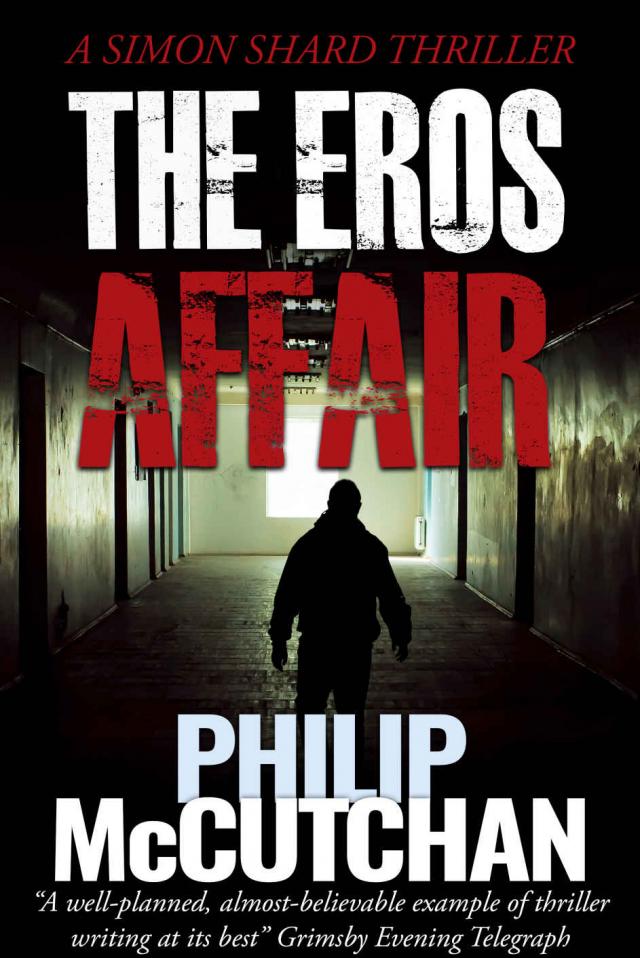
The Eros Affair
Philip McCutchan
© Philip McCutchan, 1977
Philip McCutchanhas asserted his rights under the Copyright, Design and Patents Act, 1988, to be identified as the author of this work.
First published in 1977 by Hodder and Stoughton Limited.
This edition published in 2018 by Endeavour Media Ltd.
Table of Contents
1
2
3
4
5
6
7
8
9
10
11
12
13
14
15
16
17
1
WITH THE CHIEF INSPECTOR from Ripon had come the pathologist and the forensic scientist and their teams of experts: this thing had been pre-indicated as big: the telephone call to the nick at Ripon, an anonymous call from a coin-box, but informative, had said the Foreign Office would be interested. Dig, the man, an educated man, had said, and had passed a map reference up on Grewelthorpe Moor. A certain field belonging to a man who farmed sheep: take the diagonals from corner to corner, and where they crossed — dig. A body would be found, or at any rate a skeleton. The voice had given what seemed to be a code group: four letters that failed to make a word — C, U, G, B. It hadn’t meant a thing to anyone in the Ripon nick. But the Foreign Office — without committing themselves to any knowledge of the code group — had expressed a cautious interest; precise instructions had quickly reached Ripon police from Detective Chief Superintendent Simon Shard; and Shard was now on his way from Heathrow to Leeds and Bradford airport.
Dug up as told, the skeleton contained damage: skull holed and backbone shattered by three bullets that were still there, bullets fired at close range from a 9-mm Russian Stechkin APS automatic, 20-shot, nine inches long, weight 30 ounces in pre-metric — said forensic. Forensic also gave a snap judgment, to be confirmed later, that the body would very likely have been in its grave for upwards of six years. And the farmer who leased the land swore blind that it must indeed have been there for that time at least: he had been in possession himself the last six years and there had been no disturbance of his land in all that time.
The farmer, by name Hewthwaite, waved an arm around the lonely moor, well off the road running through from Ripon to Leyburn, dappled now by cloud scudding high before a fresh wind. “My sheep have been in sole possession. I’d have known if any grave had been dug in my time. Before that, this must have been, Inspector.”
“This land was empty up to then, wasn’t it?”
Hewthwaite nodded. “That’s right. Proper gone to seed it was too, after old Garrowby died. A right job I had … It’d have been between Garrowby’s time and mine this lad were buried, take it from me.”
Sucking his teeth, the Chief Inspector watched his photographer at work. Never mind the time-lag, the full routine was in operation: measurements, soil samples, plaster casts, the lot. A search for any contact traces in grave and skeleton, anything that might have been left behind by the killer, hairs, small clothing particles or dust. Every grain of earth could have its story to tell, could begin to forge a link in the chain that would one day wrap itself around a guilty man. The Chief Inspector reflected on the voice — it had been he who had taken the call. Lah-di-dah he called it — South of England, BBC English. Could have been military — it sounded clipped. Accustomed to giving orders, and something extra: it expected to have them obeyed. The Chief Inspector, who fancied himself, as it happened, on deducting things from voices, had a theory: these days, the voice that expected obedience as in pre-war days was more muted than it used to be, more apologetic — largely because it no longer had the certainty of that obedience. And it followed from that, as from the timbre of the voice, that the caller had been an older man. Very likely an ex-officer …
The Chief Inspector turned away from Hewthwaite and looked at the macabre scene. Photographed, examined, about to be well documented, the skeleton was now being lifted carefully onto a large polythene sheet, wrapped so that no fragments would shake loose and be lost to forensic. A few moments later it started on its journey to the waiting police van beneath the bright day’s sun gilding the high edge of Wensleydale to the north-west.
*
Shard reached the police station in Ripon at the same time as the cortege from Grewelthorpe Moor came in to discharge the van’s bony content. He was given the story in detail.
“Code word, eh? CUGB. Doesn’t mean a thing to me. We can expect a follow-up before long — that’ll clarify things. The question is, why?”
“Why what, sir?”
“Why we’ve been put onto it. Why that voice on the phone wanted this bloke …” He paused. “I suppose it is a bloke?”
“Yes, sir.”
“Why do they want him dug up, for God’s sake?”
*
Hedge, later that afternoon in his comfortable Whitehall office suite, echoed the same question: “Why, Shard?”
“I don’t know yet. Maybe they’ll tell us — don’t forget the code group.” Shard added, “Perhaps they wanted to shop someone.”
Hedge dabbed at his full red lips with a linen handkerchief and glanced at the French clock on the chimney-piece, checking its time against that of his wristwatch. “What’s that supposed to mean, Shard?”
“What it says. Someone who knew about the killing at the time — or has found out about it since. Our informant may want someone to get the chop —”
Hedge pounced. “That farmer, what’s his name —”
“No.” Shard was positive. “Forget him. Known to the police in the good sense — a solid Yorkshire farmer. The Superintendent vouched for him.”
“And they don’t know who the skeleton might have been?”
“No clue. No missing persons unaccounted for in their area. Nor in adjacent areas — they checked while I was there, checked right back.” Shard paused. “Before long we’re going to be told something more —”
“What about the previous farmer?” Hedge plodded on.
“Garrowby. Dead. Died soon after giving up his tenancy. No family, no close relatives even. Blank, Hedge. To go on: I repeat, the code group —”
“Yes. CUGB. Curious. Any idea what it might mean?”
“Of itself, none. But it’s going to be used again, isn’t it? In the meantime, I’ll be busy.”
“Doing what, Shard?”
“Checking files, what else? At this moment, I hope, my detective sergeant is making a start on them — our files, the Yard’s files, and Central Register —”
“Why Central Register? I don’t want MI5 brought into this. Nor should you.”
“They’re friends, Hedge —”
“But we’re our own show — you know very well what I mean!” Hedge, that shadowy screen that stood guard between the FO’s Head of Security and the rest of the world, the lesser world in Hedge’s view, was much put out. “FO Intelligence Unit — MI6 — MI5, they’re all very well but they cut no ice so far as I’m concerned.”
“Yes, Hedge.” A gleam came into Shard’s eye: he was in a hurry, because he had a hunch that things having been given a push were going to start moving quickly after their long period in amber and identification before the next move took place, while probably impossible, could be important; but he couldn’t resist saying, tongue in cheek, “I hope you haven’t been up to anything nasty, Hedge?”
Hedge glared, and his puffy pink deepened to red. “Oh, really, Shard, haven’t I told you before, I have an intense dislike of flippancy, and your stupid idea of a joke isn’t funny. You have no … no reverence for Whitehall or for your superiors, have you? I find that distasteful.”
“In which case I apologise —”
“I often have a mind to send you packing — back to the Yard.” Hedge’s eyes glittered and he checked the time once again. “I must go. I have a dinner tonight, white tie. Eros Hotel. The Commissioner will be there — we share an interest.”
“In me?” Shard asked, face straight.
“Not in you, my dear Shard, no. It’s the annual dinner of the Royal Agricultural Charities Institution, nothing to do with professional matters.”
“I didn’t know you had an interest in that direction.”
“I haven’t. I’m the guest of honour as a matter of fact. On account of my family, don’t you know. Or more strictly, my wife’s family.”
“Ah, I see,” Shard said, and spoke no less than the truth: Hedge’s wife was the real guest of honour. Lady Felicity, daughter of a belted earl, now dead, was there in her father’s right as it were: His Lordship had had a lifelong interest in agriculture and the men of the land. Shard, feeling dismissed, wished Hedge a good dinner and left him to go home and change into his tails. Shard proceeded to his own office, a crummy set-up in Seddon’s Way off the Charing Cross Road where he pursued his cover occupation: ostensibly Shard was a Commercial Philatelist and in proof of this his office was festooned with stamps stuck upon squared paper and stamps in albums; there were stamps in drawers, stamps in filing cabinets and shelves full of Stanley Gibbons and Harmer, going back to the year dot. It was, he reflected as he took a taxi to the Charing Cross Road, all part of the Foreign Office bull and really quite unnecessary, but Hedge loved being all mystery and cloak-and-dagger. For his part, Shard was happy enough to have distance between himself and pomposity, though often enough he found it irksome and unhandy to be segregated from his own immediate staff: Detective Inspector Calvert and Detective Sergeant Harry Kenwood. Arrived in his office, he spent some time going through his own files, his own rogue’s gallery compiled partly in his Yard days and partly since his secondment to Hedge’s outfit, checking missing persons. Flip, flip, shuffle, shuffle: no help. He had hardly expected much. Getting up, he poured himself a Scotch and lit a cigarette, moved frowning around the small office, a mere two paces one way, two the other for long legs. Thought revealed no more than the files. The process of thought had in fact started in Ripon and continued throughout the afternoon flight south from Leeds. The facts were bare and led nowhere — yet. Hedge hadn’t seemed worried; only vaguely annoyed. No reason why he should be worried — again with the proviso, yet. Shard reverted to an earlier thought: for now, they could but wait for some further contact from the telephone voice, and for Harry Kenwood’s report as gleaned from the FO files. Shard decided to call it a day and go home. He checked his safe and his desk drawers, steel lined and with locks secure against anything less than a charge of dynamite, and left the office. His security line burred just as he was pulling the door to. He went back in.
“Shard.”
“Kenwood, sir.”
“Found anything, Harry?”
“Not yet, sir. Just an interim report — I’m still waiting for Central Register and CRO.” He paused, and to Shard there was something pregnant about that pause. “I’m pretty sure there’s a file missing, sir.”
“One of ours — a Foreign Office index?”
“Yes, sir. I’m suspicious — no certainties, but it looks fishy.”
“Why?”
“After a certain point in the file, all the index numbers have been altered, sir — up to about a year ahead of the last unaltered one, that is. It’s as though someone —”
“Is there any attempt at concealment, Harry?”
“No, sir, none at all. The alterations have been properly authenticated and approved.”
“Whose code?”
Kenwood said in a curious voice, “Code HA stroke HHH stroke 2, sir. That’s —”
“All right, Harry, not even on the security line. You ought to know better than to quote code and name together. I’ll be right round.” Shard slammed the handset down, his face serious. HA/HHH/2 was, of all people, Hedge. Of course there would be an explanation, and Kenwood could be seeing ghosts in any case. And he reminded himself that Hedge hadn’t seemed worried, which presumably he would have been if he’d been up to anything unethical and was likely to be bowled out. On the other hand, Hedge wouldn’t necessarily have ticked over: a skeleton was a skeleton was a skeleton, and fairly anonymous.
Another taxi, back to the Foreign Office and the security section. Kenwood was ready for him, with the altered index numbers displayed free of their steel, thief-proof cabinets. Shard examined them all closely, but shook his head. “Nothing we can do as of now, Harry. Hedge is pompous, Hedge is nine-tenths ludicrosity made man, but I’m not going behind his back. Which is not to say he won’t have to satisfy me in the morning.” He swept a hand around. “Lock all this lot away safely, Harry, and get off home. If we’re lucky, we’ll be left in peace to sleep on it.”
“No urgency, sir?”
Shard waved a warning finger in Kenwood’s face. “Don’t tempt fate, Harry. I’ve had a long day.”
*
Maybe, Shard thought later, he had tempted fate himself: as it turned out, he was to have a longer night. He had just finished another Scotch, and Beth had called through from the kitchen that supper was ready, and then the telephone chimed into the domestic scene. Frowning, Shard answered: it was Scotland Yard — Hesseltine, Assistant Commissioner Crime, Shard’s one-time chief in the Met’s CID.
“Shard, hold onto your false teeth. The Eros Hotel’s been hijacked —”
“Hijacked?”
“The Psyche suite’s been cut off by gunmen, and the hostages include your boss and mine, plus assorted other VIPs. I suggest you get there fast.”
The call was cut: Shard’s nostrils stopped registering even the smell of steak and onions.
2
OUTSIDE THE EROS HOTEL, Piccadilly was a shambles but a controlled one: the Metropolitan Police had had plenty of experience of this type of crime. All traffic had been stopped, people emerging from the underground at Piccadilly Circus and Green Park were being directed away east and west and all the side entries to the thoroughfare were sealed by police. The fire services were present and their vehicles, together with many police mobiles and vans, crowded the roadway. Searchlights mounted on army trucks had been brought up, but were being held in reserve. From the Eros Hotel, lights blazed. The foyer was filled with police officers, both CID and uniformed branch. Shard, who had come in by car, left it parked west of Green Park underground station on double yellow lines and to hell with it. Let past the police barrier, he ran along Piccadilly towards the hotel, keeping to the south side for a better view. Looking left, he saw the lighted windows of the Psyche suite, all curtains opened, clearly showing the men with guns trained on the police in the roadway below.
He crossed the road and went into the foyer, saw Assistant Commissioner Hesseltine in the centre of a group of senior officers of the uniformed branch. Hesseltine caught sight of him. “Ah, Shard —”
“What’s the form, sir? Yours — or ours?”
“It’s mine for now,” Hesseltine said, tight-lipped. “Beyond that, I can’t say yet.”
“You don’t know who they are?”
“No, nor what their demands are. All we know is, they’ve sealed the Psyche suite and are holding all the diners as hostages. Also that they’ve shot the toastmaster.”
“Dead?”
“I’m afraid so. He was foolish, but he had guts. He tried to get one of the guns, and they ripped him apart. You can imagine the effect on the others, Shard.”
Shard nodded. “How was contact made, sir?”
“By telephone from the Psyche suite to the Yard — brief enough, too. Just the facts stated baldly: the gunmen were in control, no one would be allowed to leave, and further contact would be made shortly.”
“And any police action would mean more deaths?”
Hesseltine smiled bleakly. “The obvious inference, though not put into words.”
“And the voice, sir? The man — if it was a man — on the phone?”
Hesseltine said, “It was a man all right. An educated voice, I’m told — very British and old school tie. I’ve a feeling we’re up against something different this time, Shard. I’m not sure where this leads us, if anywhere, but it so happens there’s a number of trade union leaders up there in the Psyche suite, plus some high-up Labour politicians. This could be some kind of a backlash on the part of the middle classes — fanciful, perhaps, but not too impossible!”
Shard nodded again, frowning, thinking his own thoughts. He asked, “Military, sir? The voice? Could it have been an ex-officer, wartime vintage?”
The Assistant Commissioner spread his hands. “I don’t know. The constable who took the call … what’s on your mind, Shard?”
“Just a random thought, sir. There’s a skeleton up in Ripon — but it’s a long shot, too long to worry about for now. What do you propose to do right at this moment, sir?”
“Go on past precedent. Keep talking when the time comes, but not give way. Play it cool, keep the temperature down as much as possible, full co-operation with the Press and TV. That’s the way the Commissioner will want it.”
“And Hedge?”
Hesseltine grinned: he hated Hedge’s guts, as Shard knew well. “We all know Hedge, don’t we? Since you won’t want to be disloyal, Shard, I’ll put your own thoughts into words for you: there will be two distinct Hedges till this thing’s over. One will want pompously to be the highlighted, suffering VIP, nobly facing the foe; the other will pray for total anonymity and the chance to scuttle out of sight under the nearest sofa. It’ll be quite a quandary! It’s Lady Felicity I’m sorry for.”
*
Upstairs in the Psyche suite, under the guns of twenty men in white ties and tails, men who had suddenly and at a signal got up from the long tables with automatics in their hands and moved into commanding positions, Hedge faced his quandary. His puffy face was white, the flab of the cheeks shaking like jelly. His eyes stared roundly, registering surprise that most of the diners seemed to be quite composed. Perhaps that was due to shock, perhaps it was due to the white ties and tails: they didn’t tally with danger and death, the smartly-dressed gunmen just had to be joking — that, more or less, was the atmosphere. A nice, happy answer would come soon, the gentlemanly gunmen in evening dress would play the part of highwaymen and come round with the bag in aid of the Royal Agricultural Charities. All that changed when the toastmaster was shot to ribbons by a military automatic rifle broken down into sections and assembled after the take-over: that was no joke. He died before their eyes, bloodily, staggering bravely into collapse, lips frothing red, as red as his tail coat. It was utterly horrible. With the gunsmoke in his nostrils, Hedge’s eyes sought his wife, who was seated away to his left: she looked shocked but composed, as though the worst had happened and couldn’t be repeated. Elsewhere women were crying and being calmed by the menfolk, and the atmosphere was sharp, tense, brittle. Possibly, if mistakenly — Hedge thought — Felicity was finding comfort in the very presence of the Police Commissioner and the politicians: they would never be left to rot, she might be thinking. Her life had been a well-protected one, bolstered and cocooned by titles and, until successive financial crises and Labour governments had filched most of it away, by much money. In Felicity’s eyes position still had a positive value in times like this, the Establishment still looked after its own. Hedge, naturally, knew different. In previous sieges, the lowly and the humble had had to sweat it out: the Establishment must be seen to suffer no less. Hedge trembled. Just before the killing of the toastmaster, he had felt on his arm the pressure of the hand of the lady on his right, wife of one of the trade union leaders, stout and motherly.


