

The Fer-de-Lance Contract, page 1


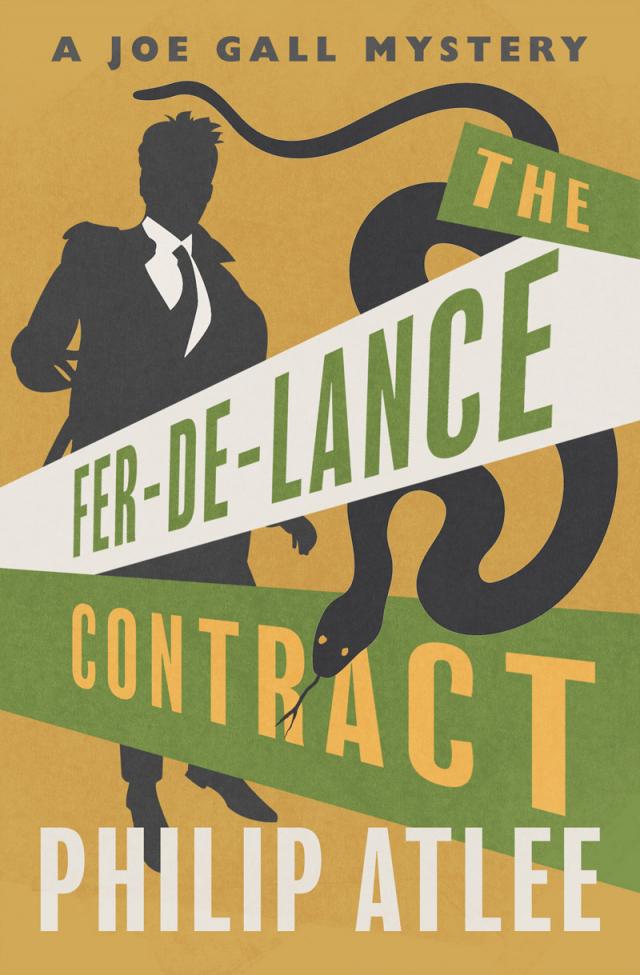
The Fer-De-Lance Contract
A Joe Gall Mystery
Philip Atlee
“The bright day is done
and we are for the dark …”
WILLIAM SHAKESPEARE
Chapter 1
The island of Antigua is a sunbaked poorhouse except for a few tropic beaches that have been appropriated by foreign millionaires and resort hotels with astronomical prices. Mercifully my plane from Kingston arrived at midnight and I was spared the sight of the seared acreage. I was not, however, spared the enthusiastic shearing given by Antiguan taxis, which are the most expensive in the Caribbean.
It was part of my cover that I had no reservation on Antigua and no continuing ticket out of it. British West Indian Airways had noted this lack, and made me sign a voucher for it, before I could board their big jet in Kingston. A few bored Americans and Canadians had deplaned with me but were whisked through customs and into chauffeured sedans. I was left alone with the black customs staff, and after I had snarled at a barefooted Negro boy who nearly dropped one of my bags, the dark official faces observed me impassively.
I looked the part. A big Yank with sunbleached hair, not bothered recently by a barber, wearing a garish sport shirt and Bermuda shorts. Add the look of a once-good heavyweight going to paunch, with a Polaroid 360 slung around his neck, and you’ve about got it. And, naturally, this American clod is short-tempered because it is still hot at midnight in the customs’ shed of Antigua’s Coolidge Field.
I dropped a few more surly remarks as the inspectors pawed through my luggage, and that made them open even the aspirin bottle. When the polite chief inspector asked how long I would be on the island, and where I was proceeding from it, I said I would stay as short a time as possible and that I had no continuing passage booked to anywhere.
“Why did you come then, sir?” he asked reasonably.
“Some friends said I should try the action at the Marmora Beach casino.”
He nodded. Marmora Beach had the only casino on the island. Its inn was operated by a large American chain, but all the personnel below manager and accountant were Antiguans. The casino was run under separate contract by some Italian types from Miami; Lansky was supposed to be the shotgun back of the operation. The customs inspector noted that I was carrying $5,000 U.S. in traveler’s checks, chalked my bags as passed, and observed in silence as I haggled with the most vociferous of the cab drivers, a fat black clown wearing a torn straw hat.
The price to Marmora Bay, he insisted, was $12 U.S. I replied with some heat that this was ridiculous, and we settled on $8. While we were hoisting my bags into his ramshackle car, I put the needle to him, too, and he stopped and walled the whites of his eyes. A barefoot old man drove a small donkey by us, walloping the tiny beast on with the flat side of a worn cutlass. As I got in beside the silent driver, I reflected that if I played my cards just right in Antigua, I might get my head sheared off by one of the sabrelike instruments.
It was nearly one in the morning before the cab pulled up before the luxury hotel. Even at that hour its terraces were blazing with lights. I got out of the car, watched my luggage unloaded, and tried for twenty minutes to get a U.S. $10 bank note changed, or a $20 American Express traveler’s check. The desk clerk was a sullen black youth, dressed neatly in black trousers, white shirt, and dark tie. He insisted that he had no change, either in U.S. money or Biwee (West Indian) dollars.
The fat lout of a cab driver was leaning over the desk beside me, smiling faintly.
“Look, Jack,” I said harshly, “I can hear the roulette wheels whirring and the slots being cranked in there. You can’t run that kind of shop without cash, can you?”
“I have no change, sir,” repeated the ebony lemur behind the hotel desk. Since the rooms started at $50 U.S. a day, I knew he was lying. I walked into the casino and located the pit boss, a small thug with a pockmarked face, named Sid. No, he could not furnish change; the hotel and casino were entirely different operations,
I nodded, went back to the hotel desk, and gave the sneering cab driver the $10 bank note. He departed without thanks, and I registered and was shown to a suite in the south wing. Each unit had its own air conditioning machine and terrace, and the bathrooms were enormous. When I asked the bellboy about room service, he said there was none, for either food or drink. He was just going off duty, in fact.
He shifted, unsmiling, from foot to foot, and I took pleasure in reminding him that because I had been unable to get change, his dash was out the window. He nodded and withdrew, a picture of dark dejection. I showered, dressed again, and went down to the dining room, which was on three levels. An ornate bar on one side and a bandstand on the other, with elaborate hanging lamps made of wicker amphoras.
A five-piece group in gaucho costumes were troubling the chilled air with a pounding beat. They were billed as Herman and The Mexicans, and a frenetic fat boy I took to be Herman was shouting lyrics and trying to organize an affair with the mike. Obviously untroubled by a score, he pranced around in erotic, pear-shaped glee. I ordered a Cutty Sark with soda, got one with ginger ale, procured a combination ham-and-cheese sandwich to take back to the room, and prowled the floodlit, poinsettia-spattered premises until I found an ice machine.
Thus secured against famine, thirst, and the hostile black population, I drank a pint of Mount Gay rum I had bought in Kingston and ate the sandwich. It was superb, and had a side order of souffléd potatoes. The air conditioning unit was of British manufacture and chilled the suite admirably. As I flaked out in the huge bed, I realized I would be able to play my nasal catarrh when I woke up.
I had breakfast on the windy terrace, gazing down across the sweep of crescent beach. It was fringed by cabbage palms (called in the brochure “Royal Palms”), thatch-roofed huts, and reclining lounges. To my left, below, was an open-sided bar, and just beyond it a black boy in shorts was oiling a whale-bellied tourist. His wife, also stout, was in a beach chair beside him, staring out to sea from under a feathered straw hat. In short, fake Polynesia.
The sand was grayish, but the water paled from light green in the shallows to emerald and indigo further out, and gentle waves creamed up and back across the beach. Beyond were only sun-seared hills bearing sparse vegetation.
The coffee was good, Blue Mountain from Jamaica, and I had two cups. Sipping, I meditated again on the frieze of sullen black faces I had encountered last night. I knew the faces were permanently set in that image, but my caustic remarks had not lightened them any. And the remarks had been deliberate. Coupled with this fact was another; the Federal Palm, one of two light cruise ships given to the Caribbean Islands by Canada, was due in Antigua this morning. She would be sailing for Montserrat at 2 P.M.
And I had to be on her for the continuing journey to Dominica, St. Lucia, Barbados, St. Vincent, and St. Sauteurs. In the last-named port, I might or might not get off; I would be notified if the agency wanted me to go on to Trinidad, the Federal Palm’s last and home port on the southern cruise that had begun in Jamaica.
The section of the agency that is in the counterspying business had contracted me to ferret out some dark fellows who were planning considerable Caribbean mischief. The chief among these connivers, I had been told, worked as assistant purser on the Federal Palm. His name was John Ratoon, and if the reports were true he had an ideal spot for such machinations. Every week he went up through the islands, from Trinidad to Jamaica, and the next week his ship worked back down again.
The mischief he was allegedly ramrodding was startling and imaginative. He and his cohorts, well-hidden on the various islands, planned to seize, on a date unknown to us but imminent, all transportation and communications facilities in the Caribbean Sea. All planes, cruise and freight ships, interisland schooners, and private yachts were to be boarded and taken simultaneously. All radio and cable installations were to be seized also, including radar and weather stations. The only islands to be excluded from this take-over were Haiti and Cuba.
The airlines affected would be Pan American, Delta, Braniff, British West Indian Airways, Air Jamaica, Lufthansa, KLM, SAS, Liat, and Caribair. The surface vessels of Cunard, Fyffes, United Fruit, Booth, Harrison, Saguenay, Geest, the two flagships of West Indian Shipping Service, Federal Palm and Federal Maple, and any other cruise ships or combination boats in Caribbean ports on the target date would be taken over.
At first the idea had seemed grandiose and even ridiculous. But after several months of patiently checking out reports, mostly from the agency’s in-depth plants through the islands, the higher echelons stopped smiling. Somebody was doing a hell of an organizational job.
There are over fifteen million blacks in the Caribbean Islands, and each of the lesser islands has a shaky and ineffective government with only a token constabulary. The proposed Federation fell apart several years ago. This is natural enough; these individual governments have not had time to educate officials or train armies. Even if they had had the time, they do not have the money. A complete paralysis of their transportation and communication facilities would cause a monstrous jam-up of their lame economies. Famine would be one immediate result.
And if the plotters also struck at Jamaica, Barbados, and Trinidad, large islands with modern economies and trained troops, that step would be headlined in every newspaper in the world and put implacable pressure on the British, Canadian, and American governments …
The trouble so far, the Black Power uprisings and invasions of Caribbean universities, had been minimal, limited mostly to Jamaica and Trinidad. But the ferment was spreading swiftly. One of the strangest aspects was a Jamaican sect called the Ras Tafarians. These odd characters were only marginally involved, but if a real break came they would rally to the barricades with confused enthusiasm.
The Ras Tafarians were unwashed hippie types sporting corkscrew curls and raffish beards. They lived, fittingly, in the Dunghill slum section of Kingston, were strong on smoking ganja, dreaming, and bombing other people’s property. They got their name from the title of Haile Selassie when he was crown prince, and viewed the Ethiopian emperor as divine and ageless. One of their tenets was that they could share his immortality by a pilgrimage to his kingdom.
This connection was hard to make, because the Ethiopians are Coptic Christians, and thus seemingly had little common ground with the Gullah adherents in the Jamaican slums. But there it was. Not long ago, a merchant vessel from Ghana had docked in Kingston, and Jamaican police had to cordon it off to prevent the unkempt Ras Tafarians from boarding her by force. They angrily proclaimed that the ship had been sent to take them on the first stage of their pilgrimage to Ethiopia.
The incident was ordure, of course, except that nothing is ordure if enough people believe it. Rebels in Guatemala had carried out the ritual murder of the West German ambassador, Count von Spreti. Insurgent forces had demonstrated in Guyana, and the Black Power firebrands in Port of Spain, Trinidad, had burned several Canadian branch banks and terrorized a Roman Catholic archbishop. Most exotic of the dissident elements was a band of fifteen miniskirted Colombian lasses who had broken jail and commandeered police machine guns and four Land Rovers in their dash to mountain freedom.
My job was to act as a provocateur, to create such a disturbance at the elegant Marmora Beach Inn that I would be forcibly deported, put on the Federal Palm that afternoon as a known racist and troublemaker. So I had a last sip of the good coffee and reflected that I might manage it, if I didn’t get killed in the convincing process.
I put on my bathing trunks, my fashionable blue terry cloth jacket with the wide patch pockets, and sauntered down to the swimming pool of the Marmora Beach. The poolside was crowded with bathers and servants. The news had gone abroad, and none of them glanced at me as I stalked by and staked out a place on the far side of the blue pool.
Chapter 2
The pool of the Marmora Beach Inn was white tiled, with blue water in it, on a terrace high above the sea. On the far side was a colonnaded area with metal tables and reclining chaises, and the seaside wall was made of glass panels, opened to let the breeze through. Beyond it, the variegated waters of the Caribbean Sea sparkled with incredible green shallows and blue depths.
I spread my towel on the far side of the poolside concrete, fetched a small metal table from under the colonnade, and as I put my cigarettes, lighter, and holder on it, counted the house. Close to fifty people, about half white, and I reflected that the black ones must be in on some kind of due bill. They were too young to stand the Marmora’s stiff tariff. A number of English couples, looking odd and aloof, trying to ignore the whole trying thing. I smiled grimly at that. Just hold the phone a sec, Your Lordship, I thought. Whitey is about to recover his dominance.
Several tables of heavily tanned breakfasters I made as yachtsmen and their wives from the Nicholson place in Nelson’s Harbor. At a number of others, screaming sport shirts announced the presence of the big butter-and-egg men from the Middle West, or a reasonable counterfeit, the wives having unbelievable brassy or dead-white coiffures. Eighteen-year-old hair framing fifty-year-old faces. Behind me and slightly to the right sat a massive black man surrounded by his fat wife and four carbon-copy children. Government minister, I tagged him, or professional man.
Sullen black boys like the ones who had put the boots to me last night stood around in their neat black pants, gleaming shoes, and white shirts, but when I tried to catch the attention of one of them he was always looking the other way. That was no problem; I cut loose with a two-fingered, ear-splitting whistle I had learned on the island of Gomera in the Canaries. They whistle news across mountains on that island.
The hum of breakfast conversation ceased. Black and white alike turned their stares on me, with only the yachtsmen laughing. When the sullen waiters did not move, I gave it to them again, an octave higher. That jarred some eardrums and brought one of the boys slouching over. I told him I wanted a double Cutty Sark on the rocks, and to keep his cotton-picking fingers out of it.
As he moved toward the bar, beyond the two arching palms with their fronds slatting in the breeze, I glanced toward the circular, unsided coffee shop just beyond, and at the lobby across from it. Several more hotel employees, all black, had moved into view and were looking toward the pool. The news was spreading; the offensive white cat in 223 was having a double, neat.
A large bundle of elegant rags came ambulating by me and took a chair in the sun close by. There was a meager figure inside the bundle, and after it had plumped into the chair and begun shedding some of its outer garments, it turned into an elderly English lady with skin like cured leather. Beady eyes stared at me, and the crone said, “G’moming, g’morning, lovely day izzn’tit?”
“Superb,” I admitted, and the apparition stood incompletely revealed in a bathing costume that must have come from a Victorian museum. It was a bathing costume, not a swimming suit, and its wearer looked like Beatrice Lillie after a long and debilitating illness.
“We shall have rain before noon, y’know,” the old lady announced, and I nodded respectfully. I do not know where they come from, these fustian old English females, but you encounter them all over the world. Alone, self-contained, and completely assured, they move decisively through the swarms of tourists and local residents, and I had often wondered if they were relicts of colonial servants, Sussex grandmothers visiting married daughters in far climes, or just what. Perhaps big, and wise, hotel managements employ them as shills, and shunt them about the world on a circuit, from Bali to Timbuktu.
My drink came, I signed for it, and under the covert gaze of the poolside and lobby watchers, slugged it down in one. The old British dame was sitting with her withered legs propped apart, and a spotless handkerchief draped over her head.
“Not quite the thing, young man,” she rebuked me, but without heat. “Far too early. I told Gerald that for thirty years.”
“Oh? Liver got him, eh?”
“Terrible thing,” she admitted. “He was in great pain at the end. Couldn’t hold wind or water, y’know.”
I nodded, distressed at the painful demise of Gerald, of whom I wot not, and uncoiled and went knifing into the pool. I did four laps in it, two with a faster crawl than they had ever seen, and another two with a thrashing backstroke that left the water churning. When I came eeling back over the edge and stretched out on my towel, the old lady spoke from under her kerchief.
“Fancy that! You looked so lumpish before. No telling about you Yanks.”
“Thank you,” I said. It was time for Phase Two, so I cut loose with the ear-splitting whistle again. The black boy was quicker off the mark this time, and I ordered another Cutty Sark double on the rocks. The black face withdrew, and over his shoulder I saw a white man in a business suit come out of the office beyond the hibiscus bushes. He was either the manager or the accountant; the hotel had only two white employees, both from stateside.
When the waiter came back with the drink, I managed to jab the small tray from underneath, and the glass with the ice cubes and Scotch fell off and smashed on the concrete. I counted three and began to curse him. The sound of my anger had no competition; it penetrated all the way to the front desk and the watching manager or accountant.
The young waiter stooped and began to rake the glass shards and ice cubes back onto his tray. I curtly ordered him to fetch me another drink, that I had no intention of paying for the one his stupidity had spilled. Kneeling, black skin taut over his Gullah cheekbones, he nodded, and went walking back toward the bar.
Not even the permissive yachtsmen were laughing now. The poolside had fallen silent, and most of the people gathered there were watching me without appearing to. I had gone from a diversion to an insistent pain-in-the-ass, and they felt that something would have to be done about me.


