

The Night Sheriff, page 1


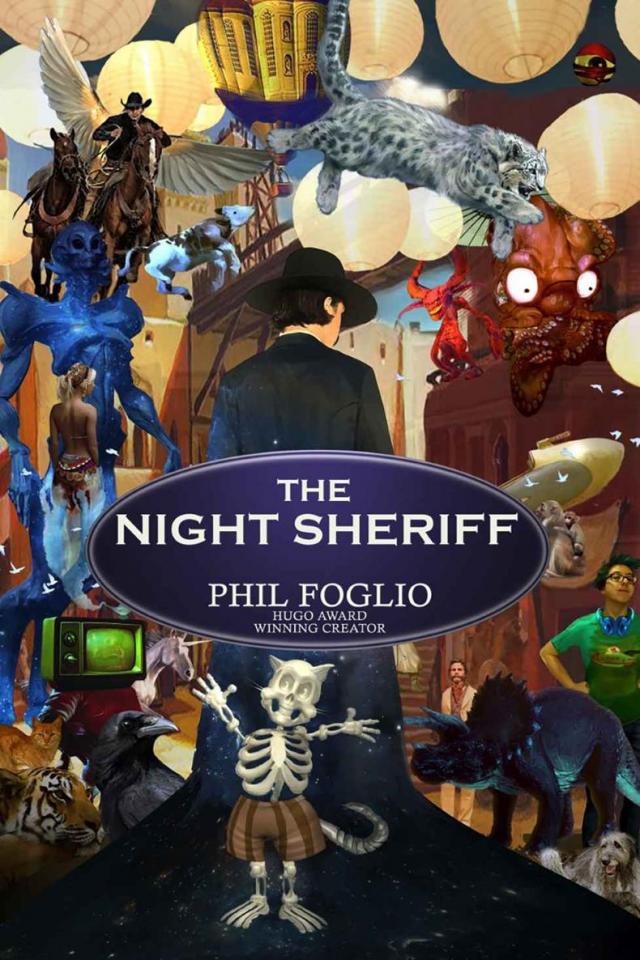
From the turreted castle and Main Street to Monte Cristo Island and Kukuanaland, Bartholomew Zenon’s Zenonland is protected by the Night Sheriff. Day and night, he is burdened by a witch’s curse to be aware of all that live and play within the massive fantasy theme park.
Now an attack on the park by a monster hunter, who knows far too much, threatens everything: guests, staff, and fellow supernaturals taking refuge in the park. The Night Sheriff must scramble to uncover not only the source of the threat, but secrets of the park of which even he was not aware.
If he doesn’t, he may be doomed, the park may be doomed, and even the world may be doomed.
… And that’s a lot of doom.
The Night Sheriff
PHIL FOGLIO
The Night Sheriff
Copyright © 2021 Phil Foglio
In Association with Prince of Cats Literary Productions
All rights reserved. No part of this book may be reproduced or transmitted in any form or by any electronic or mechanical means, including photocopying, recording or by any information storage and retrieval system, without the express written permission of the copyright holder, except where permitted by law. This novel is a work of fiction. Names, characters, places, and incidents are either the product of the author’s imagination, or, if real, used fictitiously.
Trade Paperback ISBN: 978-1-952825-44-6
Ebook ISBN: 978-1-952825-45-3
Cover Art copyright © 2021 Elizabeth Leggett, Portico Arts
Interior layout and design by Kind Composition
Prince of Cats Trade Paperback Edition 2021
Prince of Cats EBook Edition 2021
Published by Phil Foglio In Association with
Prince of Cats Literary Productions
New Jersey, USA 2021
Contents
Chapter 1
Chapter 2
Chapter 3
Chapter 4
Chapter 5
Chapter 6
Chapter 7
Chapter 8
Chapter 9
Chapter 10
Chapter 11
Chapter 12
About the Author
Other Titles From The Prince of Cats Literary Productions
Chapter One
I soar over my kingdom.
It’s early evening and the vast shield of the night sky lies above me. I miss the stars of my youth, the vast tapestries of patterned lights that wheeled down the seasons, the endless display of celestial majesty. There are stars visible, but they are a paltry remnant that makes mock of my memories. The moon is still there, of course. I think I would have gone mad if that ancient sentinel and nighttime companion had also been obscured by the enveloping vapors of this land’s machines.
As it is, I must concede that there are more of them these nights than there were even twenty years ago, a welcome trend, if it continues. The air is cleaner, though now I hear tell that it is the very glow of the city lights that work to obscure the heavens. If it isn’t one thing, it’s another.
Even after all this time, I will admit that the counterpane of lights below still causes an inrush of breath in wonder and delight at the beauty that humanity creates all too inadvertently, but these glowing confections, even with their dancing neon and sheets of LEDs, compare poorly to my no doubt jaundiced memories of the skies of yore. Call me a traditionalist.
Directly below me, the castle is lit with a particularly revolting chartreuse and pink lighting scheme. The surrounding streets and buildings are wreathed with several million lights, and hidden projectors shift colors to cheerful effect. The hidden speakers play a compositional hash of tunes, mixed and reengineered to bring a smile of memory to lips and a continuous current of energy to tired limbs.
The crowds below are clamorous and giddy with an excitement that even the most jaded of them are surprised to find still lurking within their breast. It is the time of night when even feet that have walked a league or more in fits and starts find themselves quickening as they head for a final rendezvous, jollied along by the strolling vendors selling balloons and glow sticks, assorted snacks and light-up toys.
More and more of our guests are beginning to line the central streets, staking out a tiny, impermanent claim, a temporary place of refuge against the crush of strangers, girt with insubstantial boundaries that hover scant inches away. Yet I have seen people defend these phantom territories more vigorously than they would their homes, even though, in an hour or so, these impermanent estates will dissipate into history without a second thought.
They gather to witness the nightly parade. You’d think these early defenders to be premature, considering that many of them begin settling as much as an hour before the first funambulist strides forth, but grim reality justifies their actions, as by the time the opening marching band strides down the boulevard, the seething crowd of watchers will easily be a dozen people deep, and many a tardy tot will have to be hoisted up on the shoulders of their sire to see the passing carnival in all its glory.
The shops lining the streets are beginning to see their final sales rush, though this early frenzy will be dwarfed by the mob that will descend upon them after the parade itself, as the people, energized by the procession of monsters and wonders that have pranced past them, belatedly realize that the time left to buy that last souvenir before they must depart is dwindling quickly.
The lights of the pavilions and the rides keep them from seeing me as I glide on by overhead. I swoop closer and taste their emotions. Youthful joy and excitement, with occasional dots of parental exasperation. Nothing untoward.
I sail past the bronze statue of Bartholomew Zenon, the man responsible for it all, his hand companionably slung about the shoulder of Preston Platypus, the company’s world-famous mascot. Even now, visitors are draping themselves over the statues, getting photographed one final time before they leave for the evening. I sniff deeply, tasting the winds, and leave the center of the park behind me. Like the moon pulling the tides, the incipient parade’s gravity has reached out to the park’s extremes, beguiling guests towards the heart of my kingdom, leaving the outer reaches quieter, reserved for those who care not for parades or crowds, as well as the assorted vendors who remain to tend to their needs and desires.
I enjoy this, sailing alone above it all, but I’m feeling a bit peckish. I settle down atop the mountain the Awesome Avalanche ride bursts forth from, and even as I allow my own weight to manifest, I feel the all-too-familiar figure of Bone Cat coalescing upon my shoulder.
“Took you long enough,” the familiar voice mutters in my ear. I reach up and stroke the cartoonishly absurd earbones atop his head. He drapes himself across my shoulders with a purr reminiscent of an idling chainsaw. He’s happy tonight.
Below us, the periodic bursts of terror as the riders see the drop before them are an adequate snack, but I’m in the mood for heartier fare. I settle down, and fold into myself so that anyone actually looking would just think me another faux rocky outcrop. I allow my senses to spread, seeping throughout this corner of my kingdom like a questing, invisible fog. It’s a weekday, so the crowds are slightly smaller. Early summer, so the night is warm, not that it ever really gets cold in Southern California, not cold like it used to get back home.
Occasionally I miss the cold. Real cold, the kind that used to come with the winds that screamed down off the mountains in the dead of winter, sending the peasants huddling up against their fires, their livestock, and each other for comfort and warmth. I liked the way the cold felt. The physical sensation. It made my skin tighten, and I felt more sleek and—I guess the modern word would be aerodynamic. Silly, really. But as someone who appreciates the subtly different types of fear that people are capable of generating, I will confess that the fear of the cold was a seasonal favorite. It was so primal. Ah well, different days, different ways.
Who else is back here, walking the dark paths? There are still those visitors, young and old, who are simply questing towards the next ride. This is a special time for them. The park is emptier, the lines are shorter, and their own exuberance adds to the experience of others like them, multiplying the effect and filling the very air with a sense of adventure.
Strolling amongst them are people moving at a more sedate pace. They are not here for the rides, or the souvenirs. I recognize many of them. Older couples. More interested in each other than in yet another spectacle. The myriad of lights and the exotic foliage is merely a backdrop to the quiet magic and excitement they have brought with them. People who have come to the park because it is a park. A few acres of grass and trees, ponds and romantic lamp-lighted darkness far from the cares and concerns of the surrounding city that might as well be across the salty sea. A familiar, safe, and comfortable place inhabited by sleepy birds, recorded crickets, and animatronic animals. Keeping it that way is why I’m here.
A child is crying. A quick sharpening of focus and I can ignore it. Simply another tyke stuffed full of sugar and over-stimulated by wonders, being dragged towards the entrance by determined parents. I sigh; another section perhaps—
Suddenly I feel claws prick my shoulder. “Death is abroad tonight,” Bone Cat whispers.
I hate it when he does that. He claims that Death is, in fact, an anthropomorphic entity that he can actually see, even though I cannot. Now, while I can attest that the supernatural world overlays the mundane, and that there are additional layers of reality that are unperceived by the majority of people, I still find it disquieting that there may be further levels that even I
I allow myself to tumble backwards, unfurling myself into the air, and take an immature pleasure in my companion’s yowl of annoyance as he fades away. To the North. Let’s see … there’s Monte Cristo Island, the Lost Temple, Kukuanaland, the Happiness Machine—
And there it is. In the back. Away from the great ever-changing clock and the crowds waiting for the boats. The service door used by park personnel is hanging open. That is very much against company policy. I swoop down and see that the lock has been broken. A moment later I’m in the anteroom, Bone Cat again upon my shoulder. Even back here the ever-playing music hammers at my ears. I consider taking one of the microphone-equipped headsets hanging from the rack, but I need to stay flexible. Unnoticed by most people is a small tube hanging from the ceiling. I blow into it and then speak clearly, “There is an intruder inside.” I glance at Bone Cat, who nods. “I have reason to believe that he or she is dangerous.”
Less than thirty seconds later, a small green person with an immense nose and an intricately knotted beard pops out of a small door. Automatically my hand grips the nape of Bone Cat’s neck. There is no time for his usual foolishness. This is Punch-Press, a senior gremlin. We bow to one another. “Old Tool,” he greets me with his usual grin. Gremlins are a cheerful bunch, as a rule. Bone Cat sniggers even though that’s been my name amongst the gremlins for fifty years. Partially because that is the sort of name that the gremlins themselves have, but mostly, I believe, because they cannot manage to pronounce my real one, and gremlins hate to do something incorrectly.
He opens a larger door, and we head into the backstage area of the ride. “Found your guy. He’s in Asia.” Ah. Towards the center of the ride. Punch-Press continues, “There is something seriously wrong with him.”
Terrific. “Shut down the ride at once. Put up the ‘Repairs’ sign.”
“Oh, we closed it down as soon as he started goin’ nuts.” I didn’t like the sound of that. Gremlins have a great deal of pride, and even the intimation that that they have allowed the machinery to go out of kilter would be regarded as a slap in the face. To do so voluntarily underlines that they regard the situation as serious. The gremlins are still smarting from the bad reputation they were saddled with during the Second World War.
Gremlins started out as an admittedly mischievous, but mechanically proficient clan of kobolds or some such living deep within the Harz Mountains of northern Germany. They had been known to the locals for several centuries, and there was a working détente between the two races, one that had actually showed signs of thawing as the creatures became more and more intrigued by the complicated mechanical marvels that humanity was beginning to cobble into existence.
They had actually aided the Germans during the First World War, but it had been a strictly mercenary arrangement. They never cared about nebulous things like sociopolitical conflicts. But carburetors, now that was a thing a gremlin could understand (and improve).
But it meant that they were in the German records when the Nazis took over, and all too soon they were forcibly conscripted. Their caverns were captured, and they were moved en masse to laboratories and workshops.
Even then, the Nazis could have pulled it off. Put a gremlin in a well-stocked workshop and keep him fueled with beer and sour milk and they’ll do anything you want. But Nazis do not seem capable of letting someone do something just because they actually enjoy it. They bullied and threatened them, tortured their young and their elders, and cut them off from their beer.
Stepping back here, I will concede that Germans, even Nazis, take beer pretty seriously, and the stuff that the Gremlins brew up can only be called “beer” because the science of brewing reluctantly concedes that certain processes produce substances that, technically, must be called beer. At least, that was the case back then. I think today you could legitimately classify it as biohazardous industrial waste. It is entirely possible that when they destroyed the Gremlins’ ancient brewing equipment, the Nazis believed they were doing them a favor.
What they actually did was open a third front in the war against Germany. The Gremlins managed to escape and began sabotaging the Nazi war machine. All well and good, but as I mentioned earlier, they really had no grasp of the finer details of human tribalism, and so, all too soon, they had spread from Europe to England and from there to the Americas, where they continued their depredations against mankind’s machinery in a very egalitarian fashion.
It wasn’t until after the end of the war that people like Mr. Mortimer and myself could spare the time to deal with them. By that time, of course, they had settled into their new homes, and discovered that there were benefits to living in places full of machinery, as opposed to mountain caves. Luckily, it was rather easy to turn them from sabotage to more creative pursuits. Allowing them to rebuild their terrible brewing machines was a major step, and many of these are now spread throughout the technological infrastructure of the world.
However, machinery changes. Perhaps you’ve noticed public clocks in your city that no longer function. Why don’t people repair them? The answer is because ever since the early 1950s, people had never had to. Each clock, every public fountain, every children’s science museum once housed a family of gremlins who kept things working, all for a few bottles of milk, the cost of which was tucked away in a nebulous part of some institutional or civic budget.
But today’s younger gremlins are more interested in the new machinery. Satellites, the internet, and self-driving auto-mobiles are the snares that catch a young gremlin’s fancy. The older ones, the ones that grew up on simpler, more primitive machinery, such as clock towers, railroads, and air traffic control systems, are dying off, or at least retiring to more hospitable climes—such as theme parks in southern California. Say what you will about the rides here, very few of them employ what you would call cutting-edge technology. All the more reason why the gremlins here will bristle at the intimation that they have allowed the ride to break down. But it is the quickest option. The music, of course, has not stopped, but I can already hear a rising susurrus of noise from outside, as hundreds of guests are informed that they have stood in line for the last hour to no avail.
We arrive at the observation point for the Asia Room. Someone has been here, and no mistake. Brightly costumed dolls continue to dance and sing, but someone has cut a swath of destruction through the heart of them. Dolls have been smashed and mangled, tossed aside and battered even as they continue to move, juddering and sparking as they try to perform their eternal routines. The effect is quite alarming.
I hear a small sob, which allows me to find the real people amongst the false. The girl is young, maybe eight, dressed in a space princess costume possibly purchased this very day. “He snagged the girl out of a boat,” Punch-Press muttered. “She was sitting by herself in the back, and I don’t think the people in the front even noticed.” Her parents will certainly have noticed when the boat exited without her.
The man is maybe twelve years older. Dressed in a somber outfit covered by a bulky coat that I would have thought too warm for the mild California night. He is kneeling in what looks to be prayer. Even from where I am, I can feel the emotions pouring off them. The girl is terrified. She is also in actual physical pain, and I now see that she is handcuffed to the man, who has closed the cuff too tight upon her slender wrist.
“That’s him,” Bone Cat whispers. For once he is deadly serious. “Death is poised behind them both.”
I can believe this. The man is clearly on edge. His emotions are complicated, and, it is obvious to me, chemically enhanced. I taste fear, of course, but there is also a great anticipation, which I do not like at all. I have been a hunter of men, among other things, for a very long time, and this fellow here is acting different. Now after a thousand years, you’d think different would be good, and if it was just the two of us, I might be in a better mood to savor the peculiarity of the situation. But the little girl changes everything. The prayer thing is throwing me off. It tells me that there is an element of religion here, and that can be tricky, because logic may no longer apply.


