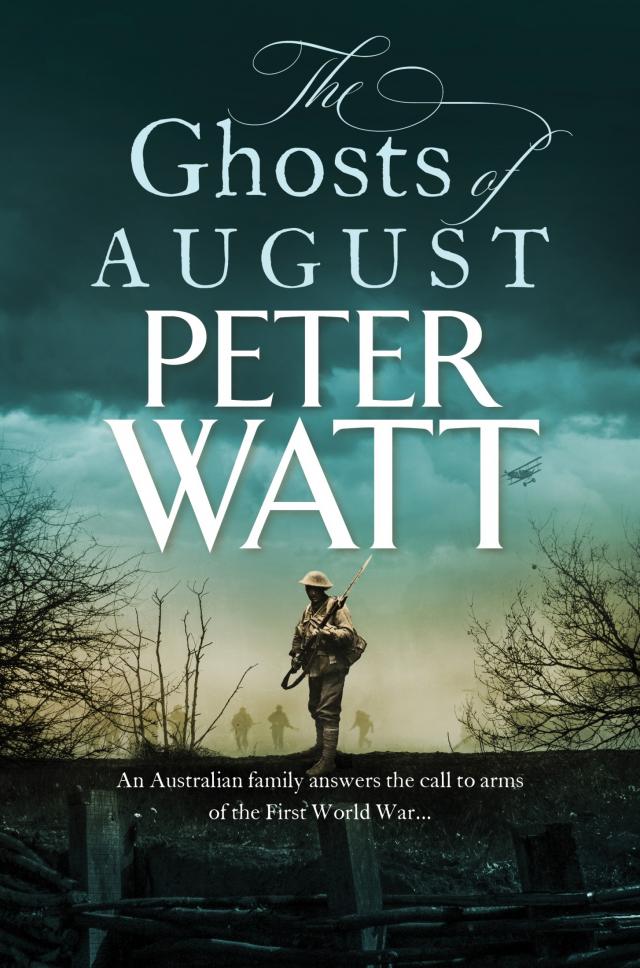
The Ghosts of August, page 21


They lapsed into a conversation about matters far from France, of family affairs and life in Sydney, and for a good half-hour, they sat together as if the war did not exist. Then a medical orderly hurried towards them from the hospital.
‘Sir, we need you immediately,’ he said to Maurice. ‘One of the lads has taken a turn.’
Maurice stubbed out his fourth cigarette and stood up, extending his hand to David. ‘With any luck we might get the chance to have a drink together in the mess, old chap.’
David rose, tossing aside his own cigarette. ‘It will be my shout,’ he said. ‘Good luck, Morrie, and I will immediately write home to say that we are together over here. I am sure it will be welcome news for them all.’
Maurice followed the medical orderly back into the hospital, leaving David to ponder with some trepidation the rumour his brother-in-law had passed on: that they had yet to face a battle possibly on a scale as terrible as that suffered by the British on the Somme and by the French at Verdun.
*
For Ben the desert war settled into a routine of scattering whenever a German aeroplane arrived to bomb and strafe them, and being put on stand to with the intelligence that the Turkish army, supported by Germans and Austrians, were moving south towards them in considerable numbers. So far there had been no real clashes with the enemy. The frustration of the command to stand down rankled Ben’s squadron as they listened at night to the howls of the desert wild dogs punctuated by the distant booming sound of Turkish artillery, rifles and machine guns as sister regiments engaged the advancing Turkish soldiers mounted on camels and on foot.
Ben had heard that the enemy comprised the finest of the Turkish army: the big men of the Anatolian regiments who his regiment had also faced at Gallipoli. Jacko – as Ben and his men called the Turks – was almost a term of endearment for their old enemy as the Turkish soldiers’ courage could not be questioned. They were also fine soldiers.
Ben was asleep when he felt his shoulder being shaken. He came awake to focus on the face of his troop officer leaning over him. Lieutenant George Martin-Smith was well liked and respected by the men in the squadron and had been granted the fond nickname of ‘Bluey’ because of his very red hair.
‘Sergeant Steele, get your troop together if you want to see some action,’ the lieutenant said quietly.
‘Boss?’ Ben asked, rubbing away the last remnants of his dream of being on Manly Beach in Sydney with a pretty girl.
‘We have been given permission to ride out now and reconnoitre Turkish positions. I am only taking you and five of the lads from your section, and I have to confess that it is a risky mission. I will leave it to you to select which men we take.’
‘No worries, boss,’ Ben replied as he sat up in the crystal-clear chilly night air, lit only by the blaze of the endless panorama of stars. ‘I know the boys who will jump at the opportunity to see some real action, and I would also like to include Corporal Ford.’
‘If he is your choice then do so,’ the officer replied. ‘Half an hour before we mount up. Report to the squadron HQ when you are ready.’
The lieutenant slipped back into the inky night and Ben made his way to where his men were bunked down in the sands. Moving at night was now a very familiar practice for Ben and he soon located the men he wanted for the mission.
‘Jeez, Sarge, when the others find out what we are up to, they are goin’ to be pissed orf that they weren’t included,’ one of the selected light horsemen said. Ben didn’t express his own thoughts that if they were to advance into enemy territory and were detected, cut off from any realistic help from the regiment, this could be a suicide mission. But at least it was the chance to see some action.
When Ben found Corporal Ken Ford snoring a short distance away from the sleeping section, he woke him with the news and thought for a terrified second that the big corporal might kiss him for the chance to participate in the mission.
Within the half-hour the section assembled at squadron HQ. Extra provisions of the detested hard biscuits and cans of bully beef were issued, as well as extra water canteens, and they prepared their horses.
Before first light the small section rode away from the regiment to travel deep into the vastness of the Sinai, where the Turkish army had assembled an impressive force to push the infidels into the Suez Canal.
*
Ben’s patrol arrived at a low ridge of sand and stone before sunrise and quickly settled in to observe the arid plains to their front, while the horses were hobbled behind them with a supply of grain and water.
For the first day they took turns with the set of binoculars, straining to see through the shimmering haze that lay over the baking dunes and plain below. Three men would keep a lookout just at the edge of the ridge while the others rested on the reverse slope before rotating roles.
Ben had finished cleaning his rifle to remove excess sand and opened a tin of bully beef, which had turned into an almost soup-like state that was far more attractive to the flies that swarmed in dark clouds around the opened tin than it was to him. Ben was careful not to swallow any of the sticky flies and took a sip of water from his canteen to wash down the near-melted processed meat.
‘Hey, Ben, look what I found!’ It was Corporal Ford who approached, holding something. ‘Saw it when I was out digging a hole for my constitutional.’
Ben sat up to see the big corporal holding what appeared to be a shard of ancient pottery.
‘What you think?’
Ben accepted the shard and examined it. All he could surmise was that it was clay hardened in a fire.
‘Probably one of my ancestors dropped it when they were on the Exodus from Egypt,’ Ben said with a serious expression.
‘Fair dinkum!’ Ken Ford exclaimed, and then saw the grin on Ben’s face.
‘I don’t know. It could be anything from Egyptian to Roman for all I know. This place has been tramped over by just about every Mediterranean army since the pyramids were built, as well as being the home of my Jewish ancestors. Since we can’t drop it into the nearest museum, you may as well hoist it.’
‘I’m keepin’ it,’ Ken said, taking back the pottery shard. ‘It might be worth something when we get to Jerusalem.’
Jerusalem . . . the word held meaning to Ben. It featured so strongly in his religious learnings, and he realised that it was a place that they might eventually capture. Ben had never been particularly religious, but the mention of a place sacred to his Christian friends and Turkish enemy alike echoed in his thoughts. It would be as if the Christian Crusaders had returned after the many centuries since the city had fallen to the Islamic empire. What would that mean to history?
He watched as Corporal Ford made his way to the ridge, assuming his observer role on the high ground and leaving Ben to ponder the piece of pottery and Jerusalem. He had loved reading as a child, and had read a lot of stories written by authorities on the Biblical lands. He reflected that in this moment he belonged to yet another invading army up against the thousand-year-old Moslem Ottoman Empire in its decline. He was also aware of the Zionist organisation that hinted at this rugged land once again becoming the home of all scattered and displaced Jews from around the world, a place where they could escape the persecution they had suffered for centuries in European lands from England to Russia. He also remembered how even in Australia there was a distinct coldness by the upper echelons of European descent towards those of the Jewish faith. Ben had learned that his squadron knew of his faith, but none seemed to care. All that mattered to them was that he performed his duties as their troop sergeant competently.
‘Sergeant Steele. Up here!’
The command had come from Lieutenant Martin-Smith, and Ben scrambled to his feet, recognising the urgency in the other man’s voice. When Ben reached the edge of the ridge, he could already see the long line of dust on the horizon, indicating a very large force of mounted troops. The officer passed Ben the binoculars.
‘Jacko,’ Ben said. ‘And a bloody lot of them, probably only a couple of miles away and coming in our direction.’
‘I think it is time to head back to the regiment and report what we have observed,’ the officer said, marking on a map the approximate location of the enemy force and direction of their advance.
‘Boss!’ The startled cry came from a trooper positioned further along the ridge. Lieutenant Martin-Smith looked where the trooper was pointing. The well-educated young officer, reared in a staunchly religious Christian family who partook of neither alcohol nor cigarettes, used an obscene word none of his troopers had ever heard him utter before.
To their left and right flanks, they could see Turkish scouting patrols mounted on camels. The Turkish army had wisely sent troops forward to either side of the advancing main body.
Ben scrambled to his feet, realising that the flanking Turkish scouts would investigate any high ground in the advance of the main body of their troops, and they would quickly be spotted and surrounded.
‘We ride as if the devil is chasing us,’ the lieutenant said to the small party of men who were already hefting saddles to fling on their horses’ backs. Scrambling down the slope, Ben snatched his saddle and all the troopers quickly reached their mounts, saddled up and took off the hobbles.
Ben swung himself into the saddle, noticing that the flanking enemy patrols were already galloping in their direction. It was now horse against camel in a death race rearward across the arid plain. The crack of bullets in the air around them indicated they were within rifle range, but Ben hoped that the pursuing camels would be wearier than their rested mounts.
They galloped in an uneven line with the patrol commander riding only a few yards from Ben, bent low over his tough mount’s neck, making him a smaller target for the pursuing Turkish cameleers who were now around four hundred yards behind them, but Ben had been correct in his estimation. The camels were falling behind and the sporadic rifle fire was also tapering off.
‘Bloody hell! Bluey is down!’ The cry came from Corporal Ford, and as he spoke Ben saw out of the corner of his eye that the patrol commander’s horse had tumbled, flinging the lieutenant into the sand.
Ben immediately pulled hard to bring his mount around, yelling to the rest of the fleeing party to keep going.
Ben flung himself from his saddle, kneeling beside the officer who he could see was alive but severely winded from the heavy impact with the hard surface. A few yards away the officer’s horse whinnied in pain, and Ben could see that it had a broken leg. Ben did not have to think but quickly aimed and fired his rifle at the critically wounded horse. The bullet brought almost instant merciful death to the doomed animal.
Quickly grabbing the officer by the shoulders, he dragged him to his feet just as sand spurted nearby. With a sick feeling in his stomach, Ben could see the rapidly approaching Turkish patrol of around ten mounted soldiers now only a couple of hundred yards away, their rifle fire now more accurate.
Suddenly a fusillade of shots came from the opposite direction and Ben saw that the fleeing Australians had stopped, dismounted, and from a kneeling position were providing covering fire to aid Ben’s escape.
Ben hefted the lieutenant onto his own horse’s rump and threw himself into the saddle. Ben’s mount hardly needed an order to gallop forward towards the men already remounting their own horses for the escape, leaving the pursuing Turkish scouts in their wake.
*
Exhausted horses in desperate need of water – with weary men in the saddles – arrived at the regiment a couple of hours later, with no fatal casualties and one very grateful patrol officer. Ben knew that it had been Corporal Ken Ford who had ordered the rearguard action, and that he really owed his life to this action, but before thanking him Ben knew that his first duty was to his horse who had carried both him and the lieutenant to safety.
After looking after his mount, he was summoned to meet with Lieutenant Martin-Smith.
‘Sergeant Steele, I am recommending you for a decoration for your courageous action of saving me today,’ he said. ‘Had you not stopped to assist me I strongly suspect we would not be having this conversation.’
Ben was impressed by the offer but quickly countered, ‘Boss, if it had not been for the quick actions of Corporal Ford, neither of us would be around to have this conversation, so I think Corporal Ford is the one you should be recommending for any gongs. It would mean a lot to his family.’
George Martin-Smith was taken aback by Ben’s counteroffer but could see in the light horseman’s expression that it was a conviction he held strongly.
‘Very well, Sergeant Steele,’ George Martin-Smith replied. ‘Your recommendation is a selfless act deserving of consideration when I write up my report on today’s action. It is possible I can compensate you for that in the future.’ The officer held out his hand to Ben. ‘My word on that.’
Ben took his commander’s hand firmly. ‘Thanks, boss,’ he said. ‘One never knows when one might have to call in a favour from friends.’
Ben did not realise that one day this promise would change his life forever.
TWENTY-SIX
The time had arrived for the Australian divisions to engage in a major military operation on the French battlefields of the Western Front.
Maurice had been right in his instinct that something big was being planned, and David found himself attending briefings and working closely with the company sergeant major to ensure that supplies were delivered to the men of the company, which left his friend and commander, Major Saul Goldstein, free to plan the tasks of each of his platoons in the upcoming attack on the German front lines – and beyond.
From what David had been told in the battalion briefings, the attack on the German lines was meant as a feint to prevent German reinforcements from reaching the British army on the Somme. An Australian division alongside a British division were to seize around 4,000 yards of German frontlines centred around a feature known as the ‘Sugar Loaf’. It would be the usual tactic of their artillery shelling the German lines prior to advancing infantry across no-man’s-land, with the infantry using rifle, bayonet, grenades and the Lewis guns in support. All was scheduled for 19 July, using the long daylight hours of midsummer to assist in seeing their enemy.
On the afternoon of the day of the planned assault, David moved among the platoons, occasionally discussing issues with the young platoon commanders, and felt just a little despondent that he would not be leading a section of men as he had done as a platoon commander with his old battalion.
For a brief moment on this fateful day, David had a rare opportunity to be alone, and decided to scribble a letter to his parents before reassuming his role as company second-in-command. With his back to an ammunition crate he sat, pencil poised over a sheet of paper resting on his map board, his hands trembling uncontrollably and his stomach fluttering. David knew that the old fear had returned, but tried to reassure himself that the British artillery landing their deadly explosive shells on the German lines would help their attack. He had grown used to the constant crump crump of artillery in the background, and made an attempt to write, but his trembling hand prevented him from doing so. He sighed, folded the blank sheet and sat back to light a cigarette, which helped soothe his shattered nerves. How much more can I take? David asked himself. Just get through this stunt, he thought, and for a moment remembered Naomi. What would she be doing right now in London? He knew that despite everything, he still loved her, and the memories of those peaceful moments in the countryside flooded back in a warm wave, temporarily taking him out of the war.
‘Sir, Major Goldstein requests your presence.’
It was the voice of the company sergeant major, a professional soldier in his mid-forties.
‘Coming, Sarn’t Major,’ David said, rising to his feet and following the senior non-commissioned officer until they found Saul surrounded by his platoon commanders, providing last-minute briefings on their allocated tasks in the assault. When he had finished, he dismissed them and turned to David.
‘Do you realise that a century and one year ago, Wellington fought Napoleon just north of here in Belgium, defeating him and bringing a hundred years of relative peace to Europe, with the help of the Germans? I can’t get over the irony that here we are today, facing the Hun who were once instrumental in bringing that long peace, and fighting alongside the one-time enemy of all Europe, the French.’ Saul stared off into the distance in the direction of the German lines.
‘A bit philosophical for this moment in history, old chap,’ David said with a slight smile. ‘A century is a long time.’
Saul turned to David, retrieving a silver flask from his trouser pocket. ‘We’ve had little chance to catch up since you arrived, so I feel it is time to share a drink.’ He passed the flask to David, who held it up. ‘Chin chin,’ he said, taking a long swig and recognising the taste of gin, then he handed it back to Saul who responded with, ‘Good luck to us today, because it is only luck that keeps us alive.’ He drank too, then returned the flask to his pocket.
‘Now, I need you to move with Mr Plymin’s platoon when we hop the bags, and that will put you on the left flank of our formation in the assault. It seems that we are almost ready to step off, so keep your head down and we will get together again over there in the German trenches.’
Saul held out his hand and the two men shook before David made his way to his assigned position in the assembly area.
Unfortunately, the Australians were unaware that the Germans had been warned of the coming attack on their trenches by the pre-assault artillery bombardments, and their artillery observers were in a position to bring down their own artillery on the Australian and British assembly areas. All hell spewed down from the deadly German artillery on the helpless troops crouching in their formations ready to attack.