The Ghosts of August, page 1
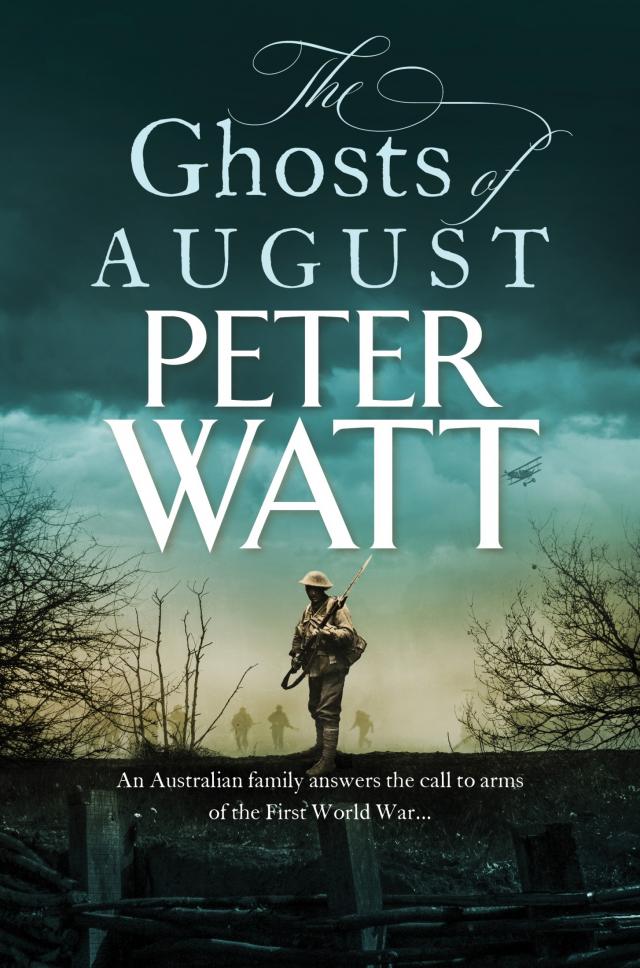


About The Ghosts of August
It is 1914, and the storm clouds of war are building on the horizon.
In Sydney, Josiah Steele is the new head of the family and grappling with his two very different sons – David, upstanding, decent and heir to the family enterprises; and Benjamin, wayward, restless and a magnet for trouble. To give Ben some responsibility, Josiah sends him on a trade mission straight into the territory of their soon-to-be enemy.
As war erupts across Europe, its repercussions are felt in the Pacific. Ben and David find themselves caught up in the first Australian action of World War I – the fight to take possession of German New Guinea.
But that is only the start. The brothers will see desperate action across Egypt, Palestine and the terrible killing fields of the Western Front, where the years of war, mud and bloody battlegrounds will forever change the Steele family . . .
Also by Peter Watt
The Duffy/Macintosh Series
Cry of the Curlew
Shadow of the Osprey
Flight of the Eagle
To Chase the Storm
To Touch the Clouds
To Ride the Wind
Beyond the Horizon
War Clouds Gather
And Fire Falls
Beneath a Rising Sun
While the Moon Burns
From the Stars Above
The Papua Series
Papua
Eden
The Pacific
The Silent Frontier
The Stone Dragon
The Frozen Circle
The Colonial Series
The Queen’s Colonial
The Queen’s Tiger
The Queen’s Captain
The Colonial’s Son
Call of Empire
Excerpts from emails sent to Peter Watt
‘Had to drop a quick note. Reading Cry of the Curlew again and just had to tell you it’s evidence that you are a superb writer/author. You are still at the top of my list. Again thanks for how you weave and blend love, hate, mysticism, tension and other emotions into an addictive work!’
‘G’day Peter, I have just finished your book Call of Empire. Reading your book was an excellent way to relax. Thanks for the excellent read.’
‘Hi Cobber, I have never been so hooked on a book as with your books so please keep the Australian stories going.’
‘G’day Peter, I have just about finished reading Call of Empire and I felt inspired to write to you. I don’t normally read fiction! As an (amateur) historian, I prefer to deal with facts and therefore generally read non-fiction, but I have to say, I am enthralled! Great work, Peter, and all the best for your future efforts.’
‘Love all your books, what’s next? I’ve run out!’
‘Peter, reading the Frontier series again, I fully realise just how superb an author you are. Everyone I’ve loaned, described or recommended your books to agrees and does so with enthusiasm and excitement. Alas the poor unfortunate who loves to read and has missed your books!’
‘Really enjoyed this [Colonial] series. I am just wondering if you intend to write another one. Hopefully so!’
Contents
Cover
About The Ghosts of August
Also by Peter Watt
Excerpts from emails sent to Peter Watt
Title page
Contents
Dedication
Maps
Prologue
Part One
One
Two
Three
Four
Five
Six
Seven
Eight
Part Two
Nine
Ten
Eleven
Twelve
Thirteen
Fourteen
Fifteen
Sixteen
Part Three
Seventeen
Eighteen
Nineteen
Twenty
Twenty-One
Twenty-Two
Twenty-Three
Twenty-Four
Twenty-Five
Twenty-Six
Twenty-Seven
Twenty-Eight
Twenty-Nine
Thirty
Thirty-One
Thirty-Two
Thirty-Three
Thirty-Four
Thirty-Five
Thirty-Six
Part Four
Thirty-Seven
Thirty-Eight
Thirty-Nine
Forty
Epilogue
Author’s Note
Acknowledgements
About Peter Watt
End Ads
Copyright page
Newsletter
For my beloved wife, Naomi
Prologue
New Year’s Eve, 1913
Josiah Steele sat alone in the library of his mansion overlooking Sydney Harbour.
By his hand was a glass of single malt Scotch. The dim light of the electric chandelier illuminated the face of a man in his mid-fifties, a man who had seen much of life in military campaigns from Afghanistan to Africa many years earlier in service to the Queen. The creases at the edges of his eyes were those of someone who had stared into the vastness of those arid lands.
Outside his great double-storeyed house with its manicured gardens, Josiah could hear the distant sounds of revelry: boat horns bleated on the harbour below and the cheers of drunken revellers drifted up from the streets of his leafy suburb. He glanced at the face of the grandfather clock as it chimed midnight and raised his glass to the night sky outside the open window. Josiah fervently hoped that 1914 would prove a better year than those just past.
Tragedy had dogged his family in recent months, with the death of his beloved sister-in-law, Rosemary, wife of his younger brother, Samuel, in early 1913. She had been such a vibrant and beautiful woman, so active in furthering the social causes of women, that she had seemed invulnerable. What had appeared to be a summer cold had quickly developed into pneumonia and she had died in Samuel’s arms. Josiah saw that the death of Rosemary had ripped the heart and soul out of his younger brother. Completely devastated and still grieving, Sam had set sail in the family schooner, the Ella, for ports in the South Pacific on Steele company business, leaving behind his children, ten-year-old Georgette and nine-year-old Saul. Both children were in the care of a nanny Josiah had employed.
Josiah knew his younger brother loved his children, but the death of Rosemary had broken him, and Josiah understood that Sam needed time to mourn in his own way. The Ella had been a possession that had provided so many wonderful memories for Sam and Rosemary as they had sailed the Pacific in their first couple of years of marriage. Both of Sam’s children had been conceived on the schooner. Josiah knew that his brother needed time to accept the loss of his wife and that he would eventually return home to his family and children.
The family was scattered; Josiah’s beloved sister, Rebecca, was married to a German aristocrat, Duke Maximillian von Kellermann, and lived on their vast estate in Bavaria where Josiah’s son, David, a young man in his late twenties, was currently visiting his best friend, Hermann – von Kellermann’s son by his first marriage.
Josiah’s other son, Benjamin, still lived in Sydney. However, to Josiah’s consternation, despite being only a year younger than David, Ben lived a rootless life. He had attempted to take on a job with the family enterprises but was obviously bored with the clerical position. Josiah anguished over his younger son’s future.
Josiah’s daughters, Judith and Rose, were now in their mid-twenties. Both were happily married with children and living in Sydney. Josiah reflected on the fact that all his family members had drawn closer to the practice of their Jewish religion – except his sons who, although they dutifully attended their synagogue, tended to stray on matters of a kosher diet and did not always observe the Sabbath. But his daughters were more spiritual, and both had married successful Jewish men and adhered to the traditional ways of their strong faith.
Josiah felt guilty that he was not a stricter observer of the old ways himself, but he had through his life found himself with a foot in the two worlds of Judaism and Christianity. His own father had been a Catholic, although in name more than in deed. Such was the nature of Australian culture, Josiah mused. His wife, Marian, was also a Christian, but had always encouraged her children to practise their Jewish faith.
Josiah raised his glass to the open window once again and muttered, ‘To 1914 – may it bring peace and happiness to my family.’ He took a long sip of his Scotch and sighed.
*
Samuel Steele moaned and sweated on his bunk under a mosquito net erected inside his tent. Malaria had him in its grip once again. Although Sam’s camp was deep in the rainforest on the western-most edge of the range of rugged hills of the Markham Valley of German New Guinea, the hiss of a lantern was the only sound he could hear. Malaria meant his gold prospecting venture was on a temporary hold.
‘Sam, we need to pack it in and return to the coast.’ The voice of Sam’s friend Nate Welsh broke through the gentle noise of the dim lantern sitting on a wooden crate beside Sam’s field cot. ‘We haven’t had any luck
Sam was in his late forties and the man kneeling beside him was of a similar age. Nate, a native of New Zealand, had served alongside Sam in the Transvaal during the Boer War fourteen years earlier, which was where Sam had lost his leg at the battle of Elands River. The bonds forged in war had united them as brothers. Nate’s own brother, Brendan, was on the Ella anchored off the mouth of the Markham River east of the valley. Brendan had also fought at Elands River. The three men were a well-known trio in the waters of German New Guinea.
‘They sure the Kukus are skulking around?’ Sam asked in a hoarse voice as Nate raised a canvas water bag to his friend’s lips.
‘Pretty bloody sure,’ Nate answered, knowing the well-earned fierce reputation of the small but stocky warriors of the inland tribes. ‘By the way, happy new year.’
‘Might explain the silence around us,’ Sam said, struggling to sit up while reaching for the Lee Enfield .303 rifle by his bed. ‘I think you’re right; it might be time to head for the coast, but we will wait for first light before we make a move.’
‘You sure you’re okay to trek out of the hills?’ Nate asked, his concern apparent. ‘I notice your leg has been playing up a bit lately.’ Nate nodded towards Sam’s artificial leg which connected below the knee.
‘I’ll be okay,’ Sam replied, placing the rifle over his shoulder, fully loaded and ready for use.
Nate nodded and rose to his feet, leaving the water bag beside Sam. ‘I will be keeping watch with our head boy. The sun should be up in about three hours, and then we will break camp.’
Sam fell back against the damp pillow. His whole body was bathed in sweat, but the fever appeared to be dissipating – along with the fevered dreams of death that had accompanied it.
But when the sun rose over the rainforest giants that shadowed the world beneath, the vast canopy was suddenly rent by the war cries of the dreaded native warriors, who unleashed a shower of arrows down on the tiny camp in the clearing. Sam and Nate were once again fighting for their lives, pouring a volley of high-velocity rifle rounds into the surrounding forest. Aside from his rifle, Sam was also armed with an American Browning semi-automatic pistol on his hip as a last resort in case he had no time to reload the rifle.
This was not the first time that Nate and Sam had faced the Kukukuku warriors. In a previous clash a few weeks earlier they had killed three of them for the loss of two of their own native porters. These were savage lands, but they were also a frontier made attractive by the promise of gold, even though the source was yet to be discovered. German and Australian prospectors vied with each other over an unmapped territorial boundary across the centre of the island, with its raging rivers and rugged, almost impenetrable tropical rainforests. Once they had retreated out of the mountains, Sam knew they would reach the broad Markham Valley with its tall kunai grass plains, and beyond that the mouth of the river and the relative safety of their schooner.
Then, as suddenly as it had started, the rain of arrows ceased and the warriors surrounding them fell back under the cover of the thick rainforest foliage. Taking a quick head count, Sam saw that none of the five native porters had been injured, but he and Nate knew it was time to retreat to the Ella and reassess their gold prospecting expedition into this wild, mysterious land that was under the control of the German government.
Part One
January–August 1914
The Storm Gathers Over the Pacific
ONE
April 1914
Archibald Stokes was a civil servant working for the Australian Department of Defence, and at twenty-five years of age he was already prematurely balding. Always clean-shaven and humourless, he made no secret of the fact that he harboured dreams of climbing the civil service ladder as a career public servant, which was why he was now wondering why he had been delegated the task of examining a cabinet full of files left by Sir Douglas Wade, who had died peacefully in his sleep a fortnight earlier.
Archibald knew that Sir Douglas had been a shadowy high-ranking civil servant in the new federal government. There had been rumours in the stuffy offices of the federal bureaucracy that Wade, who had never married, had had little time for a social life, so dedicated was he to shielding the new nation from any possible foreign enemies. Sadly, many of Wade’s colleagues had dismissed his warnings that one day Australians might face a war, given the tense conditions in Europe over the past year. Perhaps the worsening situation was the reason a directive had been made for a civil servant from the department to retrieve a file sent to the Australian government some short time after Federation.
Archibald retrieved the file in question from the wooden cabinet, aware of its title: An Outline of Possible Imperial German Threat in the Indian and Pacific Oceans. The public servant sat down at a desk, opened the folder and adjusted his spectacles. It was midmorning, and he could hear others of the small staff chatting as they took morning tea in the adjoining office, which had a single window overlooking the streets of Sydney. Beyond their chatter, he could just make out the sounds of horse-drawn wagons and flimsy automobiles moving along the narrow streets below.
Inside the folder were a jumble of papers. The top sheet contained typed copy by Sir Douglas, along with his signature. The report summarised his concern that the Pacific German fleet operating out of China and also Rabaul might pose a serious threat to Australia in the event that war became a reality between the British and German empires. Archibald scanned the document and nodded his head in agreement with the former head of the obscure information-gathering department. He shared the belief that the close proximity of the Germans in the Pacific might pose a problem if war broke out in Europe.
Archibald turned to the next sheet of paper, which appeared to be a covering letter attached to a thick pile of documents. He raised his eyebrows when he saw the signature at the bottom of the covering sheet. It was simply a single letter in green ink: C.
Archibald took a breath when he recognised that the covering report was a recommendation from the head of the British Secret Service Bureau of the Admiralty War Office in London. It was the signature of the eccentric naval captain Mansfield Smith-Cumming, whose reputation was well known to the Australian government. He was a driven man who collected information to be converted to intelligence. Archibald had heard rumours that the British naval intelligence officer and Sir Douglas Wade had become personal friends after the late knight’s numerous visits to London.
Archibald turned his attention to the thick pile of papers beneath this letter. They comprised a translation of a strategic German report that had fallen into British hands years earlier outlining that, in the event of war between Britain and Germany, the German navy should attack and bombard Australia’s eastern coastal cities, and land troops at Gladstone to seize its highly graded coal supplies. There was a similar strategy for neighbouring New Zealand. No doubt an attack along these lines would be devastating to the coastal towns – major centres of population – located along Australia’s east coast. Archibald also knew that such an attack would force a significant part of the British navy to steam from European waters, thus weakening its ability to defend Britain as well as stymie any known strategy to blockade German ports.
Archibald leaned back in his chair and considered the international state of affairs. He knew trouble was brewing in the Balkans and that Turkey had been involved in fighting in Bulgaria. There had been a military coup in Turkey by what the newspapers called the ‘young Turks’ the previous year, but Archibald did not consider the Turks to be any threat to British interests. It had also been reported that Serbians were slaughtering unarmed Moslems in the Balkans. The year 1913 had even seen strife on the border between the United States of America and Mexico, where American troops had clashed with and killed Mexican army troops. The dawn of 1914 had seen Ulster in Ireland on the brink of civil war in Britain’s backyard. Reports from London were troubling; most European nations appeared to be arming for what was considered a coming war on the continent.
It was no wonder Sir Douglas Wade’s report had suddenly raised interest in the Department of Defence, Archibald mused as he closed the file. But for now, it was time to join his staff and indulge in a cup of tea in the staffroom.