Sister Fidelma 03 - Suffer Little Children, page 1
part #3 of Sister Fidelma Series


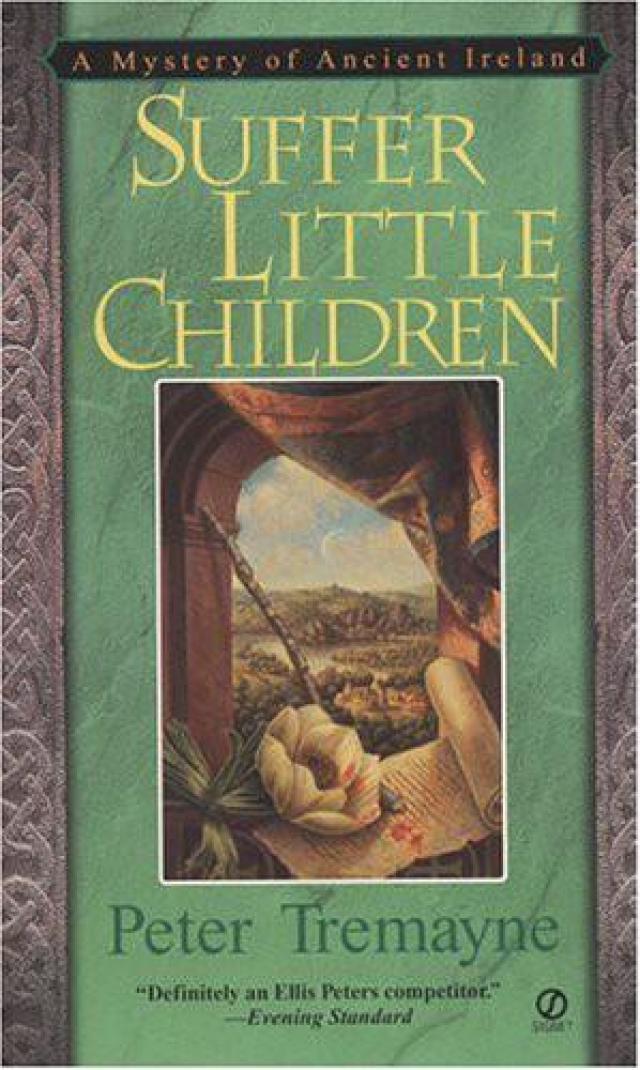
Suffer Little Children
Peter Tremayne
A SISTER FIDELMA MYSTERY
For my old and very good friend Christopher Lowder— thanks to Arnold Bennett and The Six Towns Magazine
Suffer the little children to come unto me, and forbid them not…
—Matthew, 10:14
Fear them not therefore: for there is nothing concealed that shall not be revealed; and nothing hidden that shall not be known.
—Matthew, 10:26
Historical Note
The Sister Fidelma mysteries are set during the mid-seventh century a.d.
Sister Fidelma is not simply a religieuse, a member of the community of St. Brigid of Kildare. She is also a qualified dálaigh, or advocate of the ancient law courts of Ireland. As this background will not be familiar to many readers, this foreword provides a few essential points of reference designed to make the stories more readily appreciated.
Ireland, in the seventh century a.d., consisted of five main provincial kingdoms: Indeed, the modern Irish word for a province is still cuige, literally "a fifth." Four provincial kings—of Ulaidh (Ulster), of Connacht, of Muman (Munster) and of Laigin (Leinster)—gave their allegiance to the Ard Ri or High King, who ruled from Tara, in the "royal" fifth province of Midhe (Meath), which means the "middle province." Even among these provincial kingdoms, there was a decentralization of power to petty-kingdoms and clan territories.
The law of primogeniture, the inheritance by the eldest son or daughter, was an alien concept in Ireland. Kingship, from the lowliest clan chieftain to the High King, was only partially hereditary and mainly electoral. Each ruler had to prove himself or herself worthy of office and was elected by the derbfhine of their family— three generations gathered in conclave. If a ruler did not pursue the commonwealth of the people, they were impeached and removed from office. Therefore the monarchical system of ancient Ireland had more in common with a modern-day republic than with the feudal monarchies of medieval Europe.
Ireland, in the seventh century a.d., was governed by a system of sophisticated laws called the Laws of the Fènechas, or land-tillers, which became more popularly known as the Brehon Laws, deriving from the word breitheamh—a judge. Tradition has it that these laws were first gathered in 714 b.c. by the order of the High King, Ollamh Fodhla. But it was in ad. 438 that the High King, Laoghaire, appointed a commission of nine learned people to study, revise, and commit the laws to the new writing in Latin characters. One of those serving on the commission was Patrick, eventually to become patron saint of Ireland. After three years, the commission produced a written text of the laws, the first known codification.
The first complete surviving texts of the ancient laws of Ireland are preserved in an eleventh-century manuscript book. It was not until the seventeenth century that the English colonial administration in Ireland finally suppressed the use of the Brehon Law system. To even possess a copy of the law books was punishable, often by death or transportation.
The law system was not static and every three years at the Féis Temhrach (Festival of Tara) the lawyers and administrators gathered to consider and revise the laws in the light of changing society and its needs.
Under these laws, women occupied a unique place. The Irish laws gave more rights and protection to women than any other western law code at that time or since. Women could, and did, aspire to all offices and professions as the coequal with men. They could be political leaders, command their people in battle as warriors, be physicians, local magistrates, poets, artisans, lawyers, and judges. We know the name of many female judges of Fidelma's period—Brig Briugaid, Àine Ingine Iugaire and Dari among many others. Dari, for example, was not only a judge but the author of a noted law text written in the sixth century a.d. Women were protected by the laws against sexual harassment; against discrimination; from rape; they had the right of divorce on equal terms from their husbands with equitable separation laws and could demand part of their husband's property as a divorce settlement; they had the right of inheritance of personal property and the right of sickness benefits.
Seen from today's perspective, the Brehon Laws provided for an almost feminist paradise.
This background, and its strong contrast with Ireland's neighbors, should be understood to appreciate Fidelma's role in these stories.
Fidelma was born at Cashel, capital of the kingdom of Muman (Munster) in southwest Ireland, in ad. 636. She was the youngest daughter of Failbe Fland, the king, who died the year after her birth, and was raised under the guidance of a distant cousin, Abbot Laisran of Durrow. When she reached the "Age of Choice" (fourteen years), she went to study at the bardic school of the Brehon Morann of Tara, as many other young Irish girls did. Eight years of study resulted in Fidelma obtaining the degree of Anruth, only one degree below the highest offered at either bardic or ecclesiastical universities in ancient Ireland. The highest degree was ollamh, still the modern Irish word for a professor. Fidelma's studies were in law, both in the criminal code of the Senchus Mòr and the civil code of the Leabhar Acaill. She therefore became a dálaigh or advocate of the courts.
Her role could be likened to a modern Scottish sheriff-substitute, whose job is to gather and assess the evidence, independent of the police, to see if there is a case to be answered. The modern French juge d'instruction holds a similar role.
In those days, most of the professional or intellectual classes were members of the new Christian religious houses, just as, in previous centuries, all members of professions and intellectuals were Druids. Fidelma became a member of the religious community of Kildare founded in the late fifth century A.D. by St. Brigid.
While the seventh century a.d. was considered part of the European "Dark Ages," for Ireland it was a period of "Golden Enlightenment." Students from every corner of Europe flocked to Irish universities to receive their education including the sons of the Anglo-Saxon kings. For example, Aldfrith, who became king of Northumbria from a.d. 685-705, was educated at Bangor and achieved a reputation in Ireland as a poet in the Irish language. Three of his poems still survive in ancient texts. At the great ecclesiastical university of Durrow, at this time, it
is recorded that no fewer than eighteen different nations were represented among the students. At the same time, Irish male and female missionaries were setting out to reconvert a pagan Europe to Christianity, establishing churches, monasteries, and centers of learning throughout Europe as far east as Kiev, in the Ukraine; as far north as the Faroes; and as far south as Taranto in southern Italy. Ireland was a by-word for literacy and learning.
However, the Celtic Church of Ireland was in constant dispute with Rome on matters of liturgy and ritual. Rome had begun to reform itself in the fourth century, changing its dating of Easter and aspects of its liturgy. The Celtic Church and the Eastern Orthodox Church refused to follow Rome, but the Celtic Church was gradually absorbed by Rome between the ninth and eleventh centuries while the Eastern Orthodox Churches have continued to remain independent of Rome. The Celtic Church of Ireland, during Fidelma's time, was much concerned with this conflict.
One thing that marked both the Celtic Church and Rome in the seventh century was that the concept of celibacy was not universal. While there were always ascetics in both churches who sublimated physical love in a dedication to the deity, it was not until the Council of Nicea in a.d. 325 that clerical marriages were condemned but not banned. The concept of celibacy in the Roman Church arose from the customs practiced by the pagan priestesses of Vesta and the priests of Diana. By the fifth century Rome had forbidden clerics from the rank of abbot and bishop to sleep with their wives and, shortly after, even to marry at all. The general clergy were discouraged from marrying by Rome but not forbidden to do so. Indeed, it was not until the reforming papacy of Leo IX (a.d. 1049-1054) that a serious attempt was made to force the western clergy to accept universal celibacy. In the Eastern Orthodox Church, priests below the rank of abbot and bishop have retained their right to marry until this day.
The condemnation of the "sin of the flesh" remained alien to the Celtic Church for a long time after Rome's attitude became a dogma. In Fidelma's world, both sexes inhabited abbeys and monastic foundations which were known as conhospitae, or double houses, where men and women lived raising their children in Christ's service.
Fidelma's own house of St. Brigid of Kildare was one such community of both sexes in Fidelma's time. When Brigid established her community at Kildare (Cill-Dara = the church of oaks) she invited a bishop named Conlaed to join her. Her first biography, written in a.d. 650, in Fidelma's time, was written by a monk of Kildare named Cogitosus, who makes it clear that it was a mixed community.
It should also be pointed out that, showing women's coequal role with men, women were priests of the Celtic Church at this time. Brigid herself was ordained a bishop by Patrick's nephew, Mel, and her case was not unique. Rome actually wrote a protest in the sixth century at the Celtic practice of allowing women to celebrate the divine sacrifice of Mass.
To help readers locate themselves in Fidelma's Ireland of the seventh century, where its geo-political divisions will be mainly unfamiliar, I have provided a sketch map and, to help them more readily identify personal names, a list of principal characters is also given.
I have generally refused to use anachronistic place names for obvious reasons although I have bowed to a few modern usages, e.g.: Tara, rather than Teamhair; and Cashel, rather than Caiseal Muman; and Armagh in place of Ard Macha. However, I have cleaved to the name of Muman rather than the prolepsis form "Munster" when the Norse stadr (place) was added to the Irish name Muman in the ninth century a.d. and eventually anglicized. Similarly, I have maintained the original Laigin, rather than the anglicized form of Laiginstadr which is now Leinster.
Armed with this background knowledge, we may now enter Fidelma's world. This story is placed in the year a.d. 665.
Principal Characters
Sister Fidelma of Kildare, a dálaigh or advocate of the law courts of seventh-century Ireland
Cass, a member of the King of Cashel's bodyguard
Cathal, the dying King of Cashel
Colgu, the tánaiste or heir-apparent of Cashel, and Fidelma's brother
At Rae na Serine
Intat, a bó-aire or local magistrate of the Corco Loigde
Sister Eisten, caring for orphans
Cétach and Cosrach, young brothers
Cera and Ciar, young sisters
Tressach, an orphan boy
At the abbey of Ros Ailithir
Abbot Brocc, a cousin of Fidelma
Brother Conghus, the aistreóir or doorkeeper
Brother Rumann, the fer-tighis or steward of the abbey
Brother Midach, the chief physician
Brother Tola, the assistant physician
Brother Martan, the apothecary
Sister Grella, the librarian
Brother Sègán, the fer-leginn or chief professor
Sister Necht, a novice and assistant hostel keeper
Men of the Corco Loigde
Salbach, chieftain of the Corco Loigde
Scandlán, his cousin and petty king of Osraige
Ross, captain of a coastal barc or sailing vessel
Men of the kingdom of Laigin
The Venerable Dacán, the deceased
Fianamail, the king of Laigin
Forbassach, his Brehon or judge
Abbot Noé brother of the Venerable Dacán; abbot of Fearna and advisor to Fianamail
Mugrón, captain of a Laigin warship
Midnat, a Laigin sailor
Assid of the Uí Dego, a merchant and sea captain from Laigin
At Sceilig Mhichil
Father Mel, father superior of monastery of Sceilig Mhichil
Brother Febal, a monk
At Molua's House
Brother Molua, who runs an orphanage
Sister Aibnat, his wife
At the Great Assembly Sechnassach, King of Ireland
Barrán, the Chief Brehon of Ireland
Ultan, Archbishop of Armagh, Chief Apostle of the Faith
Chapter One
The storm broke with sudden violence. The white flash of lightning heralded a crash of angry thunder. A moment later the rain began to fall in heavy, icy droplets.
The horse and rider had just emerged from the shelter of a forest and halted on a ridge overlooking a broad, low level plain. The rider was a woman, clad in a long, brown woollen cloak and hood, thick and warm, wrapping her body against the late autumnal chill. She turned her gaze to the sky, unafraid of the frenzy of the tempest. The clouds were dark gray, rolling close to the ground and obscuring the distant mountain tops like a mist. Here and there, against this background, were patches of darker, scudding clouds, black and ominous, bringing the threatening thunder with them.
The woman blinked as the cold rain splattered against her face; it was chilly to the point of being painful. Her face was youthful, attractive without being pretty, and with rebellious strands of red hair streaking from under the hood of her cloak across her broad forehead. There was a faint hint of freckles on the pale skin. The eyes seemed momentarily gray, reflecting the color of the somber skies, yet when the lightning flashed there was a hint of green fire in them. She sat her horse with a youthful agility, her tall figure firmly in control of the restless animal. A closer examination would have revealed the silver crucifix hung around her neck and the habit of a religieuse hidden by the heavy riding cloak and hood.
Sister Fidelma, of the community of the Blessed Brigid of Kildare, had been expecting the approach of the storm for some hours now and was not surprised by its apparent sudden eruption. The signs had been there for a while. She had observed the closed pine cones on the trees, the withdrawn petals of the daisies and dandelions and the swelling stems of the meadow trefoil, as she rode along. All spoke of the coming rain to her keen, observing eye. Even the last of the swallows, preparing to disappear from the skies of Eireann for the winter months, had been keeping close to the ground; a sure indication of the tempest to come. If further indications were necessary, as she had been passing a woodsman's cabin, in the forest behind her, she had seen the smoke of the cabin fire descending instead of spiraling upward; descending and causing small eddies around the building before dispersing into the cold air. Smoke behaving in such a manner, she knew from experience, was invariably an indication of rains to come.
She was fully prepared for the storm, though not its ferocity. As she halted a moment or two, she wondered whether to return into the forest and seek shelter there until the gusting rains had abated. But she was only a few miles from her destination and the urgency of the message she had received, to come with all speed, made her dig her heels into the sides of her horse and urge it forward down the track leading onto the great plain toward the distant hill that was just visible in spite of the driving rain and darkness of the sky.
This spectacular mound was her objective; a large outcrop of limestone rock rising over two hundred feet to dominate the plain in every direction. It rose in precipitous fashion and now and then the lightning would silhouette it. Fidelma found a constriction in her throat as she gazed on its familiar contours. She could see the fortified buildings which commanded the natural stronghold—Cashel, seat of the kings of Muman, the largest of the five kingdoms of Eireann. It was the place of her birth and her childhood.
As she rode forward, head bowed into the teeth of the wild, gusty wind, which drove the soaking rain at her, she felt a curious mixture of emotions. She felt an excited pleasure at the idea of seeing her brother, Colgu, after several years of absence but she also experienced anxiety as to why he should have sent her a message requesting her to leave her community at Kildare and hasten to Cashel as a matter of urgency.
All through her journey, questions assailed her mind, even though she could not possibly answer them. She had rebuked herself several times for wasting time and emotional energy on the matter. Fidelma had been raised in an old discipline. She found herself remembering the advice of her former master, the Brehon Morann of Tara: "Do not place eggs on the table before you have visited the hen." It was no use worrying about the answer to the problem before she knew the questions that she must ask.
Instead, she tried to clear her mind of such worries and sought refuge in the art of the dercad, the act of meditation, by which countless generations of Irish mystics had achieved the state of sitchain or peace, calming extraneous thought and mental irritations. She was a regular practitioner of this ancient art in times of stress although some members of the Faith, such as Ultan, the archbishop of Armagh, denounced its usage as a pagan art because it had been practiced by the Druids. Even the Blessed Patrick himself, a Briton who had been prominent in establishing the Faith in the five kingdoms two centuries before, had expressly forbade some of the meditative arts of self-enlightenment. However, the dercad, while frowned upon, was not yet forbidden. It was a means of relaxing and calming the riot of thoughts within a troubled mind.
In such fashion did her journey through the blustery rains, with the continuous crash of thunder and flashes of white lightning, draw Fidelma nearer to the fortress of the kings of Muman. She reached the edge of the township almost before she realized it.