

Peter the Great's African, page 1


alexander pushkin (1799–1837) was born in Moscow and brought up mainly by tutors and governesses. One of his great-grandfathers, Abram Gannibal, was an African slave who became a favorite and the godson of Peter the Great. Like many aristocrats, Pushkin learned Russian mainly from household serfs.
As an adolescent, he attended the new elite lyceum at Tsarskoye Selo, outside St. Petersburg. In his early twenties he was exiled because of his political verse, first to the Caucasus, then to Odessa, then to his mother’s estate in the north. Several of his friends took part in the failed 1825 Decembrist revolt, but Pushkin did not—possibly because his friends wished to protect him, possibly because they did not trust him to keep the plot secret. In 1826 Pushkin was allowed to return to St. Petersburg. During his last years he suffered many humiliations, including serious debts and worries about the fidelity of his young wife, Natalya Goncharova. In 1837 he was fatally wounded in a duel with Baron Georges d’Anthès, the Dutch ambassador’s adopted son, who was said to be having an affair with Natalya.
Pushkin’s position in Russian literature can best be compared with that of Goethe in Germany. Not only is he Russia’s greatest poet; he is also the author of the first major works in a variety of genres. As well as his masterpieces—the verse novel Eugene Onegin and the narrative poem The Bronze Horseman—Pushkin wrote one of the first important Russian dramas, Boris Godunov; one of the finest of all Russian short stories, “The Queen of Spades”; and the first great Russian prose novel, The Captain’s Daughter (published as an NYRB Classic). His prose style is clear and succinct; he wrote that “Precision and brevity are the most important qualities of prose. Prose demands thoughts and more thoughts—without thoughts, dazzling expressions serve no purpose.”
robert chandler’s translations from Russian include Alexander Pushkin’s The Captain’s Daughter; Nikolay Leskov’s Lady Macbeth of Mtsensk; Vasily Grossman’s An Armenian Sketchbook, Everything Flows, Stalingrad, Life and Fate, and The Road (all NYRB classics); and Hamid Ismailov’s Central Asian novel, The Railway. His co-translations of Andrey Platonov have won prizes both in the UK and in the United States. He is the editor and main translator of Russian Short Stories from Pushkin to Buida and Russian Magic Tales from Pushkin to Platonov. Together with Boris Dralyuk and Irina Mashinski he co-edited The Penguin Book of Russian Poetry. He also translated selections of Sappho and Apollinaire. As well as running regular translation workshops in London and teaching at an annual literary translation summer school, he works as a mentor at the British Centre for Literary Translation.
elizabeth chandler is a co-translator, with her husband, of Pushkin’s The Captain’s Daughter; of Vasily Grossman’s Stalingrad, Everything Flows, An Armenian Sketchbook, and The Road; and of several works by Andrey Platonov.
boris dralyuk is the editor in chief of the Los Angeles Review of Books; translator of Isaac Babel, Maxim Osipov, Mikhail Zoshchenko, and others; and author of My Hollywood and Other Poems.
PETER THE GREAT’S AFRICAN
Experiments in Prose
ALEXANDER PUSHKIN
Translated from the Russian by
ROBERT and ELIZABETH CHANDLER
and
BORIS DRALYUK
NEW YORK REVIEW BOOKS
New York
THIS IS A NEW YORK REVIEW BOOK
PUBLISHED BY THE NEW YORK REVIEW OF BOOKS
435 Hudson Street, New York, NY 10014
www.nyrb.com
English translation of “The History of the Village of Goriukhino,” “Dubrovsky,” and “The Egyptian Nights” © 2022 by Robert Chandler
English translation of “Peter the Great’s African” © 2022 by Boris Dralyuk and Robert Chandler
Preface, notes, and afterword © 2022 by Robert Chandler
All rights reserved.
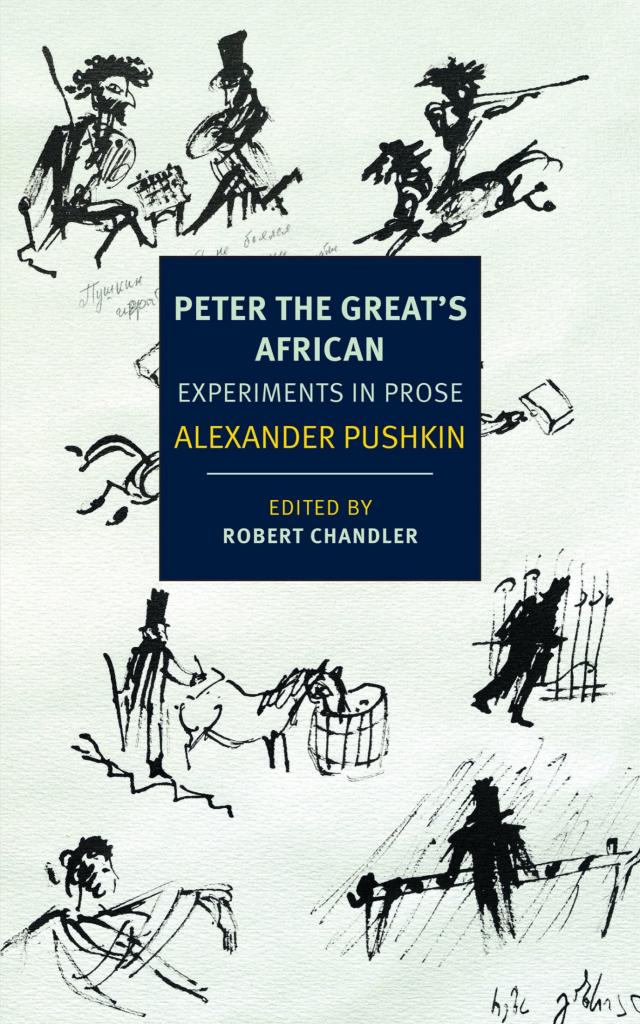
Cover image: Revaz Gabriadze, from the Alexander Pushkin series, 1991; courtesy of the Gabriadze Foundation; photograph National Pushkin Museum
Cover design: Katy Homans
The publication was effected in part under the auspices of the Mikhail Prokhorov Foundation TRANSCRIPT Programme to Support Translations of Russian Literature
Library of Congress Cataloging-in-Publication Data
Names: Pushkin, Aleksandr Sergeevich, 1799–1837, author. | Chandler, Robert, 1953– translator. | Chandler, Elizabeth, 1947– translator. | Dralyuk, Boris, translator. | Pushkin, Aleksandr Sergeevich, 1799–1837. Arap Petra Velikogo. English | Pushkin, Aleksandr Sergeevich, 1799–1837. Istorii ͡ a sela Gor ͡iukhina. English | Pushkin, Aleksandr Sergeevich, 1799–1837. Dubrovskiĭ. English | Pushkin, Aleksandr Sergeevich, 1799–1837. Egipetskie nochi. English
Title: Peter the Great’s African : experiments in prose / by Alexander Pushkin; translated by Robert Chandler & Elizabeth Chandler and Boris Dralyuk.
Description: New York: New York Review Books, [2022] | Series: New York Review Books classics
Identifiers: LCCN 2021012396 (print) | LCCN 2021012397 (ebook) | ISBN 9781681375991 (paperback) | ISBN 9781681376004 (ebook)
Subjects: LCSH: Pushkin, Aleksandr Sergeevich, 1799–1837—Translations into English. | LCGFT: Novels.
Classification: LCC PG3347.A2 C47 2021 (print) | LCC PG3347.A2 (ebook) | DDC 891.73/3—dc23
LC record available at https://lccn.loc.gov/2021012396
LC ebook record available at https://lccn.loc.gov/2021012397
ISBN 978-1-68137-600-4
v1.0
For a complete list of titles, visit www.nyrb.com
CONTENTS
Cover
Biographical Notes
Title Page
Copyright and More Information
Preface
Peter the Great’s African
The History of the Village of Goriukhino
Dubrovsky
The Egyptian Nights
Afterword
Note on Russian Names
Further Reading
Acknowledgments
Notes
PREFACE
Born in Moscow, Alexander Sergeyevich Pushkin was brought up mainly by tutors and governesses. One of his great-grandfathers, Abram Gannibal (ca. 1696–1781), was an African slave who became a favorite and godson of Peter the Great’s. Like many aristocratic children of his time, Pushkin learned Russian from household serfs; until the Napoleonic Wars, the aristocracy still spoke French rather than Russian.
In his early twenties, because of his political poems, Pushkin was exiled—first to the south of Russia, then to Mikhailovskoye, his mother’s family’s estate in the north. Several of his friends took part in the Decembrist Revolt of 1825, but Pushkin did not—perhaps simply because his friends considered him dangerously indiscreet. In 1826 Pushkin returned to St. Petersburg, with Tsar Nicholas I, promising him that he would no longer need to submit his work to the censorship; instead, he himself would be his censor. During his last years Pushkin suffered many humiliations, including serious debts and worries about the fidelity of his young wife, Natalya Goncharova. He was fatally wounded in a duel with Baron Georges d’Anthès, the Dutch ambassador’s adopted son, who was rumored to be having an affair with Natalya.
Pushkin’s importance in Russian literature is still greater than that of Shakespeare and Dante in their respective national literatures. He perhaps has more in common with Goethe. Not only is he Russia’s greatest poet, but he is also the author of foundational works in many different genres. As well as his masterpieces—the verse novel Eugene Onegin and the narrative poem The Bronze Horseman—Pushkin wrote one of the first important Russian dramas, Boris Godunov; the first major Russian historical novel, The Captain’s Daughter; and one of the greatest of all Russian short stories, “The Queen of Spades.”
Russians of all political persuasions and artistic schools have always seen Pushkin as the embodiment of something uniquely precious. Few people have written better about him than the dissident writer and scholar Andrey Sinyavsky. In Strolls with Pushkin (a high-spirited book composed in the late 1960s, in a labor camp, and sent out in installments in letters to his wife), he declares,
Pushkin is the golden mean of Russian literature. Having kicked Russian literature headlong into the future, he [ . . . ] now plays in it the role of an eternally flowering past to which it returns in order to become younger. The moment a new talent appears, there we see Pushkin with his prompts and crib notes—and generations to come, decades from now, will again find Pushkin standing behind them. If we take ourselves back in thought to far-off times, to the sources of our native tongue, there too we will find Pushkin—further back still, earlier still, on the eve of the first chronicles and songs. An archaic smile plays on his lips.1
Pushkin is nearly always referred to as a poet, though he wrote an almost equal quantity of prose. Poetry came more easily to him; he wrote poetry prolifically and seemed able to master almost any genre. Prose, on the other hand, was something he had to work at more consciously. He very much wanted to write prose fiction—in part out of a desire to write more barely and simply, in part because the reading public was losing interest in poetry and he needed to earn a living—but during the last ten years of his life he repeatedly found himself unable to complete stories and novels that had begun promisingly. In 1833, he said to the Russian scholar and lexicographer, Vladimir Dal’, “You wouldn’t believe how much I long to write a novel, yet I cannot. I have begun three of them. I start off perfectly well, but then I run out of patience and cannot manage.”2
The Captain’s Daughter, Pushkin’s one finished novel, is a masterpiece—perhaps the subtlest and most delicately constructed of all nineteenth-century Russian novels. Several of the unfinished stories and novels, however, are hardly less remarkable. They are of interest both in their own right and for the insight they allow us into Pushkin’s creative laboratory.
—Robert Chandler
PETER THE GREAT’S AFRICAN
PETER THE GREAT’S AFRICAN
Through Peter’s iron will
Russia has been transformed.
—Nikolay Yazykov1
1
I am in Paris:
I’ve begun to live, not just to breathe.
—Ivan Dmitriev, “A Traveller’s Diary”2
Peter the Great sent a number of young men to foreign lands to acquire knowledge necessary to a Russia he had transformed; among them was his godson, an African named Ibrahim. The young man studied at the École Militaire in Paris, graduated with the rank of artillery captain, distinguished himself in the war against Spain,3 and then, after being seriously wounded, returned to Paris. Absorbed though the tsar was in his vast undertakings, he often inquired after his young favorite and always received glowing reports of his progress and conduct. This greatly pleased Peter and he repeatedly summoned his godson home, but Ibrahim was in no hurry. He excused himself on various pretexts—his wound, his desire to complete his studies, a lack of funds—and Peter always relented. He urged Ibrahim to take care of his health, praised his thirst for knowledge, and, though always extremely frugal in regard to his own expenses, gave generously from his Treasury, accompanying the gold coins with fatherly words of caution and counsel.
As all the historical records testify, nothing could compare with the willful frivolity, madness, and luxury of the French at that time. The final years of the reign of Louis XIV, which had been marked by strict piety at court, by dignity and solemnity, had left not a trace behind. The Duke of Orléans,4 in whom innumerable brilliant qualities commingled with vices of every sort, was woefully devoid of hypocrisy. The orgies at the Palais-Royal were an open secret in Paris; their example proved contagious. Just then John Law came to town;5 avarice joined with a thirst for enjoyment and dissipation; estates and fortunes were frittered away; morality perished; the French laughed and speculated while the state disintegrated to the playful refrains of satirical vaudevilles.
Meanwhile, society presented a most entertaining spectacle. Sophistication and the need for amusement brought together all the estates. Wealth, affability, fame, talent, mere eccentricity—anything that might pique curiosity or promise pleasure was welcomed with equal enthusiasm. Literature, scholarship, and philosophy abandoned their quiet libraries and made their appearance in high society, both complying with fashion and informing its opinions. Women reigned, but they no longer demanded adoration. Superficial gallantry took the place of profound respect. The escapades of the Duke of Richelieu, that Alcibiades of a latter-day Athens, have been well documented and provide a glimpse of the era’s mores:6
But now behold those happy days advance,
When pleasing Folly reigns supreme in France;
Rattling her bells throughout the merry land,
She scatters blessings with a liberal hand;
Each whim indulging, each eccentric notion,
And nought was strange in France, except devotion.7
The arrival of Ibrahim—his appearance, his education, his native intelligence—set Paris abuzz. All the ladies wished to receive le Nègre du czar and vied with one another to have him attend their salons; the regent invited him to more than one of his merry soirées; he attended suppers enlivened by the young Voltaire and the elderly Chaulieu, and by the conversation of Montesquieu and Fontenelle;8 he missed not a single ball, not a single debut, not a single festivity of any kind, and he threw himself into the whirl of social life with all the ardor of his age and race. But what terrified Ibrahim was not merely the thought of exchanging this dissipation, these brilliant amusements, for the severe simplicity of the Petersburg court. The young African was bound to Paris by stronger ties. He was in love.
The Countess D., though no longer in the first bloom of her youth, was still famed for her beauty. At the age of seventeen, on leaving her convent school, she had been given in marriage to a man she had not yet come to love; and her husband had never tried to set this right. Gossip ascribed several lovers to her, but she was treated with indulgence and allowed to retain her good name, for there was never anything laughable or embarrassing about her liaisons. Her home was among the most fashionable, frequented by the finest Parisian society. Ibrahim was introduced to her by the young Merville, who was thought to be the most recent of her lovers and who had done all he could to confirm that reputation.
The countess received Ibrahim courteously, but without any excessive ado; he found this flattering. People usually looked upon the young Black man as some kind of wonder, clustering around him and showering him with greetings and questions. This general curiosity—veiled though it was by an air of goodwill—wounded his self-esteem. The sweet attention of the opposite sex, almost the only goal of all our strivings, not only failed to gladden his heart but even filled it with bitterness and indignation. He felt that women saw him as some kind of rare beast, a peculiar, alien creature accidentally transported to a world with which it had nothing in common. Indeed, he envied people who went entirely unnoticed, thinking them fortunate in their dullness.
The thought that nature had not intended him for reciprocated passion freed him from conceit and the pretensions of pride, lending a rare charm to his manner with women. His conversation was simple and dignified. All this appealed to the Countess D., who was tired of the endless jests and subtle insinuations of French wit. Ibrahim was a frequent guest at her home. Little by little, she grew accustomed to the young man’s looks, and even began to take pleasure in seeing his curly black head amid the sea of powdered wigs in her drawing room. (Ibrahim had been wounded in the head and wore a bandage instead of a wig.) He was twenty-seven years old, tall and well built, and more than one beautiful woman had glanced at him with a look more flattering than mere curiosity, but Ibrahim, in his prejudice, either did not notice these glances or saw in them only coquetry. Yet when his eyes met those of the countess, his mistrust vanished. Her gaze was so sweetly good-natured, her manner towards him so straightforward, so unaffected that it was impossible to suspect her of even the slightest coquetry or mockery.
The possibility of love had not crossed his mind, but he could no longer go a day without seeing the countess. He sought for every opportunity to meet her, yet every meeting seemed to him an unexpected favor from heaven. The countess divined his feelings before he did. Whatever anybody may say, love without hope or demands is more certain to touch a woman’s heart than all the artifices of seduction. When they were together, the countess followed Ibrahim’s every movement and listened closely to his every word; when they were apart, she grew pensive and relapsed into her usual abstraction . . . Merville was the first to notice this mutual affection. He congratulated Ibrahim. Nothing inflames love like an encouraging remark from an observer. Love is blind and, unsure of its footing, hastily clutches at every support. Merville’s words awaked Ibrahim. He had never so much as imagined the possibility of possessing the woman he loved. All at once, the light of hope illumined his soul; he fell head over heels. Frightened by the frenzy of his passion, the countess tried in vain to fend it off with friendly admonitions and prudent advice, but she herself was weakening. Reckless favors were granted in quick succession. And at last, overcome and swept away by the force of a passion she herself had inspired, the countess surrendered to the enraptured Ibrahim.
Nothing escapes the sharp eyes of society. The news of the countess’s latest liaison soon became common knowledge. A few ladies were astonished at her choice, while many others found it entirely natural. Some laughed; others thought her guilty of unpardonable indiscretion. In the first transports of their passion, Ibrahim and the countess were oblivious to everything, but then they began to notice the barbed remarks of certain women and the double entendres uttered by men. Ibrahim’s cool and dignified demeanor had hitherto shielded him from such gibes, but now he found them hard to endure and did not know how to avert them. The countess, accustomed as she was to the respect of society, did not like being the target of gossip and ridicule. Now she would tearfully complain to Ibrahim, now bitterly reproach him, now beg him not to intervene on her behalf, lest some vain squabble bring about her total downfall.


