The Rock of Battle (The Lost Book 6), page 1


Contents
Chapter 1
Chapter 2
Chapter 3
Chapter 4
Chapter 5
Chapter 6
Chapter 7
Chapter 8
Chapter 9
Chapter 10
Chapter 11
Chapter 12
Chapter 13
Chapter 14
Chapter 15
Chapter 16
Chapter 17
Chapter 18
Chapter 19
Chapter 20
Chapter 21
Chapter 22
Chapter 23
Chapter 24
Chapter 25
Chapter 26
Chapter 27
Chapter 28
Chapter 29
Chapter 30
Chapter 31
Chapter 32
Chapter 33
Chapter 34
Chapter 35
Chapter 36
Chapter 37
Chapter 38
Chapter 39
Chapter 40
Epilogue
The Lost Book 6
by
Peter Nealen
An imprint of Galaxy’s Edge Press
PO BOX 534
Puyallup, Washington 98371
Copyright © 2021 by Galaxy’s Edge, LLC
All rights reserved.
www.forgottenruin.com
www.wargatebooks.com
Chapter 1
The wind whispered through the grass, and a hawk cried overhead. Other than that, there was no sound. The slope in front of us was still except for the faint waving of the stalks of grass gone golden as fall came on. There was a chill in that wind, but my cloak kept it off, while also concealing me in the grass almost as well as a ghillie suit. I wouldn’t have thought it would, being a sort of grayish green at first glance, but it worked.
It was of Tuacha make, and therefore almost as wondrous as the people who had woven it.
I stayed utterly motionless, watching that slope. The creek at the bottom of a shallow arroyo about two hundred yards ahead was invisible from my vantage point, but I knew it was there, and I knew that the enemy’s scouts were heading for that crossing point. It was the best ford for miles.
I cocked an eye toward the sky, where that hawk was circling. I was reasonably sure it was a real hawk. We’d encountered all sorts of weird flying things in this strange world, but over time we’d all developed a certain instinct for them. This wasn’t some sorcerous construct or summoning spying on the battlefield. It was just a bird, hunting for its next meal.
That didn’t mean its presence and activity were meaningless. I’d learned that some time prior. And a moment later, as it began to stoop on its prey, then veered suddenly aside, I got the indicator I’d been looking for.
We’d been riding the grasslands to the south and east of Cor Chatha for the last couple of days, and we’d spotted this bunch from a considerable distance, some hours before. Hopefully we’d picked them up from far enough away that they weren’t aware of our presence, but even if they were, we’d gone to ground in a well-concealed spot with a good view of their probable approach, and if we hadn’t seen them for a while, that meant they hadn’t seen us, either.
Without turning my head, I reached down and gave the signal string underneath me a tug. It was an old method of intra-team communications in an ambush site, one that didn’t get taught very often anymore, but one that I remembered from reading about Recon in Vietnam. A simple tug code meant you could communicate without saying a word or moving very much.
I got two tugs from Rodeffer, where he lay in a fold of the ground off to my left. Long and lanky, he’d gotten leaner over the almost two years we’d been here. We all had, but of all of us, Rodeffer had carried the least extra weight.
Two more tugs came from Farrar to my right, followed by fainter tugs from Santos, out on the flank. Everyone was dialed in and ready.
We weren’t alone out there; Gurke’s team was another rise over, invisible in the grass from our vantage point. We’d only recently started running team ops—there was too little support when all we had was the remnant of one Force Recon platoon, a team of Tuacha, and a team of Menninkai with mortars—but we were getting used to it. It meant we had to be ready to act without any support, if we were to avoid detection, but there were certain advantages.
So long as we didn’t get cocky or careless.
After what we’d seen since coming through the mists to this haunted place, not to mention the men we’d lost, that was somewhat unlikely.
Dust rose above the grass. As flat as that plain looked, I knew from our expedition to the north, toward Myrgarak and finally Gremman, that it was anything but. Those waves of gently undulating grasses disguised a rolling, often rocky landscape cut by arroyos and valleys that simply disappeared until you were right on top of them. It was no great surprise that we could see the enemy’s dust before we could see the riders themselves.
Of course, we’d scouted this crossing thoroughly before we’d ever set in on it. I hadn’t done a FORDREP—Ford Report—since BRC, but the knowledge had come in handy, if only for the purposes of target selection. So, I knew exactly what I was looking at, since I had a range card, drawn on one of the precious few sheets of Rite-in-the-Rain paper I had left, right in front of me.
That was how I knew that the lead rider was exactly two hundred fifty yards away when he crested the rise just on the other side of the stream. My finger was already taking up the slack on the trigger as the rest of the Imperial scouts came over that little finger of grassy ground.
The crack of the shot, muted though it was by my M110’s suppressor, echoed across the nearly silent grassland. The lead rider jerked and went over his horse’s hindquarters just as the rest of the team opened fire.
Six more riders went down hard before the survivors reined in and, quick as a flash, wheeled their horses and vanished into the low ground beyond. I cursed silently. I’d been hoping to get them all, but they’d reacted too fast. A couple more shots rang out from off to the north, where Gurke was set up, but from the looks of the dust still rising above the low ground, at least one rider had gotten away.
I moved back from my vantage point. “Rally up. We need to relocate.”
* * *
As much as I wanted to go down and check the bodies, I knew that it was only a matter of time before the Peruni’s react force showed up. This was the second scouting party we’d seen in the last couple of days. They were probing, and they were sure to have backup not far away. After all, Bailey and I had gotten eyes on the main body, as massive as it was, four days before, and they were now only about twenty miles from where we had set our ambush.
I was trying not to think about that part. Trying not to imagine the numbers we’d seen. I’d seen what the Galel had to garrison Cor Chatha, as formidable a fortress as it was. Even adding in the army King Uven had been able to raise in the aftermath of the fight at Cor Legear, it didn’t amount to a third of what the Empire of Ar-Annator was about to throw at us.
And that was just thinking in terms of spears, swords, and horses. It wasn’t even taking sorcery and monsters into account.
We knew the Peruni had both at their disposal. We’d been fighting them for the last several months.
Or, perhaps, the sorcerers and monsters ultimately had the Empire of Ar-Annator at their disposal.
That was a problem for another day. Right then, we were quickly shifting positions to a short bluff that overlooked the stream directly. A few short, scrubby trees provided some extra concealment as we hunkered down behind the rocks.
Not a moment too soon, either. By the time I was all the way down in the prone, getting behind my rifle and scanning the far bank, the first riders hove into view.
Since we were slightly closer and at a different angle, I got a bit better look at them this time. We’d gotten used to fighting the Avurs, wild steppe horsemen employed by the Peruni of Ar-Annator as auxiliary cavalry and scouts. They were a short, thickset people, for the most part, usually armored in lamellar breastplates and helmets, when they wore armor at all. We’d seen a few other tribes riding for the Empire, but most of their outriders had been Avurs.
These guys weren’t Avurs, though. They were a scruffy, poorly equipped lot, mostly wearing homespun and carrying spears, axes, and battered oval Galel shields. From their faded and patched greens, oranges, reds, yellows, and blues, not to mention the preponderance of red, brown, and blond hair and beards, I gathered these were disaffected Galel, rebels who had gotten out of the kingdom ahead of the battles that had wracked it before a Dullahan, one of the ancient headless servants of the Summoner, had penetrated Cor Legear itself.
They approached the site where their predecessors had fallen with caution, circling the bodies. The horses—those that had survived the sudden burst of gunfire—had all run off, so all they had to look at were the corpses in the tall grass.
The leader, a tall, red-haired man with his hair and beard almost as shaggy and flyaway as our Tuacha teammate Bearrac’s, lifted his eyes and scanned the seemingly empty country around them. I watched him through my scope, the variable dialed up to ten power, and saw that
as feral as this man was, he was scanning his surroundings keenly. Nothing was going to get past this guy.
We were a little bit closer, but there were quite a few more in this group than there had been in the initial scouting party. I counted almost fifty. These guys were definitely the react force.
We could have dealt with quite a few of them with Santos’s Mk 48, but I didn’t trust that we’d get all of them. Fortunately, we had a bit more firepower on call.
I keyed my radio, my voice pitched as low as I could get it. My words shouldn’t travel more than a yard or two. “Four, this is One. Request immediate fire mission on Target Reference Point Two.”
“Four copies. Target Point Two.” Orava’s voice was still slightly accented, and the call for fire sounded a little different in Tenga Tuacha than English, but the important part of the message got across.
We’d set up target reference points around the ford for the Menninkai team’s mortars. The stocky northmen had taken to mortars as soon as they’d found out such weapons existed, and they had proved to be superb mortarmen. They probably would have happily adopted mountain howitzers if we’d had the capacity to haul them along. Anything that went boom seemed to tickle the Menninkai fancy.
The target reference points allowed for quick engagement without needing to send a full call for fire nine-line brief. The Menninkai mortarmen already had the firing angles preset for those reference points, and they could hang and drop rounds within seconds of getting the call.
Which is exactly what they did.
“Shot, over.” Orava’s voice was flat and emotionless over the radio. The Menninkai tended to be pretty stoic as a culture, and it lent itself well to radio discipline.
“Shot, out.” I kept my own voice even lower, even as the first pop of a round launching sounded from somewhere behind us. Redbeard out there had heard it, and his head came up quickly, looking for the source of the strange sound.
“Splash, over.”
I could already hear the faint whisper of the falling mortar rounds. “Splash, out.”
The warband weren’t quite right on top of Target Reference Point Two. The dead scouts lay about fifty yards away, to the north and east, and these guys were slightly to the east of them. So, the initial sheaf didn’t overlap their formation entirely.
It was still close enough that easily a dozen of them disappeared in the fountains of dirt, frag, and smoke as the first four rounds fell with a crackling roll of thunder.
“Left four, fire for effect.” Technically speaking, they were already firing for effect. Adjust fire was usually called one round at a time. Using the target reference points and calling for an immediate fire mission had skipped a step or two. If I could walk them a little more on target, though, I would.
Orava read back my transmission dutifully, and seconds later, the next barrage was incoming. The riders were already scattering as the smoke began to clear, and Santos opened fire a moment later, ripping into several of the riders who were trying to flee to the south. Men tumbled to the ground limply, showering blood, and horses crashed to the dirt, screaming and thrashing in agony. A heartbeat later, mortar rounds hammered into several more of them, smashing them to the earth in a welter of smoke, flying metal, torn meat, shattered bone, and blood.
I knocked another one, a stoop-shouldered, sallow character in a faded, stained blue tunic that looked like it had been bled on more than once, out of his saddle with a well-placed shot that punched through his upper torso. Then the survivors were gone, riding down into the low ground about four hundred yards beyond the arroyo.
I called in fire on Target Reference Point Four, then. Orava could get a few more before they were out of range.
In the meantime, while I’d barely finished the call for fire, we were already pulling off the top of the bluff and heading for our third and final position on the crossing. There were only so many defensible firing positions, and we had to expect that any survivors were going to report where they’d taken fire from.
Even if they didn’t, we had to assume that someone had noticed something. Back in the World, we might not have, instead holding our position and hoping to get a few more kills. Letting the ISIS dudes in Syria come get some worked sometimes, when they actually came back after getting shot to doll rags. They were usually no match for us in a standup fight. Here, though, we’d learned really fast not to take anything for granted, especially when it came to tactics.
The last position was to be on the sides of a small gully that ran into the stream during the runoff. We had only a few dozen yards to go to get to it, but someone on the other side had noticed something.
The wyvern came out of the sun.
Chapter 2
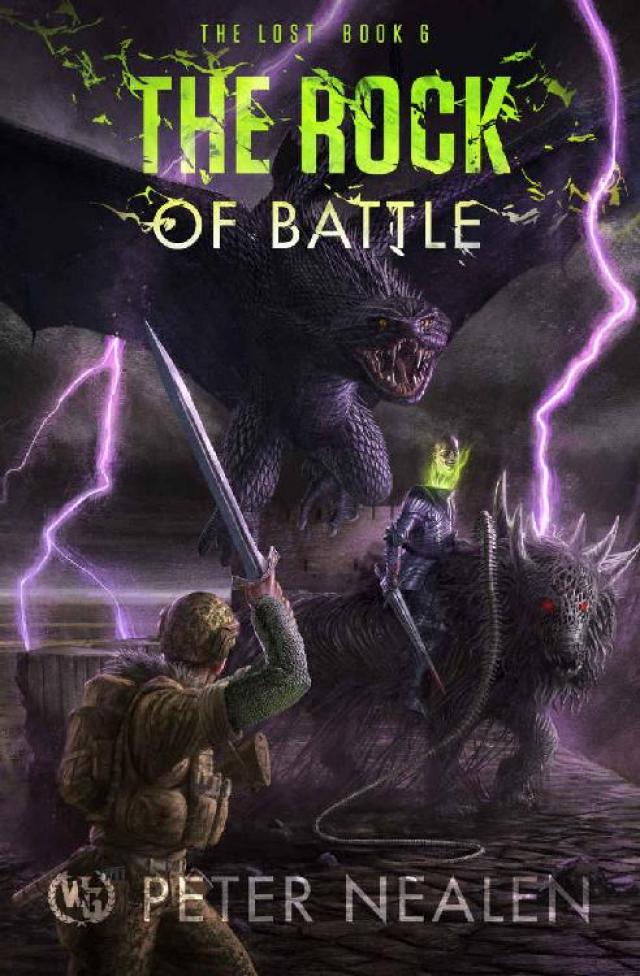
It was tiny compared to the dragon of Gremman, which is why I call it a wyvern. It had a wide, spade-like head that seemed to be mostly mouth, a gaping maw lined with two rows of teeth, its eyes tiny points of hunger and malice set well forward. Its scales, colored a sort of blend of sandy tan and green, were smooth and shiny, and its wings stretched a good thirty feet to either side, dwarfing its serpentine body and two taloned legs. It stooped on us like a hawk with a rattling hiss, those talons outstretched to seize Rodeffer as its wings blotted out the sun.
Rodeffer pivoted and snapped his rifle to his shoulder, getting a fast pair of shots off before he had to dive into the dirt to avoid those grasping talons. He might have hit with both; I know he put at least one bullet into the monster. I saw the scale crack and a spurt of black blood, and the wyvern jerked and veered off abruptly, its talons snatching at air about two feet above Rodeffer’s head. It flapped into the air again with a boiling water hiss, the spines along its back flexing.
After the dragon of Gremman, I wasn’t eager to come to grips with that thing with only our rifles and Santos’s Mk 48. The M107 .50 cal had hurt the dragon, but even that monster of a rifle hadn’t been enough to kill it. Our 7.62 NATO weapons were more formidable than the M4s and M27s we’d come through the mists with, but they weren’t dragon slayers.
I was sure the Sword of Iudicael could do a number on it, but that meant coming to grips with it. I’d stabbed the dragon of Gremman with the Sword, but that had been after Galan had given his life to pin it to the ground. This thing was still fully mobile, and those talons were as long as my forearm. Even if my Tuacha-forged mail held, they could easily crush bones before I could even get the Sword in to hurt it.
So, from where I stood, our best bet at that point was to break contact and get to cover.
Unfortunately, we were on the open plains. There wasn’t a lot of cover to be had.
Gurke wasn’t sitting on his hands, though. Even as I grabbed Rodeffer, levering him to his feet and shoving him toward the gully, a burst of machinegun fire tracked out of the weeds to our north toward the circling wyvern. At least a couple rounds had to have hit, as it dipped and screamed, flapping away from the bullets’ sting.
We took full advantage, running flat out toward the hollow where we’d left our horses. It was a good distance; we hadn’t wanted the animals to inadvertently give our position away. Fortunately, we were all in probably the best shape of our lives, despite the fact that we were all pretty worn down from months of riding, running, and fighting.
It’s a good thing that some habits are hard to break. Rodeffer ran to a hummock in the ground about twenty yards ahead, then dropped to a knee, turning back to cover our six as Farrar and I ran past him.
He immediately opened fire, prompting me to keep going for another three paces past him before throwing myself prone and looking for the wyvern.
The wyvern wasn’t our only concern. While Redbeard was dead, one of his lieutenants had rallied the survivors, and now they were coming after us, having regained some of their confidence with the wyvern overhead.
Rodeffer shot one of the spear-wielding riders out of the saddle, just before I laid my sights on the lieutenant. Or maybe he wasn’t a lieutenant, but Redbeard’s handler. The man was dressed similarly to the others, but he was taller, thinner of feature, slightly paler, and dark-haired. He looked more like a Peruni than a Galel.
I shot him through the upper chest. He jerked with the bullet’s impact, but stayed in the saddle, even as bloody froth started to leak from his mouth, spurring his mount on, his spear held forward. He was determined to get after us, even as he was dying from a lung shot.