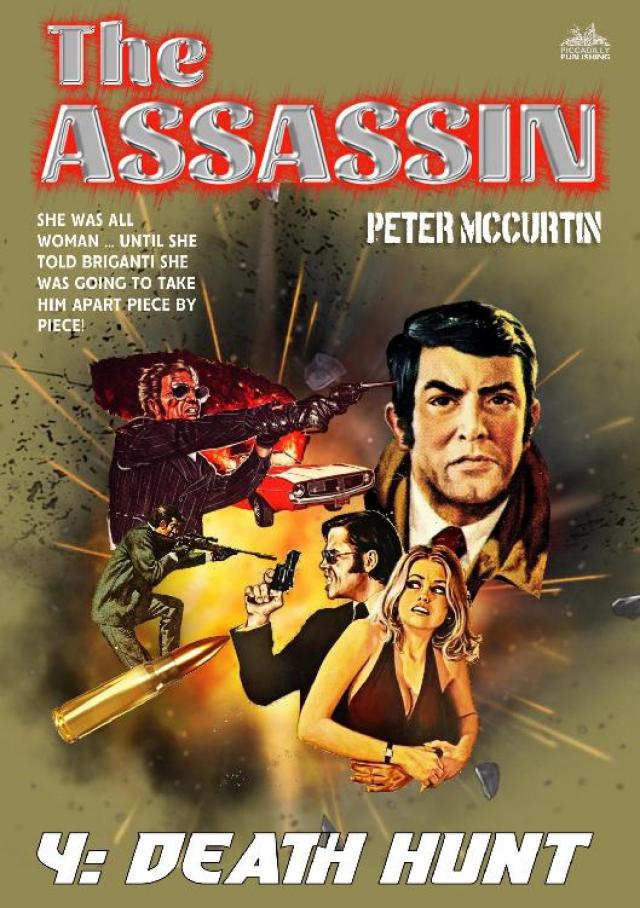
Death Hunt (The Assassin Book 4), page 1
part #4 of The Assassin Series


The Home of Great
Action-Adventure Fiction!
“The Mafia made one hell of a mistake when they killed that man’s wife and son.”
- Senator Thomas Cotton, Jr.
Robert Briganti is the Assassin.
Ruthless, indifferent to his own survival, he lives only to destroy the Mafia.
This time, armed with his hand-picked arsenal of superweapons, he meets his match in a super-cool woman with her own thirst for vengeance.
But if she stands in Briganti’s way, he has a tough choice to make.
Walk away from his latest quest for justice ... or kill a woman whose emotional scars match his own?
High-octane action-adventure in the grand tradition of Don Pendleton’s THE EXECUTIONER!
THE ASSASSIN 4: DEATH HUNT
By Peter McCurtin
First published by Belmont Tower Books in 1973
Copyright 1973, 2022 by Peter McCurtin
This electronic edition published 2022
Names, characters and incidents in this book are fictional, and any resemblance to actual events, locales, organizations, or persons living or dead is purely coincidental.
You may not copy, store, distribute, transmit, reproduce or otherwise make available this publication (or any part of it) in any form, or by means (electronic, digital, optical, photocopying, recording or otherwise), without the prior written permission of the publisher. Any person who does any unauthorized act in relation to this publication may be liable to criminal prosecution and civil claims for damages.
This is a Piccadilly Publishing Book / Text © Piccadilly Publishing
Series Editor: David Whitehead
Published by Arrangement with the Author’sEstate.
Visit www.piccadillypublishing.org to read more about our books
Table of Contents
Publisher’s Note
Chapter One
Chapter Two
Chapter Three
Chapter Four
Chapter Five
Chapter Six
Chapter Seven
Chapter Eight
Chapter Nine
Chapter Ten
About the Author
Publisher’s Note
PETER McCURTIN ORIGINALLY created the Assassin series for his usual publisher, Belmont Tower, for whom he also worked as an editor. It was clearly designed to cash in on the phenomenal success of Don Pendleton’s Executioner series, and arguably remains the best of all the many Mack Bolan clones to appear in the ensuing years.
But McCurtin ended up selling The Assassin to Dell Books instead … and it wasn’t difficult to see why. According to one of his contemporaries, “Dell paid twice as much as [Belmont] Tower. He would get a check for four or five thousand dollars for each book.”
Even before Dell published the first book, however, Harry Shorten, McCurtin’s boss at Belmont Tower, told him he could not write any further books in the series for a rival publisher. The series, he said, was to come back to BT from the fourth book onwards.
But now they faced a dilemma. McCurtin had already written the fourth book, so there was no problem there. But Dell had the copyright on The Assassin. Therefore, to avoid any accusations of copyright infringement, it was decided that The Assassin would now become The Marksman, and Robert Briganti would become Philip Magellan.
So it was, then, that the book you’re about to read was originally published as the second Marksman, when all along it should have been the fourth Assassin.
Piccadilly Publishing is proud to finally reissue the book as McCurtin originally wrote it, as the fourth instalment in Robert Briganti’s ongoing war with the Mafia.
Enjoy.
Chapter One
ROBERT BRIGANTI HELD a contract to kill. In the dark and secret world in which he moved, the contract was sacred. It was also like no other. Not consummated on legal paper, with clauses and fine print. Not closed with a handshake between understanding parties. Not even sealed with a kiss heavy with the garlic and wine of brotherhood. The contract Briganti held was by Briganti, with Briganti. It was a contract that pumped through his heart’s blood, piped along his veins; a contract burned in his brain and wired through his nerve endings. And the only thing that could make Robert Briganti break this contract was death. His own.
The food wasn’t bad. The pasta was al dente, firm, slightly underdone; the marinara sauce tangy with tomato and garlic. He bit into the steak pizzaol’ and it was good. Which, he wondered, came first:
Over at a table in the rear three mafia soldiers were making like United States Senators, settling their affairs of state over a bottle of red. He hadn’t stared; he hadn’t even appeared to notice them. But just the barest glance told him who they were, and what. The chief hood sat, like all chiefs, with his back to the wall, flanked by the two lesser lights, button-men. Steel gray hair, wavy and slicked, crowning a sad, heavily-lined dark face. His white collar was starched stiff, and his hands, which moved a lot, flashed with a huge diamond. The other two were just warm bodies; mindless servants, who would say “good evening” or pull a trigger, whichever was called for. One was short and stocky; the other, thin and dyspeptic.
Briganti had no illusions. They were discussing him. Not too many single strangers drifted into this place, he ventured to guess. Either you knew it for its food or its regulars, or you’d pass it by. It wasn’t much of a place to look at. Just another little storefront labeled “Enrico’s” situated in the heart of Little Italy; a dozen or so tables, most of them located under a huge mural of the Bay of Naples painted in green along one wall. If Naples ever looked like that, Briganti thought as he chewed, no one would ever leave it.
He became aware of a fat pair of legs standing at the table. Briganti looked up into the eyes of the fat hood. The man was squinting down at him, a quizzical look on his fleshy face.
“Eh, goombah, don’t I know you from someplace?”
Briganti talked to strangers only when he had to. He went to work with the bread and steak juice.
“You from around here?”
Briganti popped the bread into his mouth and chewed with deliberation.
“You don’t talk a lot, do you?”
Briganti stared up at the Senator, or alderman, or button. “Do you have lots of questions like that?”
“Yeah.” The edge in the heavy man’s voice was apparent. “Yeah, I got questions. You got answers?”
“Either you’re very smart to think up all those questions,” Briganti said slowly, “or you’re very dumb to ask them.”
The hood’s mouth gaped open. “Ohhh,” he said, drawing it out like taffy. “Oh, we got a wise guy.” He swiveled his thick head. “Hey, listen to this,” he called across the room. His two companions were looking on. “We got us a wise guy here.”
It could go either of two ways, Briganti thought. He could continue this line of hostility, antagonize the unholy three and risk a messy shootout. Or, he could play it close to the vest: smart, give a little, give a little more. And maybe learn something. You catch more flies with honey than vinegar, his mother used to say. Probably true, even in an Italian restaurant.
The thin one started to get out of his seat. The boss with the steel gray hair waved him down with an imperious flick of the hand. “Invite the gentleman to our table,” he said, with the barest trace of accent. At the same time, he snapped his fingers at the waiter. “Rico, the gentleman will take his dessert with us.” Briganti carefully ran the last bit of bread around the rim of the platter and popped it into his mouth.
The fleshy hood growled at Briganti, “You heard.”
Blandly, Briganti matched the man’s gaze. “That’s not what he said.”
“Eh, goombah,” the man said with exasperation, “you make a Federal case outa everything. He said, ‘Invite the guy over.’ I’m inviting you.”
Briganti said, “That’s better. Tell the gentleman I accept.”
The fat man goggled uncertainly, “But—but he’s right here!”
“Go ahead,” Briganti urged. “Tell him.”
A man had to establish his proper station in life, even if it meant playing games. Briganti was prepared to play. He lifted his glass of wine and drank. From the corner of his eye, he watched the messenger trying to sort out his confusion. But he did as he was told. He returned to his companions and sat heavily. He was, after all, only a messenger.
Rico, the waiter-owner, materialized, and began to clear the table. “I’ll bring your dessert over there.”
“What if I don’t go?” Briganti asked.
“You go,” Rico said. He did not look up.
Briganti drank the chianti and stood up. He strolled leisurely past the few other diners to the rear table. He nodded to the man who sat with his back to the wall.
“Chu-Chu,” the man elbowed the thin man beside him, “a chair for the gentleman.”
Chu-Chu leapt to his feet and slid a bentwood chair behind Briganti.
“Rico,” the head man called. “A glass for the gentleman.”
All this for Briganti’s benefit. It was important to establish his role, important that Briganti clearly understood his position as host—and boss—at the table.
Briganti sat, but reluctantly. His back was now to the entrance doorway, and this always made him uncomfortable.
Throughout the ritual of the wine-pouring, no one spoke. Three pairs of dark, mute
Diamond flashing, he raised a glass and the others followed. “Salut!” They drank, smacked their lips, set the glasses back onto the marble top of the table. They could now proceed with the business of the day.
The boss (Briganti rated him a capo) rested an elbow on the table, the diamond flashing fire, as he ran a finger sensuously along his lower lip. His eyes, narrowed, bored into Briganti.
“’Taliano?” he said in Italian.
Briganti nodded once, then studied the Roman street scene framed behind glass on the wall over the capo’s head.
“Where are your people from?” In Italian.
“Milano,” Briganti said.
The capo grunted. “In the north, everything is possible. Factories, big apartment buildings, even Italians with gray eyes.”
“And you,” he pursued, “where are you from?”
“Not New York.”
“We were saying, earlier, that you looked familiar. Should we know you?”
Briganti said, in English, “Not unless you know New Orleans.”
“Oh,” the capo said, “New Orleans.” He nodded sagely. “Did you hear of this restaurant in New Orleans?” He, too, reverted to English.
“No, but maybe I should have. The food is excellent. It would do well even in New Orleans.”
“Thank you. We enjoy a good meal here in New York, too.” The man straightened his shoulders, peered hard at Briganti. “Tell me, signor, do you have friends in New York?”
Briganti smiled. “Does everybody ask questions in this town? In New Orleans, we don’t ask questions.”
The capo shrugged. “These are only friendly questions,” he said easily; then, more to the point, “We like to know who is in our neighborhood. Let us start from the beginning.” He extended a hand to his right. “This is Chu-Chu. And this,” the fat man, “is Two Cents. I am Vincent Paoli.” He sat back and waited for the reaction.
Briganti’s face showed nothing. But the computer in his brain was plugged into retrieval. Vincent Paoli, came the readout. Capo of the Trunzio Family. Kingpin of gambling, pornography and prostitution. Congratulations, Briganti. For a man on the prowl for new contacts, as it were, this restaurant had been a good choice. Already, the meal had paid for itself.
“And you?” Paoli said, “You are …?”
“Jimmy Corsaro,” said Robert Briganti.
“So tell me, Jimmy. What are you doing in New York?”
“Looking,” Briganti said. “Just looking.”
Paoli nodded sagely, as if in reply to something profound. “And have you found anything? Do you have friends here?”
“I’ll make out,” Briganti said.
“Maybe you need some help,” Paoli prodded. “Get a few introductions, meet people. I know a lot of people.”
“Do you take such an interest in everybody, Mr. Paoli?”
The capo laughed. “No, not everybody.”
“Why me?” Briganti asked.
Vincent Paoli stared intently at the man opposite him. “You have a look, Mr. Jimmy. A certain kind of look. I would like to know about this look.”
The glass on the picture over Paoli’s head flashed as the front door was flung open. A quick flash, followed by the bang of the door as it slammed against the supporting wall. Briganti stiffened, saw the look of shock on the three faces around the table, then heard the first shot. Paoli’s eyes went blank, his rugged face slacked off, as he slipped from the chair.
Briganti took a dive under the table and simultaneously yanked it over on its side. A volley of slugs bit into the wood and pinged into the walls. Patrons screamed, bolted out of their seats and cringed against the far wall.
There were two of them, faceless hoods with hats pulled low over their eyes, blazing away with .38 Smith & Wessons. Briganti had his own Colt Python in hand, was poised for his first knockoff, when Chu-Chu’s lifeless body tumbled down upon him, deflecting his aim. And then he squeezed off two beauties, one after the other, and the shooting stopped.
He watched them fall where they had stood, just inside the door, a couple of two-bit button-men, each with his very own little hole in his head.
The whole scene, the entire assault, had taken no more than a dozen seconds. Gunsmoke swirled about the bodies and the smell of powder burned acridly in the nostrils. Five corpses, dead as mackerels.
His first thought was for himself. Let that be a lesson to you, he told himself. Never, but never, sit with your back to a door again. He took a deep gob of breath and looked about him. His drinking companions were dead. Chu-Chu, sprawled grotesquely behind the table, Two-Cents, head thrown back, pumped through like a sieve. (A fat man made an easy target.) And the Capo, flung behind his chair when the table had gone over, practically afloat in a pool of bright red blood. It was time to get out of there. Fast, before the law woke up from their naps and descended like locusts on a strawberry patch.
He jammed the Colt back into its shoulder holster and glanced around the place. The customers were clutching at each other, dazed and in a state of shock; they would not remember a thing.
Briganti straightened his tie and stepped over Chu-Chu toward the door. Behind him, he heard a moan. He turned. Two-Cents? Impossible; the man had been thoroughly punctured, blood running freely from his head and six other places. The capo? Another moan, shrill and hurt, like a wounded dog. Let him lie like a dog, Briganti thought. Die like a dog. Yeah, but Vincent Paoli was still alive. And Vincent Paoli could be useful to him.
He stepped around Chu-Chu and over Two-Cents, his heels squishing in the pools of red. Paoli was stirring, a hand reaching out weakly, clutching at straws. Briganti knelt beside the capo. His head was gushing blood along one side. Briganti swept up a napkin from where it had fallen and rammed it hard against the bloody head. With a free hand, he opened the man’s coat and ran his fingers along the body. There were no other hits.
Paoli’s eyes were open. He looked dazed. Briganti took the man up in his arms and carried him, dripping blood, through the kitchen door.
Rico and the chef were cowering behind the refrigerator. “Where does he live?” Briganti snapped.
Rico shrugged. “University Place, in the Village. He’s alive?”
“A taxi, quick!”
Rico nodded, and hurried out the kitchen door. Briganti placed Vincent Paoli on the long work table and swabbed at the wound on his head. Paoli stared up at him, frightened and mute.
To the chef, Briganti said, “Get me a damp cloth.”
The man moved to the sink, ran some water over a dish towel, wrung it out and handed it to Briganti. “You take him to a hospital?”
Briganti replaced the napkin with the damp towel. “Burn that cloth,” he said. “Lose it.” He worked the towel over the wound and took a good look at it. Paoli had simply been grazed, the slug ripping along the scalp over his left ear. Another millimeter, and the neighborhood would have been invited to a grand funeral.
“Okay,” Paoli said. “All right.” He tried to sit up.
“Think you can make it?” Briganti helped him to his feet. “You want a hospital or you want to go home?”
“Home.”
Rico came running through the door. “Cab’s waiting.”
Briganti held on to the older man, guided him through the door out to the side street. A yellow cab was at the curb, door open.
At the front entrance of the restaurant, a crowd was gathered, peering in, chattering with excitement. Two cops were just pushing their way through. Off in the distance, the piercing wail of a police siren cut through the night, growing louder and louder.
Briganti slammed the door behind them. “University Place,” he said to the driver as they moved out.
Vincent Paoli lay back against the cushion, a hand supporting the blood-stained towel along the side of his head. In the uncertain light of the cab, his dark face was haggard with pain, yet drawn tight with rage. “Spazzi,” he muttered. “That bastard. He will pay. Through the nose.” Then he became aware of the stranger beside him. A most unusual stranger. Too bad he was not Sicilian.
“You are a good man with a gun,” he said in Italian. “I saw.”