Yellow Rain (A Soldier of Fortune Adventure #4), page 1
part #4 of Soldier of Fortune Series


The Home of Great
War Fiction!
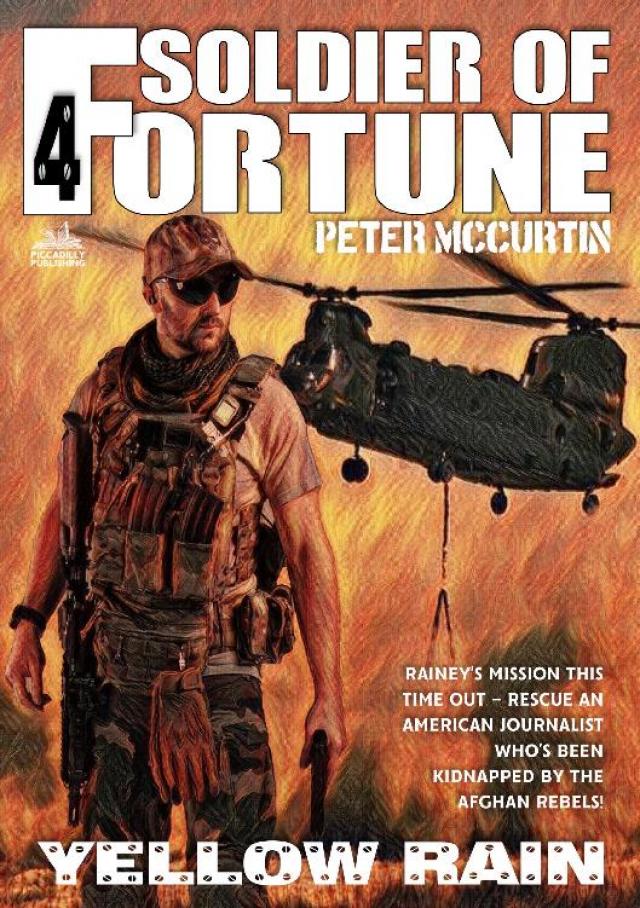
Jim Rainey’s latest assignment was his toughest to date. A wealthy magazine publisher was paying him a cool hundred thousand dollars to rescue Charles Goldman, a journalist who’d been captured in Afghanistan while reporting on the secret war between the Russians and the Islamic rebels. Befriended by the chief of a nomad tribe that is decimated by an infamous poison gas known as Yellow Rain, Jim faced death at the hands of Afghans, the Pakistanis and an American CIA agent who’s gunning for Goldman … and for Rainey as well!
SOLDIER OF FORTUNE 4: YELLOW RAIN
By Peter McCurtin
First published by Leisure Books in 1984
Copyright 1984, 2022 by Peter McCurtin
This electronic edition published November 2022
Names, characters and incidents in this book are fictional, and any resemblance to actual events, locales, organizations, or persons living or dead is purely coincidental.
You may not copy, store, distribute, transmit, reproduce or otherwise make available this publication (or any part of it) in any form, or by means (electronic, digital, optical, photocopying, recording or otherwise), without the prior written permission of the publisher. Any person who does any unauthorized act in relation to this publication may be liable to criminal prosecution and civil claims for damages.
This is a Piccadilly Publishing Book / Text © Piccadilly Publishing
Series Editor: David Whitehead
Published by Arrangement with the Author Estate.
Visit www.piccadillypublishing.org to read more about our books
Table of Contents
Chapter One
Chapter Two
Chapter Three
Chapter Four
Chapter Five
Chapter Six
Chapter Seven
Chapter Eight
Chapter Nine
Chapter Ten
Chapter Eleven
Chapter Twelve
About the Author
Chapter One
“WE ARE NOT to be disturbed for any reason,” Jackson E. Dunaway told the secretary who showed me into his office, the inner sanctum, the place where the buck stopped at Newswatch magazine. A telephone call from Dunaway, the editor and publisher, was what brought me there. Now I waited to find out what he wanted.
Newswatch takes up four floors of a 1920’s art deco building on Park Avenue South. That’s the unfashionable end of Park, below 34th Street. It used to be called Fourth Avenue before the real estate image-makers came up with the change in name. Sounded classier.
Dunaway had a corner office with a view of the avenue, but it was far from fancy. It was a working office, from the file cabinets to the paper strewn desk to the Underwood manual typewriter on a metal stand. There were bookcases with bound copies of Newswatch; displayed prominently were blown-up photographs of Lincoln Steffens and Upton Sinclair, the famous muckrakers. Dunaway was a modern muckraker. It was a functional office, no more than that, but I knew there was money there. I knew something about Dunaway, because I’d seen him on Meet the Press and other boring talk shows. A burly red-faced, fortyish man with an unreconstructed South Carolina accent, Dunaway was a multi-millionaire with a social conscience and a wife who was just as rich as he was. Sometimes called “the William Buckley of the Left,” Dunaway had been publishing Newswatch since the death of his widowed father and his own expulsion from Yale. Both events had occurred in 1963, and in the twenty years since then his magazine had made a name for itself, attacking the Right and Left and the middle of the road with equal vigor.
“You want a drink?” Dunaway asked from behind his desk. A bottle of Jack Daniel’s and a coffee maker stood on another desk. “What about coffee?”
“No thanks,” I said.
Dunaway lay back in his big leather chair, “I didn’t want to say much on the phone. For your protection as well as mine. You never know who’s listening in these days. I called from a public booth, just to be sure.”
I nodded.
Dunaway said, “I don’t know what your schedule is, Mr. Rainey, but I’d like to engage your services. If you have prior commitments, then I won’t waste your time. But this assignment can’t wait. You want to discuss it?”
“I’ll listen,” I told him. “But first, who put you onto me? I’m not in the Yellow Pages, there is no Mercenaries’ Directory.”
“I got your name from Joe Dyer,” Dunaway answered. “Joe said you might be interested. You were in Vietnam together, Joe said.”
“Yeah. Joe joined the CIA after we got out. I became a mercenary. We used to run into each other in strange parts of the world. How is Joe? I haven’t seen him for three or four years.”
“The CIA is still making life hard for him. He isn’t sure they won’t go ahead and prosecute him for that book he wrote.”
I knew all about Joe Dyer and the attack of conscience that led to his resignation from the Agency. They wanted him to lay out the plan for another political assassination, some exiled Salvadoran bishop with a big peasant following, and he said no. I knew for a fact that Joe was the brains behind several other political murders, but since the victims were all certifiable bad guys their passing hadn’t kept him awake nights. But the bishop was different: a nonpolitical old man who believed that the teachings of Christ still had some meaning. That Joe was raised a Catholic may have had something to do with his refusal to arrange the hit. Anyway, he not only said no, he threatened to blow the whistle if the Agency’s killers harmed even a hair of the old man’s saintly head. A month later, the old man was run down and killed by a hit and run driver.
“Joe shouldn’t have written that book,” I said. “He should have written spy novels and sold them to the movies. Taking on the CIA is like pissing against the wind.”
Dunaway, insulated by money, wasn’t ready to accept that. Articles attacking intelligence agencies were a standard feature of his magazine, but no one cared much. Dunaway was just a publisher, but Joe Dyer was a former top level agent with too many secrets in his head. His book had been rejected by all the established publishers, and when it was finally brought out by some underground press, it was filled with typographical errors and badly printed on cheap paper. I doubt if it sold more than a few hundred copies in the entire country.
“Joe felt he had to tell the truth,” Dunaway said. “Blow the lid off that whole rotten, murderous business. How can you say what he did was wasted?”
“Because it was. Look, Mr. Dunaway, the Russians have the KGB, we have the CIA. They have their bastards and we have ours. We don’t have to like our spooks, but they’re necessary.”
“Yes, but they must be kept under control. That’s the problem. They ...” Dunaway made a face, and didn’t go on with his argument. “Oh well, that’s not why you’re here, is it?” Dunaway said abruptly. “One of my top investigative reporters is missing in Afghanistan and I want you to find him and bring him out. Does the name Charles Goldman mean anything to you?”
“I’ve seen his stuff,” I said. “That long piece on the Connecticut Klan was pretty good. But I was turned off by his report on Gay Lib. Is he a fag?”
“No, he’s not a fag,” Dunaway the liberal said, disapproving of the word. “Would it make a difference if he was?”
“Not personally.”
“The piece on Gay Lib was kind of shrill,” Dunaway conceded. “Tell the truth, I didn’t like it much myself, but I give my writers plenty of leeway. This is a magazine of opinion; that was Charlie’s opinion.”
“And now he’s missing in Afghanistan?”
“Charlie had been itching to go to Afghanistan ever since the Russians invaded in ’79. He wanted to write the real story of what was happening there. So many wild stories were coming out. They still are. The CIA must know what’s going on, but they’re not telling the press.”
I refrained from reminding Dunaway that American intelligence agencies don’t function as a source of public information. He seemed to think they did.
“Charlie didn’t trust what little information we were getting from our own government.” Dunaway played with the end of his black knit tie. Doing that seemed to take the place of worry beads. “He wanted to find out for himself. Charlie is a leftist, has been called a mouthpiece for the Kremlin, but he’s hardly that, or I wouldn’t have him on the payroll. He was a member of the SDS in the Sixties, but that doesn’t make him a Communist. In some ways the SDS was a sort of latter-day panty raid. In Russia, they’d stand the SDS against a wall or send them to the Gulag. Most of the SDS have settled down, become as square as their fathers. Tom Hayden is married to Jane Fonda and her money. Jerry Rubin has gone Wall Street.”
“But not Charles Goldman?” I said.
“Well, he’s not as naive as he used to be,” Dunaway said. “After all, he’s thirty-seven and the world doesn’t look so simple. He can be a pain in the ass—he is a pain in the ass—but at least he’s honest. Doesn’t give the truth a helping hand like some other reporters I could name. Charlie always said sure, the Russians are paranoid, but even paranoids have enemies, and maybe they had to invade Afghanistan to keep the Chinese from getting there first. Charlie thinks the Chinese have yet to make their move toward world domination. That’s a minority opinion at the moment, but maybe it has merit.”
“You didn’t try to stop him from go
“He’d have gone anyway, and we’re in the news gathering business,” Dunaway said. A little uncomfortably, I thought. Dunaway knew all too well what Goldman faced once he crossed that border. The truth was that Dunaway wanted him to go; his weak opposition to the idea was what drove Goldman halfway around the world to report on the secret war.
Dunaway knew what I was thinking. “He’d have gone no matter what I said. If not for Newswatch, then for someone else. As a freelancer if he had to. Besides, there was always the chance that he’d pull it off. Charlie’s stuff sells magazines, and that’s the name of the game. And he wouldn’t just sit on the Paki-Afghan border and interview refugees. Stuff like that is next to worthless. Half the refugees are intelligence agents. They tell you what they think you should hear.”
“He got in through Pakistan?”
“No other way, not with Khomeini and his mad mullahs running Iran. In the Shah’s day he could have gone in through Iran.”
That figured: Afghanistan is bordered by Iran, Russia, Pakistan, a sliver of China. “What was his cover, if any?”
“No cover that I know of,” Dunaway said. “His face is too well known, and the only other language he speaks is French. French with a Boston accent. First he tried to get the Russians’ permission to enter Afghanistan. Went to the Russian consulate here in New York. Told them he was no stooge for the American Information Service and would tell the truth. They said nyet. Next he went to some anti-Russian rebel group with offices over a spice shop on Atlantic Avenue. Brooklyn. Little Islam. All they did was load him down with propaganda hand-outs and ask for a donation. The CIA and the FBI couldn’t have missed any of that. They watch these places and make movies.”
I was a little tired of the way he kept harping on the devious ways of our dedicated American spooks. “Sounds like Goldman did a good job of publicizing his intentions. The Russians and the rebels knew he was coming even before he left the States. He did everything but hold a press conference.”
“It’s supposed to be a free country,” Dunaway said irritably, not appreciating my comment. “Be that as it may, Charlie drew twenty-five thousand and said I’d be hearing from him. Then he disappeared.”
“Just like that?”
“Charlie likes the dramatic gesture,” Dunaway explained. “Likes to go it alone. And what I didn’t know couldn’t hurt him. As if the CIA might force me to tell them where he’d gone or how he was going to do it.”
“Not too likely,” I said. “But they could get you indicted under the travel-ban laws. They could also get you indicted for sending me after Goldman.”
Dunaway smiled complacently. He had one of those unlined baby faces that European men never seem to have. It must be all those vitamins. “They could and maybe they will,” he said. “The hell with the CIA! I’m a very rich man and nothing bad ever happens to a rich man in America. Not really. If they did send me to prison—after years of appeals, of course—I’d be sure to draw Lompoc, Elgin or Huntsville. One of the country club jails. Just like Attorney General Mitchell and other privileged criminals.”
I waited.
“Most of all, Charlie wanted to find out if the Russians really were using poison gas against the rebels. Yellow Rain, as it’s called.”
“Why shouldn’t they be using it?” I asked. “The Russians do as they damn well please, and who’s to stop them?” I didn’t add that we had used something very much like poison gas in Vietnam. They called it CS gas, and the special fliers who used it against enemy villages and bunkers were warned never to refer to it as anything but “tear gas.” But I was there, I saw what it could do. It blinded, it maimed, it killed. One French journalist who reported that it was much the same as the mustard gas of World War I was expelled from the country. I thought of all the deadly toxins and agents our side came close to using when we started to lose the war in Nam. But I said none of this to Dunaway.
What I said was, “How do you know Goldman is missing? Maybe he’s just lying low, waiting for the right time to get out.”
“No,” Dunaway said. “He’s in deep shit and it’s threatening to drown him. He got a message out through some merchant who trades south into Pakistan. We have a stringer in Karachi, an Australian freelancer who works for the best price. Charlie sent the message to him, and he sent it to me after he phoned.”
Dunaway opened a drawer and pushed a sheet of paper across the desk. It was stained and creased; the writing was in pencil, wobbly and hard to read.
Jack Dunaway. The Russians caught me near Kandahar and took me to the Kabul Prison but I escaped by bribing a guard with money sewn into my coat. I hid in the mountain in the center of the city while they searched for me. I froze and starved I don’t know for how long. A long time anyway. Rebel sympathizers found me and are hiding me in a house in Kabul Some of them think I am a Russian agent and want to kill me. I am not sure in what part of the city I am but I think near or in the bazaar. They won’t tell me. I am sick and weak and unable to think straight. I am afraid. Jackson, in the name of God, please help me. Your friend, Charles Goldman.
I put the sheet of cheap paper on the desk. “Is that Goldman’s writing? If it is, he’s pretty rattled.”
“It doesn’t look like it, but it is. I had a handwriting expert check it out. Charlie wrote it all right. What do you make of it?”
“I don’t know. Goldman may still be in Kabul Prison. This may have been written with a gun to his head—a Russian trick to get another American over there. The Russians like show trials. But let’s suppose Goldman really is holed up in Kabul; why haven’t you tried to get help from our government? Everybody knows the CIA is supplying the rebels with arms and intelligence. Why can’t the CIA get him out?”
Dunaway put Goldman’s cry for help back in the drawer. “I tried everything I could to get help from the government. The answer was no soap. The official response was that the CIA has no involvement in Afghanistan. Unofficially, I was told that Charlie can expect no help from the Reagan administration. I can hardly blame them, in a way, but damn it to hell, the man is an American citizen. But, you know, Charlie has been lambasting the President and his top men since they came into power.”
“Yeah,” I said. “I seem to recall one thing he wrote: ‘The Presidency as a B-movie.’”
Dunaway smiled sourly. “Yes, Charlie said Macdonald Carey would make a better President. That might have been perceived as humorous if it hadn’t been so bitter, so abusive. And his pop-psychoanalytic piece linking Reagan’s alcoholic father to his antiwelfare policies didn’t do him any good. I have to take some of the blame for that: I let it go through.”
“It’s always a mistake to dump on somebody’s old man,” I said.
“The real damage was done by Charlie’s attacks on the CIA.” Dunaway yanked at his tie. “Those bastards are a law unto themselves. Even if the President ordered them to help Charlie they probably wouldn’t do it. Who knows what they’d do? Their attitude is, Goldman got himself into this shit, now let him get himself out.”
Well, what do you expect? I wanted to ask. You throw rocks at people, you have to put up with rocks thrown back.
“I get the picture,” I said.
“Will you take the job?”
“Depends on what you’re willing to pay?”
“I have to stand behind my people. How much?”
“I think I should get a hundred thousand for this one.”
“You think big, Mr. Rainey.”
“You can afford it, Mr. Dunaway. I won’t dicker with you. Half up-front, the other half when I deliver Goldman. If I don’t deliver, you get back what’s left of the first fifty. Joe Dyer told you how I work, so you know I won’t cheat you.”
It took a little time for Dunaway to get used to the idea of parting with a hundred big ones. Then he said heartily, “Your reputation speaks for itself. I’ll have a certified check drawn up while you wait.” He dialed an inside number and talked to someone.
“I’ll need passport photographs for Goldman,” I said when he hung up. “Also date of birth. Weight. Height. Color of eyes and hair. The usual.”