

The Fantastic Pulps, page 1


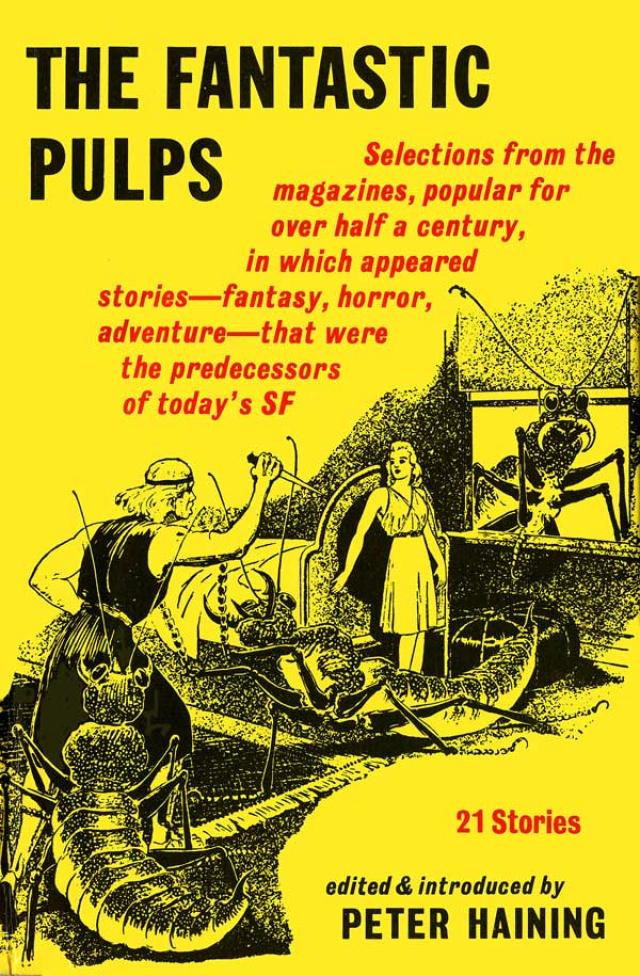
The pulp magazines in which the contents of this volume first appeared were a primarily American phenomenon. The stories were written purely as entertainment and were aimed at a readership culled from the American urban population around the turn of the century—often factory workers for whom the glossy magazines would have been too expensive. It was a publisher by the name of Frank Munsey who, in the 1880s, first predicated “the story is more important than the paper it is printed on” and thus revolutionised cheap literature. The glossy magazines were sold in those days for twenty-five cents or more—Munsey’s weekly magazine was printed on 128 pages of newsprint, or “pulp”, and sold for ten cents. But, true to his dictum, he and his imitators employed the best writers of the day and the stories they wrote were to become the predecessors of science fiction.
Among the twenty-one authors represented in this volume are names such as Stephen Crane, Jack London, Upton Sinclair, Sinclair Lewis, Dashiel Hammett, Mackinlay Kantor, H. P. Lovecraft, Robert Bloch and Ray Bradbury. The pulp magazines flourished for over half a century, but by 1945 paperback books and television had invaded their market and created a demand for more sophisticated reading material.
Peter Haining contributes an historical introduction to this collection of fantasy, horror, gothic, adventure, supernatural and embryo SF stories. He also gives a brief introductory note to each story.
THE FANTASTIC
PULPS
Edited by
PETER HAINING
LONDON
VICTOR GOLLANCZ LTD
1975
Ebook conversion by Editions Héliographe
Table of Contents
ACKNOWLEDGEMENTS
INTRODUCTION
SECTION I MANACLED by Stephen Crane (Argosy)
A THOUSAND DEATHS by Jack London (The Black Cat)
AUTHOR’S ADVENTURE by Upton Sinclair (The Popular Magazine)
THE RESURRECTION OF JIMBER-JAW by Edgar Rice Burroughs (All-Story Magazine)
JOHN OVINGTON RETURNS by Max Brand (All-Story Magazine)
THE PEOPLE OF THE PIT by A. Merritt (All-Story Magazine)
THE MAN WITH THE GLASS HEART by George Allan England (The Cavalier)
THE WOLF WOMAN by H. Bedford-Jones (The Blue Book)
A CRY FROM BEYOND by Victor Rousseau (Strange Tales)
MADMAN’S MURDER MELODY by Ray Cummings (Horror Stories)
SECTION II THE GHOST PATROL by Sinclair Lewis (Detective Story Magazine)
THE SARDONIC STAR OF TOM DOODY by Dashiell Hammett (Black Mask)
THE SECOND CHALLENGE by Mackinlay Kantor (Real Detective Tales)
BARON MÜNCHHAUSEN’S SCIENTIFIC ADVENTURES by Hugo Gernsback (Amazing Stories)
A TWENTIETH CENTURY HOMUNCULUS by David H. Keller (Amazing Stories)
THE MAN WHO SAW THE FUTURE by Edmond Hamilton (Amazing Stories)
SUICIDE CHAPEL by Seabury Quinn (Weird Tales)
THE DIARY OF ALONZO TYPER by H. P. Lovecraft and William Lumley (Weird Tales)
THE TREE OF LIFE by C. L. Moore (Weird Tales)
IRON MASK by Robert Bloch (Weird Tales) 1
2
3
4
5
6
7
THE SEA SHELL by Ray Bradbury (Weird Tales)
APPENDICES appendix i THE BLOODY PULPS by Charles Beaumont
appendix ii PULP FANS
BIBLIOGRAPHY
© SELECTION AND ORIGINAL MATERIAL, PETER HAINING 1975
ISBN o 575 02000 8
MADE AND PRINTED IN GREAT BRITAIN BY
THE GARDEN CITY PRESS LIMITED
LETCHWORTH, HERTFORDSHIRE
SG6 IJS
For Ken Chapman
—whose knowledge guided me through the ‘pulp jungle’
ACKNOWLEDGEMENTS
The Editor wishes to extend his thanks to the following authors (or their executors, trustees or agents) and publishers for permission to include copyright material in this book: Street & Smith Inc., New York for “Author’s Adventure” by Upton Sinclair from The Popular Magazine; John C. Burroughs, Joan Pierce and Hulbert Burroughs for “The Resurrection of Jimber-Jaw” by Edgar Rice Burroughs from All-Story Magazine ; The Estate of Frederick Schiller Faust for “John Ovington Returns” by Max Brand from All-Story Magazine ; The Author’s Estate for “The People of the Pit” by A. Merritt from All-Story Magazine; Mrs H. Bedford-Jones and The Scott Meredith Literary Agency for “The Wolf Woman” by H. Bedford-Jones from The Blue Book’, Curtis Brown Ltd for “The Ghost Patrol” by Sinclair Lewis from Detective Story Magazine; Mercury Press Inc., of New York for “The Sardonic Star of Tom Doody” by Dashiell Hammett from Black Mask; World Publishing Co. Inc., of New York for “The Second Challenge” by Mackinlay Kantor from Real Detective Tales; Harvey Gernsback for “Baron Münchhausen’s Scientific Adventures” by Hugo Gernsback from Amazing Stories; Mrs Celia Keller for “A Twentieth Century Homunculus” by David H. Keller from Amazing Stories; Edmond Hamilton for his story “The Man Who Saw the Future” from Amazing Stories; The Author’s Estate for “Suicide Chapel” by Seabury Quinn from Weird Tales; Arkham House and The Scott Meredith Literary Agency for “The Diary of Alonzo Typer” by H. P. Lovecraft and William Lumley from Weird Tales; C. L. Moore for her story “The Tree of Life” from Weird Tales; Robert Bloch and The Scott Meredith Literary Agency for “Iron Mask” from Weird Tales; Popular Fiction Publishing Co. for “The Sea Shell” by Ray Bradbury from Weird Tales.
While every effort has been made to find the owners of copyright stories, if any necessary acknowledgement or due permission has been omitted, the Editor extends his apologies herewith. He would also like to thank G. Ken Chapman, Denis GifFord and the late Ted Carnell for their help in compiling this work.
INTRODUCTION
Few more precise definitions of a literary phenomenon have been provided than that given by Henry Steegen the gregarious and affable President of Popular Publications Inc., of the magazines which made many fortunes, including his own: “Pulps were the principal entertainment vehicle for millions of Americans. They were an unflickering, uncoloured TV screen upon which the reader could spread the most glorious imagination he possessed. The athletes were stronger, the heroes were nobler, the girls were more beautiful and the palaces were more luxurious than any in existence, they were always there at any time of the day or night on dull, no-gloss paper that was kind to the eyes.”
Steeger was talking in 1970, nearly a quarter of a century after the demise of these publications ; yet he was speaking of something still remembered with grateful nostalgia by a large percentage of older Americans. A publishing sensation which made millions of dollars, produced a number of writers of the highest calibre and was the birthplace of several new literary genres. An era of uneven print and rough-cut paper which for all its achievements and success, has left precious few actual remnants except in the diminishing collections of a handful of enthusiasts.
For fifty years, though, millions upon millions of such magazines—over 300 titles in all—poured on to the news-stands of America, dispensing new worlds of adventure, and bringing a little light relief to a nation beset first by war, then Depression, and war again. Perhaps by their very nature, they were destined for swift destruction, yet like the British “Penny Dreadful”, to which they were an heir,1 they deserve a better fate than the oblivion to which time seems to be confining them. That, in a nutshell, is why The Fantastic Pulps has been compiled.
The pulp magazine first appeared on the news-stands at the close of the nineteenth century, and thereafter prospered, with several fluctuations in its fortunes, until the Second World War. The high point of its success was undoubtedly the 1930s, when for the modest price often cents it provided escapism for minds beset with the crushing problems of the Depression. Its demise was a result of the Second World War when paper—the very essence of its being—fell into short supply, and its crude sensationalism—the hallmark of so much of its material—was superseded by magazines and paperbacks sensing the sophistication now required by American readers.
In appearance, the publications measured seven inches by ten and were, on average, half an inch thick. The number of pages varied considerably, but were normally about 128, and were printed on the untrimmed, rough wood pulp paper which gave them their name. The covers, on the other hand, were printed on art paper and featured scenes of climactic action painted in the most vivid colours and highlighted by ingenious and provocative catch phrases. During the early years of the pulps, there were no illustrations with the stories, but when these were introduced they naturally suffered in reproduction because of the quality of the paper. Only the artists with the sharpest styles could hope to avoid murky reproduction in a morass of black ink. Initially the price was almost without exception ten cents, but rising costs were eventually to drive most publishers up to fifteen cents and quite a number to twenty-five cents.
The “creation” of the pulp magazine can be credited to one man, although he really only utilised a publishing format which had been developing for several decades. The man was Frank A. Munsey, a former telegraph operator from Maine, who, in the 1880s wanted to publish a cheap weekly magazine of inspirational stories for children. America, at that time, was enjoying a boom in reading through the production of literature in cheap paper-bound editions known as “Dime Novels”. These had resulted from the advent some years earlier of the steam printing press and new methods of producing paper quicker—developments which had presented enterprising publishers with the opp
ortunity of breaking away from the traditional expensive three-volume book and into the popular market. Apart from the obvious initial step of making the classics available in this format, go-ahead editors were quick to capitalise on the city-dwelling public’s fascination with the adventurous life of the West, not to mention the vice and decadence beneath their noses. Hence the emergence of the Buffalo Bill and Deadwood Dick Wild West school, the now-legendary Horatio Alger’s poor-boy epics reflecting the lower-class work ethic of oppression and exploitation by the industrial barons, and the first urban heroes like crime-fighter Nick Carter, the boy wonder, Frank Merriwell, and the ingenious youthful inventor, Frank Reade.
By the 1880s, when Frank Munsey came on the publishing scene, printing was geared to high-speed production, and he simply saw a way of getting mass output at an even more minimal cost. “The story,” he told an associate, “is more important than the paper it is printed on.” With that simple maxim he revolutionised cheap literature. Other magazines appeared on glossy or “slick” paper and consequently sold for twenty-five cents and more; Munsey decided to print on the cheapest paper available and charge ten cents. His readership was to be the unsophisticated and under-paid millions2 who wanted entertainment not society gossip, excitement and not the intellectual pretensions of the rich and would-be rich. He succeeded brilliantly—as many of the extracts from his publications in this collection will show—and initiated the “rag-paper to pulp-riches” era.
Over the years these pulp magazines were to reflect the tastes of the American people, and as one fad was replaced by another, new magazines appeared to cater to the new interest, and existing story themes were swiftly adapted. Their writers, as one can guess, had to be imaginative, flexible and, above all else, productive. Most publications paid abysmally low rates based on the number of words in a story—if they could not get away with a small fixed fee—and always encouraged new writers, anxious for publication regardless of payment. The life for the professional, under these circumstances, was far from easy. The great American novelist, Mackinlay Kantor, who wrote for several pulps during the years of the Depression, has provided a most perceptive analysis of these writers. He divides them into three distinct classes:
Of these, the first group is much the largest. These are professional pulp writers—men and women whose talents for simple story-telling at a rapid pace are profound, and whose output is amazing. They write hundreds of thousands of words every year. Most of them never land in the big money, but average from two to ten thousand dollars a year. A very few, relying on dictaphones and batteries of stenographers, manage to make considerably more than that. But these are freaks—minor, unsung Edgar Wallaces, who work by graph and by chart, who manufacture stories at a sweat-shop pace.
In the second class come young writers on the way up: people whose capabilities do not as yet permit them entry to the better markets, and who regard the cheap magazine market solely as a means towards an end. They write with intent and ambitious gaze fixed upon the Saturday Evening Post and Cosmopolitan and the American Magazine. Even in their angry days of struggle and reluctant apprenticeship, they firmly believe that their stories are good enough for the more expensive magazines; unless they need a quick cheque for a few dollars in a great hurry, they will send their manuscripts around to all the better markets before they have any truck with the pulps. As their skill improves, more and more frequently these writers have their stories accepted by the better magazines and eventually the one-cent, two-cents-a-word crime and detective and adventure story magazines become stained little steps in the ladder beneath and behind them.
Then there’s the dismal third group : a few unfortunates who may have achieved a certain popularity in slick paper at one time, or perhaps in the book world, but now—unable to continue meeting the excruciating demands of the “class” editors and the “class” public—are compelled to slide back into the pulp field from which they had once fondly imagined themselves forever emancipated….
In the pages of this book you will find contributions by writers from all three groups : though as this is a collection aimed at the widest possible readership the better-known names have taken preference over those already consigned—mostly with complete justification—to oblivion. Studying the list of those famous writers who either began their literary careers in the pulps, or contributed to them out of financial necessity, it is fascinating to find such as Mark Twain, O. Henry, Erie Stanley Gardner, Paul Gallico, Raymond Chandler, Rafael Sabatini, Talbot Mundy, W. C. Tuttle, Clarence E. Mulford, Negley Farson and Tennessee Williams— not to mention the other distinguished literateurs who are actually represented here. (It has to be pointed out, in all fairness, that a great many British writers also contributed to the pulps—just as Americaas were to be found in the English magazines of the time— and among the names which occurred frequently were Joseph Conrad, Rudyard Kipling, Arnold Bennett, H. G. Wells, Rider Haggard, Sir Arthur Conan Doyle, John Buchan, Edgar Wallace, Sax Rohmer and C. S. Forester. However, because this is primarily a study of an American phenomenon—and also for reasons of length—I have restricted my contributors to US writers only: perhaps a later collection might bring together overseas authors who wrote for these magazines.)
As I have intimated, the pulp magazines covered an almost endless variety of topics from adventure to the wild west—including sport, war, history, love (both innocent and semi-pornographic), crime and detection, science fiction, the occult and the weird, and a whole host of super-heroes and avengers of the oppressed such as Doc Savage, The Shadow, The Wizard, The Spider, Operator 5, Secret Agent X and a toughened-up Nick Carter. (At the time of writing, several of these characters are enjoying revivals of interest, including The Shadow and Nick Carter, whose adventures are appearing again in paperback, and Doc Savage, who is about to recommence harassing crooks and master criminals in a series of films.; This collection, however, is specifically devoted to those pulps whose contents could be covered by the word “fantastic” —that is tales of fantasy, horror, mystery (including a little crime) and science fiction.
I realised from the outset of my study of this remarkable era that it would be impossible to embrace all the different kinds of pulps in one book—or to be anything like complete in my representation of publishers3 and authors—so I decided to settle for this particular area which is my speciality. Also, thanks to the diligent work of collectors over the years, there were enough different examples still available for me to make what I considered to be a really representative selection.
Here, then, is a collection of “fantastic” stories by both famous and now no-longer famous authors. In introducing them I have provided a brief chronological history of pulp publishing and, more specifically, details of the publication from which they came. The book is divided into two sections, the first part concentrating mainly on the major publishers and their magazines, the second on the evolution of the three genres which fall into the category of “fantastic” and which the pulps played midwife to: “hard boiled” mystery, science fiction and weird tales. If any reader chooses to argue with my inclusion of the first genre, I must fall back on Frank R. Stockton’s words that “fantasy is an appliqué on a human situation” and let the stories I have picked speak for themselves. I think that the combination of background information will both inform and entertain the layman, and provide the student with some details and certainly several stories which he has not come across before. In my selection I have taken especial care to pick stories which have not previously been anthologised, and with only one or two exceptions they are appearing in print for the very first time since their original publication. Most of them, I hope you will agree, have every right to be rescued from their obscurity— both because of their inherent qualities and as representative of a unique publishing era.
Finally, although as an Englishman I cannot claim the intimate acquaintanceship with the pulps that Americans enjoyed—I bought most of my copies at the cut-price counters in Woolworth’s or in small back-street newsagents’ shops—I do remember them with pleasant nostalgia and treasure those issues which I still have in my possession. I hope therefore that this collection will serve both as a small memorial to them and their authors and the uncounted hours of pleasure they gave to millions of readers.


