

The Cancer Finishing School, page 1


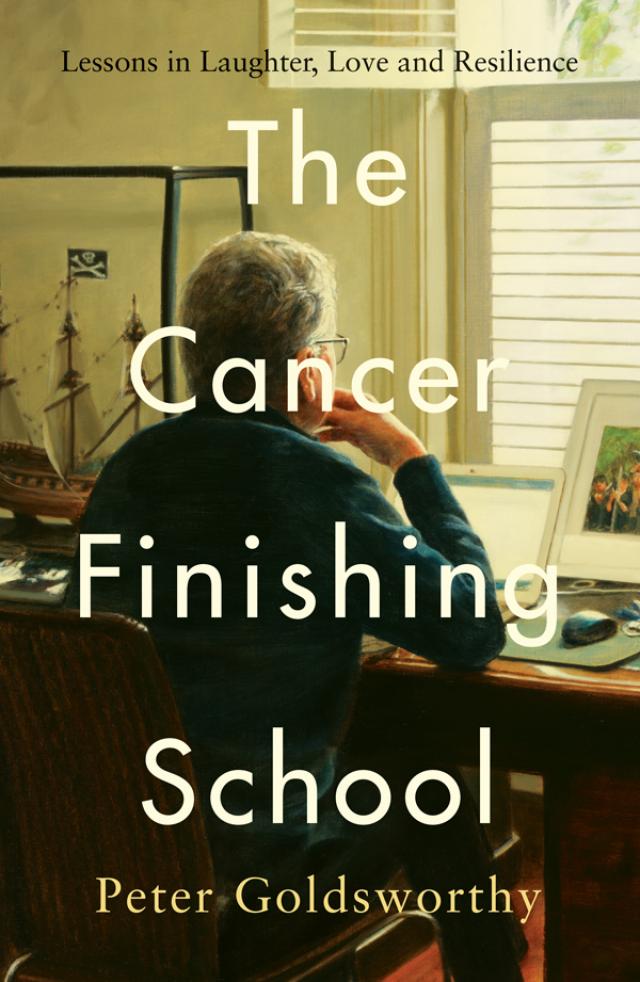
About the Book
‘My first stray thought: cancer is a gift. I might be lucky to have it. What priceless material for a doctor-writer!’
What lessons might cancer teach him before it finishes him off? Peter Goldsworthy asks, obliquely.
A GP of forty years’ practice, as well as one of Australia’s most awarded and celebrated writers, Goldsworthy (‘Doctor Pete’ to his patients) brings his characteristic black humour and storytelling power to the tale of his own cancer journey.
Accidentally diagnosed after a scan of his dicky knee, he was thrown into a world that he knew only too well from the other side: a world that soon shrank to hospital visits, sleepless and hyped-up nights on dexamethasone, and life-saving chemotherapy.
Never one to waste a story, Peter intersperses his own experience with odd and astonishing case stories of patients and literary friends who have trodden the same path: both cautionary tales and exemplary tales, sometimes laugh-out-loud, sometimes deeply moving, that intersect with, or refract, his own travels through denial, acceptance, treatment and survival.
Darkly funny, and filled with growing love and wonder, The Cancer Finishing School offers lessons in how to live life in the shadow of an incurable illness.
Contents
Cover
About the Book
Title Page
Dedication
Tomorrow
Part I: Cautionary Tales
1. False start
2. It
3. Cancer
4. Crime and self-punishment
5. Natural medicine
6. Cautionary tales
7. Cycling
8. Why write about it?
Part II: Denial
1. Writing the beginning first
2. Big win
3. Why me?
4. The bad
5. A short history of multiple myeloma
6. Father’s month
7. Grandchildren
8. Chemo
9. Patient’s guide to stem cell transplant
10. Further adventures in denial
11. Cigarettes
12. The wetsuit
13. Return of the joker
14. Heard it on the grapevine
15. Denial by proxy
Part III: Magical Thinking
1. Lunch at Joan’s
2. Exaggerated rumours
3. Hell
4. Heaven
5. Dad
6. Margot
7. The magic of science
8. The obituary
9. Scaffold style
10. Time out
Part IV: Dex Bliss
1. Chemo
2. Clock work
3. Graveyard
4. Nadia’s dream
5. A brief history of cortisone
6. The Antarctic book club of two
7. In a while, crocodile
8. Side effects
9. Sleep study
10. Le malade imaginaire
11. The necessary narcissism of illness
12. Remember me
13. Food fads
Part V: Strange Gifts
1. Dex mania
2. The irrits
3. Anxiety
4. Nocturnal poetic emissions
5. Consciousness studies 101
6. In the beginning
7. Personal saints
8. The man who mistook his doctor for a thief
9. I. M. Paul Blackwell
10. Saving lives
11. Noemi escapes from Hungary
12. Tania’s story
13. Two case studies in hubris
14. Harvest time
15. The plot thickens
16. A walk on the wild side
Part VI: Year Zero
1. Submission
2. Transplant Day
3. Home transplant. Days 1–10
4. Night 10
5. Days 11–20: shit as metaphor
6. Death in Varanasi
7. Taste
8. End-of-life planning
9. The Swiss finishing school
10. Awakenings
11. First-world problems
12. Uncle Oliver
13. Happiness revisited
14. Age of irony
Part VII: Home
1. Training wheels
2. Naive again
3. Day care
4. The four-year reading plan
5. The big bloke
6. Year Zero, Month 3
7. Rory
8. The parable of the three Samaritans
9. Night thoughts
10. No Ptolemy
Part VIII: Work Therapy
1. Return to work
2. My favourite doctor
3. Regrowth
4. Unreliable elegy
5. Hazel dies
Part IX: Plague Year
1. New ways of living
2. Time for a little something
3. Body parts
4. Post-COVID syndrome
5. Ants and bees
6. The milkshake
7. Putting your papers in order
8. Near-death experience
Part X: Lessons Learnt
1. The gift that keeps on giving
2. Journey as metaphor
3. Writing the ending, at last
4. What comes next?
The Blue Room
Acknowledgements
About the Author
Also by Peter Goldsworthy
Imprint
Read More at Penguin Books Australia
for Lisa
Tomorrow
I loved Tomorrow
from the first day we met:
her secret promises,
her sweet backward glances.
She was always the last thing
on my mind before sleep.
She made me feel special.
Often we talked all night:
her hopes and plans for us,
our future together.
Years passed, passion faded,
I began to take her for granted.
At times she disappointed me,
at times we quarrelled,
but when I needed a hand
hers was always there for me,
reaching back over difficult
midnights, hauling me across.
When did we begin to grow apart?
When did she start telling me lies?
When did I wake to find Tomorrow
had no time left for me at all?
Part I
CAUTIONARY TALES
Pebbles
If time is a river,
it washes our each soft pebble
rougher not smoother.
1. False start
‘Make sure you write the end first,’ Alan, one of my cancer patients, suggests when I tell him I plan to write the story of my own illness.
We laugh a little too loudly at the notion. If only a fairytale ending could be tacked onto any story, real-life as well as make-believe, and make it come true.
‘That would take away the suspense,’ I say. ‘Every good story needs an element of suspense.’
We share wry smiles rather than nervous laughter this time, born of our separate experiences. A cancer story is nothing if not a suspense story. Or, more accurately, a mix of suspense and mystery. Over the past forty years I’ve accompanied hundreds of patients on at least part of the journey to their endings, whether following from a clinical distance or holding their hands, literally as well as metaphorically. Yes, I still hold my patients’ hands at times, hug them and occasionally even kiss them, if only on the cheek. Physical affection is an evidence-based natural therapy, with few side effects – although the wrong dose tends to end up before the Medical Board.
Sometimes their cancer journeys have been sad short stories, sometimes decade-long epics, but in recent years, with the advent of the so-called novel chemotherapy drugs, happy endings have become more common, at least by the medical definition of a cure as not so much happy-ever-after as not-unhappy-five-years-after treatment.
Whichever way they end, and whatever the five-year survival rate, one thing these different stories have in common, besides the obvious pain and suffering, is suspense. Paradoxically, the exact opposite of suspense, boredom, is also a common thread: waiting-room boredom, all night insomnia boredom, the boredom of lethargy, listlessness and depression. But even when they – we? Surely not – lie becalmed in the doldrums, an undercurrent of suspense laps at the frail craft of the mind. Most cancer stories are serial dramas, serial edge-of-the-seat cliffhangers, especially on the eve of Results Day, or of Staging Day.
‘What stage is it?’ my patients, thoroughly briefed now by Dr Google, often ask about their own illnesses. Lately they’ve been asking the same question of mine.
‘You mean what stage am I on?’ I sometimes joke. ‘The next one out of town?’
Jokes are another useful alternative therapy, if not yet subsidised by Medicare, and, like hugs and kisses, not always appropriate.
‘Not funny, Dr Pete,’ the usually playful Barbra, a Greek matriarch who long ago decided to adopt me as an occasional, informal grandson, lectures me. ‘You need to take your cancer seriously.’
‘Must I? If I ignore it, it might go away.’
My foster yiayia remains unamused. ‘If you won’t think of yourself, think of me. I need you to see me out.’
‘I don’t think I can guarantee that, Barb. You’re indestructible.’
This, at least, at last, cracks a crooked smile across her face. Like the other matriarchs in my extended family of yiayiades, she takes a grandmotherly interest in my nourishment. She reaches into her bag for the usual afternoon tea offering. Today it’s sweet almond shortcakes, kourabiedes, thickly dusted with icing sugar. I bite into one immediately, with gusto, a small explosion of crumbs and powder, a bit of deliberately clumsy theatre that also amuses her.
As for longer term happy endings, and whether I see her out or she me, I don’t add that the best guess for most of us, cancer-staged or not, is a mystery destination somewhere between the short trip to the Dodge City graveyard and the long, if bouncy, slow coach to old age. My mouth is too full for that.
2. It
When patients ask about their own illness, the unfunny facts must always come first. Has it, they need to know, spread? Is it growing? Shrinking? In remission?
It.
The growth.
The mass. The tumour.
The neoplasm, a typically obscure medical code. The ‘mitotic lesion’, even more so.
The ‘long illness’ that is the default code of obituary columns.
Jack Dancer. The big C. The carcinoma. The (coined here, just now) mystery-destination stage.
The malignancy.
This last blunt word, at least, pulls no euphemistic punches. What’s the opposite of a euphemism? The plain, no bullshit – if hard to speak at times, especially to ourselves – truth? Which is precisely why the most truthful of all such words, two simple syllables, taken from the Latin word for crab (itself a translation from the Greek of Hippocrates, carcinos, from which, more directly, carcinoma) is the hardest of all to speak.
3. Cancer
Once the word is spoken, and thereby admitted, its most troublesome mystery must also be confronted: why?
Less why it, first-up, than why me?
Our restless brains don’t cope well with a dangling ‘why?’. They’ve been programmed by six million years of evolution to find patterns, attach causes to effects, impose narrative arcs. Worry is the brain’s default search engine, anxiety its highest-octane fuel; like some hardwired chess program it must forensically trace every possible move, every pathway in the search-tree to find a solution.
And what bigger worry than death? Or cancer, its master apprentice, which in the back of our minds, where euphemism hath no power, is still a synonym for death.
It’s worth remembering there were, and are, no natural deaths in hunter-gatherer societies, not even from old age. Something or someone was always to blame: gods, ghosts, sorcerers, evil eyes, hidden hands, plus, of course, any useful human scapegoat that came to hand. Nothing changed when we came in from the ice-age cold and began living in cities: read almost any god-haunted page in Homer, the Bible, the Aztec or Mayan codices, the Sanskrit epics.
There are exceptions, such as the second millennium BC Edwin Smith Papyrus, a collection of carefully forensic medical case studies, sometimes attributed to the earlier Egyptian thinker Imhotep. But the exception proves the rule; even the famed Diagnostic Handbook of the Babylonian sage Esagil-kin-apli, set down on cuneiform tablets many centuries later, while scrupulously observant of physical symptoms, was primarily intent on exorcising their supernatural causes. His diagnoses also included any omens that a physician (read exorcist) might encounter en route to a house call in ancient Babylon. My favourite: if a piebald pig crosses your path your patient has dropsy. The pre-Enlightenment Europe of exorcisms, witch burnings and trials by ordeal wasn’t much different.
Are we, today? Magical thinking is always lying low, biding its time in each of us – even the most outwardly irreligious. I flipped from zealous Methodism into zealous atheism at age thirteen, almost overnight, and have believed ever since that irreverence is the Eleventh and most important Commandment. Well, love thy neighbour as thyself and irreverence. But there are no atheists in foxholes, as army chaplains have long understood, and I proved to be no exception when, twenty years ago, I prayed, overcome by dread and helplessness, for the life of my son.
Daniel was in the foxhole, not me: critically ill in an intensive care unit in London, bleeding into his chest cavity and not expected to survive the night. His dodgy lungs were inherited from me – mine had likewise beached me in intensive care for a month aged nineteen – but his haemorrhaging was far worse, complicated by a bleeding disorder inherited from his mother.
Why Daniel? Why this particular ‘It’? Because his parents were to blame? We might have innocently inherited the same problems from our parents, but guilt, however irrational, was inescapable. His wife of no more than a month, Mutale, and her parents were at his side; the genetic culprits, Helen and I, were a twenty-four-hour flight away, powerless.
Of course I prayed, for the first and only time in my adult life. I did not and do not believe that prayer can affect the material world, at least outside the rubbery material inside our skulls. Later I told myself that my prayer was a version of Pascal’s tongue-in-cheek deathbed wager – with nothing to lose, and everything to gain, why not pray? – but that wasn’t in the least bit true. It was nothing more or less than its own urgent, deadly serious self, a prayer that was forced out of me, vomited out by the pressure of powerlessness, along with the tears that accompanied it.
Please, God, save him. Please.
Religion is the opiate of the people, Karl Marx famously wrote, but the rest of the quote is usually forgotten. Religion is also ‘the sigh of the oppressed creature’; the sigh of the powerless, in short. Something produced under pressure from within, not merely taken, like a narcotic. Labelling such primal urges as superstition doesn’t make them go away, just hibernate, waiting to sprout fresh shoots: they are a very thick and very ancient branch of the forensic search-tree. How could they not be? Oppressors and oppressed alike are powerless in the face of death, against which religion was once the only palliative. Without finding answers, we are helpless. Without cause there can be no cure, whether it be prayer, penance, vengeance, blood sacrifice, magic potions or that great fulcrum of so many ancient suspense narratives, magic weapons.
In short, if we can’t find a cause, we’ll invent one. We need to invent one; we can’t help ourselves. Daniel survived, as I had, decades before, due to the semi-magical weapons of the thoracic surgeons. Prayer had nothing to do with it. But even as I laughed the impulse off, my guilt persisted, dumbly, a kind of spell itself, a black magic that couldn’t be shaken free, especially in the small, dark hours.
Guilt often feels like that to me, a tune I can’t get out of my head, less an earworm than a conscience worm, and less a penance granting release than an extra punishment, endlessly repeated without getting anywhere.


