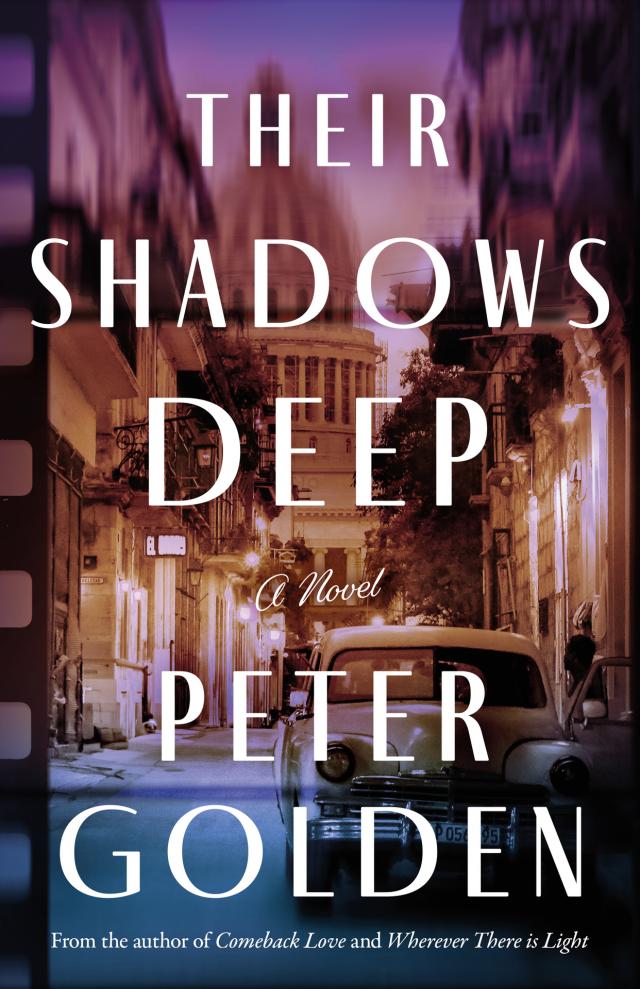
Their Shadows Deep: A Novel, page 1


Praise for Peter Golden
“An absorbing story . . . Golden knows how to pique our interest . . . Vivid characters and strong storytelling.”
—The Washington Post
“Keenly detailed . . . compelling . . . Author Golden proves his stripes as a historian, detailing the lovers’ brief bliss in prewar Greenwich Village, separating them for their individual battles during the war, and reuniting them in a skillfully evoked postwar Paris . . . The love story is epic and truly felt. Fascinating, complex.”
—Kirkus Reviews
“Each setting is recreated with a socially conscious eye, from the horrifying racism of the Jim Crow South to the Greenwich Village art scene to postwar Paris, whose residents’ emotional suffering hasn’t dimmed their appreciation for beauty. Julian and Kendall are independent, courageous people who grow over time, and their story feels undeniably romantic.”
—Booklist
“Glenna and Gordon’s romance rises and falls with the familiar but engrossing tempo of reckless, youthful passion.”
—Publishers Weekly
“Golden draws a vivid portrait of the Cold War era, but it is the complex and unexpected connection between Holocaust survivors and their descendants that turns this book into a page-turner.”
—RT Book Reviews
“Both heartbreaking and mesmerizing.”
—Lisa Wingate, New York Times bestselling author of Before We Were Yours
“Stirring and romantic, a sweeping novel about first loves and second chances.”
—Sarah Pekkanen, author of The Opposite of Me
“An absorbing, intelligent novel about retracing one’s steps to recover what was lost, and about coming to terms with the mistakes of the past in order to rediscover a future. Peter Golden reminds us that going back is sometimes the only way to move ahead.”
—Elizabeth Brundage, author of A Stranger Like You and The Doctor’s Wife
Also by Peter Golden
Nothing Is Forgotten
Wherever There Is Light
Comeback Love
O Powerful Western Star!
Quiet Diplomat
This is a work of fiction. Names, characters, organizations, places, events, and incidents are either products of the author’s imagination or are used fictitiously.
Text copyright © 2025 by Chestnut Street Press Inc.
All rights reserved.
No part of this book may be reproduced, or stored in a retrieval system, or transmitted in any form or by any means, electronic, mechanical, photocopying, recording, or otherwise, without express written permission of the publisher.
Published by Lake Union Publishing, Seattle
www.apub.com
Amazon, the Amazon logo, and Lake Union Publishing are trademarks of Amazon.com, Inc., or its affiliates.
ISBN-13: 9781662525971 (paperback)
ISBN-13: 9781662525988 (digital)
Cover design by Shasti O’Leary Soudant
Cover image: © Alexandre Rosa / Alamy; © Simon Herrmann / Getty
Interior image: © Denys / Adobe Stock
For Molly and Benjamin,
with best wishes from the past
and hope for the future.
And for Annis, with love.
Contents
Epigraph
Part I
Chapter 1
Chapter 2
Chapter 3
Chapter 4
Chapter 5
Chapter 6
Chapter 7
Chapter 8
Chapter 9
Chapter 10
Chapter 11
Chapter 12
Chapter 13
Chapter 14
Chapter 15
Chapter 16
Chapter 17
Chapter 18
Chapter 19
Part II
Chapter 20
Chapter 21
Chapter 22
Chapter 23
Chapter 24
Chapter 25
Chapter 26
Chapter 27
Chapter 28
Chapter 29
Chapter 30
Chapter 31
Chapter 32
Chapter 33
Chapter 34
Chapter 35
Chapter 36
Chapter 37
Chapter 38
Chapter 39
Chapter 40
Chapter 41
Chapter 42
Chapter 43
Part III
Chapter 44
Chapter 45
Chapter 46
Chapter 47
Chapter 48
Chapter 49
Chapter 50
Chapter 51
Chapter 52
Chapter 53
Chapter 54
Chapter 55
Chapter 56
Chapter 57
Chapter 58
Chapter 59
Chapter 60
Chapter 61
Chapter 62
Chapter 63
Chapter 64
Chapter 65
Chapter 66
Chapter 67
Chapter 68
Chapter 69
Part IV
Chapter 70
Chapter 71
Chapter 72
Chapter 73
Chapter 74
Chapter 75
A Note on Sources
Sources
Acknowledgments
About the Author
When you are old and gray and full of sleep,
And nodding by the fire, take down this book,
And slowly read, and dream of the soft look
Your eyes had once, and of their shadows deep.
—W. B. Yeats
Part I
Chapter 1
Greenwich Village
December 1959
Caitlin Russo was being watched. The man was across MacDougal. His fedora and topcoat with the upturned velvet collar were out of place among the Saturday-night parade of beatniks, students, and assorted lunatics swarming past him in Salvation Army castoffs. But he was staring at her. Caitlin’s maiden name was Gallagher, and willowy Irish girls with a cascade of reddish-brown hair and electric-blue eyes knew about getting stared at.
As the man cupped his hands to light a cigarette, Caitlin started walking. Christmas lights shone in the shop windows, and bursts of music leaked from the coffeehouses. She was supposed to meet her husband at Café Bohemia, on Barrow Street. Miles Davis was in town, and Gabe was a jazz fiend and had become friends with Miles after the war. Gabe had been working narcotics in Midtown then, and Miles had gotten busted copping heroin outside the Three Deuces before playing his set. Gabe had collared the dealer and let Miles slide. The quickest way to Barrow was up Sixth Avenue, but Caitlin wanted to find out how serious the man was about watching her and decided to take him through Washington Square Park.
He was walking along with her on the other side of MacDougal. Staying on her side of the street, Caitlin walked up to the corner of MacDougal and West Fourth, waited for two cars to pass, and then darted into the park. Up ahead, an old woman with long white hair was sitting on a bench with a blanket over her shoulders. Caitlin looked back. His hat was pulled low, so she couldn’t see the man’s face. A trio of coeds in raccoon coats staggered drunkenly past him, singing “Do You Wanna Dance?” After they turned onto West Fourth, the man was gone.
Still, Caitlin would take the long way through Washington Square. You can’t be too careful. Caitlin’s mother repeated that warning so often, with her pink-beaded rosary in her hand, that it might as well have been part of the Apostles’ Creed. Caitlin gave the old woman on the bench a dollar. The woman gazed up at her with eyes as vacant as the night sky. Caitlin remembered nursing her mother and her mother looking at her as if she were a stranger. Caitlin liked to think that her mother had recognized her before she died.
Faith, Hope, and Charity. Caitlin believed in all three.
Chapter 2
Manhattan
“Where did you get this shit?” Jack Kennedy asked.
He was on the phone with the author of a Kennedy-family biography scheduled to be published in the spring. The writer had sent him the galley proofs, and Jack had finished reading the pages in his penthouse duplex at the Carlyle Hotel.
The author, a freelance writer, said, “From an interview I did with your father in 1945.”
Jack felt as if his head would explode. “After the Nazis got done murdering millions of Jews?”
“Yeah. That’s why I didn’t pitch the interview to any magazines.”
The galley was on his lap, and phrases Jack had underlined jumped out at him:
Honestly, I’ll tell you, I’m not a fan of some Jews, but I don’t want them thrown into gas chambers.
If Jews would quit talking about everyone hating them, people wouldn’t hate them so much.
Jack said, “My father knew you quoted this garbage in your book?”
“Senator, your father’s been helping me.”
Jesus, what was his father thinking? He had been just as tone deaf when he had served as ambassador to Great Britain in the run-up to World War Ii and he got going on his isolationism rants and tried to convince Roosevelt and Churchill to cut a deal with Germany.
Jack removed his reading glasses. “Get rid of my father’s comments on Jews.”
The author’s voice shot up an octave. “The publisher’s read
y to print.”
“Tell him to get unready.”
“Senator, it’ll cost a fortune.”
“It’ll cost a lot more when I get my father to sue you silly bastards.”
The author was still talking as Jack slammed down the receiver. A slice of chocolate layer cake was on a room service cart. He was shoveling the last bite of it into his mouth when the phone rang. Jack knew it was the ambassador.
“Hiya, Dad.”
“That writer called. Why you giving him the business? He’s a poor mick living in some town in Arizona and just trying to earn a buck.”
When it came to politics, Jack thought, Joe Kennedy could be brilliant. It was the ambassador who had convinced him, four years ago, that the country was ready to put a young Catholic war hero in the White House. And his father had backed up his optimism with millions of dollars for his campaign. Yet here was his other side, a baffling tactlessness, and Jack was slow to reply because his father was unaccustomed to his children criticizing him.
“Dad, if those quotes come out, I can forget about the Jewish vote. I’ll lose New Jersey, Illinois, Florida, maybe New York, and definitely California—Nixon grew up there.”
“Jack, I call ’em like I see ’em. With Jews, wops, the coloreds, and my own kind. You know how many shamrocks I bought drinks and the SOBs threw up on my shoes to say thanks?”
“Can’t we lay off the Jews? And the Italians, Negroes, Hindus, or anybody else you feel like telling off.”
“I’ve never said a goddamn word about Hindus.”
Jack laughed. “I need a favor.”
“What now?”
“My friend Gabe’s wife knows Julian Rose. Gabe’s going to ask her to set up a meeting with me, you, and Bobby.”
His father snapped, “Julian and his gangster pal Longy Zwillman, those sheeny bastards hijacked a shipment—”
“Longy hung himself ten months ago, so let’s skip the good old days of Prohibition.”
“I know, Jack. You think I’m too old to read the newspaper?”
“All I think is that except for FDR, New Jersey usually goes Republican, and Julian can help turn that around. That’s sixteen electoral votes.”
“Don’t expect me to come north and freeze my ass off. Tell Julian I’ll see him in Florida. Is that all, Jack?”
“I love you, Dad.”
“You should,” the ambassador said and hung up.
Jack knew his father believed every move he’d made since the end of the war had been done in his son’s interest, so butting heads with him left Jack feeling guilty. He wished his sister Kathleen was alive. Kick had a way with Dad. She had a way with everyone. Jack remembered the scowling old man in a hunting cap who collected seashells on East Beach. All the kids had been frightened of him until Kick dropped a handful of periwinkle shells in his pail and treated him to one of her dimpled grins. His eyes had opened wide, as if he were offended by her forwardness; then he’d broken out in a toothless smile. That was Kick’s gift: a talent for improving anyone’s day.
A knock sounded on the door. Jack stood, his lower back throbbing. Opening the door, he found a young blonde in a tight, salmon pink dress before him—just what the doctor ordered.
“Please,” Jack said, stepping aside. “Come in.”
Chapter 3
Gabe was double-parked under a streetlamp outside Café Bohemia. Caitlin was shivering when she got into the Chevy Bel Air.
He cranked up the heat. “You OK?”
“Some creep—”
“Where?”
Caitlin turned to Gabe. His father’s family were Jews originally from Madrid, and with his black hair curling out from under his tweed cap, dark eyes, and features as precise as a wood carving, Gabe could have passed for a Spanish nobleman. There was something thrilling about his face, an alloy of feral intelligence and restrained fury, which made Caitlin feel as if nothing could hurt her.
She said, “I dropped off our deposit for the apartment, went for a cup of coffee at Caffe Reggio, and when I came out, he was on MacDougal watching me.”
“What’d the creep look like?”
“Fedora, expensive topcoat.”
“That’s the best you can do? C’mon, Cait. You used to be a cop.”
Caitlin heard a note of fear in his voice and regretted mentioning the creep. Even though Gabe was thirty-seven, nine years older than her, and had been a detective and a marine decorated for bravery fighting the Japanese on Okinawa, he was a worrier—a tendency, he conceded, that he shared with his mother, who had come to America from Kyiv as a girl and never lost her conviction that the Jew-hating Cossacks had followed her to Brooklyn. And lately, Gabe worried more than ever. It didn’t help that they were residing in his parents’ apartment in Flatbush. Gabe had moved back in to look after his ailing mother and father, who’d died within months of each other. That was a year ago, and Gabe couldn’t bring himself to leave his childhood home. Caitlin blamed Gabe’s anxiety mainly on his new job. Running errands for the State Department was all he’d say about it. Caitlin didn’t believe him. She suspected the work was dangerous and he didn’t want to scare her with the details. It paid well. Gabe shopped at Brooks Brothers now and had bought her a diamond-and-emerald wedding band and agreed to rent a bigger place in Greenwich Village. But he traveled frequently and returned from his trips quiet and distant, sitting by the window, watching the people on Ocean Avenue, and chain-smoking Camels. His silence worried Caitlin, and when she would finally ask him what was wrong, he’d brush her off with a quip. “The Dodgers moved to Los Angeles,” he’d say and grin.
Now, Caitlin said, “If I remember anything about the guy watching me, I’ll tell you.”
Gabe frowned and started driving uptown. “I’ve got to make a stop.”
Caitlin leaned against him, and he put his arm around her. “What time do we have to leave for Washington next Sunday?” she asked.
“Été’s plane gets in from Paris at two, and we’ll pick her up and go.”
“Her novel was terrific.”
“That’s why I volunteered to drive her down. You want to be a writer. Maybe she can help. And we’re going to Joe Alsop’s. I told him about you. Besides his column for the Herald Tribune, he writes for the Saturday Evening Post. Joe says he’s got an idea for you.”
On Seventy-Ninth Street, Caitlin spotted a woman standing between two children with her arms over their shoulders while they looked up at a whirl of snowflakes, and suddenly, she missed her mother. “There’s room for a baby in the new apartment.”
Gabe grinned. “I noticed. Want to hop in the back seat?”
They were stopped at a red light. Caitlin put a hand on his thigh and massaged the pinstripe flannel of his trousers.
“That’s a start,” Gabe said.
At night, traffic was sparse on Riverside Drive, and as Gabe backed into a space across from the park, he said, “I’ve got to see a guy.”
“Who?”
“Just a guy.”
Caitlin, annoyed by another one of his secrets, changed the subject. “What’s Jack Kennedy like?” Gabe had been with the NYPD in 1950, when fighting broke out in Korea and the marines recalled him. For some inexplicable bureaucratic reason, he had been shipped to French Indochina to guard the American legation in Saigon, and Kennedy, hoping to run for the Senate and wanting to buff up his foreign affairs résumé with a tour of the Middle East and Asia, stopped in the city. Gabe had given him his take on the war between the French and the Indochinese Communists. They became friendly and had kept in touch. Caitlin assumed Kennedy had helped him get his new job, though that was another thing Gabe wouldn’t tell her.
Gabe said, “Jack’s smart and funny. He’ll be at the party on Sunday.”
Caitlin smiled. “He’s very handsome.”
He arched his eyebrows in mock horror.
“Not as handsome as you.”
“That’s better,” he replied and kissed her. “Be right back.”
After taking a briefcase from the trunk, Gabe crossed Riverside to a dingy brick apartment house and entered a vestibule. He pushed the button for 901 and was buzzed in. The apartment was across from the elevator. Victor Diaz, in a zebra-striped dressing gown and velvet slippers, was waiting for him in the doorway.
“Hola, Gabriel.” Victor was about forty, a wiry Cuban as blond and blue eyed as a Swede. He had been a pimp in Havana, then relocated to Miami Beach, where he’d discovered arranging to smuggle American small arms was more profitable than renting out women.