

The Ambassador, page 17
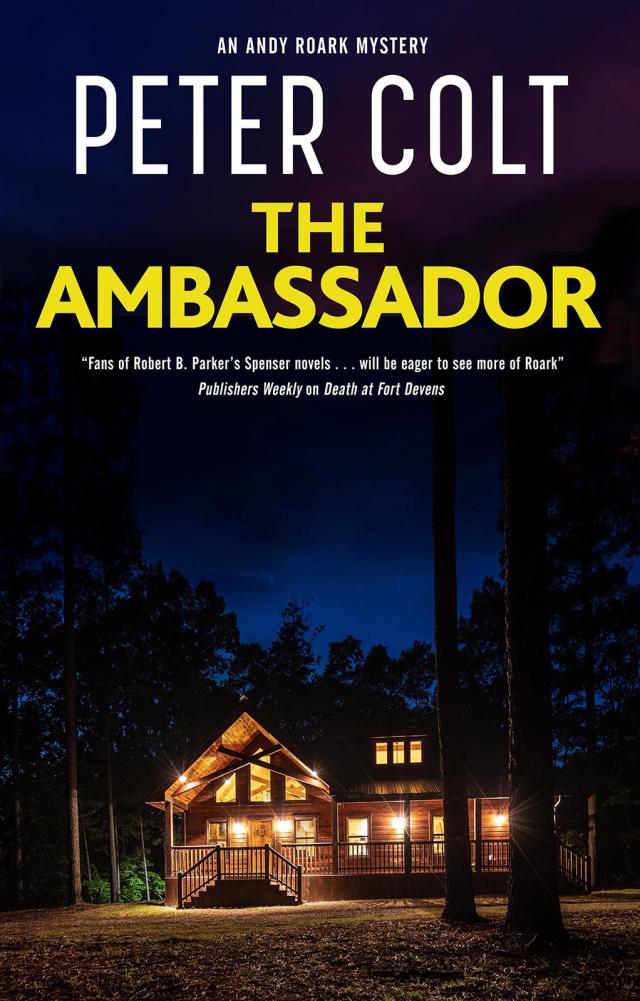


I walked around to the front of the house, passing the parked cars by the driveway. I walked up the hill and then up the steps and went to the edge of the patio, the side facing the valley. Between the house and the tree line was the backyard, a grassy hill that sloped steeply down to the woods and the road beyond that.
I went inside and was treated to the smell of bacon cooking and coffee brewing. I grinned to myself as I pictured Frieda pouring my offensive attempts to percolate down the drain. I walked into the living room to find Honey and Stevenson already at the table.
‘Roark, come have something to eat. Breakfast is a pretty informal affair here.’ Stevenson was in gregarious host mode.
‘Yes, Mr Roark, do.’ Honey was the soul of politeness.
‘Sounds great.’
As with dinner the night before, there were serving dishes in the middle of the table. One held eggs that were scrambled with green peppers, onions, and cubes of Virginia ham. Another held breakfast potatoes that had been uniformly cubed as only an elderly German lady could. They were brown and I would bet a little crunchy but soft inside. There was a plate with bacon laid out on it. It was cooked perfectly, with a little life left in it and some fat at the ends. The Army had convinced me that it was OK to eat bacon cooked to the point of fossilization. It had taken me years to readjust.
There was a plate with toasted English muffins, pre-buttered. However, in the Stevenson house you could pick from a variety of jams and jellies in fancy jars and labels. Every one was French or English, no Smucker’s grape jelly here. Both tea and coffee could be had from either the teapot or the electric coffee pot on the table.
I picked up a plate, covered it with food, and then filled my coffee cup.
‘Mr Roark, how was your walk?’
‘Very pleasant. I was enjoying your woods. I saw a deer.’
‘Yes, do be careful. It will be hunting season soon, and you shouldn’t go out in the woods without something orange on to let the hunters know you aren’t a deer. Some of the locals like to take them out of season,’ Honey said.
‘Ha. Honey, I bet Roark would be fine. Hell, the best soldiers in the North Vietnamese Army couldn’t kill him when they were hunting him. I think he’d be fine with a couple of local yokels in the woods.’ I didn’t feel like pointing out to Stevenson that the NVA had managed to shoot me, just not kill me.
‘Thanks. I don’t want to get shot.’
‘Again?’ Honey added unnecessarily.
‘Well, I can’t say that it is a pleasant experience. Plus, I bruise easily.’
‘Hahaha, see that, Honey. What a tough guy. He even jokes about being shot.’
‘Well, it is better to laugh than cry,’ I said.
‘You’ve been shot before?’ Maureen had appeared in the living room from around the big brick chimney/wall.
‘One of the hazards of being in the Army, I guess.’
‘That’s right. Vietnam?’
‘Yes, I was too young for the other wars, even the Dominican Republic thing.’
‘Is that what happened to your ear?’
‘Similar people, wrong war.’
‘Communists?’
‘No, Vietnamese gangsters, here in America, several months ago.’ It had been long enough ago that my earlobe only itched occasionally.
‘Oh, I thought you said you weren’t a very good detective?’
‘If I had been a better detective, I wouldn’t have been in the situation to begin with.’
‘Did you at least get the girl?’ Maureen asked.
‘No, and I lost my car too.’ It had been a rough month.
Bradley and Gordon Junior walked in, said their ‘good mornings’, filled plates and sat down. Maureen turned to Bradley and said, ‘Mr Roark was just telling us that he isn’t a very good detective.’
‘Oh, I hope that isn’t the case.’ Bradley looked queasy.
‘Unfortunately, it was. I really liked that car too.’
‘I meant the part about your being a poor detective.’
‘Only my finances … the rest of me is A-OK.’
‘Mr Roark, can I ask you a question?’ This from Gordon Junior.
‘Sure.’
‘How did you end up in Vietnam? I mean were you, like, drafted and had to go or …’
‘I grew up in South Boston, Southie. I screwed off and got kicked out of university. I didn’t want to go back home to Southie or a dead-end job in a mill. The Army offered me a way to avoid that, so I enlisted and eventually ended up in the pearl of the Orient.’
‘You enlisted knowing you’d go to Vietnam?’ he asked incredulously.
‘Yes.’ I didn’t blame him. Everyone who went to college from the late sixties on had been taught to believe that the war was wrong, and the government was wrong, and that those of us who volunteered were wrong too.
‘Did you kill anyone?’ It seemed a question more suited to a ten-year-old than a man in his late twenties.
‘Gordon!’ Honey exclaimed. I guess that wasn’t her idea of polite breakfast conversation.
‘Yes, I did.’ It wasn’t something I was particularly proud of, nor was I guilt-ridden about it. It had been part of the game. It didn’t matter if it was with a gun or a radio calling in air strikes, dead was dead, and I had killed.
‘But the war was wrong. It was immoral,’ he said indignantly.
‘Never had the time to really think about it. We were too busy trying to stay alive in our little section of it.’
‘Roark, don’t hold it against the boy. They get indoctrinated in the schools these days. It isn’t his fault he went to Dartmouth.’
‘I should go shower.’ I stood up. There was no point arguing with the boy. There was no way to explain it to him. He didn’t have the context to understand anything more about it other than what he had been taught. There was no explaining that very quickly war becomes about your team, your brothers, and not much else. I picked up my plate and cup and went into the kitchen. Frieda was sitting at the plain oak kitchen table with Baz, who was eating breakfast.
‘You were in Nam, mate?’
‘Yes.’
‘Me too. I was in the 25th.’
‘Funny, I didn’t take you for an American, much less a veteran.’
‘I am, well, sort of. My mum was Rhodesian, my dad American. I lived in Rhodesia until I was thirteen then I moved to California.’
‘When were you there?’
‘Sixty-nine and seventy. Then I went home and joined up with the Rhodesian Light Infantry. Now that was some shit. You thought fighting the communists was bad … nothing like Rhodesia. Fought at home until there wasn’t a home to fight for anymore. Then moved back to the US and realized I could make money being a bodyguard. You?’
‘I was there in sixty-nine, in the northern part of the country. Went home, was a cop for a while and decided that I didn’t like taking orders anymore. That is how I ended up here.’ I was leaving a lot out, but I wasn’t in the mood to swap war stories with Baz. After Gordon Junior’s comments and Gordon Senior’s big, loud show of bonhomie, I needed a little break from everyone else’s opinion about the war.
‘Yeah, we can swap notes sometime,’ I said with absolutely no conviction.
I walked out of the kitchen and then down the stairs into the land of knotty pine and Stevenson’s memorial to his career. I took my .38 out of my waist and put it behind a copy of Bernard Fall’s outstanding Street Without Joy on the bookshelf in the bar. Then I took my shaving kit and clean clothes to the shower.
The bathroom was small, and the tile-covered shower was dark and mildly claustrophobic. The water was hot, and I washed, trying as much to clean myself as rub away the mild annoyance that the morning had offered me already. I was about to turn the water off when Maureen pulled the shower curtain back. She put a hand on my chest and pushed me back into the shower.
‘You missed a spot,’ she said teasingly.
‘Where is that?’
‘Let me show you.’ And she did. She showed me one or two more while she was at it. I kissed her deeply and ran my hands over her body. The shower was a tight fit, but we managed to make it work, and there were advantages to being with a woman who was only a few inches shorter than I was. Several minutes later, she had finished showing me the spots I had missed, the water was going from hot to tepid, and we got out.
Fortunately, our breathing was no longer the ragged breathing of sprinters. I enjoyed watching her as she toweled off. She wasn’t a slim woman, but she had curves and wore them well. She looked as though she had spent time riding horses around the farm. I dried myself off, aware of her watching me too.
‘That was nice,’ she said, smiling.
‘I am glad to hear it. I would say the day is off to a good start.’
‘You’re staring.’
‘I’d be a fool not to.’
‘I’ll blush.’
‘It’s a bit late for that, don’t you think? And you are staring too.’
‘I am. I am sorry. Are those bullet wounds?’
‘The scars? A couple. Some are from shrapnel.’ There was a pretty gnarly one from a piece of white phosphorus that one of my Yards had to dig out with the tip of his knife.
‘You seem to have been wounded a lot?’
‘Well, most of it is from Vietnam.’
‘God. Why? It can’t be worth it, the war, the cops, this?’ she said, looking up at me from an odd angle while she dried her red hair with a towel.
‘I don’t know. I have never thought about it. It is just what I did, what I do.’
‘Well, I am glad that I write books. I don’t think I could do what you do.’
‘It isn’t for everybody,’ I said lightly, hoping to turn it into a joke.
We dressed and she slipped out after giving me a light kiss on the lips.
I wanted a cigarette, but it was a bit of a cliché, and I wasn’t in the mood for that. I also wanted a nap, but that wasn’t in the cards either. I quickly folded up my bedding and put it in a neat stack on the end of the couch. After I put on my sneakers and retrieved my .38, I went back upstairs to find Stevenson and start going through his journals. As I passed by the kitchen, I heard Frieda complaining in German about the lack of hot water for her to wash the dishes. The little grandmotherly lady used language that would have made a sailor blush.
Stevenson was sitting at the dining-room table with the coffeepot and stacks of old journals piled around him like he was in some sandbagged defensive position. In many ways he was, given that Kovach or somebody was out there sending threatening notes and making half-hearted attempts to kill him.
‘Roark, pull up a chair. Grab an ashtray, you look like you could use a smoke.’
‘I don’t want to run afoul of Frieda.’
‘Nonsense, just crack a window.’ I did as I was told. I took a fresh cup and filled it with coffee from the pot and settled in with Stevenson to go through his journals.
It felt strange, sitting down to read the intimate thoughts of a man who was a part of history and who had played such a significant role in my part of the war. It was mildly uncomfortable and felt a little bit voyeuristic.
‘Where do you want to begin?’ he asked me.
‘How far back do these go?’
‘College, but those are mostly sentimental and philosophical musings and observations.’
‘After that?’
‘The war and the OSS.’
‘Seems like a good place to make an enemy. Let’s start with those.’
THIRTEEN
It took us two days to go through his journals. The first day was boring and, except for Bradley and Frieda, we didn’t see anyone. That night at dinner it was just Honey, Bradley, Stevenson and me. I had no complaints because the excellent roast duck was stuffed with apples and buckwheat was not something I wanted to share with anyone I didn’t have to. Stevenson had again managed to pair it with an excellent bottle, this time of red wine. Thankfully Honey only had a half-glass, leaving all the more for us.
Later the Ambassador and I adjourned to the lower floor, and I listened to his stories about Washington and his various postings. The stories had the feel of often-repeated cocktail party fare. They were interesting enough, but not as interesting as his journal entries about his time in the war.
His early months in the Navy, when he described going through his initial training, were not unlike the college journal entries we went through the day before. But it was fascinating to hear about his time on destroyers, and it reaffirmed my belief that I was not cut out for the Navy or life aboard ship. I did all right on the ferry to Nantucket, but that was as much time as I wanted to spend at sea.
There wasn’t much of interest between his time on the ship and when he ended up in the OSS. Stevenson’s ability to speak French made him quite valuable to the OSS. He was sent to work with a small team operating in and around French Indochina, which was occupied by the Japanese. His time in the OSS was fascinating, as he had been in Indochina twenty-five years before I got there. He had worked with the communists at times, fighting the Japanese. Those stories were the stuff of adventure novels. Stevenson had acquitted himself well and, by war’s end, was a lieutenant commander with a chest full of medals.
We drank too much bourbon. Stevenson was the type who liked having an audience and that led him to have a heavy pour. I went to bed wondering what type of shape I would be in in the morning. Waking feeling better than I had any right to. Breakfast was the same every morning and after a post-breakfast cigarette we would set to work.
It was interesting seeing his take on events that had turned up in my research at the Boston Public Library. Then there were things that hadn’t made it into the BPL research, like a trip to Africa to hunt big game with a friend from the OSS. It was right out of Hemingway but not as well written.
From Africa, it was off to Canada and his days prospecting for uranium. His journals made mention of the fact that Stanhope was a drunk but a decent enough pilot when he was sober. His description of their big find and his sale of it was oddly lacking in detail.
That was quickly overshadowed by his courtship and marriage to his first wife. He was married and in the State Department. He was investing wisely with the help of his brother-in-law, and Gordon Junior was born. Then he was posted to Asia. He was leaving the Philippines for his role as head of mission in Laos by the time we decided to break for lunch.
Lunch was a simple affair. Frieda brought us a basket of bread and a plate piled with slices of fancy Serrano ham from Spain. There were slices of cheese on the plate too, and a small pot of mustard. Stevenson opted for sweetened iced tea, and I just had a glass of water. We made small open-faced sandwiches; the Serrano ham was unlike anything I had ever tasted. I knew I would never be able to afford it on my earnings.
‘Is anyone leaping out at you?’ he asked me.
‘The only person, other than your ex-wife, would be Stanhope.’
‘Stanhope?’
‘There is an argument to be made that he might view your good fortune with some jealousy.’
‘Sure, sure … he might. But he has been dead for years now.’
‘I know. That is why I ruled him out. What happened there?’
‘You mean, did I cheat my friend?’
‘Yes, exactly.’
‘Stanhope was a drunk, not a bad man, but he drank his money away. The business wasn’t going well, and he was worried about it going under. I found out that one of our claims was the big one. He was trying to sell it for pennies to keep his plane up in the air.’
‘What did you do?’
‘Oh, I gave him a bottle of rye, and several drinks later he signed everything over to me. It wasn’t a nice thing to do, but it was better than having him sell our claim for pennies.’
‘What happened?’
‘I skipped out and sold the claim to a big Canadian mining concern. I wired Stanhope a few hundred dollars so he could join me in the States. He sent me a telegram that told me where to go. I met my first wife and sometime later I heard or read that he died in a crash. I wish it had worked out better. If he were alive, he would make the perfect suspect for all of this.’
‘Not very convenient of him,’ I said dryly.
‘No, but your Kovach looks good too.’ I didn’t bother to point out that Arno Kovach wasn’t mine.
‘He does,’ I said reluctantly.
‘But you have doubts?’
‘Yes, but I am not entirely sure why. Maybe motive.’
‘Motive?’
‘Whoever is doing this is going to a lot of effort to get under your skin. Whoever it is has a grudge, but you don’t remember Kovach.’
‘You think that if it is him, did I do something so bad to him that I should remember it?’
‘Maybe, you were responsible for a lot of people. Did you have a policy about GIs marrying local girls?’
‘It was heavily discouraged. If they were attached to the embassy, or USAID, which in reality most Americans were, then it was up to me. If they were with the Company, then that was up to their chain of command to deal with. But if I had anything to say about it, the answer was no.’
‘Did it come up a lot?’
‘Not often. Most of the people we ended up with were older, more mature. Once in a while you might get an Air America guy, usually a sheep-dipped Air Force type who might fall in love. But it wasn’t very common.’
‘OK, well, do you remember any Lodge Act guys in your outfit? Kovach is Hungarian, with an accent.’
‘Sure, we had some, but the ones that stand out really stand out. I know them, I know their names. I don’t remember anyone named Kovach. He might have been there. We were fighting our own war. He might have been at a camp somewhere or with Vang Pao’s people.’
‘So, it’s possible he was there, and not inconceivable that he wanted to marry a local girl and you kiboshed it?’
‘Sure. That is possible.’
‘OK, makes sense. Let’s do our due diligence and see what there is to see in your journals.’


