

The School for Thieves, page 1
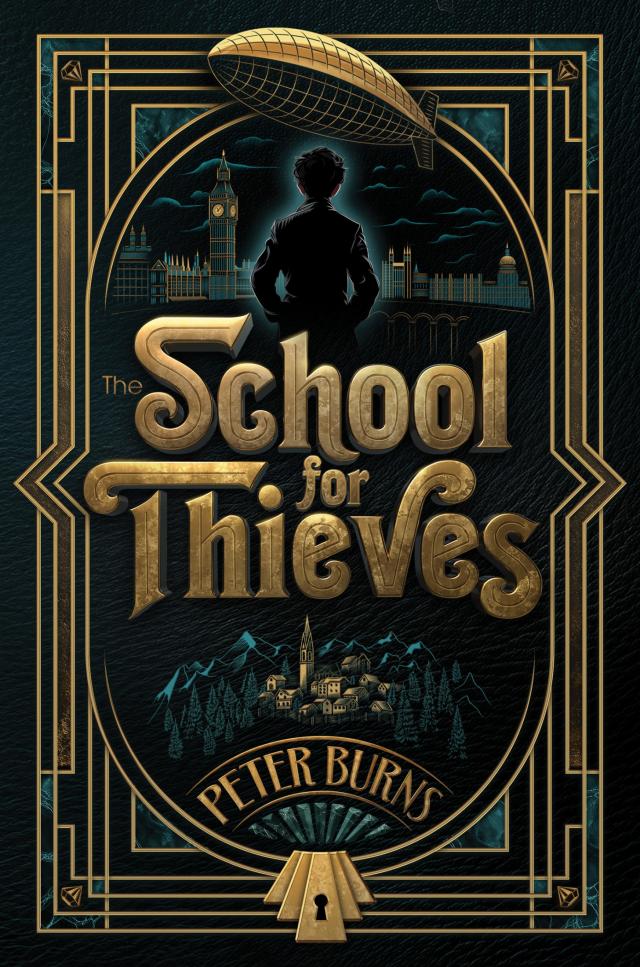


Description 1
To Julie, Isla, Hector, Rory, and Phoebe,
the pack of thieves who stole my heart
And in memory of Gavin Walker,
the best storyteller I ever knew
Concise Conversations and Conclusions Concerning Conceptual Cons
THE LONG CON
Definition: A “con” is an abbreviation of confidence, as in confidence trick or confidence scam. The perpetrator—known as a con artist, swindler, or grifter—gains the confidence of their victim (or mark) and utilizes a combination of deception, disinformation, subterfuge, and psychological manipulation to defraud them.
For the best examples of the most lucrative—and daring—long cons carried out in the last seventy years, see Selling the World with Smoke and Mirrors by Mortimer B. Hooklake (Beaufort’s School for Deceptive Arts graduate no. 24397).
It is generally accepted that long cons see greater returns for the Thief than short cons, but it should be noted that the dedication of time, effort, and resources (both financial and intellectual) required to execute a successful long con is considerable.
A confidence scam of any sort is based on the manipulation of basic human psychology. Once the plan for the con is conceived and set in motion (known as the set-up) and the mark is identified (known as the put-up), the con artist must establish an empathetic relationship with the mark (known as the play); once done, stage two (the rope) sets up a scenario that convinces the mark to work willingly with the con artist without knowing their true end goal (known as the sting).
This extract is taken from chapter two of Concise Conversations and Conclusions Concerning Conceptual Cons by Forrester D. Bellona (Beaufort’s School for Deceptive Arts graduate no. 26418).
NOTE FROM THE AUTHOR
What if certain moments in the past had occurred differently? A message delivered, a leader who lived, a battle won…
A child who didn’t lose his parents.
What if?
In fiction, history is ours to play with.
And so…
Prologue THE SET-UP
In the cool of a late-summer night, four figures crept through the depths of an alpine forest. Dark clothes clung to their skin, sweat beading on the greasepaint covering their faces. In spite of deep fatigue, they kept their breathing to little more than a whisper and their steps as light as snowfall. They were ghosts in the night.
A tapestry of stars wreathed the sky above and a fat full moon cast the forest and surrounding peaks in silver. In the distance an owl shrieked.
The leader of the group raised her hand to indicate that they should halt. Ahead of them, the tree line thinned abruptly, and fifty yards of grass separated them from the perimeter wall of a small, fortified town. Sentry turrets jutted out a hundred yards to either side, while a high tower could be seen rising above crooked rooftops in the center of the town like an arrow pointing to the stars. A clock face beneath its spire gleamed in the moonlight, announcing that it was nearly two in the morning.
The figures in the forest trained their gazes across the battlements, searching for patrolling guards. They were in luck—none could be seen. The leader of the group clenched her fist and then pumped it forward before breaking clear from the cover of the trees and slinking through the long grass, the others behind, their footsteps deftly following exactly where hers had fallen. Well, almost. The first three figures in the group were neat and fast and moved like shifting moon shadows. The fourth was more ungainly, his footfalls heavy, and he struggled to keep his much bulkier frame low and inconspicuous as he ran.
Crossing this exposed stretch of grass under bright moonlight was the moment the group of thieves were most at risk of observation from the guards that patrolled the wall.
After twenty yards they encountered the first trip wire in a network that crisscrossed the clearing. The thieves knew that the wires, which were as taut as piano strings, would be attached to flares and that just the slightest touch would trigger them. The first three figures skimmed the wires with barely a pause for thought, but then they had to turn back to help their trailing comrade awkwardly hurdle his way over the final two wires.
To their great relief, they made it to the wall. They pressed their backs against the rough stone and took a moment to compose themselves. Then the leader made a series of hand signals—and each figure pulled two blackened blades from silk sheaths on their belts. These were delicately inserted into the mortar in the wall, and they began to climb.
The leader had nearly reached the top when she heard the crackle of a radio and the muttered voices of two guards passing by on patrol. She shot out a balled fist, and the climbers froze.
“You got a light?” one guard asked the other.
There was a murmured reply, followed by the scrape and hiss of a match being struck.
“Who you got your money on, then?” asked the first guard as they began to wander on.
“Novgorod runs a tight ship,” said the second. “But Artemis looks strong this year.”
“Yeah, but you can never write off the Corsair, can you?”
“Ach, he’s a cunning one right enough. We’ll see.”
The voices drifted away.
The lead thief looked down at her comrades. The two directly below her were patiently waiting for her signal; the other was grimacing as he struggled to hold his weight on the narrow handles of the climbing knives. She motioned for them to move. The first three slithered up and over the parapet, then turned to haul up their trailing comrade. They swept across the walkway, attached blackened grappling hooks to the lip of the far wall, and then descended like spiders silently dropping from their webs. Even the ungainly thief managed this with some panache.
They were on a narrow, cobbled street lined with houses. Every window was dark. The thieves pressed themselves into the shadows while they scanned their surroundings. A series of cobbles looked slightly raised above the others. They might be hooked up to an alarm system. Or even a trap.
They skipped lightly over the suspicious-looking cobbles and snaked down the street, emerging on a wide avenue that ran alongside a canal. There was a bridge ahead of them, and beyond that they were just a few streets away from their target: the tower. They were so close.
But it never hurt to be too careful. The leader held out her palm, dotted two fingers on top, and then flipped them around to walk across the back of her hand. The other two nodded, and the fourth in the group had an elbow dug into his ribs for breathing too loudly.
They crept forward, keeping out of the moonlight. They slunk down the side of the bridge and pulled themselves underneath, locking their hands and feet to the old iron girders that supported the timber above, and began to edge their way toward the other side.
The leader was almost on the far bank when she realized something was wrong. As she had crossed the underside of the bridge, she had noticed that two of the girders felt different from the others. It had barely registered with her at the time, but as her two smaller comrades dropped down beside her, alarm bells began ringing in her head—and she could tell from the look in their eyes that they had just come to the same realization. But there was nothing any of them could do as the fourth figure gripped the first of the loosened girders, then yelped in panic as it gave way.
He plummeted downward with a cry, which was silenced as he crashed into the water. He emerged almost at once, screaming in agony. The leader realized that he was far higher in the water than he should have been. Some kind of platform had been submerged in the canal to make it deliberately shallow beneath the bridge.
The whole thing was a trap.
The three thieves on the parapet moved quickly to make their escape, but as the girder had fallen away from its spring-loaded housing, it had triggered an intricate pulley system that now released a cage, which came crashing down from the bridge, imprisoning them. As the clang of iron on stone rang out, the fourth figure continued to cry out in pain, a broken leg lying at an odd angle as he writhed on the surface of the water.
* * *
On a terrace below the clock face on the tower, a tall, thin man in a dark tweed three-piece suit and an elegant woman with long auburn hair drew back from a line of telescopes and muttered in disappointment as they scratched scores and brief notes on exam ledgers.
“When did you rig up the underside of the bridge, Hezekiah?” asked the man.
“Oh, a few weeks ago, Headmaster,” came a languid reply from the shadows at the back of the terrace. Another man was sitting there, his feet propped on a barrel of wine—the prize for the teacher whose pupils performed best in the exam—picking his nails with the tip of a long knife.
“I thought we agreed to make the slats on the walkway pressure-sensitive and set the balustrades on greased hinges?” noted the headmaster, Siegfried Templeton, peevishly.
“I did that too,” replied Hezekiah von Stuppe—known more generally as the Corsair. “But I thought I would throw in one or two other little treats as well. They’re lucky I didn’t submerge spikes in the canal instead of concrete blocks, or infest it with widow eels—I was sorely tempted. We all know they should have constructed their own wire crossing under the bridge—”
“You didn’t think,” broke in Templeton hotly, “that the extra viper pit, the poison-gas explosives, or the pack of mountain lions on obstacles two and three were already enough?”
The Corsair held up a placating hand, realizing that the headmaster was close to apoplexy. “If we want the best pupils, we ha
Templeton stared down at the canal below, where a recovery team was pulling the hapless pupil out of the water and on to a stretcher. “Matthias Hoffmann,” he muttered. “Is that boy ever going to excel at anything? Such a stain on his family name. I had high hopes when he arrived—but what is it, three years? And he’s still a wretched Greenhorn! Such a disappointment.” He paused and smoothed back his already slicked and impossibly smooth hair. “We may actually have to go along with that harebrained idea of yours, Hezekiah, and do some recruitment. Spruce up this year’s intake.”
“Midsemester?” broke in the woman. Her name was Valeria Novgorod and she, like the headmaster, was very tall and very thin, with ice-blue eyes.
“It’s not ideal, I grant you,” said Templeton. “But what else are we to do? Nine long-term injuries, who knows how many minor wounds… Forget the International Shadow Cup. Even our rather more straightforward House Challenge is going to be seriously compromised if we don’t have the right number of able-bodied students to compete.”
“I suppose there must be some good family names on the waiting list,” conceded Novgorod. “But it was the Corsair’s ridiculous amendments that caused all the injuries, so he can tell the other Masters—they’re going to be furious! Did you have to cause so many injuries, Hezekiah?”
Templeton, eager to intervene before Novgorod turned violent, pivoted back to the Corsair. “Hezekiah, do you have any potential recruits in mind?”
There was a pause. “Perhaps one or two,” came the reply.
“I will do the recruitment for the Ghost House pupils,” cut in Novgorod. She smiled tightly at the Corsair. “Not that I question your judgment, of course—but I don’t want you picking three new versions of Matthias Hoffmann for my house while you get a couple of Nikita Moons for yours.”
“Ah, Nikita Moon,” murmured the Corsair wistfully. “If only there were more like her. What a talent she was.”
Templeton clapped his hands impatiently. “I don’t care how it’s done or where they come from. Just make sure they’re better than Matthias Hoffmann. All I need to know is whether they’re up to scratch. We do have standards. They will need to be here before the beginning of the Candlemas semester—and ideally before the end of Michaelmas so they can play a full part in the House Challenge.”
Templeton glanced down to see the recovery unit moving Hoffmann’s prone body off toward the infirmary. “And next time you think of altering the exam course—” he started, turning back to the Corsair.
But the Corsair had already vanished.
Chapter One SLEIGHT OF HAND AND FOOT
It was a crisp autumn morning and Tom Morgan was sitting on a stool on the roadside just outside Fermian’s Café on Rue Notre-Dame—which had once been known as Oxford Street—the sun shining brightly and adding a welcome warmth to the cool air. Cabs, motor cars, and buses rattled over the cobbles in either direction, and the branches of the cork trees, brought there by the French thirty years earlier, swayed gently overhead, casting flickering silhouettes on the smooth gray stone of the buildings across the street.
The scent of coffee and freshly baked pastries drifted tantalizingly—agonizingly—from the open doors of Fermian’s, accompanied by the gentle sounds of a jazz record on the gramophone by the bar and the chink of cups and saucers.
Just a few doors down the street, Tom could see Maxine and Bernie unfolding a portable table.
“Magic ball trick!” Maxine began to call out to passersby. “Stop and see a magic ball trick! Guess which cup it’s under and double your money!”
A thickset man with a dark beard appeared beside Tom and gave one of the legs of his stool a nudge with the toe of a hobnail boot.
“How much for a shine?” he asked.
Tom glanced warily up at the man’s face, scanning his features to check whether he knew him. There was always a risk that he could be a policeman, a workhouse agent, or worst of all, a previous mark. But the tanned face behind the dark beard wasn’t one Tom recognized, so he relaxed and looked down at the boots, which were badly scuffed and well worn. Tom puffed his cheeks and then sucked his teeth in ponderous thought. “Quite a bit of work to do there, mister,” he said at last. “But I should be able to get them up to scratch for three francs.”
“See what you can do for two,” said the man, and he tossed the coins into the upturned hat lying by Tom’s feet.
“Right you are, sir,” said Tom, and slapped a polishing cloth on the box in front of him, just as his old friend and mentor Morris used to do. The man rested his left boot on it. Tom flipped open a toolbox beside the stool and lifted out a dog-eared copy of The Count of Monte Cristo, underneath which he kept every item a shoeshiner could ever need, and got to work.
The man pulled a newspaper from his coat pocket and began to read, humming along absently to the music coming from Fermian’s. Tom let his mind wander as he scrubbed the dirt from the cracks in the leather. Then he reached into the toolbox and withdrew two tins of polish. “Which color you after, mister?” he asked.
The man pulled back a corner of the paper and looked down. “The darker one,” he said, then went back to reading, leaving Tom staring up at a front-page headline: TREASURE FOR THE AGES GOES ON TOUR followed by the subheading THE ANCIENT BURIAL HOARD OF SARGON THE GREAT OF MESOPOTAMIA BEGINS WORLD TOUR. Intrigued, Tom scanned the opening lines of the article while unscrewing the lid of the polish and dabbing a cloth into the oily glop within.
The long-lost treasure of the twenty-fourth and twenty-third century BC Mesopotamian ruler, Sargon the Great, discovered just three years ago by archaeologists from the University of New Avignon, begins its world tour tomorrow with a grand opening at the British Museum. The treasure is on loan from its permanent home at the Metropolitan Museum of New Avignon for nine months and will travel to seven different museums around the world. Tickets to the London exhibition have been sold out for more than a year.
The hoard, one of the largest ever discovered at a single burial site, is of significant historical importance as the runes and hieroglyphs that adorn many of the items reveal new information about Mesopotamian society, culture, and politics that had been previously unknown to historians.
He turned back to the boots, massaging the oily polish into the leather and then beginning to buff it with a brush.
Somewhere down the road an exhaust backfired and a blue van rumbled past. The word “Guttknot” was etched in white on the flaking paint. Tom ducked his head low and tucked his arms in, trying to make himself as small as possible. After a few moments he risked a glance through the legs of passing pedestrians, but he couldn’t see the van. Then he realized he couldn’t hear it either. His hand paused its brushing. Was that a vehicle door closing? A sound followed that froze him. It was the clip, clip, clip of a metal-tipped staff striking the paving stones in time with its owner’s steps. Tom snapped his head up to see Cyril Borthwick, a workhouse agent, wandering toward them.
The shiny brass buckles of Borthwick’s uniform glinted in the morning sunshine, as did the silver globe on the top of his staff. Borthwick wasn’t a particularly tall man, but he was strong looking, with thick forearms, powerful shoulders, and a bull neck. A huge dark moustache drooped down below his jawline, and bushy whiskers spread across the edges of his cheeks and up to a ring of hair that circled a perfectly smooth crown.
Tom gave a shrill whistle. Maxine glanced up at Tom and then across to Borthwick. After a quick look of understanding, she gathered up her ball and cups, picked up the foldaway table, and grabbed Bernie by his jacket collar before dashing down a side alley.
“Nearly done, mister,” said Tom, attempting a grin that felt as thin as paper. He was a rat caught in a trap. He had to think fast.
Tom kept his head down and concentrated on buffing the boots. They were now shining brilliantly, but still he kept the polishing cloth gliding back and forth as the shrill tapping of Borthwick’s staff grew louder.


