Watershed, page 1


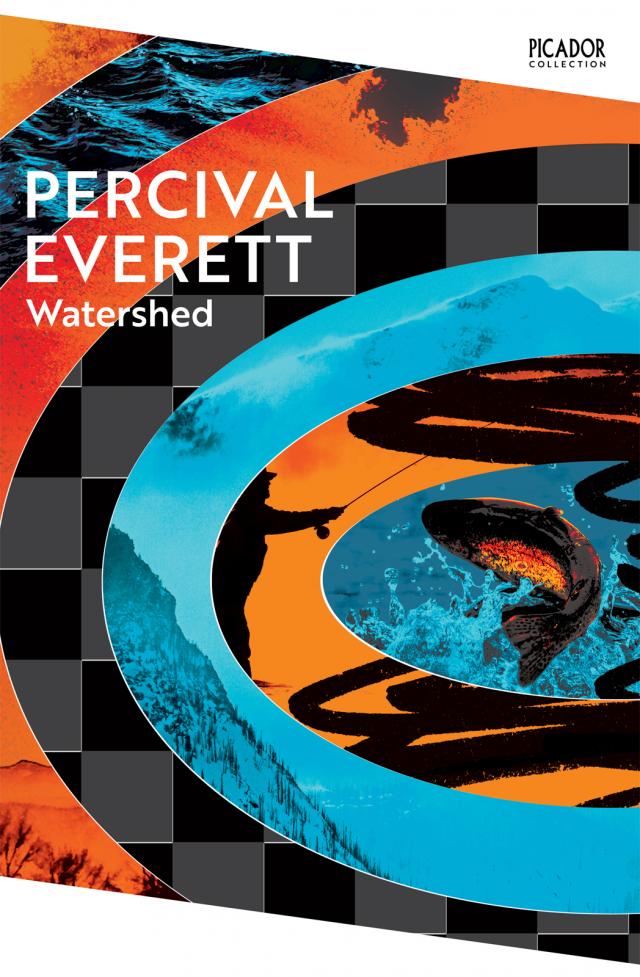
PERCIVAL EVERETT
Watershed
Contents
1
2
3
4
5
6
7
8
9
10
11
12
13
14
15
Acknowledgments
For Chessie
As always, with love
1
LANDSCAPES EVOLVE SEQUENTIALLY EXCEPT under extraordinary provocation, or in circumstances not at all to be apprehended, it is not probable that as many as five hundred Indian warriors will ever again be mustered at one point for a fight; and with the conflicting interests of the different tribes, and the occupation of the intervening country by advancing settlements, such an event as a general Indian war can never occur in the United States.
(Edward Parmelee Smith, 1873)
My blood is my own and my name is Robert Hawks. I am sitting on a painted green wooden bench in a small Episcopal church on the northern edge of the Plata Indian Reservation, holding in my hands a Vietnam-era M-16, the butt of the weapon flat against the plank floor between my feet. There are seven other armed people sitting on the floor, backs against the paneled walls, or pacing and peering out the windows—stained and clear—at the armored personnel carrier some hundred yards away across the dirt and gravel parking lot, and at the pasture where two sad-looking bulls stand, their sides, black and gray, flat against the sky behind them. Out there, there are two hundred and fifty police—FBI, all clad in blue windbreakers with large gold letters, and National Guardsmen, looking like the soldiers they want to be. There is an FBI agent sitting in a chair opposite me; his hands are bound with yellow nylon cord; his mouth is ungagged; his feet are bare and rubbing against each other in this cold room. The hard look he had worn just hours ago has faded and, although his blue eyes show no fear, the continual licking of his lips betrays him. His partner, a shorter, wider man, is face down on the ground outside; his blood and last heat having melted the snow beneath him. He lies dead between two dead Indians, brothers, twins.
That I should feel put out or annoyed or even dismayed at having to tell this story is absurd since I do want the story told and since I am the only one who can properly and accurately reproduce it. There is no one else in whom I place sufficient trust to attempt a fair representation of the events—not that the events related would be anything less than factual, but that those chosen for exhibition would not cover the canvas with the stain or under-painting of truth—and of course truth necessarily exists only as perception and its subsequent recitation alters it. But I can tell it, my own incriminations aside.
The insignificant point of light on the ceiling seemed to dilate as I watched, and I wondered how it was that the perforation would not let in enough light to illuminate even a section of the poorly lit room, but could allow in enough water to ruin the entire house; how it had to be in some way dark to see the distending prick, but water would always find me in there. I slapped myself for pondering like an idiot and did the only thing that made any sense: I grabbed my vest, the box of flies I’d tied the previous night, and my sixty-year-old Wright and McGill bamboo rod that no one could believe I actually got wet, much less used, and went fishing.
Nymphs are meant to be fished near or on the bottom of the water and so must absorb moisture and/or be weighted so they get to the bottom quickly. The materials of their construction must give the appearance of life, suggesting the movement of a living insect in its larval or nymphal stage, its pulsing, vibrating. The fish get close to it, without the concern of the surface predators, and take a good look, and so it must be lifelike.
My father had never liked fishing. It seemed enough to him that my grandfather, his father, hunted and fished. My grandfather never pushed the idea on him, however. In fact, he confided in me that he understood my father needed the difference between them as a necessary point of divergence. “We’re so much alike,” he would say, then make a cast or load his rifle or rip the guts out of a fish in one quick motion. Indeed, he and my father looked enough alike to be brothers and to my mind, in matters all but those having to do with the outdoors, they shared the same beliefs. They were both physicians and both well liked, though to hear them speak you’d have assumed they found people objectionable and you would have been right, but it was people, not persons, who were problematic, they would articulately point out. They hated America, policemen, and especially churches. Their outright detestation for Christianity—it was much more than a simple disregard—had ended their marriages: my grandfather had known full well that his wife was a member of the AME Church but had hoped that he could live with it; my father claimed that my mother had found religion and bushwhacked him one day with a prayer at the dinner table. My grandmother died when I was ten and we went to the funeral, Christian service and all, and my aunt shouted at my grandfather, called him a heathen. She then turned to my father and said, “You’re just as bad.” She then knelt in front of me and tried to be nice, offering me a Lifesaver—I said, “Blow it out your barracks bag.” After my parents’ divorce I lived with my mother, and the religious stuff weighed heavily on me, my being convinced that one had to be in some way born Christian because there was not a genuflecting bone in my body, and so my mother and I lived with our horns locked. The religious stuff became a lot more important than it should have been, as I did not actively dislike it, but simply did not care. When I was twelve, I went to live with my father and grandfather, whom “I was just like,” and for four and a half years until I left for college, I watched the two of whom it would seem I was a pretty faithful copy.
The fishing turned out to be slow—I took three trout in a couple of hours, all on a store-bought Royal Coachman. I hated the generalized flies, the ones that didn’t look like some particular insect native to the water but that because of their color or glitter caused the fish to strike them out of interest or anger or whatever, but I enjoyed following the green-and-red fly whiz through the air and light with its stark white calf-hair wings on the surface of the water. Anyway, the fish were small and I let them go. I switched to a hare’s ear nymph and began to have pretty good success, starting on a string of keepers.
*
Before I came out here to the cabin, to fish and think and be alone, I was in the city with Karen, a woman I had been fucking. I decided on this term for our interaction, having found disfavor with the term relationship and seeing that I had simply and stupidly fallen into something out of convenience and, sadly, habit and, as with most things entered into easily, extricating myself turned out to be decidedly more difficult. Her voice grated on me, as did her attitudes and disposition, and finally her smells, but still I would lie between her legs again and again, pathetically seeking release or simply seeking.
“This is not a good time to go fishing,” Karen had said, sitting at the kitchen table in my apartment, drumming her nails against the Formica, her index finger striking the place that had been chipped when I dropped my binoculars some months earlier. I just stood there, in sort of agreement, sort of nodding. We had been arguing, about what exactly was unclear now, but it had come, as it always did, to my defending myself by telling her that I did indeed care about her and that I did want to make her happy. As the discussion wore on I realized my lie and wanted to tell her that indeed I was not in love with her, never had been in love with her and, further, believed completely that she was too insane to be capable of love herself. Karen was a smart person and not unreasonable, but she wouldn’t let me talk, wouldn’t take a breath, and, sadly, as I was forced to listen now, was saying nothing new. “So, are you going fishing?” she had asked. Her drumming stopped.
Her words had sounded exactly like, “I dare you to go fishing.” I studied her eyes and felt sick to my stomach at how I, in some way, genuinely detested her and her ways and here she was again daring me to do what I had done so many times before. I had been chanting in my head, and perhaps she heard it, that this was the last time, that this time I meant it, that there was no coming back, that I was turning the corner, no longer the weak man I had proven myself to be. I had said, “Yes.”
“Why!?” she had screamed, her voice much louder than her size. “Because you need to get away from me? Am I that awful?”
“No, because I want to go fishing. I like fishing. It relaxes me.”
“And I don’t relax you?!”
That had been some weeks ago, just more than a month, when I had left Karen for the third and last time and come to the mountains. The weather was turning colder, with stiff winds from the northwest pressing through the canyons. I wondered if the fishing was relaxing me. It made the days pass and I was at least obliged to use my hands, for repairs on the cabin and tying flies—my hands needing the work, my eyes needing the attention to detail. And the fish didn’t yell at me. They more often than not ignored me, but they didn’t yell at me. I watched the no. 12 hare’s ear I had tied the night before land and sink beneath the surface of the water.
Hook: Mustad 9674
Thread: Reddish or dark brown
Tail: Brown or ginger hackle fibers (1½ gap widths in length)
Rib: Fine gold tinsel
Abdomen: Hare’s mask and ear dubbing fur blend
Wing case: Gray duck-wing quill section (folded over)
Thorax: Same as abdomen
Legs: Guard hairs plucked from under thorax with a dubbing needle
I had a string of six decent browns wrapp
“Hi, hon,” Clara said as I walked in. She was a rough-looking woman with a soft, pleasant voice that came from beneath a massive mound of white hair and from behind oversized, red-framed bifocals. The glasses were new, one in a long line of pairs, as it seemed the woman was unable to locate her glasses once removed from her narrow face and set on some surface.
“Clara.” I greeted her at the old brass-scrolled register she sat behind in the front of the store. Light found its way through the collecting clouds and into the store through the painted window beside her. “I brought you some trout. What do you say? Six fish for milk, butter, and eggs?”
“Why them ain’t trout,” she said, giving the fish a look, lifting her glasses and squinting, then gazing through both lenses of her bifocals. “Them’s minnows.”
“They told me they were trout.”
“It’s a deal then,” Clara said, no smile, her lips tight. “But remember, I’m doing you a favor.”
I felt the woman watching me as I collected the items from the refrigerator on the other side of the store, the air outside the unit fogging up the door as I held it open. I walked back toward her, smiling.
She said, as I dropped the butter on the counter with a thud, “You’re pretty ugly for a young feller.” She entered the routine smoothly, the same line as always; I assumed she reserved it for all younger men.
“Precocious.”
“I call ’em likes I see ’em.”
“A fine quality in anyone.” I grabbed a loaf of rye bread from the unstable wire rack beside me and took some fruit, three bananas and ten apples, from the big wicker basket on the counter.
“How long do you think that many bananas are going to last you?” Clara asked.
“They get ripe too fast,” I told her. “I like them while they’re still a little green.”
“Go figure ugly guys.” She tallied in her head, her eyes disappearing behind the change in her lenses. “Let’s call it two bucks.”
I gave her the money.
“By the way, your lady friend called,” Clara said, opening a paper sack with a snap and setting it on the counter. She looked at the message book she kept by the phone. “Let me see. She said call her back.” My hands found the groceries and began to bag them. “You’re welcome,” she said. She watched me load the fruit into the bag. “So, you gonna call her?”
“What do you think I should do?”
“A feller what looks like you? I think you should call.”
“You’re probably right.” I shook my head. “Still, I don’t know. I don’t know what to say. Suppose you were a woman, what would you want to hear me say?”
“That’s why I like you,” Clara laughed, then coughed, roughly. “Tell her to cut the crap and get the hell up here so you can frolic and cavort in the deep woods in your all-together. Either that or you go back down there where you can have anxious sex next to a banging radiator and traffic clatter outside the window.”
“You do have a way of putting things.” But, of course, I was not uncertain whether I should return the call. I felt the easiness of assured resolve, knowing and trusting, finally, my decision to abandon the sickness, as it were.
Clara nodded. “So what are you going to do?”
“I’m going to go home and fix the hole in my roof.”
“What is that, some kind of metaphor?”
“Probably.”
The Half-breeds of said tribes, and those persons, citizens of the United States who have intermarried with Indian women of said tribe and continue to maintain domestic relations with them, shall not be compelled to remove to said reservation, but shall be allowed to remain undisturbed upon the lands herein above ceded and relinquished to the United States.
Outside, I fell in behind the wheel of my pickup, turned the key, and heard the engine try but fail to start. I pumped the gas pedal and turned the key again. A third time. A fourth. I sighed and leaned forward to rest my head on the steering wheel. I didn’t feel anxious or even put out; that was what the mountain did for me. So the car wouldn’t start—the car could be fixed. It might take a little time, but time was free and it might take a little money, but money was just money.
“Pop the hood,” a small voice said. I looked out the open window and saw no one, then glancing slightly downward I found a very short woman. The woman was the size of a child, with her dark hair pulled tightly back exposing a largish, almost hooked nose and oddly flat cheekbones. “Pop the hood,” she said again.
“Doesn’t need to be popped,” I told her and watched her walk around to the front of my truck. I could see the top of her head as she searched for, then found and released the hood latch. Then I couldn’t see her, but I heard her climbing onto the bumper as she pushed open the hood, heard her fumbling around on my engine. I stayed put and waited.
“Try it now,” she called.
I turned the key and the truck fired up. The small woman walked around to the back of the truck. I watched in my mirror as she picked up a knapsack and stowed it in the bed just behind the cab. She opened the passenger-side door and climbed in beside me, scooting her butt back into the seat and fastening the belt. The shoulder strap bothered her face and so she put it under her arm.
“Thanks,” I said to her. “I guess I do owe you a ride. Where am I taking you?”
“Just go wherever you were going.”
“I live twenty-five miles up the road,” I said, expecting that to give her pause.
“That’s fine.”
“You don’t want to go to my house. And there’s nothing else up there.”
“No, just get me close to the lake.”
I looked back over my shoulder into the bed at her pack, red with yellow pockets. She was diminutive, so her clothes were no doubt little, but still her pack seemed slight: no tent, no pad, no sleeping bag. “You don’t have much gear,” I said. “You know, it gets cold up there.”
“Let’s just go.”
“So, what was wrong with my engine?” I asked, backing away from the planking of the store’s porch and driving out onto the road.
“I don’t know. I just jiggled a do-hickey.”
“You’ll have to show it to me. The do-hickey. In case that ever happens again.” I glanced at her briefly. “It sounded like the distributor wire was loose.” I looked at her again, but she kept her eyes straight ahead. “You know the old trick where you disable a car and then fix it so the person will give you a ride?”
“That’s an old trick?” She didn’t look at me.
“I’ve never heard of anybody doing it. Actually, I just thought it up.”
“So what you’re telling me is that you’re paranoid.”
“It doesn’t sound good when you say it,” I said.
The woman laughed. “My name is Louise.”
“Robert.” I shook her hand, her little bones feeling unreal in my grasp, feeling as though they might break, rolling together under my thumb the way I had once felt my mother’s roll together when she was old. After another glance at her gear I asked, “Just planning a hike back down the trail?”
“Yes,” Louise said quickly, too quickly, quickly enough to tell me to shut up, quickly enough to raise if not concern, then my curiosity.
I observed her canvas sneakers with their white, semicircled rubber toes, then looked at the slate sky. “You realize it’s likely to snow today. I haven’t heard the report, but it looks like snow.”
Louise looked at the sky, leaning her small frame forward, her dark eyes searching.
“I mention it because of your shoes.”
“Oh, I’ve got boots in my pack.”
“I see.”
I felt her uneasiness and so I backed off, attending to my driving, putting both hands on the wheel. I hoped that I had not made her feel that I was interested in her. I felt somewhat badly that her size, or lack thereof, had caused me to believe she was not quite capable of taking care of herself. It was a stupid thing to think, but I couldn’t deny it, and I recognized and acknowledged once again one of my problems—my inability to deny conveniently some stupidity of mine, even momentarily. It seemed that, at every opportunity, I examined closely the nature, structure, and philosophical ramifications of my stupid feelings, a kind of over-the-top second-order thinking that turned out to be a detaching device rather than a constructive exercise.