

Weaver, page 1
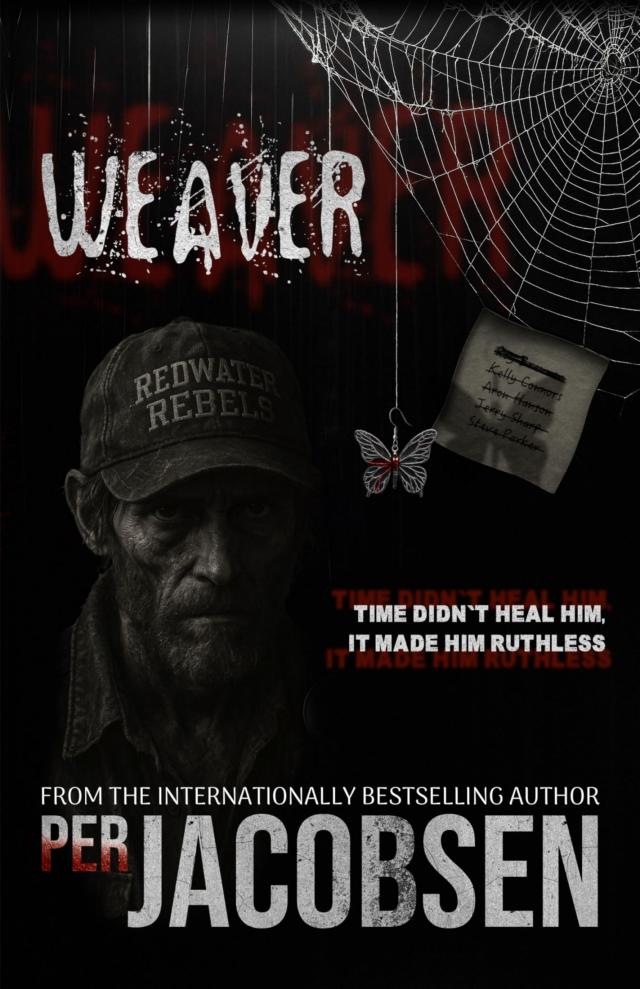


WEAVER
(US)
PER JACOBSEN
HUMBLEBOOKS
Weaver
Copyright © 2025
Per Jacobsen & HumbleBooks
1st edition, 2025
Cover art: Per Jacobsen
ISBN (e-book): 978-87-94319-41-6
All rights reserved.
This book is dedicated to
Emely Thrane Buchholt.
A genuinely good person.
Only when you’ve lost everything
will you learn
what you’re truly capable of.
O. E. GERALT
PROLOGUE
EAST ALIN, 2015
A sharp wedge of light cuts across the dark parking lot behind Carol’s Diner as the young woman opens the door and steps outside. She is still in uniform: a dark red shirt— one of the cheap synthetic ones that clings to your skin—creased and crooked after a long shift, just like the name tag on her chest.
She glances around. He sits quietly, watching her for a moment through the rain-soaked windshield. Then he flicks the headlights on for a split second and turns them off again.
It worked. She is heading his way.
There is a soft click as he unlocks the passenger door from the inside. She slips into the seat without a word, closing the door gently behind her.
For a while, they just sit there in silence. Like they both need a moment to gather their nerve before doing anything else. And in reality, that might be the most fitting description.
“There is a folder in the glove box,” he says, once the moment has passed. “It’s all in there if . . . if you’re still sure?”
She doesn’t answer. She just leans forward, opens the glove compartment, and pulls out the folder. Its edges are worn, and it’s held together by two rubber bands. She opens it, skims the contents, then closes it again and puts it on her lap.
“I’m sure.”
“I just don’t want you to—”
“I’m sure,” she repeats, after which she lifts her hand to her ear. “This isn’t a life.”
A quick, practiced flick of her fingers, and the earring is freed. A silver hook with a small charm. A butterfly.
She holds it out and lets it drop into his open palm. The metal feels ice-cold against his skin.
“You’ll have to take the other one yourself,” she whispers.
“We don’t have to do it this way,” he says.
“Yes, we do,” she responds, exhaling through her nose as she tucks a lock of hair behind her ear, revealing the other earring. “It has to be believable.”
He nods, swallows, and nods again. Then he pulls a latex glove from his jacket pocket and slips it on. Next, he raises his hand, finds the butterfly’s wing, and pinches his fingers around it.
He meets her gaze. She closes her eyes and gives a single nod.
Then, in one sharp pull, he yanks downward.
KELLY CONNORS
WHAT & WHY
THE INTERROGATION, PART 1
GLEAMSDALE POLICE DEPARTMENT, 2018
It’s almost a shame. Someone clearly put in a lot of effort to make this small room as intimidating and uncomfortable as possible. The concrete walls are bare and cold, same with the floor. Two of the three chairs in the room are padded and upholstered in black leather while the third one—also the only one bolted to the floor—has a hard wooden seat that looks suspiciously loose. High on the walls, just below the ceiling, are three small cameras, all aimed directly at that uncomfortable chair. A constant reminder to whoever sits there that they’re being watched.
At the center of it all is the light source: a lamp with a fabric shade and a single incandescent bulb that shines bright enough to blind anyone sitting in the uncomfortable chair—while at the same time hanging just low enough to spare the eyes of anyone sitting in one of the comfy executive chairs on the other side. Because, naturally, those are also noticeably higher than the one with the wobbly wooden seat.
All that effort . . . and it has no effect at all on Eddie Weaver when he walks in.
“Take a seat,” the officer behind him growls.
Eddie glances back at him. He is a big guy, broad shoulders. Way bigger than old Chuck Anderson, who had the job back when Eddie still lived in Gleamsdale. But Chuck retired a few years back and moved to Tinfields. At least that’s what Eddie has heard.
“Which one?”
“Funny,” the officer replies, though his tone says otherwise. He gestures toward the wooden chair. “Sit down.”
Eddie nods and lowers himself onto the seat. Sure enough, it shifts under him every time he moves—and he has to admit, it almost works. Even though he knows it’s just a cheap trick, his body still reacts with unease.
Just remember that you’ve got the upper hand, he tells himself. You chose to be here.
“Is it just gonna be the two of us?” he asks, nodding toward the empty leather chair next to the one the officer just took.
“Normally there’s two of us for interviews,” the officer confirms, tapping his notepad with a pen. “But people don’t usually walk in off the street and turn themselves in like you did today. That makes me assume you’ll be cooperative. Am I wrong?”
“Not at all. Like I told the nice lady at the front desk, I’m here to confess all my sins and take what’s coming to me.”
“That’s an interesting way to put it,” the officer says, reaching for a small bag that’s lying on the table in front of him. “Especially having seen this.”
The bag contains Eddie’s personal effects, the ones they took before bringing him in—and he already knows what the officer is about to pull out.
And he is right. The officer grabs the small, crumpled piece of paper and flattens it. Then he slides it across the table with a dry, scraping sound and brings it to a halt right in front of Eddie.
On the paper—its edges frayed and bent from years in Eddie’s pockets—are five names, written in pen and crossed out with single lines.
No, that’s not entirely true. Four of the names are crossed out neatly, so they’re still readable, but one is completely blacked out, each letter buried under several layers of ink.
Eddie had to do it that way. Anything less would have ruined everything.
“I take it this is why you’re here,” the officer says, planting a thick finger in the center of the note. “Am I right?”
Eddie nods, and the officer bites his lip, staring at him thoughtfully.
“Those names,” he says after a pause. “They’re . . . quite interesting. Especially if you run them through our case files. But I’ve got a feeling I don’t need to tell you that.”
Once more, Eddie answers without words, merely shaking his head slowly.
“All right then,” the officer says, his voice dropping a notch, gaining a weight that tells Eddie the interview has officially begun. “Let’s hear about those sins of yours.”
An unexpected wave of nerves hits Eddie. He looks up, tries to catch the officer’s eyes, but the big man’s face is swallowed in the glare of the light bulb. His hands, though, are still on the table—fingers drumming lightly on the surface.
“How about you start from the top? Kelly Connors.”
“Okay, and, um . . . what do you want to know?”
“What you did, and why you did it.”
“Just what and why?”
The officer nods, and Eddie takes a deep breath with his eyes closed. Then he starts talking.
HOMECOMING
GLEAMSDALE, 2017
It feels pathetic. He feels pathetic. He has spent nearly eight years preparing for this moment, and now he can’t even bring himself to open the car door and step out. He just sits there, staring in disbelief at the sidewalk like it’s a river of lava that will set his shoes on fire the second he touches it.
Pull yourself together!
Once, this little town was Eddie Weaver’s home. Once, he was happy here. He would stroll on the sidewalks, glance through shop windows, and nod to people on the street. Because he thought they were his friends.
A lot of them are still here. He doesn’t even have to get out of the car to confirm that. They’re right there in the streets and behind the windows. Sean Laurel in his barbershop, Martha Hymwell at the bakery, John and William Duke in the auto shop, old Mr. Moody on the bench with that soft felt hat and his newspaper.
That has got to be a dying breed—people who still read print newspapers. But of course, Mr. Moody is still alive and kicking. In fact, it feels like time has stopped in Gleamsdale, while the rest of the world keeps marching into the future.
Eddie had stopped too. Completely stopped. Losing everything can do that to a person. But not anymore. Now he has a purpose. A plan he intends to carry out.
And its first step is to get out of the car. Because he needs to know whether people in this town will still recognize him—and sitting here hiding behind the wheel of his old Ford isn’t going to answer that question.
With that thought, Eddie opens the car door and steps out onto the sidewalk in Gleamsdale.
Dry autumn leaves join him, swirling around his shoes as he starts walking down Main Street. Just like him, they wear dull, brown colors. The kind that don’t attract attention.
If you’re gonna play, you might as well go all in, he thinks, taking the final steps and stopping in front of the barbershop window.
Unlike Eddie, Sean hasn’t changed one bit. He is still slim, still wearing makeup, and his long curls are still dyed to match his brightly colored outfits. Sean has never been shy about expressing his sexuality or his rebellious personality—which most of his customers respect him for. And the ones who don’t—like old Theodor Moody over on the bench—enjoy having something to be offended by.
Sean should be a solid test. Eddie has sat in that chair and made small talk with him more times than he can count. So, if the barber doesn’t recognize him, chances are nobody else will either.
Ironically, Eddie barely recognizes his own reflection in the window. His face—framed by the G in the shop’s name, SHEAR GENIUS—looks pale and tattered, half-hidden beneath a ballcap and a scruffy beard. Even his eyes seem to have lost their color. Used to be blue. Now they look gray. Lifeless.
Now, Sean turns toward the window and spots him. He smiles . . . but it’s not a smile of recognition. It’s a polite smile. The kind you would give a potential customer. Maybe even with a hint of discomfort. As if he is secretly hoping that the scruffy guy on the other side of the glass will find another barber.
Relieved, Eddie smiles back, after which he turns away and resumes his stroll down the street.
Twenty minutes later, Eddie has visited several places from his old life—and the conclusion is clear. No one in Gleamsdale recognizes the man who once was the target of everyone’s judgmental stares.
Amazing what eight years of physical and emotional wear will do.
But that’s okay. It only makes things easier.
Nighttime. Eddie sits on the motel bed with his laptop balanced on his thighs, dusty curtains filtering the glow of a humming streetlamp outside.
On the nightstand beside him sits a stale cup of coffee. It’s cold, but he drinks it anyway. It’s not the taste he needs.
On the computer screen is a photo from a Harrisburg Gazette article—a young woman smiling professionally, dressed in a dark blazer and pearl earrings.
The article is a little over a year old. Eddie has read it before. Dozens of times. Hell, he has probably read everything there is to find about this woman online. He knows Kelly Connors’ public life better than she does herself. Every social media update, every conference, every name mentioned in a caption or footnote. All of it stored in his head—and on his notepad.
The main reason, of course, is the anger. His need for revenge. But there is something else behind his obsession with her life.
Curiosity. The urge to understand how someone who ruined another person’s life could move on with her own so effortlessly. And thrive.
But yes, revenge is the dominant force. It’s what brought him here. It’s why he is sitting on this creaky bed in a motel room, surrounded by peeling wallpaper, with his laptop as his only weapon.
And it’s almost time to fire the first shot.
On the screen, a new photo appears. At its center is her boss, Thomas Langford, standing at a podium during a campaign event.
Langford isn’t just anybody. He is a rising star in politics, and he is climbing the ladder quickly. Family man, former school board chairman, small-town attorney turned state legislator in record time—elected to Pennsylvania’s House on a platform of pragmatism, family values, and fiscal responsibility.
Kelly Connors is his press secretary—and she is very good at her job. She is eloquent, charismatic, and has an uncanny ability to gauge the mood in any room. She knows exactly what to say and, just as importantly, when saying nothing at all is the best response.
Yet Eddie knows that’s not the whole story. Beneath the humble exterior, the old Kelly still hides. The manipulative, calculating girl from Gleamsdale High. And there is no way she is planning on staying behind the curtain forever.
She craves the spotlight. Always has.
For now, though, she is not the one taking the stage. She is close to power but not holding it—which works in Eddie’s favor.
Another advantage is Langford’s obsession with his public image. Everything is carefully managed. Rumor has it that press releases, social media posts—even off-the-cuff remarks to reporters—are all crafted with Kelly’s help. She is his mouthpiece, his filter, his shield, and increasingly, his Achilles’ heel. Because all of this obviously means that he has a very close relationship with her. Not necessarily romantic, but close enough for it to make headlines if spun that way.
True, Langford has never had a scandal tied to his name . . . but that doesn’t mean he is immune to it.
And that’s how Eddie plans to take down Kelly Connors.
Not with shouting or wild accusations.
With doubt.
Public doubt.
THE FIRST DOMINO
GLEAMSDALE, 2017
The mouse cursor drifts hesitantly back and forth across the top edge of the photo, as though it, too, can feel the tension and the weight of what is about to happen.
Kelly, in part profile, blurred by the rain but identifiable. She is looking back over her shoulder. The expression in her eyes is open to interpretation, and that is what makes it perfect. Next to her is Thomas Langford, slightly out of focus but still easily recognizable. Behind them, the door to Collin Suites stands ajar.
No contact, no physical touch, and no hard evidence. Only context and implication . . . but served the right way, that should be enough.
Beneath the image on the screen, a small snippet of Kelly’s weekly schedule is visible. That’s how Eddie found out that Collin Suites on Capitol Street is Langford and Connors’ usual place of retreat when campaign work runs late.
The best part is that it wasn’t even hard to get that information. Most of it is public . . . if you know where to look.
He takes a deep breath. Time to knock over the first domino.
Three mouse clicks, and the screen fills with drafts. Short messages and tips that will soon be on their way to various news outlets and online forums.
Close collaboration is key in politics. Real close, apparently.
#LangfordAfterDark
Not implying anything, but kinda strange that our moral crusader and his press secretary are checking into Collin Suites after 9 p.m. Strategy sessions—or something else?
#Langford2017 #justapicture #thebosssdoorisalwaysopen
FYI: Word is that Langford and KC (press aide) have been meeting late nights at Collin Suites. Last two Wednesdays. Suite 614. 10 p.m. Source unverified—worth a look?
Nothing conclusive. That’s the beauty of it. No direct accusations. Just vague enough to be shareable.
Quote-worthy.
Adrenaline surging through his veins, Eddie logs into the fake email account he created for this exact purpose and starts sending the messages out.
Each one is tailored to its recipients—podcasters, YouTubers, newspapers, political operatives, opposition campaign staff—but all of them include the same attachment.
The photo. The blurry image of the politician and his press secretary under a streetlamp outside the hotel where they have been meeting late at night.
Undramatic. Nothing scandalous or explicit. Just . . . raw material, fuel for the viewer’s imagination. A spark that, with a bit of luck, might just turn into a sea of flames.
After having clicked Send for the last time, Eddie leans back and closes his eyes. Not to rest. Just to feel it. The rush of having set something in motion that can’t be taken back.
THE INTERROGATION, PART 2
GLEAMSDALE POLICE DEPARTMENT, 2018
The chair’s seat creaks as Eddie leans back, and above him, the filament inside the light bulb flickers faintly.
“The Collin Suites scandal,” the officer says from across the table, exhaling through his nose. “I remember those headlines. Booty Collin Suite 614, the press called it. For an entire week you practically didn’t hear about anything else.”
Eddie nods slowly, suppressing a smile trying to claw its way to the surface.


