

Marching With Caesar-Antony and Cleopatra: Part I-Antony, page 1


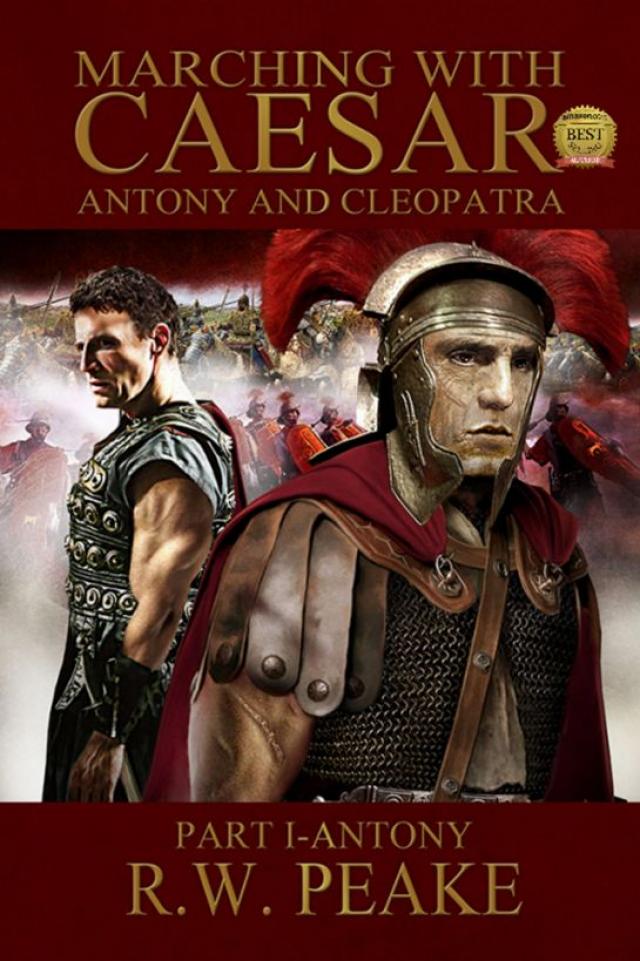
Also by R.W Peake
Marching with Caesar-Conquest of Gaul
Marching with Caesar-Civil War
Critical praise for the Marching With Caesar series:
"Fans of the author will be delighted that Peake’s writing has gone from strength to strength in this, the second volume...Peake manages to portray Pullus and all his fellow soldiers with a marvelous feeling of reality quite apart from the star historical name... There’s history here, and character, and action enough for three novels, and all of it can be enjoyed even if readers haven’t seen the first volume yet. Very highly recommended."
~The Historical Novel Society
“The hinge of history pivoted on the career of Julius Caesar, as Rome’s Republic became an Empire, but the muscle to swing that gateway came from soldiers like Titus Pullus. What an amazing story from a student now become the master of historical fiction at its best.”
~Professor Frank Holt, University of Houston
Marching with Caesar
Antony and Cleopatra
Part 1 Antony
By R.W. Peake
Marching with Caesar –Antony and Cleopatra by R.W. Peake
Copyright © 2013 by R.W. Peake
Cover Artwork by Marina Shipova
Cover Artwork Copyright © 2013 by R.W. Peake
Smashwords Edition
All maps reprinted from "The Roman Republic and The Founder of The Empire" by T. Rice-Holmes
Oxford University Press; London, 1923
All rights reserved. This book or any portion thereof may not be reproduced or used in any manner whatsoever without the express written permission of the publisher except for the use of brief quotations in a book review.
Printed in the United States of America
First Printing, 2013
Foreword
As the Marching With Caesar series continues and grows in popularity, so too does my need for a solid team of people to help me continue this dream journey that I'm on. What you see in Marching With Caesar-Antony and Cleopatra Parts I and II, the third and fourth book in the series, is even more a collaborative effort than the first two books combined. This is because of a group of unselfish, excellent people who have taken Titus' story into their hearts and minds, and have become invested in helping me make these books the best they can be.
As always, I owe a deep thanks to Beth Lynne, my outstanding editor who's willing to put up with what I freely admit are moments of OCD combined with my own streak of perfectionism, with just a dash of paranoia thrown in. She does what I believe is a remarkable job at not only understanding the structural aspects of the craft of editing, but the underlying intent of the author.
To my cover artist, the superlative Marina Shipova, who I believe outdid herself with these covers, she too is easier to work with than I imagine I am! She has not only managed to make Titus come alive with her first cover, she tells the story of all that Titus endures and how the ravages of time catch up with all of us. Through her covers you can see Titus age and progress, in a way that not even my words can convey as well.
Perhaps the biggest change from the first book to this one is the addition of my team of advance, or beta if you prefer, readers. This small group of fans has given me input that is so valuable that it's impossible to put a price on, and saying thanks seems to be a paltry way of thanking them for their help. Specifically, and in no particular order, Stu McPherson, Joe Corso (who is an author in his own right and whose wonderful books you can find at http://www.corsobooks.com), Curtis Graham, Margaret Courtney and Jim Zipko. Between their keen eyes, thorough understanding of the previous books and insights into the characters, they provided me with advice and guidance that there is no way to put a price on its value.
Finally, perhaps the nicest surprise benefit from the books has been in enabling me to reconnect with Marines with whom I served, along with the chance to connect with other veterans, who have apparently found something that resonates with them in Titus' story. That in itself has made all of this worthwhile.
Historical Note
With this, the third installment of the Marching With Caesar series Titus Pullus, his surviving friends and comrades, and I venture into exotic, little-known, and dangerous, territory with Marcus Antonius' doomed expedition into the wilds of Parthia. What today covers Turkey and Iran in many ways is as remote and mysterious to most Westerners as it was when the general launched what was the largest such campaign up to that point in history.
Although the physical dangers and hardship were borne by Antonius and the men who marched for him, I am fully aware that I am also stepping into my own version of dangerous territory because there are so few extant sources existing for Antony's attempt to exact revenge for the defeat of Marcus Publius Crassus and his army at Carrhae years before. At least, that was the goal according to the Triumvir, although there is more than one historian who has posited that it was more to enhance his own prestige in the ongoing battle with his rival Gaius Octavius. It is not my goal, or my concern frankly, to examine the motives of Antonius, simply because his real reason for launching this campaign would not have meant anything to Titus or his comrades. No matter what the reason the Legions were on the march, and the fact that the order was given by a lawfully appointed Legate was the only reason that was needed.
There has been much written about the composition of the Legions composing Antonius' army, but the truth is that with a couple of exceptions, nobody knows for sure. From my research it seems to be accepted that the 10th Legion was with Antonius, so it was easy to tell the story from that perspective, with Titus and the 10th part of the army. And while I have endeavored to hew as close to the historical record as possible, there are indeed places where I diverge, at least by design. One thing I have learned from the first two books is that no matter how deeply you dive into what is available as primary source material there will always be someone who insists that you got it wrong. Fortunately, those who hold this view seem to be a very small minority, no matter how vocal they may be.
Specifically, in the only successful campaign against the Parthians the Romans ever conducted, when the army was led by Aulus Ventidius in Antonius' stead, the "Muleteer" began an investment of the city of Samosata on the Euphrates River, where the modern-day city of Samsun is located. According to some sources, Antonius showed up before the city fell and Antiochus, the king of Commagene came to a financial arrangement with the Triumvir. In this story, Titus and the army conduct a siege and take the city by assault but reach an accommodation with Antiochus before they take the palace complex itself. I did this to further increase the tension between Ventidius and Antonius, who believed that his general was deliberately trying to outshine him. The fact that, at least militarily, this was not that hard to do is made apparent when Antonius conducted his own campaign. Whatever the case, Antonius was clearly displeased, whether the city fell before he arrived or not. I chose for dramatic purposes to have Ventidius and his army take the city, to add "fuel to the fire" for Antonius' actions towards this older but loyal lieutenant.
Speaking of Ventidius, I would like to take this time to clear up something that I personally found very confusing, but thanks to the superlative (and expensive!) Barrington Atlas Of The Greek And Roman World, I now understand, and that is the location of the Cilician Gates. When I was reading the source material, particularly Plutarch's account and he mentioned the Gates and the Taurus Mountains, that confused me, since the location of the Gates is along the coast. Besides the fact that there was apparently a real gate there, when "walking" the ground thanks to Google Earth, the nearest thing that could only charitably be called a mountain is a little more than a mile inland from the coast, and is barely three hundred feet high. It wasn't until, after something of an odyssey in itself, I finally received my Barrington Atlas that I was able to determine the reason for the confusion. Located on the southern slopes of the Taurus Mountain, at roughly Latitude 37'15"N and Longitude 34'40"E is the PASS of Cilicia, while the gates are located at roughly Latitude 36'50"N and Longitude 36'05"E.
One of my goals for this entire series of books has been to cleave as close to the historical record that I can. To that end, I did my best to lean on those scholars who have made the study of Rome and this time period in particular their lives' work, in conjunction with the advantages modern technology has to offer, like the aforementioned Google Earth. Particularly vexing, for me anyway, was the mapping of Antonius' Parthian campaign, particularly the point at which he leaves the Euphrates River behind. I have placed in the book the map that T. Rice-Holmes claimed was Antonius' route, but I confess I have major reservations about its accuracy. The source of this confusion comes from his labeling of the modern Turkish town of Erzerum as Karana. However, as I was in the process of fact-checking I kept running into an issue because, since the maps in the atlas are arranged for the most part on an east-west axis, they naturally can't be aligned along a north-south axis. So I was left trying to piece together the maps in a way that would match up in a way where I could look at the entire route as described by Rice-Holmes. That's when I discovered there is a discrepancy between what Rice-Holmes labels as Karana, and where it's located in the Barrington Atlas. Where Barrington's places Karana is much farther west than would make sense for Antonius, who had turned east south of Satala. Using Rice-Holmes' reference point of Erzerum for physical location but Barrington's for a place name, the nearest point I could find was Calcidava. However, there is no current evidence that suggests that any settlement with the name Calcidava was even in existence when Antonius and his army, with Titus, marched through. Therefore, I refer to it in the book only as a reference point to help the reader understand the route that Antonius most likely took.
Table of Contents
Prologue
Chapter 1 – Prelude
Chapter 2 – The Liberators
Chapter 3 – Philippi
Chapter 4 – Ventidius’ Men
Chapter 5 – Parthia
Chapter 6 – Retreat
Chapter 7 – Respite
Prologue
(Note by Diocles: I confess that I was snooping when I found this. My former master and now-friend has not been sleeping well lately, and I can see that telling this tale of his is putting more strain on him than he lets on. But two days ago now, he closeted himself away one night, barring even me from his presence. That did not prevent me, however, from keeping a careful eye on him, even if it was through a keyhole, as I watched him scratching feverishly on a scroll. Or more accurately, a series of scrolls. For a day and into the night, he scribbled away, and now he is sleeping, well past his normal time to rise, prompting me to go poking about in his desk, equipped with a number of cubbyholes specifically designed for such scrolls as the one here. This is what I found; even with his adoption of Caesar's practice of placing a dot above the last letter of a sentence, his handwriting is almost impossible to decipher! What I do not know is whether he plans on including this in his account of his extraordinary life; I will have to ask him, but only when the time is right.)
Every man, or woman I suppose, has a favorite time of the day. For some, it is as the sun is coming up, the rays of light chasing the dark away as the watches of daylight time lay before them, fresh with promise and possibility. For others, it is the opposite: the sight of the sun sinking down over the horizon, a signal that the day's labor is over and those delights that the night will bring are before them. Neither of those appeals to me. No, despite spending 42 years under the standard, where I started almost every single day before the sun made its appearance, I have never particularly enjoyed that part of the day. At least not for the sun coming up, although I must say that once I made the Centurionate I became rather fond of putting a boot up the backside of Publius for moving too slowly and the resulting organized chaos of a Legion waking up. No, for this old soldier, I enjoy the quiet time of the night, just before I retire, after all the servants have retired and only my old friend Diocles is still up, despite the fact he has long since surpassed the status of body slave and no longer needs to attend to me. I must admit I find it somewhat humorous that here in my 61st year, for the first time in many years, I am putting myself to bed. It is especially nice now that I can rise whenever I choose, and I find that I rather enjoy the slightly sinful feeling of sleeping well past the rise of the sun, which in turn fuels my ability to stay up even later. Usually, I try to read as I sit in my favorite chair, but over the last few months, I have found that increasingly difficult, as I squint and turn the scroll this way and that, putting it so close to the lamp that I have been scolded by Diocles on more than one occasion for the scorch marks on the edges of his precious manuscripts. That is when I remind him that it is scandalous for a slave to own a library as extensive as that of his master, but he is just as quick to remind me that I freed him long before and that the only reason he is still around is because he takes such pity on me for my age and decrepitude. Truly, we are like an old married couple in many ways, only genuinely happy when we are squabbling.
Now, instead of reading I spend most of my time in quiet reflection, a curious habit I have formed, given that I have come to this practice so late in life. When I was younger, I was possessed with very little self-doubt and was never inclined to look back on events and actions that I took with any kind of critical examination. While that made me very good at my job, it is only now in these waning years of my life that I realize how ill this trait served me in every other aspect of my life. So I suppose I am making up for lost time as I reflect back on the twists and turns that my life has taken, because of the choices that I have made. At one point in time, like most of my friends and contemporaries, I ascribed all that happened to me as being the will of the gods. Now I, for one, no longer carry that belief; in fact, I think it is an illusion that we use to excuse our actions. But I have not worshiped the gods for some time now nor do I intend to start as I feel my string playing out, as it does for all of us. Consequently, I lie back in my chair, with my feet propped up because they tend to swell now, and stare into the fire. The fireplace itself is an oddity, not so much for its presence but its location, because I had it specially built for my private chambers. I do not boast when I say I am more than wealthy enough to have every convenience in my villa here in Arelate, and I do have the same hypocaust heating that is present in the finest homes in Rome. But I am a soldier who spent more nights than can be easily counted sitting with my friends by a fire, and there is something so comforting about the sight and feel of the dancing flames. I am sure that my face carries the same expression as I gaze into the cleansing flames as it did when I was a young tirone on my first campaign in Hispania.
But instead of solid, corporeal forms sitting around me, there are nothing but ghosts, of both friend and foe, especially since I was destined to live during a time when a Legionary of Rome was as likely to look over his shield at another Roman as a Gallaeci, Gaul, or Parthian. And some of those Roman foes, even in the civil wars that threatened to rip our Republic apart, were ostensibly on the same side as I was, and I shared more than one fire with them, yet that did not make them any less deadly an enemy. These are the deaths that trouble me the most, whose faces are the most commonly seen in my dreams, making me wonder if it was all worth it.
What I am about to relate is not as much of a dream as it is, well, I do not know what to call it. I suppose it is possible that I was dozing in my chair next to the fire, but in my recollection, I was wide awake when I became aware of a presence beside me. Thinking it was Diocles, who had the habit of appearing at about this time every night, rousing himself from his own slumber to ensure that I had put myself to bed, I turned away from the fire to assure him that I was about to do that very thing. However, the figure who was somehow seated next to me, despite the fact that under normal circumstances there was no extra chair in that spot, was both familiar and foreign to me. Familiar because it was a face that I had gazed down upon more times than I could easily count, but foreign because this face, and the body along with it, was consumed and cleansed by fire many years ago.
Yet, somehow, I was not surprised; at least, my voice did not sound like it as I said, "Salve, Caesar."
"Salve, Titus Pullus," Caesar, or his shade, replied in a genial tone, as if we had somehow just bumped into each other on the street.
For his part, he looked essentially unchanged from the last time I laid eyes on him, in his Praetorium tent in Hispania, where he, the young Octavian, and I dealt with the allocation of Centurions for the new enlistment of the 10th Legion Equestris, a Legion that no longer exists. Even as my mind struggled to comprehend the portent and meaning of what had to be an apparition, there was a part that registered that of course he would not have aged, because he was dead.
"Are you here to take me with you in Charon's Boat?"


